AI Procurement Guide: Nearshoring Rules of Origin Explained

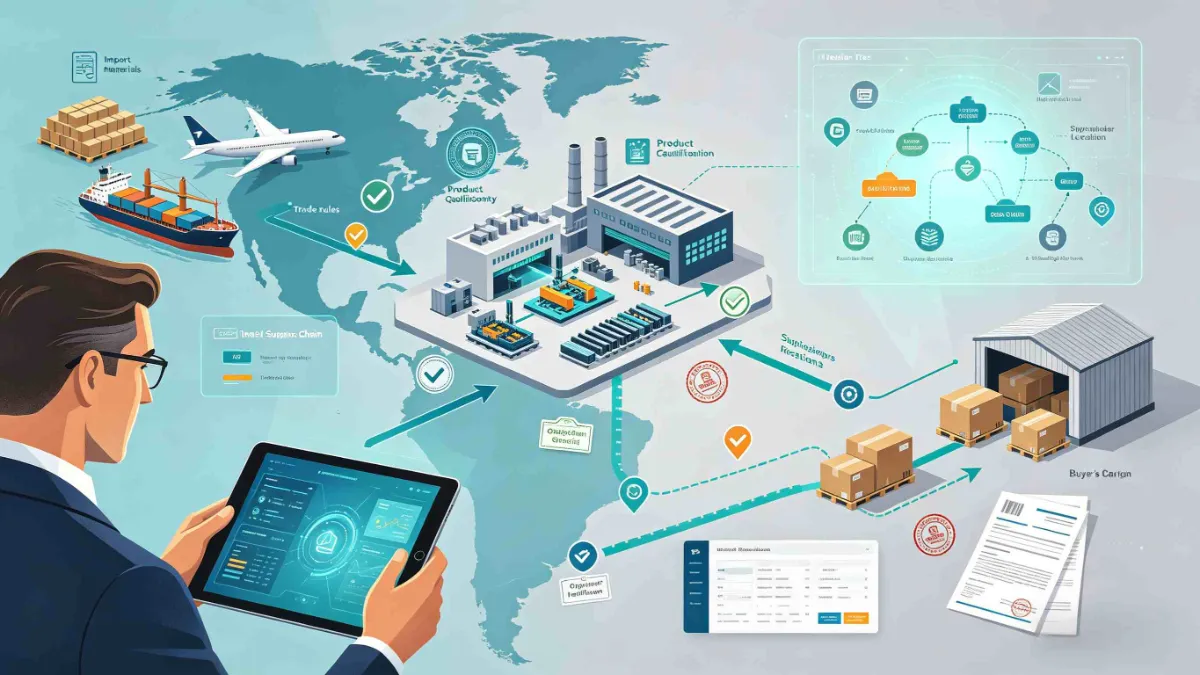
The Hidden Tax That Catches New Buyers Off Guard
If you are a small business owner dipping your toes into cross-border sourcing for the first time, you have probably already felt the sting of high customer-acquisition costs and the exhausting grind of manual product digitization. You found a promising supplier in Mexico or Vietnam, negotiated what seemed like a competitive price, and then—bam—your shipment got held at customs because of a certificate you did not even know existed.
Welcome to the world of Rules of Origin (RoO).
For decades, RoO existed as a back-office compliance headache handled by freight forwarders. But in the era of nearshoring—where SMEs are rushing to diversify beyond China to Vietnam, India, Mexico, and Eastern Europe—understanding origin rules has shifted from a "nice-to-know" detail to a make-or-break profit variable. Get it wrong, and you face unexpected tariffs, delayed shipments, or outright seizures. Get it right, and you unlock preferential duty rates that can slash landed costs by 10–25%.
The problem? Traditional RoO research is painfully slow. It involves cross-referencing Free Trade Agreements (FTAs), Harmonized System (HS) codes, and supplier bill-of-materials (BOM) data across fragmented government portals and PDF documents. For a micro-buyer without a dedicated compliance team, this process can eat up 20–30 hours per SKU—time you do not have.
This is exactly where AI procurement tools are rewriting the playbook. Instead of drowning in regulatory PDFs, modern sourcing platforms can now parse FTA text, analyze BOM structures, and flag origin-compliance risks in minutes, not days. The efficiency leap is not incremental; it is 10× or greater.
What Are Rules of Origin? A Simple Analogy
Think of Rules of Origin as the "passport system" for goods.
Just because a product is shipped from Mexico does not mean it is from Mexico in the eyes of customs. RoO are the legal criteria that determine a product's nationality. These rules decide whether your goods qualify for zero-duty treatment under agreements like USMCA, EVFTA, or RCEP.
There are two main flavors:
- Wholly Obtained: The product is 100% born and bred in the exporting country (e.g., coffee beans grown in Colombia).
- Substantial Transformation: The product underwent enough change in the country—through manufacturing, assembly, or material inputs—to earn a new identity. This is where most nearshoring headaches live.
Here is the catch: every FTA writes its "substantial transformation" test differently. Some use change-in-tariff-classification (did the HS code change?). Others demand a regional value content (RVC) threshold (e.g., 60% of the value must come from within the trade bloc). A few apply specific process rules (certain manufacturing steps must occur locally).
For a beginner, it is like trying to file taxes in five countries at once—using a calculator and a highlighter.
From Paper Chase to Intelligent Agents: How RoO Research Evolved
To appreciate why AI matters, it helps to see how we got here.
Phase 1: The Broker Era (1990s–2010s) Buyers outsourced everything to customs brokers. RoO was a black box. You paid a fee and hoped for the best. If the broker made a mistake, you paid the penalty.
Phase 2: The Spreadsheet Era (2010s–2023) Digitization brought HS-code lookup tools and FTA databases. Savvy buyers built Excel models to calculate RVC percentages. It was better, but still manual, error-prone, and unscalable. One wrong cell reference could invalidate an entire shipment strategy.
Phase 3: The Agentic Era (2024–Present) We are now entering the age of AI sourcing agents. These systems do not just store data; they reason across it. An AI procurement agent can read the full text of USMCA Chapter 5, cross-check your supplier's component sourcing against the rules, and simulate different BOM scenarios to maximize duty savings. It transforms RoO from a reactive compliance cost into a proactive sourcing strategy lever.
This is the strategic leap: from tools that help you work faster to intelligent agents that help you think smarter.
Why AI-Powered RoO Analysis Changes Everything
Let us get specific about the pain points AI solves.
1. Fragmented Information, Unified Intelligence
FTA rules live in government PDFs, HS codes in WCO databases, and supplier certificates in email attachments. AI procurement platforms ingest all three, normalize the data, and present a single risk score. No more tab-switching.
2. Verification at Scale
Manually auditing a supplier's claim that "60% of value is regional" requires reviewing invoices, material lists, and subcontractor locations. AI can parse these documents in seconds, flag inconsistencies, and even suggest alternative suppliers with cleaner origin profiles.
3. Eliminating Process Redundancy
Traditional workflows force buyers to repeat the same RoO analysis for every new SKU. AI systems learn your product categories and auto-apply relevant FTA rules, cutting research time from days to minutes.
4. Dynamic Scenario Modeling
What if you switched a plastic component from a Chinese sub-supplier to a Mexican one? Would that push your RVC from 58% to 62%? AI can run these "what-if" simulations instantly, turning compliance into a profit-optimization exercise.
The Human + AI Paradigm: Your Smart Sourcing Coach
Here is a misconception we need to kill immediately: AI is not replacing buyers; it is elevating them.
The best way to think about modern AI procurement tools is as a 24/7 strategic coach—like having a veteran trade attorney and a data analyst sitting beside you, but at SaaS pricing. The AI handles the grunt work (document parsing, threshold calculations, cross-referencing), while you retain control over the strategic decisions:
- Which FTA corridor offers the best long-term tariff advantage?
- When does the compliance cost outweigh the duty savings?
- How do we communicate new requirements to suppliers without damaging the relationship?
This human-in-the-loop model is critical. AI can tell you that a product fails the RVC test; only you can decide whether to renegotiate with the supplier, redesign the BOM, or absorb the tariff. The machine brings speed and precision; you bring judgment and commercial context. Together, they form a sourcing capability that neither could achieve alone.
5 Rookie Mistakes Nearshoring Buyers Make (And How to Avoid Them)
After ten years in global trade, I have seen the same errors repeat across SMEs. Here is your shortcut to wisdom:
Mistake 1: Assuming "Assembled in Mexico" Equals "Made in Mexico"
Reality: Assembly alone often fails the substantial transformation test. If 90% of the component value is Chinese and the final product does not shift HS chapters, customs may reject the preferential claim.
Fix: Use an AI tool to run a pre-shipment origin simulation before you commit to the supplier.
Mistake 2: Ignoring Cumulation Rules
Many FTAs allow you to "cumulate" origin across multiple member countries. For example, under USMCA, Mexican-made goods using U.S. inputs may still qualify. Beginners often miss these hidden savings pathways.
Fix: Configure your AI procurement platform to map multi-tier supplier networks, not just the final assembler.
Mistake 3: Treating Certificates as "Set and Forget"
Supplier origin certificates expire, materials change, and subcontractors switch. A valid certificate from January may be worthless by June.
Fix: Set up automated certificate-monitoring alerts. AI agents can track expiration dates and flag supplier BOM changes that threaten compliance.
Mistake 4: Optimizing for Price, Not Landed Cost
A Vietnamese supplier quoting 8% less than a Mexican one looks attractive—until you add the 25% tariff hit because the product lacks sufficient regional content.
Fix: Always model total landed cost (product price + tariff + freight + compliance overhead) inside your sourcing platform before making decisions.
Mistake 5: Going It Alone with Spreadsheets
Excel is a calculator, not a compliance engine. As FTA networks grow more complex (CPTPP expansion, AfCFTA rollout, Indo-Pacific frameworks), spreadsheet logic breaks down.
Fix: Migrate RoO analysis to a dedicated AI procurement system that updates rules automatically as treaties evolve.
Your Next Move: From Reactive to Strategic Sourcing
Rules of Origin are no longer a back-office footnote. In the nearshoring era, they are a frontline competitive weapon. The buyers who master them—armed with AI-driven intelligence and a clear understanding of FTA mechanics—will enjoy lower costs, faster customs clearance, and supplier relationships built on transparency rather than guesswork.
The shift from traditional sourcing to agentic AI procurement is not a distant future. It is happening now. And for SMEs without massive compliance departments, it is the single greatest leveling of the playing field in decades.
Start small, but start smart. Audit your top three SKUs for origin compliance this week. Run an AI-powered scenario analysis on your nearshoring options. Ask your suppliers for detailed BOM breakdowns—not just finished-goods prices.
The supply chain of tomorrow belongs to buyers who treat compliance as strategy, not paperwork. Will you be one of them?
Ready to turn origin complexity into a sourcing advantage? Explore how AI-powered procurement platforms are helping SMEs navigate nearshoring with confidence.
Comments
0