China's Service Trade Surges 8.3% in H1 2026: Knowledge-Intensive Exports Cross the 50% Threshold

China's Service Trade Surges 8.3% in H1 2026: Knowledge-Intensive Exports Cross the 50% Threshold
Category: Industry Trends | Date: August 6, 2026
Executive Summary
China's Ministry of Commerce released H1 2026 service trade data showing total service imports and exports reached 3.78 trillion yuan (approximately USD 520 billion), growing 8.3% year-on-year. Service exports hit 15.05 trillion yuan with a remarkable 17.6% growth rate, while knowledge-intensive service exports accounted for over 53.5% of total service exports, surpassing the halfway mark for the first time. Personal culture and entertainment services, alongside intellectual property royalties, posted the strongest export growth. This structural shift signals China's transition from a manufacturing-only export powerhouse toward a diversified trade economy where high-value services play an increasingly central role. For global sourcing professionals, the data highlights emerging opportunities in knowledge-based service procurement, cross-border IP licensing, and digital content supply chains.
The Numbers Behind the Growth
The H1 2026 figures tell a story of both volume growth and structural transformation:
Total service trade: 3,779.75 billion yuan, up 8.3% YoY
- Service exports: 1,504.7 billion yuan, up 17.6% YoY
- Service imports: 2,275.05 billion yuan, up 3.0% YoY
- Trade deficit in services: 770.35 billion yuan, narrowing significantly
Knowledge-intensive services:
- Exports: 805.67 billion yuan, accounting for 53.5% of total service exports
- Strongest growth categories: Personal culture and entertainment services, intellectual property royalty fees
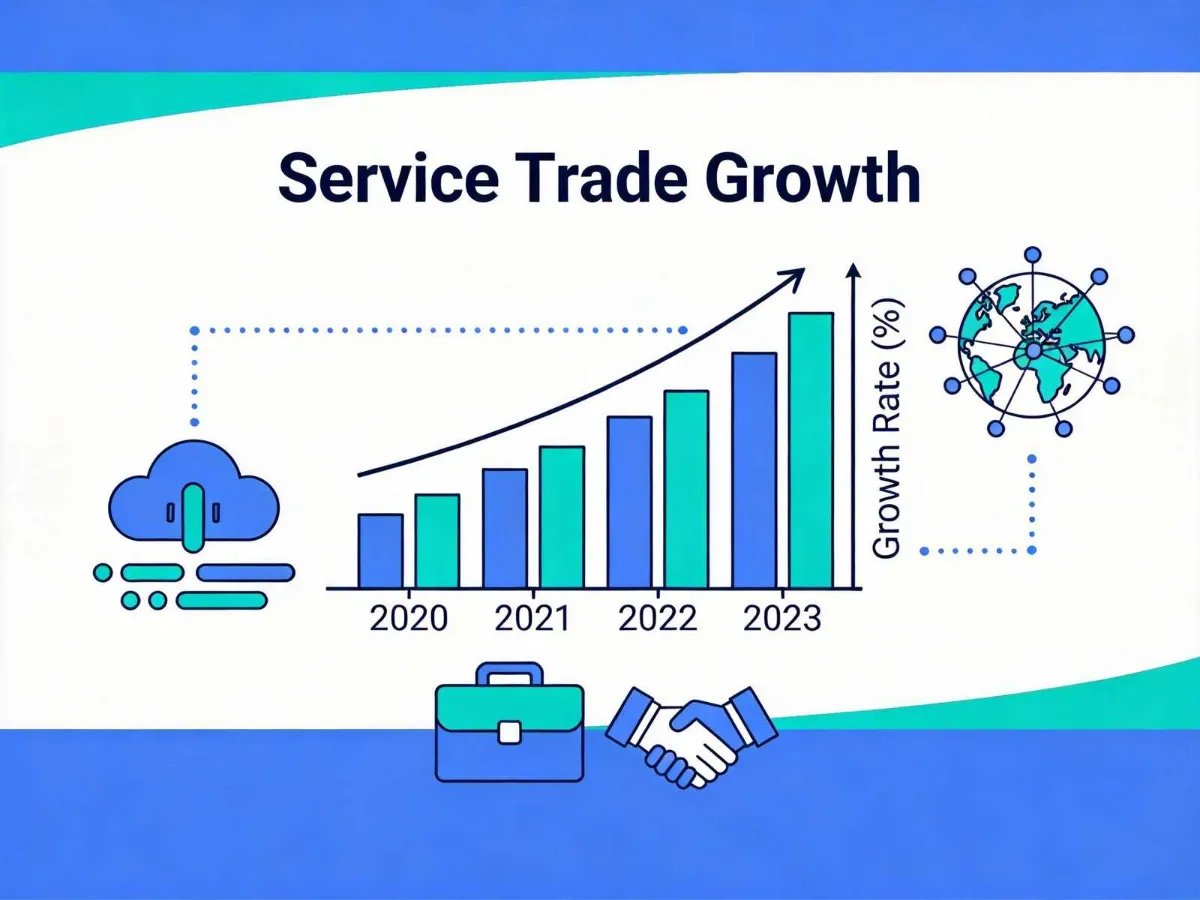
The 17.6% export growth rate far outpaces the 8.3% overall trade growth, indicating that China's service exports are not just growing but accelerating relative to the broader trade picture. The fact that knowledge-intensive services now constitute more than half of all service exports represents a structural milestone, reflecting years of investment in technology, creative industries, and intellectual property development.
Why This Matters for Global Sourcing
The traditional view of China as purely a manufacturing export hub is increasingly outdated. The H1 2026 data reveals a multi-dimensional trade economy where services—particularly knowledge-intensive ones—are becoming a primary growth engine. For international sourcing teams, this creates new procurement categories and supplier discovery opportunities:
1. Digital Content and Entertainment Services
The surge in personal culture and entertainment service exports reflects China's growing capabilities in digital content production, gaming, streaming platforms, and creative media. Companies sourcing digital content, creative services, or entertainment IP should expand their supplier search to include Chinese providers who offer competitive pricing and increasing quality.
2. Intellectual Property and Technology Licensing
Strong growth in IP royalty exports means Chinese companies are increasingly developing proprietary technologies worth licensing internationally. This opens new channels for technology procurement, particularly in sectors where Chinese firms have built strong IP portfolios through years of R&D investment—5G telecommunications, artificial intelligence, renewable energy, and consumer electronics.
3. Knowledge-Intensive Business Services
The 53.5% knowledge-intensive share suggests robust capabilities in consulting, engineering services, software development, and technical design. Sourcing teams looking for high-value professional services can find cost-effective partners in China who deliver developed-market quality at emerging-market prices.
The Structural Shift: From Factory to Knowledge Hub
China's service trade transformation did not happen overnight. It reflects deliberate policy choices and market forces that have been building for over a decade:
Policy drivers: The Belt and Road Initiative, Digital Silk Road programs, and various service trade liberalization policies have systematically reduced barriers to service exports and imports. The establishment of service trade innovation pilot zones has created testing grounds for new service trade models.
Market drivers: Chinese technology companies have matured from imitators to innovators, building IP portfolios that generate licensing revenue. The creative industries have benefited from a massive domestic market that provides scale before international expansion.
Investment drivers: Sustained R&D spending—now exceeding 2.5% of GDP—has produced a deep talent pool in engineering, design, and digital technologies that directly feeds knowledge-intensive service exports.
For sourcing professionals, understanding these structural drivers helps identify which service categories will continue to grow and which represent temporary spikes. The knowledge-intensive trend is structural, not cyclical, meaning the opportunities will likely expand in coming years.
How SourcingX Helps Navigate Service Trade Opportunities
While SourcingX is primarily known for physical product sourcing across B2B platforms, its capabilities extend to service supplier discovery and market intelligence:
- Cross-Platform Search: Identify service providers across multiple B2B platforms, including those specializing in knowledge-intensive services like software development, design, and technical consulting.
- Supplier Risk Assessment: Evaluate potential service suppliers using structured risk scoring that considers company history, certifications, and trade compliance history.
- Market Intelligence: Track trade policy developments and market trends that affect both product and service sourcing decisions, providing a holistic view of the China sourcing landscape.
- Structured Export: Compile and export supplier comparison data in structured formats for internal review and decision-making, streamlining the service supplier qualification process.
FAQs
Q1: What counts as "knowledge-intensive services" in China's trade statistics?
Knowledge-intensive services include telecommunications, computer and information services, financial services, intellectual property royalties, research and development, professional consulting, and personal culture and entertainment services. These categories require significant intellectual input and typically command higher value than traditional services like transportation or tourism.
Q2: How does China's service trade growth compare to global trends?
China's 8.3% service trade growth outpaces the global average, which has been growing at approximately 4-5% annually in recent years. The 17.6% service export growth rate is particularly strong, placing China among the fastest-growing service exporters in major economies.
Q3: Should manufacturing-focused sourcing teams pay attention to service trade data?
Yes. The growth in knowledge-intensive service exports often signals adjacent capabilities in product design, engineering, and technical support that can enhance product sourcing outcomes. A supplier with strong R&D capabilities (reflected in IP exports) may offer better product customization and innovation than a pure manufacturer.
Q4: How can SourcingX help me find knowledge-intensive service providers in China?
SourcingX's multi-platform search covers major B2B platforms where service providers list their offerings. By using targeted keywords and category filters, you can identify service suppliers alongside product manufacturers, then use the platform's comparison tools to evaluate them on capability, certification, and risk metrics.
Q5: What are the risks of sourcing knowledge-intensive services from China?
Key risks include IP protection concerns, data security and privacy compliance (especially under GDPR for European buyers), quality consistency, and regulatory changes affecting cross-border service delivery. SourcingX's risk scoring and supplier background checks help mitigate these risks by providing structured due diligence data before engagement.
Comments
0