Decoding De Minimis Collapse: Procurement Trends & Insights

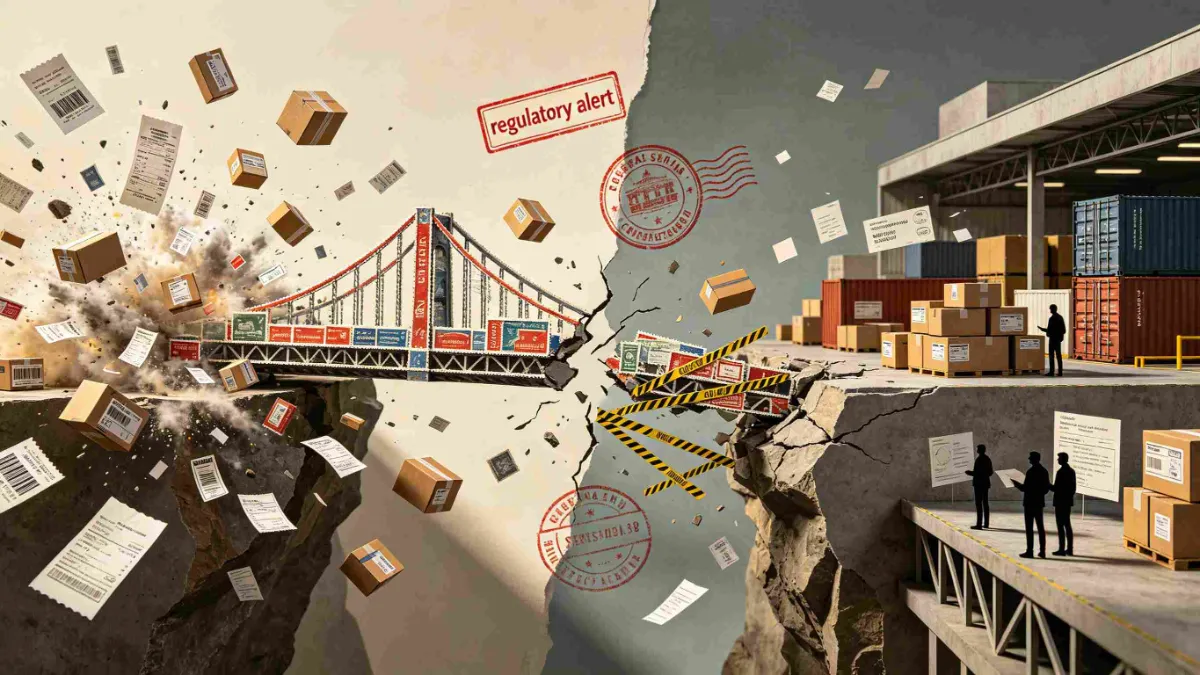
Decoding De Minimis Collapse: Procurement Trends & Insights
The "What & Why": The End of the Fast Lane
For over a decade, the de minimis threshold—the U.S. customs provision allowing shipments valued under USD 800 to enter duty-free with minimal documentation—functioned as an invisible subsidy for cross-border e-commerce. It enabled direct-to-consumer (D2C) brands, Amazon FBA sellers, and independent dropshippers to move small parcels from Shenzhen or Guangzhou to American doorsteps without the friction of formal customs entries, tariff lines, or lengthy HS code declarations.
That era is closing. In 2024, U.S. Customs and Border Protection (CBP) began tightening Type 86 (T86) clearance protocols—the electronic entry type that processed the vast majority of de minimis flows. By early 2025, legislative momentum to eliminate the USD 800 exemption entirely gained traction, driven by concerns over trade deficits, customs enforcement gaps, and the surge in low-value e-commerce volumes. Google Trends data reflects this inflection point: search interest for terms such as "Section 321 changes," "de minimis threshold ecommerce," and "T86 customs clearance" spiked by triple-digit percentages between Q3 2024 and Q1 2026, concentrated in procurement-heavy regions including California, New York, and Guangdong Province.
For SME buyers, this is not a peripheral policy update. It is a structural cost shock. The de minimis pipeline reportedly handled over four million entries daily at its peak, with a substantial share originating from Chinese manufacturing clusters. When that fast lane narrows or closes, procurement logic must shift from velocity to compliance density.
Decoding the Numbers: Where the Volume Is Moving
The Anatomy of a Collapse
To understand the redistribution of trade flows, it helps to visualize de minimis traffic as a water main. For years, it carried low-pressure, high-volume D2C parcels directly to consumers. Now, with pressure regulations tightening, that water is being forced into narrower, higher-friction pipes: formal B2B entries, bonded warehousing, and regional fulfillment centers.
Chinese customs data and U.S. import manifests reveal a clear reallocation pattern:
- HS Chapters 61–62 (Apparel & Textiles): Small-package garment flows—previously dominant in de minimis channels—are increasingly consolidating into full-container-load (FCL) or less-than-container-load (LCL) B2B shipments. Export growth in these categories is now concentrated in bulk orders rather than parcel dispersion.
- HS Chapter 85 (Electrical Machinery): Consumer electronics, particularly sub-USD 800 accessories, are experiencing a bifurcation. High-volume, low-margin items are either retreating from the U.S. market or relocating final assembly to Mexico and Vietnam to access USMCA or EVFTA preferential rates.
- HS Chapter 94 (Furniture): Bulky, low-value furniture SKUs—historically dependent on de minimis to avoid prohibitive duty rates—are now shifting to nearshore production in Mexico, where regional value content (RVC) thresholds can be met more efficiently than across Pacific parcel routes.
The Trade Balance Analogy
Trade statistics often cite the U.S. goods trade deficit as a macroeconomic abstraction. For the SME buyer, a more useful mental model is the "compliance ledger." Under de minimis, this ledger was thin: minimal duties, minimal brokerage fees, minimal documentation. Post-collapse, every line item thickens. Duties apply. Formal entry fees accumulate. Importer security filings (ISF) and partner government agency (PGA) clearances—previously bypassed—now require dedicated attention.
In this context, HS codes function less like bureaucratic labels and more like tax brackets for products. Misclassification is no longer a clerical error; it is a direct margin erosion event. A Bluetooth speaker misclassified under 8518 instead of 8519, for instance, can trigger duty differentials that erase the product's retail markup.
Sourcing Strategy: Three Data-Driven Moves for New Buyers
The de minimis collapse punishes improvisation. It rewards procurement systems built on pre-clearance intelligence and multi-node supplier visibility. Below are three operational pivots calibrated for buyers without dedicated trade compliance departments.
1. Migrate from Parcel Arbitrage to Bulk + Fulfillment Node Architecture
The old model—ship single units directly from factory to consumer—relied on de minimis to absorb logistics costs. Without it, unit economics collapse.
- Action: Consolidate purchasing into minimum order quantity (MOQ) optimized batches and inject inventory into U.S.-based or Mexico-based fulfillment nodes.
- Data application: Use sourcing platforms to identify suppliers willing to flex MOQs downward without destroying pricing tiers. This requires comparing not just unit costs, but landed cost per SKU across parcel, air freight, and sea freight modalities.
2. Build a Dynamic HS Code Compliance Matrix
Static product catalogs are liabilities in a post-de minimis environment. Tariff lines shift. Anti-dumping duties expand. PGA rules (FDA, FCC, CPSC) tighten without warning.
- Action: Maintain a living document mapping every active SKU to its precise HS code, duty rate, and applicable FTA status.
- AI application: Procurement intelligence systems can now monitor regulatory gazettes and CBP rulings in real time, flagging when a product's classification or duty exposure changes. This shifts compliance from a quarterly audit to a continuous signal.
3. Diversify Origin Nodes to Dilute Single-Corridor Risk
The de minimis shock exposed a concentration risk: too many SME supply chains were architected around a single corridor (China → U.S. parcel stream). Resilience requires geographic optionality.
- Action: Qualify secondary suppliers in Vietnam, India, or Mexico for core SKU categories—not as replacements, but as parallel production lanes.
- Data application: Cross-reference export volume trends from these regions against your SKU's HS profile. If Vietnamese exports in your product category are rising while Chinese parcel flows contract, that divergence is a market signal worth investigating.
The Procurement Intelligence Layer
Executing these three moves manually demands resources that most SMEs do not possess: multilingual regulatory monitoring, multi-platform supplier discovery, and continuous BOM cost modeling. This is where the role of AI procurement architecture becomes operational rather than theoretical.
SourcingX functions as an active procurement specialist—not a passive query tool. It initiates tasks: parsing a buyer's vague demand (e.g., "sustainable packaging under USD 0.40 per unit"), clarifying specifications through structured dialogue, executing multi-channel supplier retrieval, and scoring candidates across dimensions including product match, verified capability, and origin-compliance risk. When policy shifts—such as a de minimis rule change or a sudden HS code reclassification—the system surfaces alerts before the buyer's next shipment hits the port.
The critical distinction is relational, not transactional. The platform learns from feedback loops: which suppliers the buyer preferred, which quotes were rejected, which quality issues emerged post-inspection. Over time, this calibration produces sourcing recommendations that align with the buyer's risk tolerance and margin structure, not generic marketplace rankings.
Conclusion: From Loophole to Leverage
The de minimis collapse removes a subsidy that many SME buyers did not realize they were dependent upon. The transition will be painful for operators still running parcel-native supply chains. But for buyers willing to re-architect their sourcing around formal compliance, bulk intelligence, and multi-origin redundancy, the new environment offers something the old one did not: defensible margins.
In a market where every competitor once enjoyed the same duty-free fast lane, the advantage now belongs to those who can navigate the slower, more complex lanes with superior data. The procurement function is no longer about finding the cheapest factory. It is about building the most intelligent path from factory to balance sheet.
Comments
0