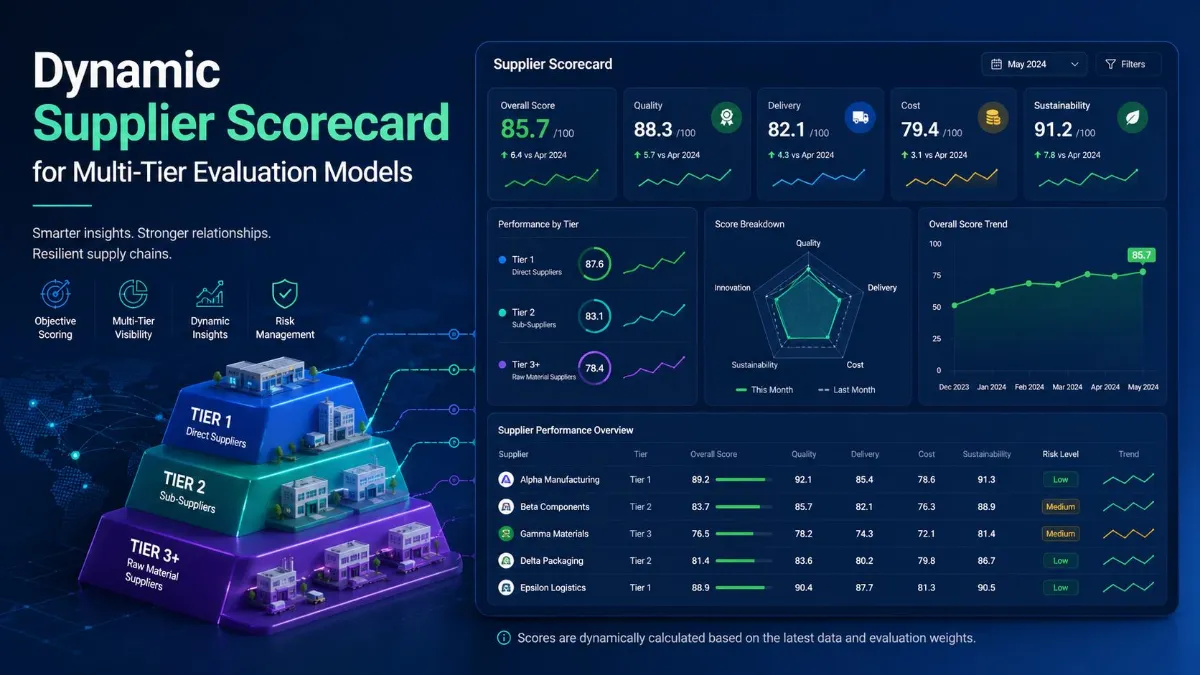
Dynamic Supplier Scorecard for Multi-Tier Evaluation Models

1. Executive Summary (The Value of Quantifiable Metrics)
- If supplier evaluation relies on subjective judgment, then decision consistency declines; if it is based on quantifiable metrics, then sourcing outcomes become repeatable and auditable.
- If multi-dimensional scorecards integrate operational, financial, and strategic data, then supplier selection shifts from reactive comparison to proactive optimization.
- If AI continuously updates supplier performance metrics, then organizations can transition from static reviews to dynamic risk-adjusted sourcing decisions.
At the core of modern sourcing lies a fundamental shift: Data-driven objectivity replaces subjective bias.
A Dynamic Supplier Scorecard enables this shift by structuring evaluation into measurable dimensions, supported by real-time, verifiable data streams rather than self-reported inputs.
2. The Multi-Dimensional Matrix (Core Evaluation Framework)
A robust supplier scorecard must operate as a multi-tier evaluation matrix, where each dimension is independently measurable yet collectively optimized.
2.1 Operational Excellence
Definition: Execution reliability and supply continuity
-
On-Time In-Full (OTIF): % of orders delivered as committed
- Data Source: Logistics tracking systems, shipment confirmations
-
Customs Export Frequency: Number of export transactions over time
- Data Source: Verified customs and trade databases
-
Capacity Stability: Variance in production output over defined periods
- Data Source: Historical shipment volume trends, order fulfillment data
Insight: If export frequency is stable and OTIF is high, then operational reliability is statistically validated.
2.2 Quality & Compliance
Definition: Conformance to product and regulatory standards
-
Defect Rate (PPM / %): Non-conforming units per shipment
- Data Source: Inspection reports, third-party QA audits
-
Certification Validity (e.g., ISO): Active vs. expired compliance credentials
- Data Source: Certification registries, compliance databases
-
Export Compliance Record: History of customs violations or delays
- Data Source: Trade compliance databases, customs records
Insight: If compliance records are clean and certifications are valid, then regulatory risk is minimized.
2.3 Financial Health
Definition: Supplier viability and risk exposure
-
Credit Score: External financial reliability rating
- Data Source: Financial institutions, credit agencies
-
Trade Frequency Volatility: Fluctuation in transaction volume
- Data Source: Customs trade data over time
-
Liquidity Stability Proxy: Consistency of export activity as a proxy for cash flow
- Data Source: Shipment continuity and order patterns
Insight: If trade activity shows sharp volatility, then financial instability risk increases.
2.4 Strategic Alignment
Definition: Long-term partnership potential
-
R&D Capability: Evidence of product innovation or technical upgrades
- Data Source: Patent databases, product iteration history
-
Collaboration Responsiveness: Speed and quality of communication
- Data Source: Interaction logs, RFQ response time
-
ESG Execution: Environmental and social compliance performance
- Data Source: ESG disclosures, third-party audits
Insight: If ESG compliance and innovation capability are high, then long-term strategic fit is strengthened.
3. Scorecard Comparison (Structured Benchmark)
| Scoring Factor | Traditional Manual Scorecard | SourcingX AI Dynamic Scoring |
|---|---|---|
| Data Update | Annual / Quarterly (Lagging) | Real-time Integration (Instant) |
| Source Logic | Self-reported by Supplier | Verified Trade Data (Customs) |
| Bias Control | High Human Subjectivity | Algorithmic Fairness |
Interpretation: If data latency is high, then risk detection is delayed. If data is verified and real-time, then decision accuracy improves exponentially.
4. 4-Step Guide to Building Your Scoring Model
Step 1: Define Weighted KPIs
Establish a weighted scoring formula across dimensions:
Total Score = Σ (Weightᵢ × KPIᵢ Score)
-
Example:
- Operational Excellence: 30%
- Quality & Compliance: 30%
- Financial Health: 20%
- Strategic Alignment: 20%
Principle: If business priorities shift, then weights must be dynamically adjustable.
Step 2: Data Ingestion
Integrate multi-source data streams:
- Customs and trade databases
- Quality inspection systems
- Financial and credit data providers
- ESG and certification registries
SourcingX Advantage: SourcingX acts as an AI-powered procurement expert, automatically aggregating multi-channel supplier data and eliminating fragmented information silos .
If data sources are fragmented, then scoring accuracy declines. If data ingestion is automated, then evaluation scalability increases.
Step 3: Normalization
Standardize heterogeneous metrics into comparable scores:
- Convert all KPIs into a 0–100 scoring scale
- Apply min-max normalization or percentile ranking
- Adjust for industry benchmarks
If metrics are not normalized, then cross-dimensional comparison becomes invalid.
Step 4: Continuous Feedback Loop
Establish a dynamic optimization mechanism:
- Continuously update scores based on new data
- Incorporate user feedback and sourcing outcomes
- Recalibrate weights based on performance impact
SourcingX Capability: Through continuous learning from user behavior and market data, SourcingX refines scoring models over time, improving decision quality with each interaction .
If feedback loops exist, then the model evolves; if not, it becomes obsolete.
5. Active Intelligence Perspective (Future of Supplier Evaluation)
The next evolution of supplier performance management is Active Intelligence:
- If a supplier’s score drops below threshold → then trigger risk alerts
- If a supplier outperforms peers → then recommend strategic allocation
- If market signals shift (e.g., trade disruption) → then re-rank suppliers dynamically
SourcingX differentiator: Unlike passive tools, SourcingX operates as an “active AI sourcing agent”—it not only evaluates suppliers but also initiates actions, such as:
- Proactively identifying alternative suppliers
- Recommending sourcing strategies
- Alerting users to market, policy, or cost fluctuations
- Supporting end-to-end procurement decisions across the lifecycle
Final Insight
A Dynamic Supplier Scorecard is no longer a reporting tool—it is a decision engine.
If organizations adopt multi-dimensional, AI-driven scoring models, then supplier management transforms from periodic evaluation to continuous optimization.
Comments
0