Seven Chinese Food Shipments Blocked By EU This Week -- And What Every Food Buyer Needs To Watch Next

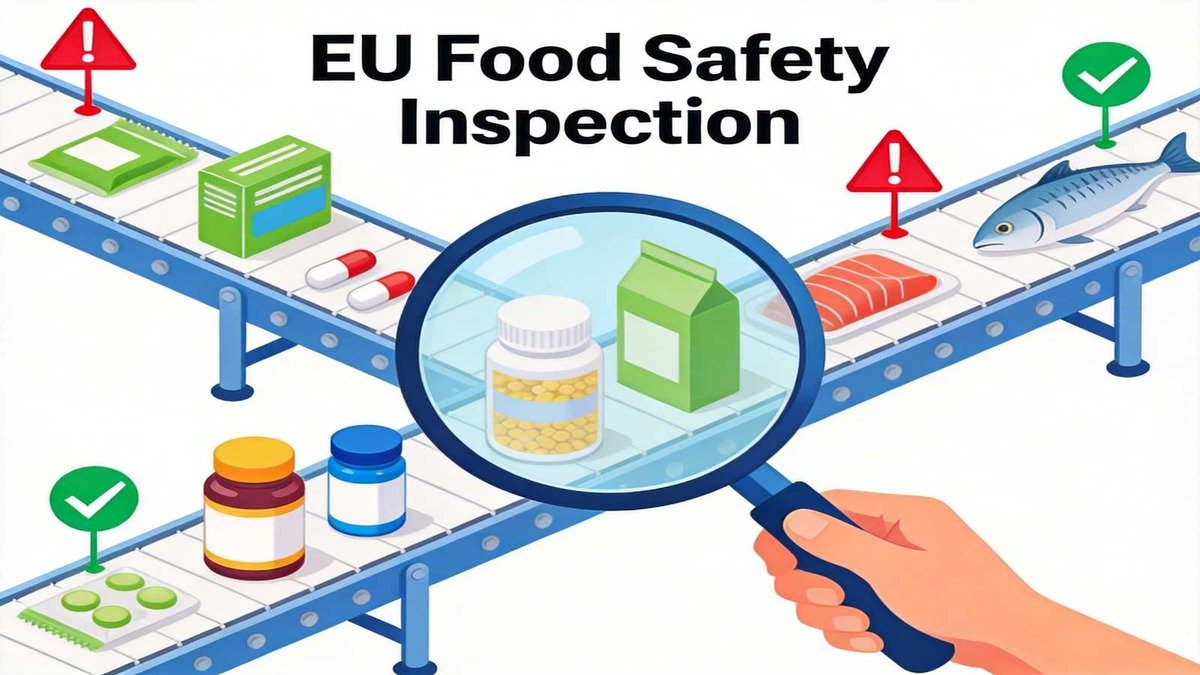
Seven Chinese Food Shipments Blocked By EU This Week -- And What Every Food Buyer Needs To Watch Next
Category: Risk & Compliance | Date: 2026-11-04
Executive Summary
The EU's RASFF system recorded seven Chinese food-related notifications during the week of October 26 to November 1, covering food supplements, food contact materials, and fish products. With over one hundred total notifications across all regions that same week, Chinese products accounted for roughly six and a half percent -- a figure that seems manageable until you realize each notification represents a real shipment sitting at a European border, rejected, and requiring immediate action. This is not a crisis. But it is a pattern worth understanding.
The Numbers Behind The Notification
Let us start with the full picture. During the forty-fourth week of 2026 -- October 26 through November 1 -- the European Union's Rapid Alert System for Food and Feed, known as RASFF, processed 108 product notifications involving food safety concerns across all origin countries. Of those, seven were linked to Chinese products excluding Hong Kong, Macau, and Taiwan. That places China at approximately six point five percent of total notifications.
On the surface, six and a half percent sounds benign. It is a small slice of a large pie. But the structure of those seven notifications tells a more specific story about where the vulnerability points are for Chinese food exporters to Europe.
The seven notifications clustered around three product categories:
Food supplements were flagged for detecting pancreatin -- an animal-derived enzyme that requires specific authorization and labeling. This is not a contamination issue in the traditional sense. It is a compliance gap: a product entered the EU market without proper documentation for its enzymatic ingredients.
Food contact materials -- the packaging, wrappers, and containers that touch food during storage and transport -- were flagged for migration exceeding permitted limits. Migration refers to chemicals transferring from packaging into food. When those transfers exceed EU-established thresholds, the material cannot be used for food contact in the European market.
Fish products were flagged for parasitic infection. Unlike chemical contamination, which can be caught through lab testing before shipment, parasites are harder to detect in routine quality checks and often require specific freezing protocols that some supply chains simply do not implement.
Why This Week's Notifications Are Different
RASFF notifications are not new. They have been published every week for decades. What makes this particular week worth attention is not the raw count -- seven is a moderate number in any given week -- but the diversity of violation types and what they reveal about systemic gaps in Chinese food export quality management.
Consider the food supplement case. Pancreatin is a commonly used enzyme in dietary supplements, particularly those targeting digestive health. The issue here is not that pancreatin is dangerous -- it is that its use in food supplements requires specific authorization under EU food law, and the product in question entered the market without proper declaration. This is a documentation and compliance failure, not a manufacturing defect. The factory likely produced exactly what the order specified. The gap was in understanding EU regulatory requirements for enzymatic ingredients.
For food buyers sourcing supplements from China, this creates a clear lesson: your quality specifications must include not just product composition but regulatory compliance validation for the destination market. A factory that has been supplying the domestic Chinese market for years may have zero institutional knowledge of EU enzyme authorization requirements.
The food contact material case is similarly instructive. Migration limits are not arbitrary numbers. They are based on extensive toxicological assessment and represent the maximum amount of chemical transfer considered safe over a lifetime of exposure. When a packaging material exceeds these limits, it means either the material formulation is wrong, the quality control on the manufacturing line is inconsistent, or the material was designed for a market with less stringent requirements and simply carried over without adjustment.
Every buyer who sources food-grade packaging from China should ask their suppliers which regulatory markets they currently serve. A supplier who only supplies the domestic Chinese market will not have the same migration testing capabilities as one who has been producing for the EU or US market. This distinction matters enormously when you are building a supply chain that needs to survive multiple regulatory environments.
The Parasite Problem -- And Why Freezing Protocols Matter
The fish product notification involving parasitic infection deserves separate attention because it highlights a category of risk that is fundamentally different from chemical contamination and is particularly relevant for seafood buyers.
Parasites in fish -- particularly anisakis and other nematodes -- are a well-known concern in the seafood industry. The EU has specific requirements for freezing fish to kill parasites before it enters the food supply. The standard protocol involves freezing at minus twenty degrees Celsius or below for a specified minimum duration, typically seventy-two hours for most fish species.
When a shipment fails due to parasitic infection, it usually means one of three things: the freezing protocol was not applied, the freezing temperature was not maintained consistently, or the product was not subjected to adequate monitoring after freezing. For a buyer sourcing fish from China, this is not a quality issue you can detect by looking at the product. You need to verify that your supplier has implemented and maintained the required freezing infrastructure.
This is where traditional supplier evaluation methods break down. A supplier may have excellent quality control for chemical residues, microbiological safety, and allergen management, and still lack proper freezing infrastructure for parasite control. Conversely, a supplier with advanced freezing facilities may have gaps in their chemical residue testing. The evaluation needs to be category-specific, not generalized.
If you are building or managing a supplier base for seafood products, platforms like SourcingX can help you assess not just basic company capabilities but compliance-specific infrastructure. Understanding which suppliers have which certifications, which testing capabilities, and which regulatory markets they currently serve is not optional -- it is the foundation of risk-managed sourcing.
The Broader Pattern: Compliance Is Getting More Fragmented
What is interesting about the current RASFF notification landscape is not any single week's results. It is the trajectory over the past three years. The EU has been steadily expanding its food safety scope, introducing new migration limits, adding new enzymes to authorization lists, and tightening surveillance on food contact materials. This is not anti-China policy. This is the natural evolution of a mature regulatory system that is continuously raising its standards.
The challenge for Chinese food exporters is that the EU regulatory landscape is not a single target but a moving constellation of requirements. New directives are published, old directives are amended, guidance documents are updated, and enforcement priorities shift based on emerging risk assessments. A supplier who was fully compliant twelve months ago may find that a recently amended directive now covers a product category they did not previously need to consider.
This fragmentation creates a genuine need for continuous compliance monitoring. It is not enough to achieve certification once. You need a system that tracks regulatory changes relevant to your product portfolio and triggers action when those changes affect your market access.
For procurement professionals managing food supply chains, this means compliance cannot be treated as a one-time project at supplier onboarding. It must be an ongoing process. You need to know when the EU adds a new substance to its migration testing list. You need to know when a new enzyme requires authorization. You need to know when enforcement priorities shift toward your product category.
Building A Compliance-Ready Supply Chain
The practical response to this notification landscape is not panic -- it is architecture. Here is how to build a food supply chain that can withstand continuous regulatory tightening:
Map your compliance landscape by product category. Not all food products face the same risks. Chemical-sensitive products need rigorous residue testing frameworks. Products with animal-derived ingredients need authorization tracking. Products requiring specific treatment (like freezing for parasites) need infrastructure verification. Start with a category-by-category compliance map that identifies the specific requirements, testing protocols, and documentation needed for each product type.
Segment your suppliers by regulatory maturity. Not all suppliers are created equal in terms of compliance capability. Some suppliers have been producing for the EU market for years and have institutional knowledge of regulatory requirements. Others serve primarily domestic markets and have minimal compliance infrastructure. Segment your supplier base by regulatory maturity and allocate your monitoring resources accordingly. High-maturity suppliers need periodic verification. Low-maturity suppliers need active capability building or strategic replacement.
Invest in pre-shipment compliance verification. RASFF notifications represent products that passed the supplier's quality control but failed at the European border. This gap between factory-level QC and destination-market compliance is where most violations occur. Implement pre-shipment compliance verification protocols that test products against destination market requirements before they leave the factory. This is not additional cost -- it is insurance against border rejection, which carries far higher costs including lost inventory, missed delivery windows, and customer relationships damaged by late shipments.
Maintain a regulatory change tracking system. Subscribe to EU regulatory updates relevant to your product categories. The European Commission publishes amendments to food safety directives, and the European Food Safety Authority publishes scientific opinions that often precede new regulatory requirements. Being notified of changes before they take effect gives you time to adjust formulations, packaging, or testing protocols without emergency reactions.
Leverage technology for supplier comparison. Building and managing a compliance-ready supply chain requires visibility across multiple suppliers and their capabilities. This is where digital sourcing platforms become essential infrastructure. Having a tool that lets you compare supplier credentials, compliance certifications, and market experience across multiple categories and regions is not a nice-to-have -- it is a competitive advantage. SourcingX provides structured comparison tools that help buyers evaluate suppliers based on compliance-relevant criteria, making it easier to build and maintain a supply chain that is both competitive and compliant.
The Bottom Line
Seven notifications in a week is not a crisis. It is a data point. But when you look at the structure of those notifications -- the categories of products involved, the types of violations, the underlying compliance gaps -- you get a clear window into what food buyers need to watch.
The EU food safety system is not getting more protectionist. It is getting more sophisticated. And sophistication raises the bar for everyone. The suppliers and buyers who understand this and adapt their supply chain architecture accordingly will thrive. Those who treat compliance as a static checkbox will find themselves managing crisis after crisis at the border.
Compliance is not a destination. It is a moving target. Build your supply chain to chase it.
FAQs
Q: What is RASFF and how does it work?
A: RASFF is the EU's Rapid Alert System for Food and Feed, a notification system where member states report food safety concerns detected during border checks or market surveillance. Once a notification is entered, all EU countries are informed and can take corresponding actions such as withholding, returning, or destroying affected products.
Q: Are seven notifications a lot for one week?
A: No. During the forty-fourth week of 2026, there were 108 total notifications across all origin countries. Seven Chinese-related notifications represent approximately six and a half percent, which is a moderate share. What matters more is the structure and types of violations.
Q: What does "migration exceeding limits" mean for food contact materials?
A: Migration refers to chemicals transferring from packaging or containers into food. The EU sets maximum migration limits based on toxicological safety assessments. When a material exceeds these limits, it cannot be legally used for food contact in the EU market.
Q: How can I verify if my seafood supplier meets EU parasite control requirements?
A: Ask specifically about their freezing protocols: minimum temperature (minus twenty degrees Celsius or below), minimum duration (typically seventy-two hours), and whether they have test records verifying parasite elimination. Request their EU market certifications as evidence of compliance capability.
Q: Should I be worried about increasing EU food safety restrictions?
A: EU food safety standards are continuously evolving, not becoming more restrictive in a protectionist sense. The system is raising its technical sophistication. The key is to build a supply chain that can adapt to this evolution through proactive compliance monitoring rather than reactive crisis management.
Comments
0