China's Auto Export Boom: Why Geely's 169 Percent Growth Is the Visible Tip of a Structural Transformation in Global Automotive Trade

China's Auto Export Boom: Why Geely's 169 Percent Growth Is the Visible Tip of a Structural Transformation in Global Automotive Trade
Category: Industry Trends | Date: 2026-10-30
Executive Summary
Geely Automobile reported that its export sales during the first three quarters of 2026 reached 798,000 units, representing a staggering 169 percent year-over-year increase that fundamentally reshapes the competitive landscape of the global automotive industry. New energy vehicle exports alone surged an astonishing 531 percent to 484,000 units, with the Zeekr premium brand leading Chinese NEV exports globally across multiple markets. This is not a cyclical blip, a temporary tariff arbitrage opportunity, or a short-lived pricing anomaly. It is the visible surface of a structural transformation in global automotive manufacturing and trade patterns that will reshape procurement strategies, supply chain configurations, competitive dynamics, and regulatory frameworks across every major auto market for the next decade, demanding immediate strategic reassessment from every procurement professional and supply chain decision-maker in the automotive sector.
The Data That Demands Your Full Attention
Let us examine the numbers that tell the real story, because raw volume figures alone do not capture the full significance of what Geely has accomplished.
Seventy-nine point eight thousand export units. That is the total output Geely shipped to overseas markets in just nine months of 2026 -- not a full year, not a holiday season spike, but a sustained nine-month period of unprecedented export growth. For context, this single company's export volume now exceeds the annual auto exports of entire countries that have been traditional automotive powerhouses for decades, including nations with decades of manufacturing heritage and globally recognized brand portfolios. The 169 percent year-over-year growth rate is not an anomaly or a statistical outlier -- it reflects a trajectory that has been building systematically for half a decade, accelerated by China's massive strategic investments in NEV supply chain capacity, deliberate overseas market expansion strategies, and a manufacturing cost advantage that Western competitors have struggled to match through traditional efficiency improvements alone.
But the more striking and strategically significant number is the new energy vehicle segment: 484,000 units exported in nine months, up 531 percent from the same period last year. New energy vehicles now account for 60.7 percent of Geely's total export volume. This means the export surge is not happening across all vehicle types equally or gradually. It is being driven overwhelmingly by electrified powertrains -- a fact that changes everything about how we should interpret these numbers, plan our procurement strategies, and assess the competitive threat or opportunity that Chinese automotive exports represent.
A Story From the Factory Floor That Reveals the Bigger Picture
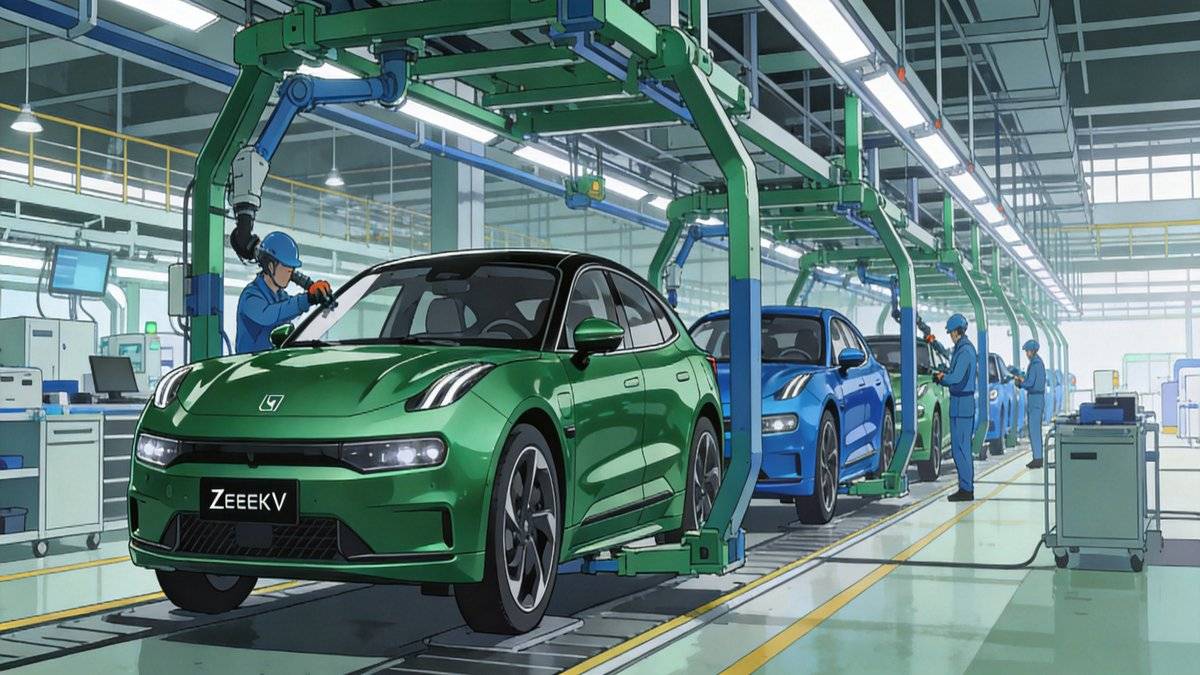
Imagine a production line in Hangzhou, China, where a Zeekr electric SUV rolls off the assembly line every four minutes around the clock. Each vehicle carries within its components a global supply chain stretching across continents: battery cells manufactured by CATL in Ningbo, semiconductor chips sourced from multiple international suppliers across Asia and Europe, interior materials and electronics sourced from across China's vast manufacturing belt, and software systems developed by engineers in Beijing and Shenzhen. When that vehicle ships -- whether it heads to Europe, Southeast Asia, the Middle East, or Latin America -- it carries with it the accumulated manufacturing capability, process expertise, and cost efficiency of China's entire NEV ecosystem, built through a decade of strategic investment and scale.
This is not a Chinese company exporting Chinese products to the world in the traditional trade sense. This is a Chinese company leveraging a globally integrated supply chain, combined with domestic manufacturing scale and technological advancement, to compete effectively in markets where local traditional OEM manufacturers are still navigating the complex and costly transition from internal combustion engine to electric vehicle production. The competitive advantage comes not from cheap labor or government subsidies alone -- those factors were important in the early days of Chinese automotive manufacturing, but they are no longer the primary drivers -- but from a vertically integrated supply chain that has spent a decade building scale, process expertise, technological capability, and cost efficiency in battery technology, electric motor manufacturing, power electronics, and smart vehicle systems.
The Structural Forces Behind the Export Surge: Three Converging Transformations
Three fundamental forces are converging to create this export explosion, and understanding each of them in depth is essential for any procurement team that deals with automotive components, vehicle sourcing, supply chain strategy, or any aspect of the broader mobility ecosystem.
First, the NEV supply chain maturity curve. China's massive strategic investment in battery production capacity, electric motor manufacturing, vehicle electronics design, and smart system development has created a cost and quality advantage in the NEV sector that is now structurally embedded in the industry rather than temporarily competitive. Battery pack costs have fallen approximately 65 percent over the past eight years, a decline driven by economies of scale, technological improvements in cell chemistry, and vertical integration across the supply chain. This cost reduction makes electric vehicles price-competitive with internal combustion engine vehicles in most major global markets without any government subsidies or tariff advantages. This cost curve does not reverse. It accelerates, as continued investment and scale drive further improvements.
Second, the Western auto industry's transition lag. Traditional OEMs in Europe, North America, and even Japan are facing enormous and increasingly urgent challenges in transitioning their manufacturing bases, dealer networks, supplier relationships, and workforce skills from ICE to EV production. Their capital expenditure requirements for retooling factories, union negotiations around workforce transitions, legacy infrastructure costs that cannot be easily repurposed, and brand perception challenges in the EV segment create a window of competitive vulnerability that Chinese exporters are actively and systematically exploiting. This is not a temporary advantage -- Western OEMs will eventually catch up -- but the timeline matters enormously for procurement teams who need to make sourcing decisions today and plan supply chains for the next five to ten years.
Third, emerging market demand acceleration. Southeast Asia, the Middle East, Latin America, Africa, and Oceania are all experiencing rapid and sustained growth in NEV adoption, driven by energy security concerns, tightening environmental regulations, total cost of ownership advantages that electric vehicles offer in markets with high fuel prices, and government incentives that are accelerating the transition away from fossil fuels. These markets are not waiting for Western OEMs to develop products specifically tailored to their needs, price points, and infrastructure conditions. They are buying what is available from manufacturers who can deliver competitive products immediately, and Chinese manufacturers are positioned uniquely to deliver both the products and the volume that these markets demand.
The Procurement Implications: Three Strategic Questions Every Automotive Procurement Team Must Answer
If you are a procurement professional who sources automotive components, vehicles, or related supply chain services, these three strategic questions should frame your thinking and guide your decision-making over the coming months and years.
Are you positioned to benefit from or hedge against continued Chinese NEV export growth in your supply chain? If your business involves importing Chinese vehicles or NEV components for sale or deployment in your home market, the current trend favors you in the short term -- you can expect more competitive pricing, wider product selection, faster delivery cycles, and increasingly sophisticated product features from Chinese manufacturers. But you must also prepare proactively for the regulatory response. European and North American markets are increasingly likely to impose tariffs, local content requirements, enhanced safety certification barriers, or data security restrictions on Chinese NEV exports and related components. Your procurement strategy needs scenario planning for multiple outcomes: continued open-market access with stable pricing, moderate protectionism with 10 to 20 percent tariff impacts that compress margins, and aggressive protectionism with significant market access barriers that require you to find alternative sourcing channels entirely.
Is your current supplier base evolving fast enough to match the NEV transition and the capabilities demonstrated by Chinese manufacturers? Traditional automotive suppliers whose product lines and engineering capabilities are centered on engines, transmissions, exhaust systems, and mechanical components face a long-term demand decline that is already visible in financial reports and industry forecasts. Suppliers of battery components, power electronics, sensors, cameras, software systems, and smart vehicle connectivity face demand growth that may significantly outpace their current capacity to scale production, hire engineering talent, and expand manufacturing facilities. Procurement teams need to audit their supplier portfolios not just on current pricing and quality metrics, but on strategic positioning within the NEV value chain, technological capability trajectory, and capacity expansion plans. This requires a more sophisticated and forward-looking approach to supplier evaluation than traditional procurement practices have typically demanded.
How should you systematically evaluate competing sourcing channels for NEV products, components, and complete supply chain partnerships? Geely's export performance demonstrates unequivocally that Chinese NEV manufacturers are not just cost-competitive relative to Western alternatives -- they are increasingly technologically competitive, with brands like Zeekr achieving genuine premium positioning in multiple overseas markets and receiving positive reviews from automotive journalists and consumers worldwide. This means the procurement evaluation equation is no longer simply and reductionistically "Chinese suppliers are cheaper than Western suppliers." It is a far more nuanced assessment: "Chinese suppliers may offer superior technology capability, broader product range diversity, faster innovation cycle speeds, and more aggressive pricing than Western alternatives -- but what are the compliance risks, logistics complexities, and long-term supply relationship considerations?" Procurement teams need evaluation frameworks and tools that can assess suppliers across multiple dimensions simultaneously -- not just price, but technology capability and innovation pace, compliance documentation quality and regulatory readiness, delivery reliability and logistics infrastructure maturity, financial stability and strategic alignment with your organization's long-term sourcing goals, and cultural and operational compatibility. This is precisely the capability that structured procurement and supplier comparison platforms like SourcingX SourcingX are designed to support. The platform's multi-dimensional supplier evaluation tools, opportunity scoring models, and compliance tracking capabilities help procurement teams conduct systematic and data-driven supplier assessments, compare sourcing options across complex criteria, and manage evolving regulatory requirements across multiple supply channels -- all essential capabilities when evaluating whether to source vehicles, components, or complete supply chain partnerships from Chinese or other international manufacturers. Teams that leverage SourcingX SourcingX for their supplier evaluations report more consistent decision-making and better alignment between procurement strategy and overall business objectives.
The Competitive Landscape: Who Is Gaining Market Share and Who Is Losing It
Geely's export surge does not happen in isolation or in a vacuum. It is part of a broader and more dramatic competitive reshuffling that affects every participant in the global automotive value chain, from raw material suppliers to end consumers.
Chinese automakers are gaining market share not just in emerging markets where they have traditionally faced less competition but increasingly in Europe and other traditionally protected and highly competitive markets. BYD, NIO, XPeng, Li Auto, and Geely's multiple premium brands including Zeekr, Lynk Co, and Polestar are all expanding their overseas footprints simultaneously, creating a Chinese auto export ecosystem that is competitive internally -- driving rapid innovation and cost improvement through rivalry -- but collectively formidable externally against incumbent Western and Japanese automakers.
Western Tier-1 automotive suppliers face an existential strategic question. If Chinese OEMs continue to improve their vertical integration, reduce their dependence on Western component suppliers, and develop their own in-house capabilities for batteries, chips, software, and systems integration, the long-term demand for traditional Western automotive components will decline significantly. Suppliers who can partner strategically with Chinese manufacturers on NEV-specific technology development, joint ventures, and co-innovation will survive and thrive in this new environment. Those that cannot or will not adapt their business models will face declining revenues, stranded manufacturing capacity, and eventual exit from the market.
Aftermarket and service network operators in overseas markets face a structural transformation. As Chinese NEV volumes increase substantially in Europe, Southeast Asia, the Middle East, Latin America, and other regions, the infrastructure for vehicle servicing, parts supply, software updates, and warranty management must expand rapidly to keep pace with growing vehicle populations. Procurement teams in the automotive aftermarket, parts distribution, and service network sectors should monitor this development closely, because it creates both immediate challenges around parts sourcing and technology compatibility and longer-term opportunities for building new supply chain relationships with Chinese manufacturers and their component suppliers.
The Regulatory Counter-Movement: What Comes Next and When
The export surge that Geely and other Chinese manufacturers are experiencing will inevitably trigger regulatory responses from governments seeking to protect domestic automotive industries, preserve manufacturing employment, and ensure national security in strategic sectors. The timeline for these regulatory responses is compressing rapidly, and procurement teams who assume the current open-market environment will persist are making a dangerous strategic error.
The European Union is actively considering and debating multiple measures to protect its domestic automotive industry from Chinese NEV import competition, including potential countervailing tariffs, local manufacturing requirements, enhanced safety and cybersecurity certification standards, and restrictions on vehicles with certain software architectures. The United States has maintained stringent barriers to Chinese vehicle imports but is increasingly focused on regulating battery supply chains, semiconductor content, and data security in connected vehicles, which could affect a broader range of Chinese automotive products beyond finished vehicles. Southeast Asian countries that have welcomed Chinese NEV exports with open arms and generous incentives are now beginning to discuss local content requirements, mandatory assembly plant investments, and technology transfer conditions as conditions for continued market access and tariff benefits.
For procurement teams whose sourcing strategies depend on cross-border automotive trade, these regulatory developments are not background noise or peripheral concerns. They are central to your sourcing strategy, your supplier relationships, your cost structure, and your supply chain resilience. A procurement decision made today that assumes continued open-market access for Chinese vehicles and components may be fundamentally wrong in three years if tariffs, local content rules, or certification barriers eliminate the price and product advantages that currently drive the export surge. Scenario planning across multiple regulatory outcomes is not optional for procurement teams who want to build resilient and competitive supply chains. Procurement teams should model at least three distinct scenarios: continued open-market access with stable pricing and broad product availability, moderate protectionism with 10 to 20 percent tariff impacts that compress margins but do not eliminate competitive advantage, and aggressive protectionism with significant market access barriers, high tariffs, or outright bans that require you to find entirely alternative sourcing channels, restructure your supply chain, or adjust your product strategy. Each scenario requires different supplier strategies, inventory policies, pricing approaches, and strategic partnerships.
The Long-Term Vision: The Global Automotive Landscape in 2030
If Geely's export trajectory and the broader industry trends continue at their current pace, we are looking at a fundamentally different global automotive landscape by 2030 -- one that will be unrecognizable to procurement professionals who made their decisions based on the market conditions of 2024 or 2025.
Chinese manufacturers could account for 20 to 25 percent of global NEV sales by 2030, up from current levels well below 10 percent, representing a market share expansion of two to three times the current level. The supply chain configurations that procurement teams build today -- supplier relationships and partnership structures, logistics channels and fulfillment networks, compliance systems and documentation workflows, technology evaluation frameworks and innovation tracking -- will determine whether they are positioned to compete effectively in that future or stranded with outdated sourcing models, non-compliant suppliers, and supply chains that cannot adapt to rapidly changing regulatory and competitive conditions.
The companies and procurement teams that will succeed in this evolving landscape will be those that treat the Chinese NEV export surge not as a temporary pricing opportunity to exploit and then ignore but as a powerful signal of structural change in global manufacturing that requires fundamental strategic reassessment. They will build supplier relationships that leverage Chinese innovation, manufacturing scale, and cost advantage while actively managing regulatory risk through geographic diversification, strategic positioning in favorable jurisdictions, and compliance infrastructure investment. They will use data-driven procurement platforms and analytical tools to continuously evaluate the competitive landscape, track regulatory developments, assess supplier performance, and adjust their sourcing strategies in real time rather than relying on annual procurement reviews that are already obsolete by the time they are completed.
The window for strategic preparation is closing rapidly. The export surge that Geely reported in October 2026 is tomorrow's market reality for procurement teams who have not yet adapted their sourcing strategies, supplier evaluation frameworks, and supply chain designs to the realities of the NEV era. The teams that move first will capture the most attractive supplier relationships, the best market positioning, and the strongest competitive advantage. The teams that delay will face higher costs, limited options, and structural disadvantages that are extremely difficult to reverse once they have accumulated.
FAQs
What does Geely's 169 percent export growth rate mean for other Chinese automakers in the market? Geely's performance reflects a broader industry-wide trend rather than an isolated company-specific event. Other major Chinese automakers including BYD, NIO, XPeng, Li Auto, and Great Wall Motor have reported similarly impressive export growth trajectories across multiple overseas markets, indicating a structural and systemic shift in Chinese auto export capabilities rather than company-specific dynamics that would not generalize to the broader industry.
How sustainable is this extraordinary export growth rate over the next three to five years? The growth is driven by fundamental structural factors including NEV supply chain maturity that has been years in the building, Western OEM transition lag that is unlikely to resolve quickly, and emerging market demand acceleration that shows no signs of slowing. While the percentage growth rate may moderate as the mathematical base effect diminishes from an already large base, the underlying trend toward increased Chinese NEV exports is expected to continue strongly for the foreseeable future, though the pace and magnitude may vary by market and product category.
What specific risks should procurement teams monitor regarding Chinese auto exports in their sourcing decisions? Key risks to monitor actively include potential tariffs and trade barrier implementations in European and North American markets, evolving and potentially stringent safety and cybersecurity certification requirements for connected and autonomous vehicles, currency fluctuation impacts on pricing competitiveness and margin stability, supply chain disruptions that could affect critical component availability including chips and battery materials, and regulatory developments around data security and software architecture that could restrict certain Chinese vehicle models from key markets.
How should procurement teams systematically evaluate Chinese NEV suppliers versus Western or Japanese alternatives? Evaluation should cover multiple strategic dimensions simultaneously: total cost of ownership including purchase price, shipping, tariffs, and after-sales service costs; technology capability and innovation cycle speed measured by product development timelines and feature introduction rates; compliance documentation quality and regulatory readiness assessed against target market requirements; delivery reliability and logistics infrastructure maturity evaluated through historical performance data; and strategic alignment with your organization's long-term sourcing goals, sustainability commitments, and risk tolerance. Structured comparison tools and platforms can help systematize this multidimensional evaluation process and provide data-driven insights that go beyond simple price comparisons.
What role will new energy vehicle exports play in global trade flows over the next five to ten years? NEV exports are expected to become an increasingly significant and strategically important component of global trade in manufactured goods, particularly between China and emerging markets in Southeast Asia, the Middle East, Latin America, and Africa, as well as between Chinese manufacturers and European and North American markets as regulatory frameworks evolve. Procurement teams should plan their sourcing strategies and supply chain designs assuming continued growth in NEV trade flows, increasing regulatory complexity around cross-border vehicle commerce, and a competitive landscape that rewards suppliers who can combine cost competitiveness with compliance readiness and technological innovation.
Comments
0