Guangdong's Q3 Trade Hit 3 Trillion Yuan – A Data Deep Dive Into What's Driving China's Export Engine

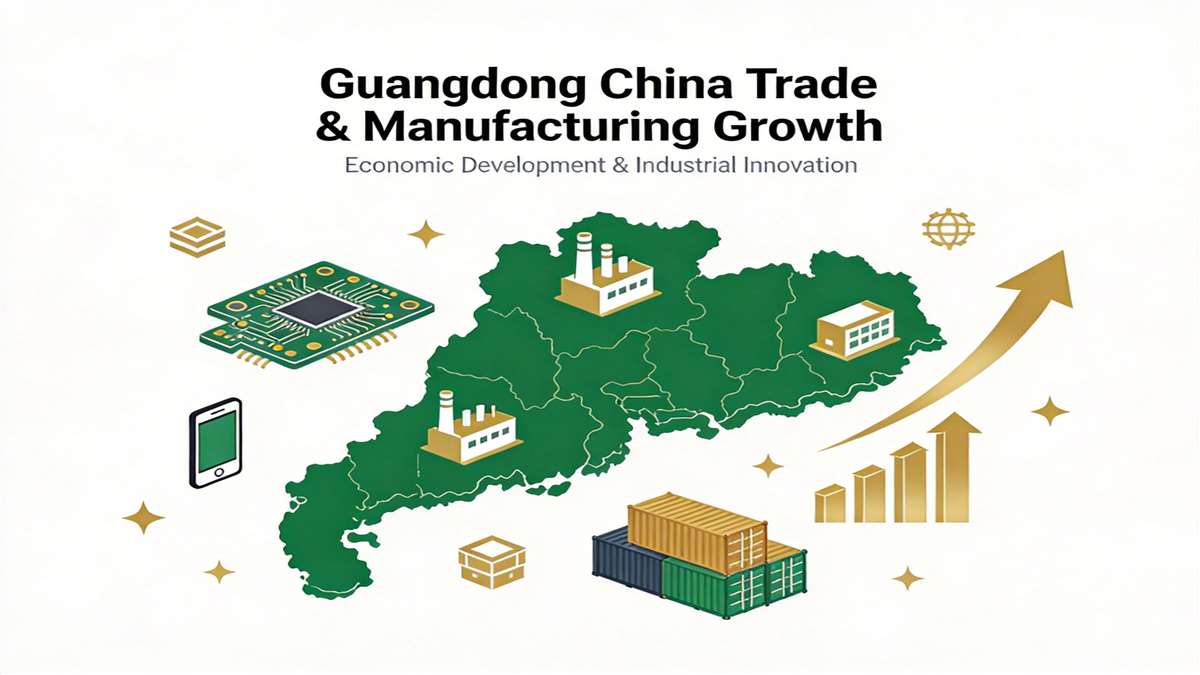
Guangdong's Q3 Trade Hit 3 Trillion Yuan â A Data Deep Dive Into What's Driving China's Export Engine
Category: Procurement Guides | Date: 2026-10-21
Executive Summary
Guangdong province achieved a record-breaking 3 trillion yuan in Q3 foreign trade â the first time any Chinese province has crossed that quarterly threshold. Total imports and exports for the first three quarters reached 8.72 trillion yuan, up 24.5% year-over-year, with advanced manufacturing leading at 33% growth in high-tech exports. This is a data-rich signal about where global supply chains are heading and where B2B buyers should position their procurement strategies for the rest of 2026.
The Numbers That Matter
Let us start with the data before interpreting what it means for sourcing decisions.
Guangdong's Q3 2026 foreign trade reached over 3 trillion yuan in a single quarter â a first in the province's history. The first three quarters combined for 8.72 trillion yuan, representing a 24.5% increase compared to the same period last year. September's monthly trade data contributed significantly to this quarterly surge, but the cumulative trend is what demands attention.
High-tech product exports grew by 33% year-over-year, far outpacing the overall trade growth rate. This is the key divergence point: while traditional categories like textiles and basic electronics may be stabilizing, advanced manufacturing products are accelerating at a pace that reshapes the competitive landscape for global buyers.
Market diversification is also worth noting. Guangdong's trade with Belt and Road Initiative countries and Asia-Pacific Economic Cooperation (APEC) economies both showed significant growth, indicating that Chinese export expansion is not concentrated in any single regional market but is broadly distributed across multiple trading partners.
What the Data Tells Us About Supply Chain Shifts
When a province whose trade volume rivals the entire GDP of many nations reports 33% growth in high-tech exports, it is not a trend â it is a structural shift. Here is what the data reveals.
Advanced manufacturing is the dominant growth driver. The 33% figure for high-tech products is not an aggregate of minor category improvements. It reflects a concentrated acceleration in areas like new energy equipment, semiconductor-related products, industrial automation, and advanced components. For B2B buyers in these categories, the implication is straightforward: supplier capacity is expanding rapidly in Guangdong, which means more competitive pricing, faster lead times, and greater product variety are available now â before the market catches up to this supply-side shift.
Geographic diversification reduces concentration risk. The significant growth in trade with Belt and Road and APEC economies means that Guangdong's export network is becoming less dependent on any single market. For procurement teams, this translates into more resilient supplier options. When supply chains are diversified across multiple regions, disruptions in one corridor have less impact on overall sourcing stability.
The scale itself signals infrastructure maturity. A quarterly trade volume exceeding 3 trillion yuan requires an extraordinary level of logistical, financial, and regulatory infrastructure to function efficiently. Guangdong has built exactly that â and the result is a sourcing ecosystem where B2B buyers can access a wider range of suppliers, with more competitive terms and shorter decision cycles than in any other Chinese manufacturing region.
Category-Level Insights for Procurement Teams
Breaking down the advanced manufacturing growth into actionable sourcing intelligence.
New energy products. Global demand for solar panels, battery systems, and energy storage solutions continues to outpace production capacity in many markets. Guangdong's suppliers in this category are scaling rapidly, and buyers who engage now can lock in favorable contracts before prices normalize with increased competition.
Industrial automation and equipment. The 33% high-tech export growth includes significant volumes of CNC machines, robotic components, and industrial sensors â products that are essential for manufacturers worldwide who are upgrading their production capabilities. Chinese suppliers in this space have improved quality significantly over the past three years, making them increasingly competitive with European and Japanese alternatives at a fraction of the cost.
Consumer electronics components. Even as finished consumer electronics markets mature, the component supply chain continues to expand. Displays, circuit boards, connectors, and battery cells from Guangdong represent some of the most cost-efficient sourcing options available for global electronics manufacturers and assemblers.
The Supply-Side Implications: Capacity, Pricing, and Lead Times
When a province of Guangdong-scale manufacturing reports 33% growth in high-tech exports, the supply-side implications extend far beyond the headline numbers. Increased production capacity creates a temporary window of buyer advantage that is well understood by experienced procurement professionals but easily overlooked by those who do not track supply-side dynamics systematically.
During periods of rapid capacity expansion, suppliers are more willing to negotiate on pricing because they are investing in equipment, labor, and supply chain relationships that need utilization. They are also more flexible on minimum order quantities because the marginal cost of producing additional units is declining as scale increases. And lead times tend to compress because production scheduling is less constrained â factories have more available capacity and fewer conflicts between customer orders.
This window typically closes within 12 to 18 months as the market reaches equilibrium and competition normalizes. The buyers who lock in favorable terms during this expansion phase gain a cost advantage that persists even after pricing normalizes, because long-term contracts negotiated at expansion-phase prices often remain in effect as market conditions shift.
The Innovation Spillover Effect
High-tech export growth is not just about volume â it is also about capability. As Guangdong suppliers increase production of advanced manufacturing products, they are simultaneously accumulating production experience, refining manufacturing processes, and developing technical capabilities that translate into product quality improvements.
This innovation spillover effect means that the suppliers available through Guangdong's manufacturing ecosystem are not just producing more â they are producing better. The same factories that once competed primarily on cost are now competing on a combination of cost, quality, and technical capability. This shift is particularly evident in categories like industrial automation equipment, where Chinese manufacturers have moved from basic product reproduction to genuine innovation in areas like adaptive control systems, predictive maintenance integration, and modular manufacturing architectures.
For B2B buyers evaluating sourcing options across regions, this capability shift means that Guangdong-based suppliers should no longer be positioned solely as cost alternatives to European or Japanese manufacturers. In many advanced manufacturing categories, they are now genuine technical competitors â and evaluating them through that lens opens a wider range of sourcing strategies than the traditional cost-versus-quality dichotomy allows.
How Buyers Should Respond
The data from Guangdong is clear, but data without action is just noise. Here is how procurement teams should translate these findings into sourcing strategy.
Re-evaluate your Guangdong supplier base. If your current sourcing strategy does not include active engagement with Guangdong-based advanced manufacturing suppliers, you are leaving significant cost and capability improvements on the table. Start with categories where the 33% growth is most concentrated â new energy, automation equipment, and advanced components.
Build supplier comparison frameworks around capacity and compliance. As supplier capacity expands rapidly, the market will become more competitive, and quality variance will increase. Buyers need structured comparison tools that evaluate suppliers not just on price, but on production capacity, compliance records, and risk profiles. SourcingX provides exactly this kind of structured comparison, enabling buyers to evaluate multiple Guangdong suppliers side by side with quantified risk and opportunity scores.
Time your procurement cycles to match supplier capacity expansion. Suppliers that are scaling to meet growing demand will be more flexible on pricing and delivery terms during the expansion phase. Understanding the timeline of capacity buildup â and acting before the market matures â gives buyers negotiating leverage that shrinks as supply-demand balance shifts.
Diversify across Guangdong's manufacturing clusters. Guangdong is not a monolith. Shenzhen leads in consumer electronics and communications equipment, Dongguan specializes in manufacturing automation and precision components, and Guangzhou dominates trade services and light manufacturing. Understanding which cluster serves your category best is a sourcing advantage in itself. Use structured comparison tools to evaluate suppliers across clusters with quantified risk and opportunity scores â SourcingX makes this possible.
The Policy and Infrastructure Support Layer
Guangdong's trade performance does not emerge from market forces alone. The province benefits from targeted policy support that directly enhances its sourcing ecosystem. The Greater Bay Area initiative, which integrates Guangdong with Hong Kong and Macau, has created a regulatory and financial infrastructure that facilitates cross-border trade, intellectual property protection, and technology transfer â all of which directly benefit international buyers sourcing from the region.
Special economic zones within Guangdong offer streamlined customs procedures, reduced regulatory friction, and dedicated industrial parks focused on specific high-tech categories. These zones are not just manufacturing locations â they are sourcing ecosystems that provide buyers with integrated access to suppliers, testing laboratories, logistics providers, and trade finance services in a single geographic cluster.
Understanding the policy and infrastructure landscape that supports Guangdong's manufacturing sector gives buyers additional leverage in supplier negotiations. When you understand which suppliers operate in policy-supported zones with streamlined procedures, you can make more accurate assessments of delivery reliability, compliance risk, and long-term sourcing stability.
The Long-Term Sourcing Strategy Takeaway
Guangdong's record-breaking trade data should not be read as a momentary achievement. It is a structural confirmation of trends that have been building for years and will continue to accelerate for the foreseeable future. The buyers who treat this as a signal to adjust their sourcing strategy â rather than a headline to file away â will be building supply chains that are more competitive, more resilient, and better positioned to capitalize on the next wave of global demand.
The specific actions are clear: engage with Guangdong's advanced manufacturing suppliers now, while capacity expansion creates favorable negotiation conditions. Build structured comparison frameworks that evaluate suppliers across multiple dimensions, not just price. Diversify across Guangdong's specialized manufacturing clusters to access different capability profiles. And invest in the data tools and analytical frameworks that turn market intelligence into actionable sourcing decisions.
These are not tactical adjustments. They are strategic positioning moves that determine whether your supply chain will be a cost center or a competitive advantage for years to come.
The Data Comparison Imperative
All of this points to a single conclusion: successful sourcing in this environment requires data-driven comparison at scale. Buyers who evaluate suppliers one at a time using spreadsheets and email chains cannot keep pace with the speed at which market dynamics are shifting. They miss opportunities to identify the best supplier for a specific category because they lack the structured comparison data needed to make informed decisions.
Platforms that enable side-by-side supplier comparison with standardized data fields â production capacity, compliance records, risk scores, pricing trends â are becoming essential tools for procurement teams that want to stay competitive. The ability to process supplier information from multiple sources, apply consistent evaluation criteria, and generate structured comparison reports in minutes rather than days is not a convenience feature. It is a competitive necessity.
The buyer who can evaluate ten Guangdong-based suppliers in the time it takes a competitor to evaluate one â with quantified risk and opportunity scores for each â will consistently outperform in supplier selection, pricing negotiation, and supply chain resilience. This is the practical reality of modern B2B sourcing in an accelerating market.
FAQs
Q: How much did Guangdong's foreign trade grow in Q3 2026?
A: Guangdong's Q3 foreign trade exceeded 3 trillion yuan for the first time, with total imports and exports for the first three quarters reaching 8.72 trillion yuan, a 24.5% year-over-year increase.
Q: Which product categories drove the growth?
A: High-tech and advanced manufacturing products led with 33% export growth, significantly outpacing overall trade expansion.
Q: What does this mean for B2B buyers sourcing from China?
A: It signals expanded supplier capacity, more competitive pricing, and greater product variety in advanced manufacturing categories â particularly new energy, industrial automation, and electronics components.
Q: How should buyers adjust their sourcing strategy?
A: Re-evaluate your Guangdong supplier base, build structured supplier comparison frameworks, time procurement cycles to match capacity expansion phases, and diversify across Guangdong's specialized manufacturing clusters.
Q: Is this growth concentrated in specific markets?
A: No. Guangdong's trade with Belt and Road countries and APEC economies both showed significant growth, indicating broad geographic diversification rather than concentration in any single market.
Comments
0