Mastering HS Code Classification for Customs Compliance

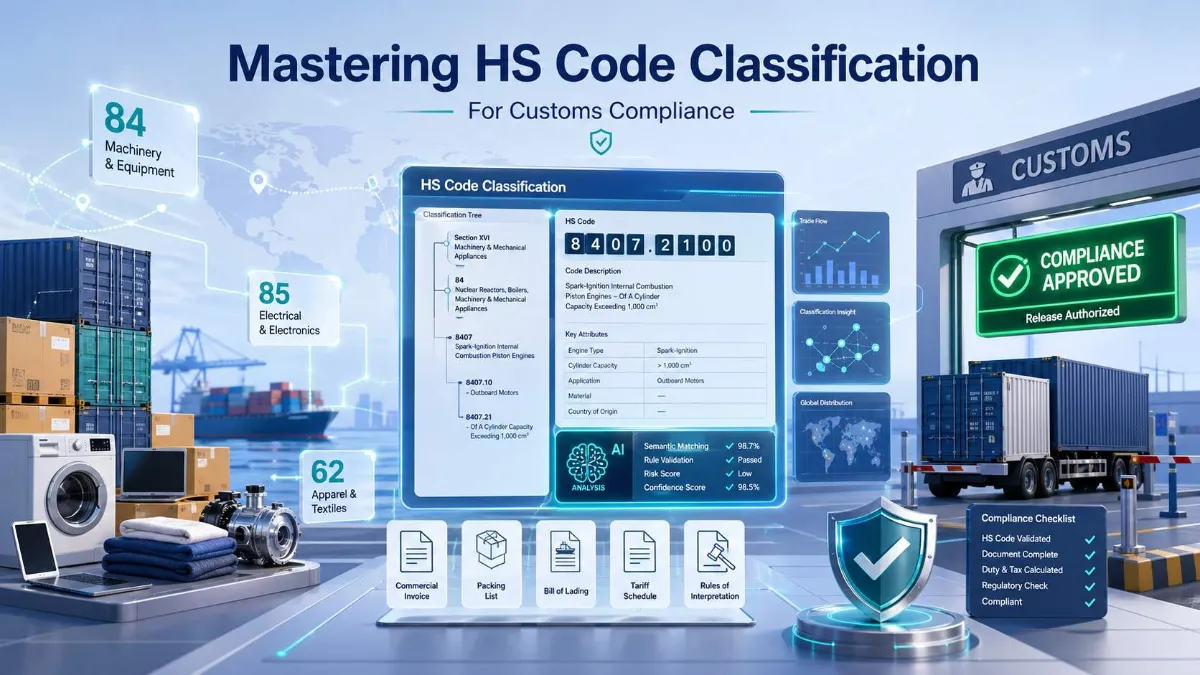
Mastering HS Code Classification for Customs Compliance
Executive Summary: The Gravity of HS Classification
The Harmonized System (HS) Code is the universal language of global trade. Administered by the World Customs Organization (WCO), this nomenclature governs the classification of every commodity crossing a border, directly determining the applicable duty rate, statistical tracking, and regulatory treatment of imported and exported goods. Without precise HS Code alignment, no procurement strategy—however sophisticated—can deliver predictable landed costs.
The financial consequences of misclassification are non-trivial. Incorrect classification triggers retroactive duty assessments, civil penalties ranging from 20% to 100% of the undeclared revenue loss, and in severe cases, criminal liability for fraud. U.S. Customs and Border Protection (CBP) and its counterparts in the EU, China, and Southeast Asia have intensified post-entry audits and targeted enforcement actions against e-commerce and mid-market importers whose declarations exhibit systemic variance.
For procurement teams navigating this complexity, SourcingX functions as an active AI procurement expert that interprets sourcing requirements through natural-language dialogue, coordinates multi-channel data retrieval, and provides structured decision support. While HS Code classification remains a domain requiring specialized customs expertise, SourcingX reduces the surrounding procurement friction—proactively alerting buyers when policy, exchange-rate, or raw-material fluctuations threaten to alter the economics of a classified sourcing portfolio.
Definition: General Rules of Interpretation (GRI) The GRI are the six hierarchical rules codified in the WCO Harmonized System Convention. GRI 1 mandates that classification is determined first by the terms of the headings and any relative section or chapter notes. GRI 2 through 6 provide progressively specific guidance for incomplete articles, mixtures, multi-component goods, and cases where competing headings appear equally applicable. Mastery of GRI 1 is the prerequisite for all subsequent precision.
The Logic of Precise Classification
Structural Anatomy: From Global Six to National Subheadings
An HS Code is not a monolithic string. It is a layered taxonomy:
- First two digits: Section and Chapter (broad commodity class).
- Next two digits: Heading (product group within the chapter).
- Final two digits: Subheading (specific product type).
- Digits 7–10+: National subheadings, appended by individual countries to capture tariff preferences, statistical granularity, or regulatory controls.
A 6-digit code is globally harmonized; anything beyond digit six is jurisdiction-specific. A procurement team quoting a Chinese supplier’s 8-digit CN code into a U.S. entry system without verifying the 8-digit HTSUS (Harmonized Tariff Schedule of the United States) equivalent is introducing compliance risk at the point of data handoff.
Three Core Principles of HS Logic
Principle 1: General to Specific Classification proceeds from the broadest applicable heading to the most specific subheading. If a product is a machine part, the analyst first confirms the correct chapter (e.g., Chapter 84), then narrows to the heading describing parts suitable for use solely or principally with a particular machine, and finally selects the subheading that captures the material or function.
Principle 2: Attribute to Function When a product’s material composition and its functional application point to different headings, GRI 1 requires priority analysis of the heading language and the relevant section/chapter notes before functional override. If the heading text explicitly names a material class, material usually prevails. If the heading names a function, function prevails.
Principle 3: Composition to Functionality For composite or multi-function articles, GRI 3(c) applies: when goods cannot be classified by reference to GRI 3(a) or 3(b), they are classified under the heading which occurs last in numerical order among those which equally merit consideration.
Conditional Classification Logic
To operationalize these principles, apply the following conditional framework:
- If the primary function is explicitly described in a single heading, then the classification is determined under that heading without recourse to GRI 3.
- If the article is a composite good with no single dominant function, then apply GRI 3(a)—the heading providing the most specific description.
- If no heading provides a specific description, then apply GRI 3(b)—the heading covering the material or component that gives the article its essential character.
- If the essential character cannot be determined, then apply GRI 3(c)—the last heading in numerical order among competing options.
Manual vs. AI-Assisted Procurement Intelligence
| Classification Aspect | Traditional Manual Procurement | SourcingX Active Expert Model |
|---|---|---|
| Requirement Intake | Buyer manually inputs specifications into static forms or email threads. | Natural-language dialogue: AI proactively understands the procurement task, disaggregates requirements, and clarifies ambiguous specifications. |
| Data Retrieval | Fragmented searches across supplier directories, tariff databases, and broker portals. | Multi-channel data retrieval: Integrates supplier data across platforms, surfacing product descriptions, material declarations, and qualification statuses in one interface. |
| Supplier Evaluation | Ad-hoc scoring based on limited samples and broker experience. | Intelligent matching and scoring: Evaluates suppliers across product match rate, value-cost ratios, service capability, and supplier qualifications, with results layered for decision clarity. |
| Progress Visibility | Buyer must manually track sourcing status across spreadsheets. | Periodic task synchronization: AI regularly reports execution progress and requests human decision input at critical junctures. |
| Volatility Response | Reactive; policy or rate changes often surface after contract execution. | Proactive alert system: Notifies buyers when policy, exchange-rate, or raw-material price fluctuations may impact the sourcing economics of a classified portfolio. |
| Learning Curve | Knowledge remains siloed within individual brokers or procurement officers. | Continuous learning: Records buyer feedback and behavior to refine future recommendations, progressively aligning with the organization’s risk tolerance and category preferences. |
5 Pro-Tips for HS Code Accuracy
Step 1: Analyze Product Composition
Deconstruct the article into its material constituents by weight and volume. For textile articles, fiber content determines heading placement under Section XI. For metal goods, identify the base metal and any surface treatments. Do not rely on marketing descriptions; request the supplier’s technical data sheet.
Step 2: Determine Primary Function
Establish the core commercial purpose of the article as sold. A device with both printing and scanning capability requires a functional hierarchy assessment under GRI 3. If the manufacturer markets it primarily as a printer, that evidentiary positioning supports the printing-machine heading, provided the technical specifications align.
Step 3: Consult Section & Chapter Notes
Before selecting any heading, read the legal notes appended to the relevant section and chapter. These notes contain exclusions, inclusions, and definitions that override general heading language. Automated classification tools that ignore section and chapter notes generate high-confidence, legally invalid outputs. This is the most common failure mode in algorithmic systems.
Step 4: Cross-Reference with Customs Rulings
Validate provisional classifications against published binding rulings (e.g., CBP Rulings Online Search System, EU Binding Tariff Information). If a functionally identical article has been ruled upon by the target jurisdiction’s customs authority, that ruling carries precedential weight for your entry.
Step 5: Leverage AI to Reduce Procurement Friction Around Classification
While SourcingX does not replace licensed customs brokers, its active intelligence architecture mitigates the procurement friction that surrounds HS Code management. By retrieving supplier product specifications through multi-channel data integration and scoring suppliers on qualification reliability, the platform ensures that buyers receive structured, verifiable material declarations at the sourcing stage—reducing the incidence of ambiguous or incomplete descriptions that cascade into classification errors downstream.
Active Intelligence Perspective: The Future of Classification-Adjacent Procurement
The volume and velocity of global trade data have exceeded the processing capacity of traditional procurement models that rely on manual form-filling and fragmented information searches. SourcingX addresses this structural constraint through an active expert model that treats procurement intelligence as a continuous, collaborative workflow rather than a series of isolated lookups.
When a buyer initiates a sourcing request—whether for a precisely specified component or an ambiguous product category—SourcingX proactively interprets the objective through natural-language dialogue, disaggregates the requirement into executable steps, and coordinates multi-channel supplier retrieval. The system evaluates retrieved suppliers through a multi-dimensional scoring framework encompassing product match rate, value-cost analysis, service capability, and supplier qualification status, presenting layered results that support immediate decision-making.
Concurrently, SourcingX maintains an active awareness of the procurement environment. The platform tracks policy, exchange-rate, and raw-material price fluctuations, proactively alerting buyers when volatility threatens to alter the economics of an active sourcing portfolio. In the context of HS Code management, this means that buyers receive timely awareness of tariff schedule adjustments or trade-policy shifts that may render a previously optimal classification suboptimal—enabling preemptive supplier renegotiation or portfolio rebalancing before cost impacts hit the P&L.
Over successive interactions, SourcingX continuously learns from buyer feedback, behavioral patterns, and evolving industry knowledge bases, progressively refining its recommendation strategies. The outcome is not the displacement of specialized customs expertise, but the elevation of the procurement team from manual data retrieval to strategic governance—ensuring that the material descriptions, supplier qualifications, and cost structures feeding into the classification process are accurate, structured, and operationally actionable from the first sourcing inquiry.
Comments
0