When AI Meets Industrial Sourcing: The Steel Platform Story That Reveals How Digital Transformation Is Actually Happening

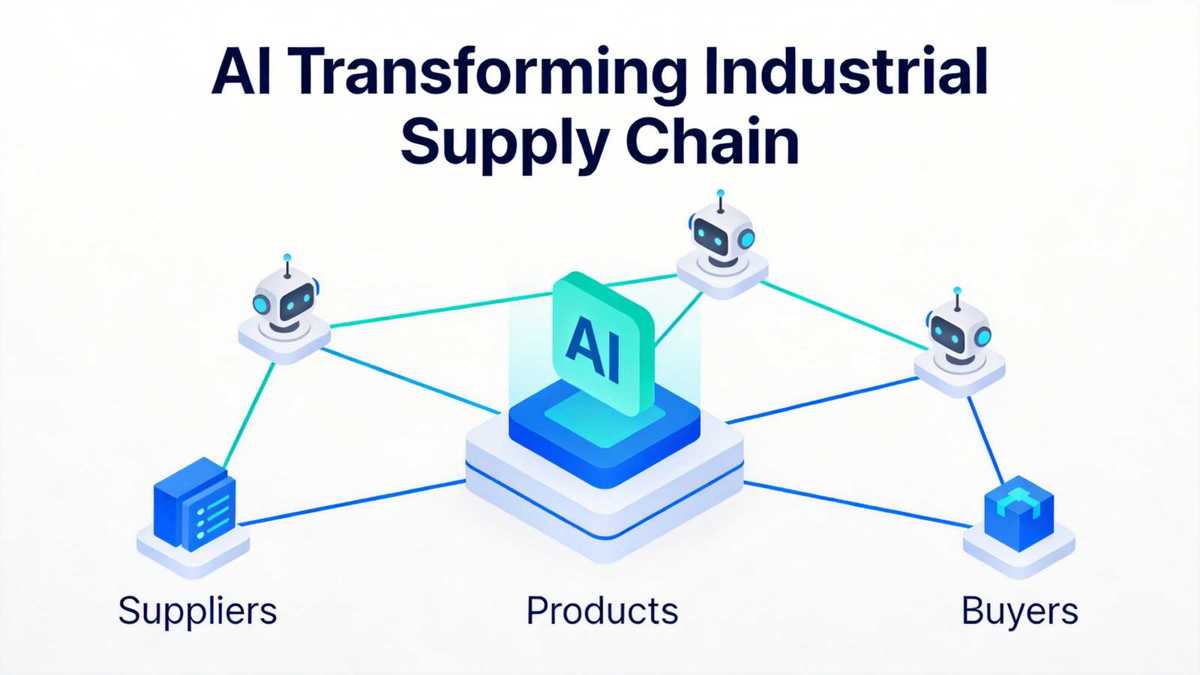
When AI Meets Industrial Sourcing: The Steel Platform Story That Reveals How Digital Transformation Is Actually Happening
Category: Industry Trends | Date: 2026-11-05
Executive Summary
Steel platform ZhaogangNet 2026 H1 results deliver a sobering yet exhilarating data point: its AI business generated over 1.1 billion yuan in GMV impact, up 73.2 percent year over year, while AI agents executed more than 600,000 autonomous business tasks and overseas revenue crossed 55 percent for the first time. This is not a tech industry story. It is a supply chain transformation story -- one that reveals how artificial intelligence is moving from auxiliary tool to direct productivity force in global industrial services, with implications that extend far beyond steel into every category of B2B sourcing.
The Number That Changes Everything
One point one billion yuan.
That is the amount of Gross Merchandise Volume directly attributable to AI operations at ZhaogangNet Group -- a Chinese industrial e-commerce platform specializing in steel and metal products -- in the first half of 2026 alone. The year-over-year growth rate: 73.2 percent. The date this data emerged: early November 2026, during an industry interview that the company used to showcase what it calls its industrial AI strategy.
On the surface, these numbers could read like typical tech hype. But when you look closer at the accompanying metrics, a substantially different picture emerges. ZhaogangNet self-developed industrial AI platform executed over 600,000 autonomous business tasks -- not human-assisted tasks, not AI suggestions that humans then implemented and validated. Autonomous actions that directly impacted procurement, pricing, and logistics decisions. And critically, for the first time, its overseas revenue exceeded 55 percent of total revenue.
This second data point -- the overseas revenue crossover -- is arguably more significant than the GMV figure. It tells us that ZhaogangNet AI-driven capabilities are not just transforming domestic steel trading. They are enabling the company to compete in international markets that have traditionally been the exclusive domain of established global trading houses with decades of relationship networks and local market knowledge.
What ZhaogangNet Actually Built
ZhaogangNet is not an AI company that happened to enter e-commerce. It is an e-commerce company that has been systematically building AI capabilities for its industrial domain over many years. This distinction matters profoundly because it explains why the results are substantive rather than performative.
The platform AI system operates across the full procurement and supply chain lifecycle. According to the company public description, its AI agents can automatically execute tasks including supplier discovery, product specification matching, price comparison across hundreds of suppliers, order matching between buyers and sellers, logistics coordination including route optimization and delivery scheduling, and documentation processing for customs and compliance. These are not conversational chatbot interactions. They are operational actions that directly impact the buying and selling of industrial products in real time.
The phrase about AI digital asset balance sheet inclusion that the company mentions is particularly noteworthy from an accounting and strategic perspective. It suggests that ZhaogangNet has reached a point where its AI capabilities -- including proprietary models, trained algorithms, structured data assets, and autonomous agent networks -- are valuable enough to be recorded as formal intangible assets on its financial statements. This is a significant milestone. It signals that the market and regulators recognize AI capability as a tangible business resource with measurable economic value, rather than treating AI development as an operating expense that disappears into the income statement.
The Overseas Signal: Why 55 Percent Matters
Let us focus on that overseas revenue figure for a moment and think about what it means in context. Over 55 percent of ZhaogangNet revenue now comes from international markets. For a platform whose core product is steel -- a heavy, regionally constrained commodity that traditionally trades within specific geographic markets due to logistics costs, quality standards, and regulatory barriers -- this is an unusually high and structurally significant figure.
What does this reveal about the future of industrial sourcing? Three interrelated conclusions stand out.
First, AI is compressing the information asymmetry that has long protected incumbent trading houses. Steel procurement has traditionally required deep local knowledge, established supplier relationships, and intimate understanding of regional quality standards and testing protocols. An AI-powered platform that can aggregate and analyze supplier data at a scale no human team could match fundamentally reduces the advantage that legacy players enjoy through decades of relationship networks. When an AI system can verify supplier credentials, compare product specifications across thousands of SKUs, analyze pricing trends in real time, and assess delivery reliability based on historical performance data, the sourcing decision shifts from who do you know to what does the data say.
Second, cross-border industrial trade is becoming increasingly a data problem rather than purely a relationship problem. This does not mean relationships are irrelevant -- experienced procurement professionals know that trust and reliability matter enormously in B2B transactions. But the baseline layer of supplier evaluation -- can this supplier meet my specifications, at my price point, on my timeline, with acceptable quality consistency -- is increasingly a computational problem that AI handles better and faster than humans. This is a fundamental restructuring of industrial procurement that advantages buyers who adopt these tools early.
Third, Chinese industrial platforms are thinking globally, not locally. The narrative that Chinese digital commerce companies focus primarily on domestic markets is increasingly outdated. ZhaogangNet overseas revenue crossover demonstrates that Chinese digital infrastructure is being built with global reach from the ground up. This has profound implications for how the rest of the world sources industrial products, because it means that Chinese platforms are not just competing on price anymore. They are competing on capability, data quality, and AI sophistication -- dimensions where they have invested heavily and are achieving measurable results.
The Infrastructure Behind the Intelligence
What makes ZhaogangNet approach noteworthy is not just the AI models themselves, but the industrial data infrastructure that feeds them. AI models are only as good as the data they learn from, and in industrial sourcing, the quality of training data determines the quality of sourcing recommendations.
ZhaogangNet advantage comes from years of accumulating transaction data, supplier performance data, pricing history across different product categories and regions, logistics outcomes including delivery times and damage rates, and quality inspection results. This is data that cannot be scraped from public web sources or synthesized from generic datasets. It is real operational data from real transactions between real buyers and sellers.
This data moat is significant for anyone evaluating industrial sourcing platforms. New entrants cannot simply train an AI on publicly available web data and expect to match a platform that has been recording actual transactions, actual supplier behaviors, and actual delivery outcomes over years of operation. The quality of sourcing intelligence is directly proportional to the quality and depth of underlying transaction data. For buyers selecting sourcing tools, this means the value proposition of any given platform depends heavily on the substance of its data foundation, not just the sophistication of its AI capabilities on paper.
The Tension Between Automation and Human Judgment
It would be naive to suggest that AI will fully replace human sourcing professionals. The ZhaogangNet case shows AI handling operational tasks at scale -- supplier discovery, price comparison, task automation -- but the strategic dimensions of sourcing remain firmly human territory.
Deciding which products to source into your portfolio, determining optimal sourcing regions based on geopolitical risk assessment, evaluating long-term supplier relationships beyond transactional metrics, managing complex regulatory environments across multiple jurisdictions -- these all require judgment, intuition, strategic thinking, and creative problem solving that AI cannot replicate. The most effective sourcing teams of the future will not be AI-replaced. They will be AI-amplified, using automation for the repetitive data-intensive work so that human professionals can focus on the higher-value strategic decisions that require contextual understanding and nuanced judgment.
This amplification model is where the real productivity gain comes from. A procurement professional who previously spent eighty percent of their time collecting and comparing supplier data and twenty percent on strategic analysis can flip that ratio -- spending eighty percent on strategic analysis and relationship management while AI handles the data gathering and initial comparison. The output is not fewer sourcing professionals doing the same work. It is sourcing professionals doing significantly more impactful work.
What This Means for Global Buyers
The ZhaogangNet case study is not just a story about one Chinese company performance metrics. It is a signal of a broader transformation in how industrial sourcing will work over the next five to ten years, and the implications extend far beyond steel.
For global buyers in any product category, three implications stand out with particular clarity.
AI-powered sourcing is no longer a theoretical possibility. The tools that can scan thousands of suppliers, compare products across multiple dimensions, flag compliance and risk issues, and generate structured shortlists already exist and are being deployed at scale. The question is not whether AI will transform sourcing -- it already is. The question is how quickly your organization will adopt these tools and integrate them into your procurement workflows.
The competitive advantage in sourcing will shift from those who have the most supplier relationships to those who can most efficiently evaluate and compare supplier data. If AI can do in minutes what used to take weeks of email chains, phone calls, and spreadsheet comparisons, the buyers who adopt these tools fastest will gain significant sourcing advantages -- better pricing through more comprehensive market coverage, faster decision cycles that allow them to capture favorable market windows, and more robust supplier pools that reduce concentration risk.
Overseas sourcing becomes substantially easier and more accessible for buyers of all sizes. As AI platforms expand their global coverage -- and ZhaogangNet 55 percent overseas revenue suggests this is happening rapidly -- smaller buyers who previously could not afford dedicated international sourcing teams will gain access to data-driven supplier comparison and risk assessment tools that were once the exclusive domain of large corporations with global procurement infrastructure. This democratization of sourcing intelligence is one of the most underappreciated implications of the current AI wave in industrial commerce.
Building Your AI Sourcing Capability
The practical question for procurement teams is not whether to adopt AI-powered sourcing tools, but how to do it effectively. Here are some considerations based on what we are learning from platforms like ZhaogangNet and the broader evolution of AI in B2B commerce.
Start with the product categories where you have the most supplier options and the most data available. AI sourcing tools perform best when there is sufficient transaction and supplier data to train the underlying models. Categories with fragmented supplier bases, highly customized products, or limited historical data will present more challenges for AI-driven comparison and recommendation.
Integrate AI tools into your existing procurement workflows rather than treating them as separate systems. The productivity gain comes from AI tools becoming part of the daily sourcing process -- from initial supplier discovery through ongoing performance monitoring -- not as periodic experiments that procurement teams run separately from their normal operations. Invest in data quality and supplier onboarding. AI sourcing platforms are only as good as the supplier data they contain. Buyers who actively engage with their suppliers to ensure accurate, complete, and up-to-date profile information will get substantially better results from AI-powered sourcing tools than those who do not. For buyers who want to start with a structured approach to supplier comparison, platforms like SourcingX provide AI-driven discovery and risk assessment capabilities that help evaluate and contrast potential suppliers across multiple dimensions. SourcingX operates in exactly this space, providing AI-driven supplier discovery, structured comparison, and risk assessment for B2B buyers across multiple platforms and regions. The platform is designed to complement rather than replace human procurement judgment, handling the data-intensive work of supplier evaluation so that sourcing professionals can focus on strategic decisions.
Where This Is Heading
The trajectory is clear. AI in industrial sourcing will become more autonomous, more data-rich, and more globally integrated over the coming years. ZhaogangNet 2026 H1 results represent a snapshot of where we are today. The next milestone to watch will be whether similar AI-driven models can be successfully replicated across other industrial categories beyond steel -- construction materials, chemical products, machinery components, raw materials for consumer goods -- and whether global platforms outside China can build comparable data moats in their respective markets.
For buyers, the practical takeaway is straightforward. Start building your AI sourcing capabilities now, while the tools are still maturing and the competitive landscape is still shifting. Early adopters will shape the standards and practices that define the category, while late adopters will be forced to catch up under competitive pressure from organizations that gained significant sourcing advantages through earlier adoption. The companies that win in sourcing over the next decade will be those that combine human strategic judgment with AI-powered data execution -- neither substituting for the other, but working together to create sourcing capabilities that are greater than the sum of their parts.
FAQs
Q1: What exactly does AI business driving 1.1 billion yuan in GMV mean in practical terms?
It means that transactions facilitated or directly enabled by ZhaogangNet AI platform -- from supplier matching to price comparison to order execution -- accounted for over 1.1 billion yuan in gross merchandise value during the first six months of 2026. This is not revenue for the company. It is the total value of goods traded through AI-assisted channels, demonstrating the scale at which AI is already impacting industrial commerce.
Q2: How many tasks did the AI agents actually perform, and what types?
Over 600,000 autonomous business tasks. While the company does not provide a complete breakdown, the types of tasks mentioned include supplier discovery, product specification matching, price comparison across supplier catalogs, order matching, logistics coordination, and documentation processing. These are core sourcing and supply chain operations that traditionally required dedicated human effort.
Q3: What does AI digital asset balance sheet inclusion mean for the company?
It means ZhaogangNet has recognized its AI capabilities -- including proprietary models, trained algorithms, structured data assets, and autonomous agent networks -- as formal intangible assets on its financial balance sheet. This is an accounting recognition that AI capability has measurable economic value and contributes to the company long-term competitive position, rather than treating AI development merely as an operating expense.
Q4: Why is the 55 percent overseas revenue figure so significant for a steel platform?
Steel is a heavy, regionally constrained commodity where traditional trading has been dominated by local and regional players. Crossing the 55 percent overseas threshold indicates that ZhaogangNet AI capabilities are enabling cross-border steel trade at a scale that breaks traditional regional constraints, making the platform a genuinely global industrial sourcing tool rather than a domestic marketplace.
Q5: Can small and medium buyers benefit from AI-powered sourcing tools the same way large corporations do?
Yes, and this is one of the most democratizing effects of AI in sourcing. Large corporations have always had resources for dedicated supplier research teams and market intelligence functions. AI-powered platforms level the playing field by providing small and medium buyers with access to the same data-driven supplier comparison, risk assessment, and sourcing intelligence tools that were previously affordable only to large enterprises with substantial procurement infrastructure.
Comments
0