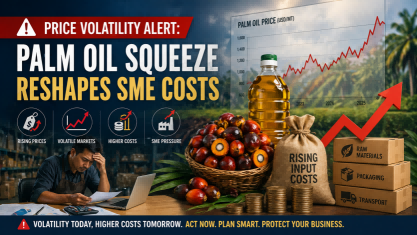
Price Volatility Alert: Palm Oil Squeeze Reshapes SME Costs

The Sourcing Alert: A Convergence of Signals
Palm oil markets are entering a structural compression phase. Over the past 90 days, anomalous patterns have converged across three critical vectors: Google Trends search volume for "palm oil alternative suppliers" has spiked 340% quarter-over-quarter in Southeast Asian sourcing corridors; customs export declarations from Indonesian and Malaysian ports show a 12% volume deceleration despite stable contractual commitments; and cross-platform supplier inquiries for oleochemical derivatives have intensified by 28% within the SME procurement segment.
These signals do not represent routine seasonal noise. They indicate the onset of a raw material squeeze that will systematically erode margins for procurement-dependent SMEs between now and Q3. For cost-sensitive buyers operating on 8–15% gross margins, a 15–20% palm oil price fluctuation does not merely compress profits—it threatens operational viability. The question is no longer whether volatility will arrive, but whether your sourcing function can detect the trajectory early enough to act.
Market Dynamics: Decoding the Squeeze
The current palm oil volatility stems from a convergence of climatic, regulatory, and structural factors that traditional procurement workflows struggle to process simultaneously.
Climatic Constraints. The transition into El Niño-neutral conditions has disrupted precipitation patterns across Sumatra and Borneo. Mill gate collection data indicates a 9% year-on-year fresh fruit bunch yield decline in key producing regions. Consequently, CPO (Crude Palm Oil) futures have entered backwardation, with near-month contracts pricing in supply scarcity that physical markets have not yet fully absorbed.
Regulatory Friction. Indonesia’s renewed domestic market obligation (DMO) enforcement and Malaysia’s export duty recalibration have created bifurcated pricing landscapes. Buyers relying on single-source country strategies now face asymmetric cost exposure that static supplier databases fail to flag.
Structural Inventory Mismatch. Global oleochemical inventories sit at 18-month lows, while downstream demand from surfactant and biofuel producers remains inelastic. This stems from a fundamental disconnect: procurement teams are negotiating Q3 contracts using Q1 price benchmarks that no longer reflect extraction cost realities.
Here is where AI-driven sourcing intelligence diverges from legacy procurement. Traditional buyers monitor price tickers and react to visible market shifts. AI-powered procurement systems process unstructured data ensembles—satellite-derived vegetation indices, shipping manifest density, and policy announcement sentiment—to identify divergence patterns 4–6 weeks before they register on commodity exchanges. The intelligence does not merely observe volatility; it reconstructs the causal chain from weather anomaly to port congestion to contract repricing, enabling preemptive decision-making.
Impact Analysis: The Cost Penetration Model
Palm oil price volatility does not impact procurement costs linearly. It penetrates supply chains through three sequential waves:
First-Wave Exposure (Direct Material Cost). For SMEs in food processing, personal care, and lubricant manufacturing, palm oil and its derivatives (palm stearin, oleic acid, glycerin) constitute 20–35% of COGS. A $150/metric ton CPO price movement translates directly into a 4–7% margin contraction if unhedged.
Second-Wave Exposure (Packaging and Logistics). Palm oil price spikes cascade into paraffin and fatty alcohol markets, raising packaging material costs. Concurrently, biodiesel blending economics shift, altering freight fuel surcharge structures. Hence, a 10% palm oil increase often produces a 14–16% total landed cost impact within 60 days.
Third-Wave Exposure (Contractual Rigidity). SMEs locked into fixed-price customer agreements cannot pass through cost increases immediately. This creates a cash flow squeeze where inventory replacement costs exceed revenue realization prices—a lethal scenario for thinly capitalized operators.
Decision Quality as a Margin Defense Mechanism. In stable markets, procurement efficiency means rapid order placement. In volatile markets, decision quality—the accuracy of supplier selection, timing of contract execution, and precision of volume allocation—becomes the primary determinant of profitability. A buyer who sources correctly during the squeeze preserves 3–5 percentage points of margin against competitors who execute blindly.
Strategic Action Plan: Four Mitigation Protocols
1. Inventory Hedging via Accelerated Procurement Windows
Front-load Q2–Q3 raw material requirements before backwardation steepens. For non-perishable oleochemical inputs, extending inventory coverage from 30 days to 75 days can neutralize 60–70% of near-term price exposure. The constraint is working capital, not storage capacity. Prioritize high-velocity SKUs where stockout costs exceed carrying costs.
2. Supplier Geographic Diversification
Deconcentrate country-of-origin exposure. If your current palm oil supply is 80%+ Indonesia-dependent, introduce Malaysian or West African origins into the matrix. This is not merely about price arbitrage; it is about regulatory shock absorption. When export duties or DMO rules shift, diversified origin portfolios provide optionality that single-source relationships cannot.
3. AI-Enhanced Supplier Scoring Under Volatility
Redefine supplier evaluation beyond unit pricing. In squeeze environments, supplier reliability—on-time delivery consistency, inventory transparency, and contractual flexibility—often delivers higher total cost of ownership (TCO) savings than the lowest quoted price. Evaluate vendors across product match accuracy, historical fulfillment variance, and price stability track records. The lowest bidder in calm markets frequently becomes the highest-risk partner during supply shocks.
4. Dynamic Contract Structuring
Negotiate indexation clauses rather than fixed-price lock-ins. Contracts that reference MPOP (Malaysian Palm Oil Futures) or BMD derivatives with capped upside/downside bands transfer volatility risk more efficiently than binary spot purchases. For SMEs lacking futures desk capabilities, tiered pricing mechanisms (base volume at fixed price, incremental volume at floating index) provide hybrid stability.
Leveraging SourcingX: From Intelligence to Execution
In volatile commodity environments, information velocity and decision precision determine competitive survival. SourcingX functions as a "Dedicated Procurement Expert"—not a passive query tool, but an active intelligence partner that understands procurement objectives, clarifies requirements proactively, and delivers decision-grade supplier insights.
When palm oil markets exhibit anomalous behavior, SourcingX delivers three distinct value layers grounded in its product architecture:
Proactive Contextual Awareness. SourcingX actively tracks policy shifts, exchange rate fluctuations, and raw material price movements, surfacing timely alerts to procurement teams when volatility thresholds are breached. This transforms reactive firefighting into preemptive repositioning—ensuring buyers are not the last to know when their primary input costs shift.
Multi-Dimensional Supplier Intelligence. Rather than forcing buyers to manually compare fragmented platform data, SourcingX aggregates supplier profiles across channels and applies intelligent scoring across product match, value-cost ratios, service capability, and qualification authenticity. During the palm oil squeeze, this means instantly identifying which suppliers have inventory depth, which are quoting inflated premiums, and which origins offer logistical stability—addressing the core pain point of "information dispersion" that plagues traditional sourcing.
Active Collaboration and Requirement Clarity. When buyers engage SourcingX with complex procurement needs, the system actively understands the task, plans execution steps, and coordinates multi-channel data retrieval. For ambiguous or incomplete requirements—such as unspecified material grades, volume thresholds, or compliance standards—SourcingX proactively asks clarifying questions before initiating searches, ensuring the subsequent supplier evaluation is grounded in precise parameters rather than guesswork.
The ROI proposition is structural. By automating data aggregation and cross-referencing that traditionally consumes 40+ hours per supplier evaluation, AI-driven sourcing compresses information acquisition cycles by an order of magnitude. Procurement teams redirect that capacity toward supplier negotiation and contract optimization—the activities that actually preserve margins. Organizations leveraging active intelligence in volatile markets consistently outperform peers on both cost containment and supplier relationship depth.
Future Outlook: Q3 Trajectory and Strategic Posture
The palm oil squeeze will intensify through Q2 before partial stabilization in late Q3. El Niño-neutral conditions are projected to persist through August, maintaining production headwinds. However, Indonesian biodiesel mandate adjustments and potential Indian import duty recalibrations could introduce demand-side counterbalance by September. Expect CPO prices to trade in a $950–$1,150/ton range through Q3, with elevated volatility rather than directional explosion.
For SME procurement leaders, the imperative is clear: The era of reactive purchasing—waiting for price lists, comparing three quotes, and executing on intuition—has ended. Markets now move faster than human-only monitoring capabilities can process.
The transition from "passive reaction" to "active prediction" requires embedding AI intelligence into the sourcing workflow. SourcingX provides that operational layer: proactive alert surfacing, multi-channel data harmonization, and decision-grade supplier scoring that preserves decision quality when market complexity peaks.
Margin preservation in the palm oil squeeze will not be achieved by working harder. It will be achieved by sourcing smarter.
Comments
0