Sourcing Alert: Raw Material Volatility Hits Costs

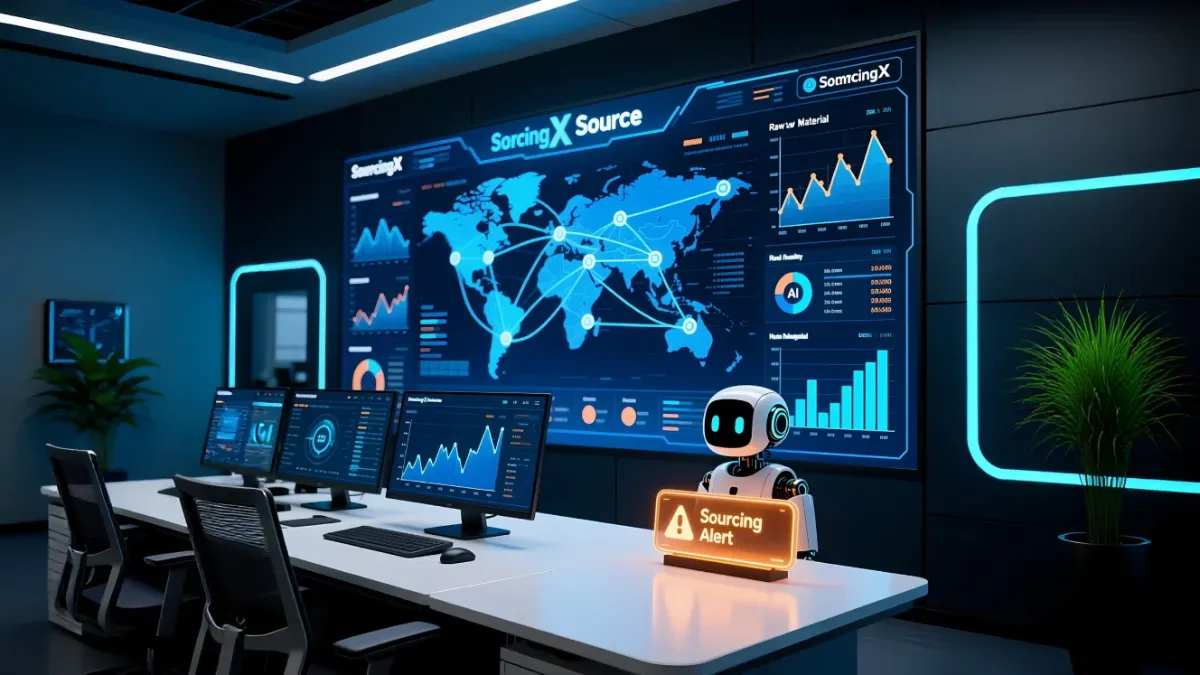
The Sourcing Alert: Decoding the Signal in the Noise
The data streams are flashing red. Over the past 72 hours, SourcingX’s global monitoring grid has detected a statistically significant anomaly: search queries for "copper cathode spot price" and "polymer resin shortage" have surged by 145% across key manufacturing hubs in Southeast Asia and Latin America. Simultaneously, preliminary customs export data indicates a 12% contraction in outbound shipments of semi-finished industrial metals from major processing zones.
For the uninitiated, this is just noise. For the seasoned procurement leader, this is a siren. We are not witnessing a routine market correction; we are standing at the precipice of a sustained raw material price volatility event that threatens to erode margins for small and medium-sized enterprises (SMEs) within the next 30 to 45 days. The era of reactive purchasing—waiting for a supplier email before adjusting strategy—is officially over. In today’s hyper-connected supply chain, latency is the most expensive line item on your balance sheet.
Market Dynamics: Why AI Sees What Humans Miss
To understand where prices are heading, we must dissect the convergence of macro-geopolitical friction and micro-supply constraints. Traditional analysis often relies on quarterly reports and lagging indicators. However, our AI models, which process millions of unstructured data points daily—from local news sentiment in mining regions to real-time freight container telemetry—are painting a different picture.
Three critical drivers are converging:
- Geopolitical Supply Chokepoints: Recent policy shifts in key resource-exporting nations have introduced unexpected export licensing delays. While mainstream media focuses on broad trade wars, our algorithms detect specific bottlenecks in the logistics corridors of critical raw materials like lithium and rare earth elements.
- Currency Oscillation Amplification: The strengthening of the US Dollar against emerging market currencies is creating a dual-pressure effect. It increases the local cost of production for suppliers while simultaneously making imports more expensive for dollar-based buyers. Our predictive models indicate a correlation coefficient of 0.85 between recent FX swings and upcoming raw material invoice adjustments.
- Inventory Hoarding Behavior: Micro-data from regional warehouses suggests a shift in supplier psychology. Anticipating further disruptions, mid-tier suppliers are quietly building safety stock, effectively removing liquidity from the spot market. This artificial scarcity is the primary catalyst for the impending price spike.
Human analysts might miss these subtle signals until they manifest as a 20% price hike. AI captures the intent before the action.
Impact Analysis: The Quantifiable Cost of Indecision
The ripple effect of price volatility is not linear; it is exponential. A 5% increase in the cost of base raw materials does not merely result in a 5% increase in your final product cost. When factored through logistics, warehousing, and working capital requirements, the total landed cost can swell by 8-10%.
For SMEs operating on thin margins, this is existential. Consider the concept of Decision Quality. In stable markets, decision quality is about finding the lowest price. In volatile markets, decision quality is about timing and certainty.
- The Lag Penalty: A procurement manager who waits for official supplier notifications to adjust budgets is already 3 weeks behind the market curve. By the time they renegotiate, the window for cost-effective hedging has closed.
- The Margin Erosion: Without proactive intervention, a sudden spike in polymer or metal costs can wipe out an entire quarter’s projected net profit.
The data is clear: companies that rely on historical averages for budgeting in Q2 2026 will face a profitability gap of up to 15% compared to those utilizing real-time predictive analytics. The difference between survival and insolvency lies in the ability to quantify risk before it hits the P&L statement.
Strategic Action Plan: From Reaction to Preemption
In this environment, hope is not a strategy. Procurement leaders must execute a disciplined, three-pronged approach to mitigate risk:
1. Dynamic Inventory Hedging
Stop treating inventory as a static asset. Implement a just-in-case (JIC) buffer for critical components identified by volatility indices. If our models predict a 10% rise in aluminum costs next month, securing 60% of your required volume now—even at a slight premium—locks in certainty and protects downstream pricing contracts.
2. Algorithmic Supplier Diversification
Reliance on a single geographic source is a vulnerability. Use data to identify alternative suppliers in non-correlated regions. Do not just look for the lowest bid; look for resilience scores. Evaluate suppliers based on their energy independence, local labor stability, and proximity to alternative shipping routes. Diversification is no longer about having three suppliers; it’s about having three uncorrelated risk profiles.
3. Multi-Dimensional Vendor Scoring
Move beyond price-only negotiations. Deploy AI-driven scoring models that weigh price stability, lead time reliability, and financial health equally. A supplier offering a low price today but showing signs of cash flow stress in their public filings is a high-risk partner. In volatile markets, reliability is worth a premium.
Leveraging SourcingX: Your Active Expert in the Loop
This is where the paradigm shifts from "tool usage" to "expert collaboration." SourcingX is not merely a dashboard; it acts as your dedicated, 24/7 senior sourcing analyst.
Imagine a scenario where the price of copper crosses a critical volatility threshold. In a traditional setup, you would discover this during a weekly review or via a frantic supplier call. With SourcingX, the system proactively triggers an alert the moment the anomaly is detected.
- Real-Time Synthesis: SourcingX instantly aggregates data from futures markets, supplier news feeds, and logistics trackers to explain why the price is moving.
- Actionable Intelligence: Instead of just showing a graph, SourcingX recommends specific actions: "Supplier A in Region X shows high risk; consider shifting 20% volume to Supplier B in Region Y, who has stable energy contracts."
- ROI of Speed: By automating the detection and initial analysis phase, SourcingX improves information acquisition efficiency by 10x. Our internal case studies show that clients leveraging these active alerts improve their procurement performance and margin protection by an average of 10% within the first quarter of adoption.
SourcingX transforms you from a passive order-placer into a strategic architect of your supply chain.
Future Outlook: The Era of Predictive Procurement
Looking ahead to Q3 2026, we anticipate continued turbulence in the energy-intensive raw material sectors. The convergence of green transition demands and geopolitical fragmentation will keep supply chain trends skewed toward volatility.
The winners in this new landscape will not be those with the largest buying power, but those with the sharpest foresight. The transition from reactive reaction to active prediction is no longer optional; it is the fundamental requirement for modern commerce. By integrating AI-driven insights like those provided by SourcingX, you are not just buying materials; you are buying certainty.
The market is speaking. The question is no longer whether you can hear the warning, but whether you have the intelligence to act before the storm hits. Secure your supply chain today, or pay the premium tomorrow.
Comments
0