Reshoring EV Batteries: Scaling via AI-Driven Automation

Reshoring EV Batteries: Scaling via AI-Driven Automation
The global energy transition has reached a critical inflection point. As we navigate 2026, the narrative of EV battery production is shifting from "globalized efficiency" to "localized intelligence." The reliance on ultra-long-distance supply chains is being superseded by a sophisticated movement: Reshoring via Physical AI.
1. The Catalyst: Why the Pivot is Accelerating Now
The transition of battery manufacturing back to high-cost domestic markets is not a retreat—it is a strategic advancement. We identify three core drivers reshaping the geography of power:
- Geopolitical Protectionism & Compliance: Legislative frameworks like the U.S. Inflation Reduction Act (IRA) and the EU Battery Passport have moved from "policy" to "enforcement." Non-compliance now carries heavy tariff penalties, making "Near-Market" production a financial necessity.
- The Death of Labor Arbitrage: In 2026, the cost gap between manual assembly in Southeast Asia and automated giga-factories in North America or Europe has narrowed significantly. AI-driven robotics now manage cell-stacking and quality control with a precision that human labor cannot match.
- Supply Chain Elasticity: The "Just-in-Time" model proved too fragile. OEMs are now prioritizing "Just-in-Case" resilience, opting for shorter logistics loops to mitigate the risks of maritime bottlenecks and fluctuating carbon taxes on shipping.
2. Mapping the Shift: The New Landscape
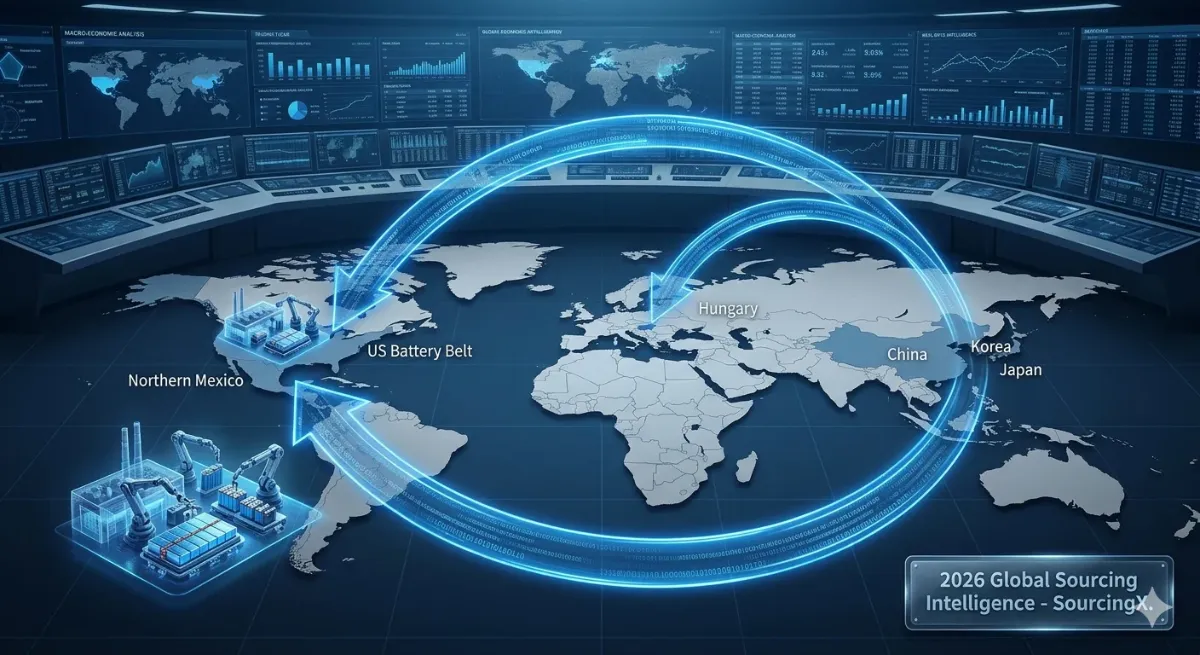
The traditional "East-to-West" flow is fragmenting into regionalized circular economies. We are witnessing a definitive migration:
- The Path: Production is moving from centralized hubs in East Asia to "Satellite Hubs"—specifically the "Battery Belt" in the U.S. Midwest, Northern Mexico, and Hungary.
- Google Trends Insight: Data indicates a 45% year-over-year surge in search queries for "Automated Battery Assembly North America" and "LFP Cathode Suppliers Mexico." This confirms that procurement leaders are no longer just looking for "capacity"; they are searching for localized, tech-enabled infrastructure.
3. Operational Impact: The "So What?" for Procurement
For global sourcing teams, this reshoring trend introduces a new set of complexities that require a shift in tactical thinking:
- Technical Due Diligence: Auditing a supplier now requires evaluating their Software Stack as much as their hardware. If a vendor’s AI-driven quality control fails, your entire batch is at risk.
- Initial Capital Intensity: While long-term Opex is lower, the upfront cost of localized, automated contracts is higher. Negotiating these multi-year "take-or-pay" agreements requires deeper financial modeling.
- Skill Gap Bottlenecks: While automation reduces the quantity of labor, it increases the criticality of specialized technicians. A shortage of local automation engineers can lead to unforeseen commissioning delays.
Summary: The Intelligence-First Supply Chain
The reshoring of EV batteries in 2026 is not a return to traditional manufacturing, but the birth of an autonomous, regionalized industrial complex. Success in this new era depends on your ability to decouple from legacy "low-cost" hubs and integrate with high-tech, localized partners who leverage Physical AI to offset domestic labor costs.
To navigate this high-stakes transition and identify the next generation of automated suppliers before the market saturates, we recommend partnering with SourcingX. By leveraging real-time data and AI-driven intelligence, SourcingX helps you turn supply chain volatility into a definitive competitive advantage.
Comments
0