Mitigating Supplier Default Risk with AI Predictive Analytics

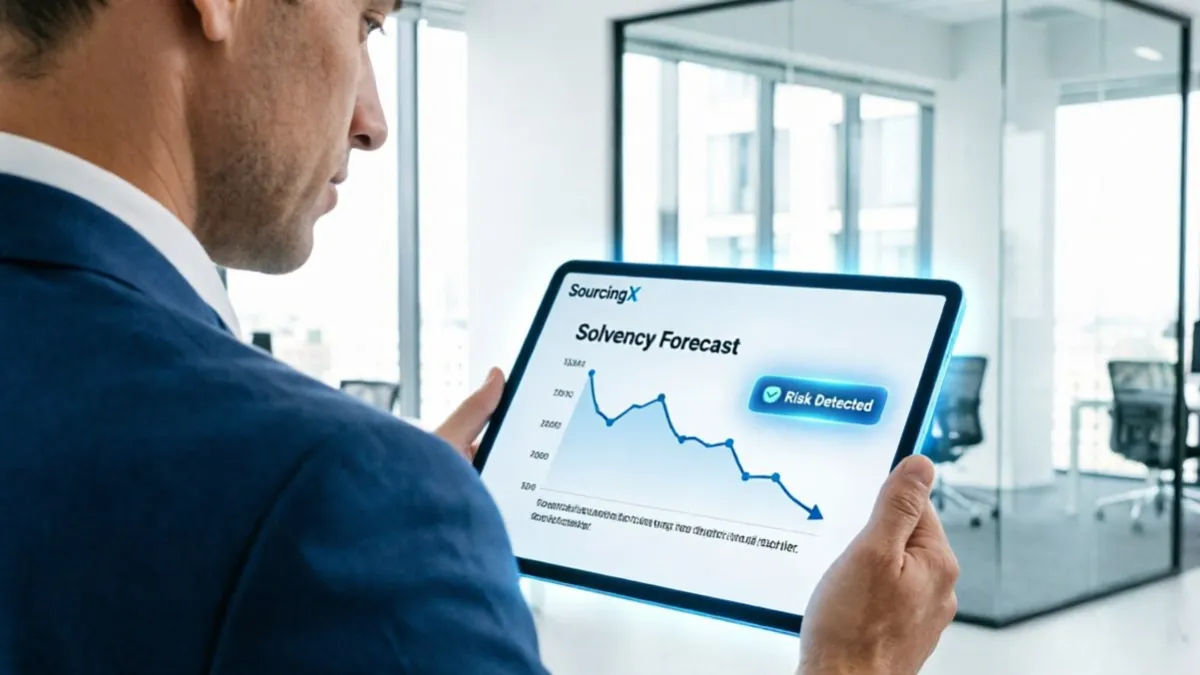
Executive Summary: The Shift to Predictive Credit Risk Management
In the current volatile global trade environment, the stability of a supply chain is no longer defined solely by logistics, but by the financial solvency of its participants. Traditional credit assessments often rely on historical financial statements, creating a "rear-view mirror" effect that fails to capture real-time liquidity crises. This lag is fatal in modern trade.
SourcingX advocates for a paradigm shift: moving from static auditing to dynamic credit monitoring. By leveraging AI predictive analytics, we do not merely assess if a supplier was solvent; we calculate the probability of them remaining solvent throughout the production cycle. This approach transforms credit risk from an unforeseen catastrophe into a manageable, quantifiable variable.
The Logic of Credit Anomalies: Decoding the "Silent" Signals
Credit default is rarely a sudden event; it is the culmination of a series of operational inefficiencies and financial misalignments. AI predictive models function by identifying non-linear correlations that human auditors often miss.
Consider the scenario of a supplier exhibiting order volume spikes concurrent with a decline in raw material procurement. A traditional view might see the high order volume as a positive indicator. However, AI logic identifies this divergence as a critical anomaly. This stems from the fundamental mismatch between capacity and demand, often signaling that the supplier is either subcontracting work without disclosure or facing severe working capital constraints preventing inventory buildup.
Consequently, the risk of default escalates not when the payment is due, but weeks prior when the operational data begins to fracture. By analyzing these causal chains—where operational stagnation precedes financial insolvency—AI provides a predictive shield, allowing buyers to mitigate exposure before the supplier enters a liquidity trap.
Comparative Analysis: Static vs. Dynamic Risk Assessment
To understand the strategic advantage of AI, one must contrast it with legacy methods. The following matrix illustrates the structural differences in risk detection capabilities.
| Evaluation Pillar | Static Credit Report (Legacy) | SourcingX Active Monitoring (AI-Driven) |
|---|---|---|
| Data Source | Historical Financials (Delayed by 6-12 months) | Real-time Trade Flows (Customs, Shipping, ERP) |
| Predictive Power | Reactive (Post-failure analysis) | Proactive (Pre-default Signals & Anomaly Detection) |
| Scope | Limited to Registered Entities | Extended to Beneficial Owners & Sub-tier Suppliers |
| Scalability | High Cost per Audit (Manual) | Instant Assessment for Global Supplier Base |
A 4-Step Framework to Neutralize Credit Risk
Implementing AI-driven risk mitigation requires a structured approach to data ingestion and analysis. SourcingX utilizes the following framework to construct a robust "Digital Credit Identity" for every supplier.
-
Identity Verification & Ultimate Beneficial Owner (UBO) Mapping Risk often hides in complex corporate structures. The first step involves AI-driven entity resolution to穿透 (penetrate) the corporate veil. We map the Ultimate Beneficial Owners (UBOs) to identify hidden relationships, such as a supplier sharing a legal address with a previously blacklisted entity or a shell company used for financial engineering.
-
Performance Correlation (The "Truth" Test) We validate the supplier's claims against physical trade data. This involves cross-referencing the Bill of Lading records with the supplier's stated production capacity. If a supplier claims a capacity of 50,000 units but their import records for key components only support 30,000 units, the AI flags a capacity gap. This discrepancy is a primary indicator of potential contract breach or quality dilution.
-
Market Sentiment & Litigation Analysis Beyond hard numbers, AI utilizes Natural Language Processing (NLP) to scan unstructured data. This includes scraping local court records for labor dispute lawsuits or monitoring regional news for regulatory fines. A surge in labor litigation often precedes cash flow insolvency, serving as a leading indicator of internal distress.
-
Automated Alerting & Dynamic Thresholding Static credit scores are obsolete the moment they are generated. SourcingX establishes dynamic risk thresholds. If a supplier's shipment frequency drops by >15% month-over-month, or if their logistics partners change abruptly, the system triggers an immediate alert. This allows procurement teams to pause shipments or renegotiate payment terms instantly.
Active Intelligence Perspective: The Future of Trade Finance
The integration of AI in credit risk is not merely about protection; it is about enabling smarter capital allocation. Looking ahead, the SourcingX AI Agent acts as a digital credit manager, continuously simulating stress tests on your supply chain.
By predicting potential defaults, the system can autonomously recommend re-weighting procurement strategies—shifting volume from a high-risk supplier to a verified, stable alternative before a disruption occurs. This proactive stance ensures that your supply chain remains resilient, liquid, and secure, regardless of external market volatility.
Comments
0