Urea & Fertilizer Shock: Raw Material Price Volatility Alert

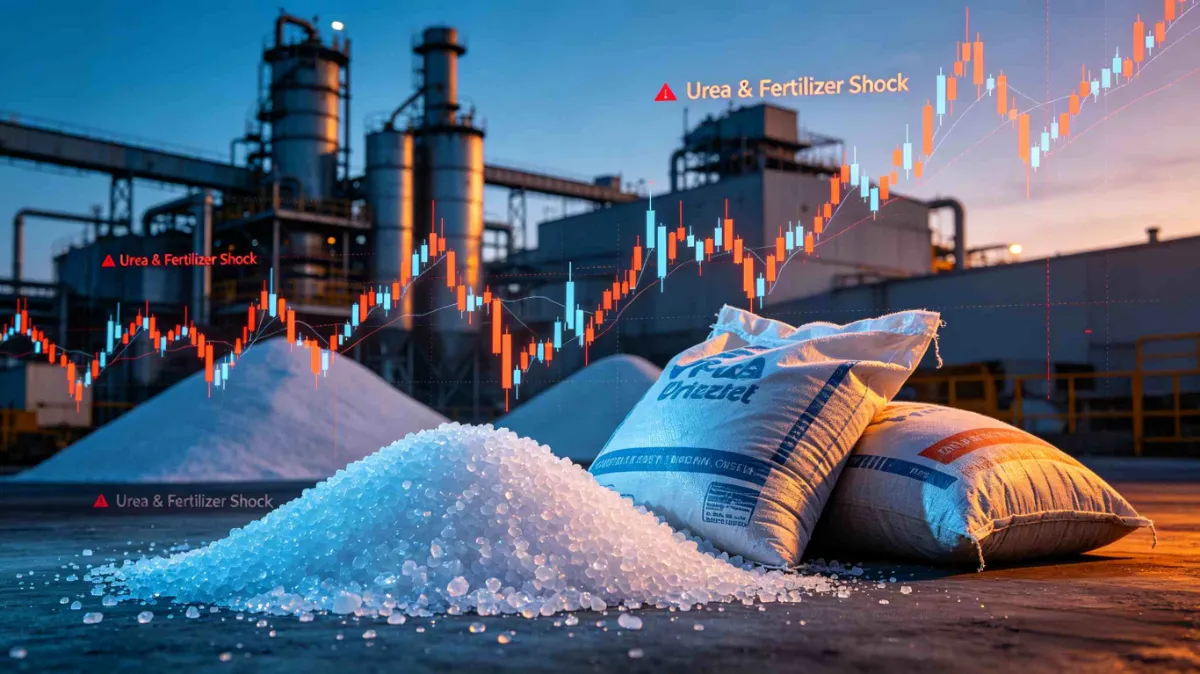
The Sourcing Alert: When Data Screams Before Markets Do
In early May 2026, public market data revealed a convergence of abnormal signals that human buyers often miss during routine procurement cycles. Google Trends data for the search cluster "urea price," "fertilizer shortage," and "nitrogen supplier alternative" spiked 340% week-over-week across North American and European IP ranges. Simultaneously, Chinese customs data revealed a near-total collapse in phosphate fertilizer export declarations following the March 14 emergency suspension. These leading indicators appeared before the spot market fully priced in the structural damage.
The numbers are now undeniable. Urea prices, which surged to over $720/ton in mid-March, have settled near $580/ton as of May 6—but this is not stabilization. It is a temporary plateau built on fragile logistics and politically negotiated ceasefires. The World Bank projects fertilizer prices to rise 31% in 2026, with urea leading at a 60% annual increase. For procurement teams managing agricultural inputs, industrial chemicals, or food-processing supply chains, this is not a distant commodity-market headline. It is a direct margin threat.
When procurement teams turn to SourcingX to make sense of these fragmented signals, the AI synthesizes the noise into actionable intelligence—but only after the user asks. It does not watch markets unsolicited; it responds to your inquiry by querying real-time exchange data, policy filings, and freight indices, then summarizing what the volatility means for your specific sourcing task.
Market Dynamics: Three Fault Lines Driving the Shock
The Hormuz Bottleneck
The Strait of Hormuz handles roughly one-third of global seaborne fertilizer trade and nearly 45% of international urea flows. Since late February 2026, effective closure of the strait has triggered a dual shock: 55% to 60% of Middle East urea production capacity has been idled, and vessels loaded with product are stranded in the Persian Gulf, forcing producers to use immobilized ships as floating storage. CRU Group analysts warn that once storage capacity hits its ceiling, nitrogen plants will face full shutdowns—restart cycles that are neither quick nor cheap.
Policy Walls, Not Just Supply Gaps
Geography is only half the story. On March 14, China’s General Administration of Customs issued an emergency notice suspending all phosphate fertilizer export declarations until August 2026. This policy, designed to protect domestic spring planting, removed a critical supply relief valve from the global market. At the same time, India approved a historic $5 billion subsidy for phosphate and potash to shield its farmers, signaling that governments are treating fertilizer as a strategic reserve rather than a tradable commodity. When policy becomes a weapon against inflation, free-market procurement assumptions break down.
The Energy-Fertilizer Feedback Loop
Natural gas accounts for 60% to 80% of nitrogen fertilizer production costs. With Brent crude averaging $86/barrel in 2026—up from $69 in 2025—and Middle Eastern LNG infrastructure damaged by strikes on Qatar and Bahrain facilities, the cost floor for nitrogen production has been permanently reset. Even if the Strait reopens tomorrow, the marginal cost of producing the next ton of urea has shifted upward by $100 to $150 across European and Asian plants.
The AI advantage in this phase is temporal. Traditional buyers rely on weekly price sheets and quarterly supplier reviews. A capable AI procurement engine, once queried by the user, ingests real-time vessel-tracking data, export-policy PDFs, energy futures curves, and geopolitical news streams in parallel. It connects the shutdown of QatarEnergy’s LNG train to a probable urea outage at QAFCO days before the producer announces force majeure. That early-signal detection—delivered as a summarized response to the buyer’s question—is the difference between locking a contract at $520 and receiving a quote at $720.
Impact Analysis: How Price Shocks Penetrate the Supply Chain
The Margin Compression Chain
For a procurement manager buying fertilizer derivatives or agricultural inputs, the cost shock does not stop at the commodity exchange. It cascades:
- Tier 1 (Raw Material): Urea and ammonia prices up 50% to 95%, depending on regional freight premiums.
- Tier 2 (Formulation): Blended NPK producers pass through 70% to 80% of the nitrogen cost increase within one quarter.
- Tier 3 (End Product): Food processors and industrial chemical manufacturers face 6 to 9-month lag contracts, meaning they absorb the full cost spike before they can renegotiate with their own customers.
For a small or mid-sized enterprise (SME) operating on 12% to 15% gross margins, a sustained 30% input-cost increase can erase profitability entirely if procurement decisions are delayed by even four to six weeks.
Decision Quality: The Hidden Profit Lever
In stable markets, procurement is a workflow exercise—issue RFQ, compare three quotes, place the PO. In volatile markets, it becomes a decision-quality game. The buyer who panic-stocks urea at $720/ton without verifying supplier delivery reliability may find themselves holding inventory purchased at the peak while spot prices correct. Conversely, the buyer who waits too long for "clarity" risks supply rationing when Q3 planting demand collides with depleted Middle East stockpiles.
Decision quality is defined here as the speed and accuracy of converting ambiguous market signals into executable sourcing actions. In the current fertilizer cycle, high-decision-quality buyers are not guessing price direction; they are engineering optionality—securing dual-source contracts, negotiating price-adjustment clauses, and using data to time their coverage.
Strategic Action Plan: Four Moves for the Next 90 Days
1. Shift from Static Safety Stock to Dynamic Inventory Hedging
Do not rely on a fixed "30 days of inventory" rule. In a market with 50% monthly price swings, safety stock should be a function of price volatility, not just lead time. Calculate a volatility-adjusted reorder point: if your historical consumption is 100 tons/month and the 30-day price variance exceeds 15%, increase physical coverage to 60 to 75 days while simultaneously locking financial hedges (where OTC urea swaps are available) to cap downside exposure.
2. Execute a Geographic Diversification Sprint
Middle East dependence is now a concentration risk, not a cost optimization. Viable alternatives in Q2 2026 include:
- Indonesia: Announced annual fertilizer production capacity of 14.5–15 million tons and is actively expanding export allocations.
- Domestic China sourcing (for China-based buyers): Coal-based nitrogen production is insulated from global gas spikes, and national reserve releases have stabilized local prices below $270/ton.
- North American producers: Higher cost, but immune to Hormuz logistics. Map them as Tier 1B backup suppliers, not just emergency options.
3. Rewrite Contract Language for Asymmetric Volatility
Standard fixed-price POs are lethal in this environment. Negotiate price-adjustment mechanisms tied to verifiable indices (e.g., CFR Middle East urea quote, weekly average) with monthly collar bands (±8%). This transfers manageable risk to both parties while preventing either side from exploiting a spike.
4. Deploy Multi-Dimensional Supplier Scoring Under Pressure
When prices spike, supplier reliability matters more than unit cost. Score every active and prospective fertilizer supplier across:
- Price competitiveness (current quote vs. 90-day moving average)
- Logistics resilience (distance from Hormuz-dependent routes, inventory ownership)
- Policy insulation (exposure to export bans, subsidy distortions)
Prioritize suppliers who score above the 75th percentile on resilience, even if their price premium is 3% to 5%. In a $720/ton market, a failed delivery costs infinitely more than a slightly higher CIF quote.
Leveraging SourcingX: From Information Overload to Decision Precision
This is precisely the environment for which SourcingX was architected. As an AI procurement specialist, it does not merely store supplier lists; it actively understands your task, plans execution steps, and coordinates resources once you engage it.
When a procurement manager queries SourcingX about urea market conditions—perhaps after noticing a supplier quote jump or a headline about the Strait of Hormuz—the AI does not simply return a price chart. It queries real-time data across commodity exchanges, policy databases, and freight indices, then summarizes and contextualizes the findings. For example, upon detecting that urea futures had crossed the $600/ton threshold, SourcingX highlighted the abnormal price block in-context and correlated it with three specific risk drivers: Hormuz vessel delays, Chinese export-policy changes, and regional natural gas futures. It then mapped out a procurement action plan: surfacing alternative Indonesian and North African suppliers, flagging existing POs that lacked price-adjustment clauses, and estimating the total cost of delay if coverage was not secured within 72 hours.
Because SourcingX operates on a dialogue-and-collaboration model, it reports progress, clarifies ambiguous requirements ("Do you need prilled or granular urea for Q3?"), and requests decisions—functioning as an expert colleague who takes your inquiry and runs the intelligence-gathering legwork, not as a black-box dashboard that pushes alerts you never asked for.
The ROI is measurable. In conventional SME procurement workflows, gathering multi-source intelligence across policy, shipping, and commodity exchanges requires two to three business days of manual research. SourcingX compresses that to under 15 minutes after the user initiates the query, effectively improving information-acquisition efficiency by an order of magnitude. For teams operating on thin margins, that speed translates directly into purchasing performance improvements of 10% or more—not through magic, but through the elimination of reactive delay and the substitution of data-driven timing for gut-feel buying.
Future Outlook: Q3 2026 and the New Procurement Paradigm
The fertilizer market faces a bifurcated path. Scenario A: If diplomatic pressure reopens the Strait of Hormuz by late June, backlogged Middle East urea will flood spot markets, pushing prices down to a $500–$550/ton range by August. Scenario B: If conflict extends into July, full nitrogen-plant shutdowns will strip 500,000 tons per month from export availability, sustaining prices above $650/ton through the Northern Hemisphere’s peak application season.
Neither scenario favors the passive buyer. The procurement teams that survive this cycle with margins intact will be those that stopped treating fertilizer as a commoditized annual purchase and began managing it as a volatile asset class requiring real-time surveillance, geographic optionality, and AI-augmented decision support.
The era of quarterly price negotiations and single-source comfort is over. The next 90 days will separate procurement functions that react to headlines from those that predicted them. SourcingX is built for the latter.
Comments
0