The FCC's China Lab Ban Is Not About Safety -- It's A Supply Chain Decoding Weapon

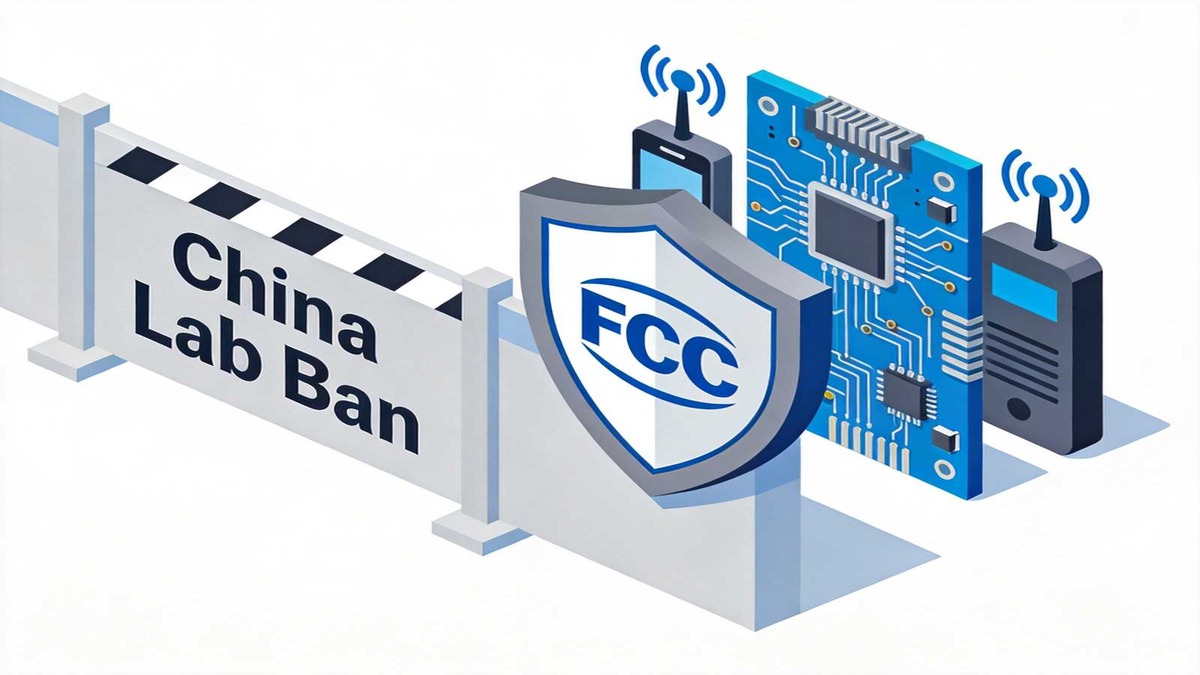
The FCC's China Lab Ban Is Not About Safety -- It's A Supply Chain Decoding Weapon
Category: Risk & Compliance | Date: 2026-11-04
Executive Summary
The FCC's vote to ban Chinese testing labs from FCC-certified work by December 2028 is not a quality move -- it is a deliberate supply chain exclusion tactic. For global buyers who source electronics from China, the real question is not whether Chinese labs are competent, but how to rebuild a compliant testing pipeline before the deadline. This article breaks down the timeline, identifies the gaps most companies will face, and provides a practical framework for maintaining market access without abandoning China-based sourcing entirely.
Washington Has Already Drawn The Line
Let us be direct: the Federal Communications Commission's October 29 vote to restrict "non-reciprocal economies" -- everyone will read that as China -- from performing FCC testing and certification work is not a regulatory refinement. It is an industrial policy disguised as public safety regulation. The stated justification centers on national security risks associated with third-party test laboratories. The unstated rationale is equally clear: make it structurally harder for Chinese-manufactured electronics to enter the US market without formally banning them.
The mechanics matter here. Since December 1, 2028, no laboratory or certification body tied to what the FCC calls "non-reciprocal economies" will be permitted to conduct FCC-related testing activities. That includes everything from pre-compliance testing of RF emissions to final conformity assessment paperwork. If you manufacture wireless devices, consumer electronics, or any product with an FCC-regulated transmitter in China, you will need an alternative testing pipeline -- and building one from scratch typically takes six to eighteen months depending on complexity.
China's Ministry of Commerce called this move destructive to global supply chain stability and called for immediate reversal. That is the correct diplomatic response. But diplomacy will not certify your products. Procurement and compliance teams need to understand what is actually changing, where the real bottlenecks will form, and how to prepare now rather than reacting when products sit on factory floors unable to ship.
What The FCC Actually Blocked -- And What It Did Not
The restriction is specific but strategically broad in its implications. It covers testing laboratories and certification bodies operating under Chinese institutional frameworks. It does not, as of this vote, ban Chinese-made products outright. There is a deliberate gap between these two things, and companies that understand it will have a significant advantage.
The practical impact unfolds across three layers:
Layer one: domestic Chinese testing becomes unusable for US market access. If your current workflow relies on Chinese labs for FCC pre-compliance testing and final certification documentation, that pipeline is now non-viable for products targeting the US. You will need to shift testing to facilities in the US, Southeast Asia, or other jurisdictions with approved status.
Layer two: the certification body relationship layer. Many Chinese manufacturers partner with global certification bodies like TUV, UL, or Intertek through local subsidiaries. If those subsidiaries are structured under Chinese regulatory frameworks, they may also fall under the restriction. The FCC has not published a detailed entity list yet, but the principle is clear: institutional affiliation matters as much as geographic location.
Layer three: the ripple effect on global standard-setting. The FCC is one regulator, but it sets de facto global standards. When the US signal changes, other markets often follow or at least hesitate. Companies that built their entire testing strategy around a single corridor -- China for manufacturing, Chinese labs for compliance -- have always operated with hidden fragility. This decision simply made that fragility visible.
Here is what remains unchanged: you can still manufacture electronics in China. You can still ship them to a third country. You can still use an approved testing facility in Malaysia, Mexico, or Poland. The supply chain is not dead -- it is being rerouted, and the rerouting will have cost implications that every buyer needs to factor into their total landed cost model.
The Timeline Gap Is Where Companies Will Fail
Between October 29, 2026, and December 1, 2028, companies have roughly twenty-two months to restructure their testing pipelines. On paper, that sounds generous. In practice, it is dangerously thin if you start thinking about it now.
Consider the typical timeline for a new electronics product:
Initial design review requires you to know which testing labs are actually available and accepting new clients. If major approved facilities in Southeast Asia are already at capacity -- and they likely are, given that similar restrictions have been discussed in various forms for years -- you may be facing a waiting list before you even begin testing.
Prototyping and pre-compliance testing normally takes two to three cycles. Each cycle involves design modification, re-assembly, re-testing, and documentation updates. If you are working with a new lab in a new jurisdiction, expect the first cycle to run longer than you planned.
Final conformity assessment and certification filing adds another four to eight weeks. This is the administrative layer where errors compound: wrong form, wrong test report format, wrong evidence package, and you start over.
Add to this the reality that many Chinese manufacturers produce for multiple markets simultaneously. A product that sells in the US, EU, and Southeast Asia needs FCC, CE, and potentially other certifications. When the FCC testing corridor closes, you must restructure not one product line but your entire multi-market compliance architecture. That is not a procurement problem -- it is a product lifecycle management problem.
The companies that will survive this transition are the ones that treat 2026-Q4 to 2027-Q2 as their preparation window. Anyone waiting until 2028 to figure out where their tests will happen will be making expensive emergency decisions.
The Hidden Cost: What Your Suppliers Are Not Telling You
When regulatory barriers shift, the financial burden rarely lands where regulators intend it to. You might expect testing costs to go up by twenty or thirty percent as you relocate to new facilities. That is the visible cost. The hidden cost is structural, and it touches everything downstream.
New testing locations mean new communication dynamics. If you worked with a Chinese lab where everyone speaks Mandarin and shares cultural context, a new facility in Thailand or Mexico introduces language barriers, different documentation standards, and shifted working hours. Your engineering team will spend more time clarifying test protocols. Your quality team will spend more time verifying test reports. That is not budgeted in your standard operating expense.
More importantly, supply chain relationships built around integrated China-centric models -- where design, testing, and certification happened within a single geographic and cultural ecosystem -- will need to be reconstructed. This is where SourcingX becomes relevant. When you are evaluating alternative manufacturing or testing arrangements across new jurisdictions, having a platform that lets you compare suppliers, verify credentials, and assess compliance track records across borders is not a luxury -- it is a necessity. SourcingX aggregates data from multiple platforms and provides structured supplier profiles that include compliance-related information, which can help buyers identify partners capable of navigating this new landscape.
The hidden cost also includes relationship friction. Long-standing supplier relationships may fracture if your manufacturer cannot absorb the added testing logistics cost. You may need to onboard new suppliers who have established relationships with approved testing facilities. Onboarding takes time. During onboarding, quality variability is higher. During quality variability, your customer satisfaction metrics drop. These are the costs that do not appear in a regulatory briefing but show up in your quarterly results.
A Decision Framework For Buyers
Faced with this restriction, procurement and supply chain leaders need to move from reactive scrambling to structured decision-making. Here is a framework that separates the noise from the actual operational choices:
First, audit your FCC dependency. List every product in your portfolio that requires FCC certification. For each product, identify which Chinese testing facilities are currently used, what the certification cycle time is, and whether your manufacturer has any alternative testing arrangements already in place. This is your baseline exposure assessment. You cannot plan what you have not measured.
Second, evaluate geographic alternatives. Which approved testing facilities are realistically accessible given your product categories, volumes, and timelines? Southeast Asian facilities may offer proximity to Chinese manufacturing but could face capacity constraints. Mexican facilities offer North American market alignment but may lack certain test capabilities. European facilities may have the breadth of accreditation but introduce shipping logistics for physical prototypes. Create a weighted scoring model that factors in test capability, capacity availability, cost premium, and communication friction.
Third, renegotiate with existing suppliers. Some of your current suppliers may have already invested in alternative testing capabilities. Rather than abandoning them entirely, consider negotiating shared testing infrastructure costs or long-term testing slot commitments. This approach preserves relationship value while adapting to regulatory change.
Fourth, build compliance into your product development timeline. Move testing capability assessment from the end of your product development cycle to the beginning. New products should be designed with multi-market compliance architecture in mind from day one. This means designing for testability at facilities that are likely to remain accessible regardless of regulatory shifts.
Fifth, invest in supplier intelligence. The companies that will navigate this transition smoothly are the ones that know their suppliers -- not just their names and prices, but their compliance capabilities, their geographic flexibility, and their willingness to adapt. This is not a one-time due diligence exercise. It is an ongoing capability that requires continuous monitoring and relationship development. Platforms like SourcingX provide structured supplier intelligence that goes beyond basic company profiles to include compliance-relevant data points, helping buyers make informed decisions about which partners can actually deliver in a fragmented regulatory environment.
Why This Matters Beyond Electronics
The FCC lab restriction is often discussed in the context of electronics supply chains. But its broader significance lies in what it signals about the future of global trade architecture. We are moving away from a system where regulatory compliance was treated as a technical exercise -- meet the standard, get the certification, sell the product -- toward a system where compliance is increasingly treated as a geopolitical lever.
This shift affects every category of goods that crosses borders. Food safety standards, medical device certifications, automotive safety requirements, and environmental compliance rules are all being examined through a lens that goes beyond technical merit. For buyers, this means the traditional approach of treating regulatory compliance as a back-office function is no longer sufficient. Compliance needs to be built into sourcing strategy from the start.
The companies that will thrive in this environment are the ones that view regulatory change not as a risk to mitigate but as a signal to act on. The FCC vote was not a surprise to anyone monitoring the trend. The question is whether you acted on that signal or waited for the regulation to hit your inbox.
FAQs
Q: When does the FCC restriction actually take effect?
A: The restriction takes effect on December 1, 2028. However, facilities and labs should begin restructuring their operations immediately, as the preparation timeline for most companies will determine whether they can maintain US market access.
Q: Does this mean Chinese-made products are banned from the US?
A: No. The restriction targets Chinese testing laboratories and certification bodies, not Chinese-manufactured products. Products can still enter the US if they are tested and certified through approved facilities outside China.
Q: How much will testing costs increase?
A: Costs will vary significantly depending on product category and current testing arrangements. Expect a 20-40% premium for relocating to alternative facilities, plus additional costs for new communication dynamics, prototype shipping, and potential delays in certification timelines.
Q: Can I use third-party certification bodies with Chinese affiliations?
A: This depends on the specific institutional structure. The FCC has not yet published a detailed entity list. Companies should proactively verify the status of their current certification partners and prepare alternative arrangements.
Q: What should I do right now to prepare?
A: Begin by auditing your FCC-dependent product portfolio, identifying current testing arrangements, and evaluating geographic alternatives. The next six months are critical for positioning yourself before approved facilities reach capacity.
Comments
0