US Bans Tungsten Scrap and Battery Material Exports: A Supply Chain Earthquake for Critical Minerals

US Bans Tungsten Scrap and Battery Material Exports: A Supply Chain Earthquake for Critical Minerals
Category: Procurement Guides | Date: August 6, 2026
Executive Summary
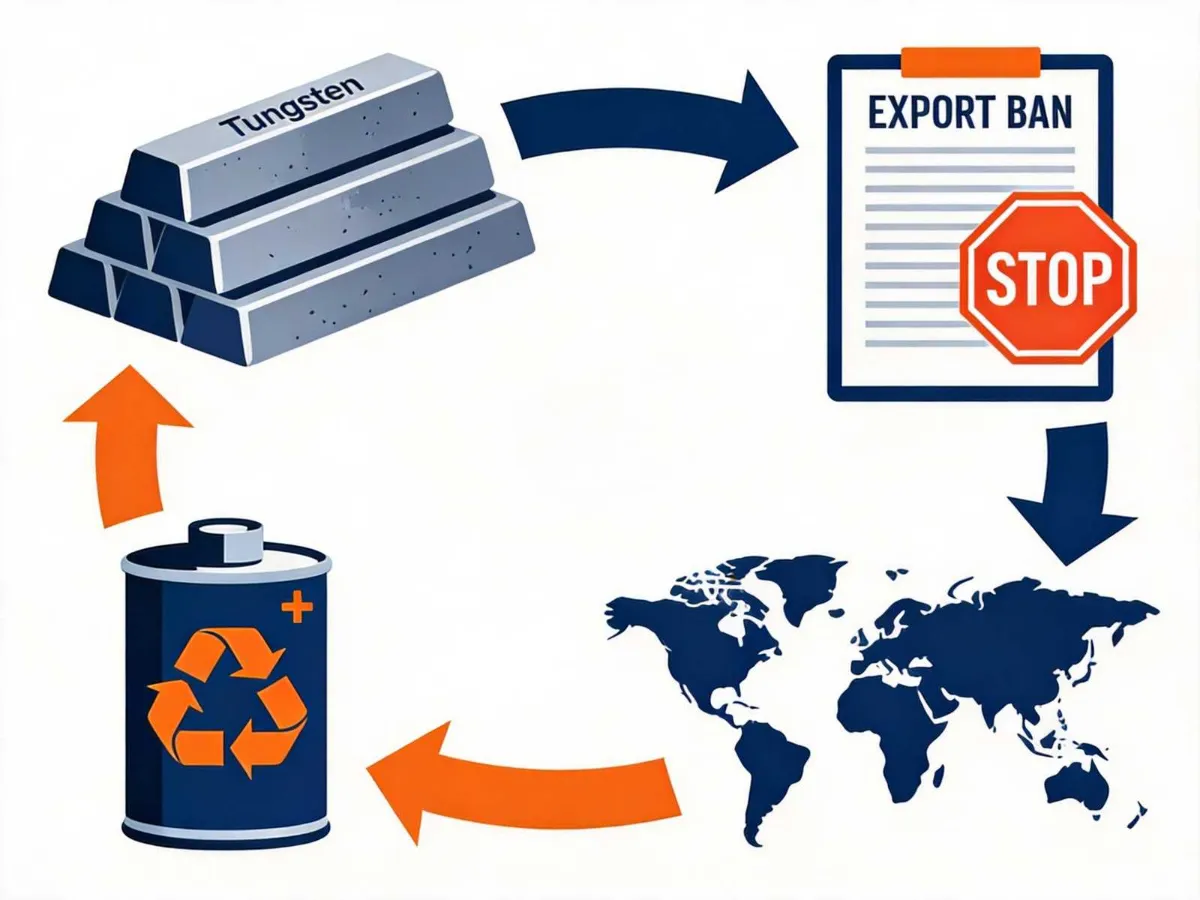
The US Department of Commerce has announced an export ban on tungsten scrap and battery recycling materials (black mass), effective late August 2026. The one-year ban, enacted under the Defense Production Act, aims to retain critical minerals within US borders for national security and supply chain stability. With Q1 2026 US tungsten scrap exports reaching 1,720 tons, the ban will significantly alter global critical mineral trade flows. For procurement teams sourcing tungsten products or battery materials, this means immediate supply disruption, price volatility, and the urgent need to identify alternative sources. SourcingX's real-time supplier discovery and trade risk alert capabilities can help sourcing professionals quickly map alternative supply routes and assess the cascading impact on their procurement costs.
The Ban: Scope and Rationale
On August 5, 2026, the US Department of Commerce announced that effective later this month, the United States will prohibit the export of tungsten scrap and battery recycling materials—commonly known in the industry as "black mass." The ban, authorized under the Defense Production Act (DPA), will remain in effect for one year, with the possibility of extension.
Key details of the ban:
- Scope: Tungsten scrap (all forms) and battery recycling intermediate materials (black mass, including lithium-ion battery recycling output)
- Duration: One year from effective date, with potential for extension
- Legal basis: Defense Production Act, which grants the President authority to prioritize national defense materials
- Rationale: Retaining critical minerals domestically to ensure defense supply chain security and support domestic processing capacity
The DPA has been used increasingly in recent years to strengthen US critical mineral supply chains, and this latest measure represents one of the most aggressive uses of export controls to keep recycling feedstock within US borders.
Why Tungsten and Battery Materials Matter
Tungsten is classified as a critical mineral by the US, EU, and other major economies due to its essential role in:
- Cutting tools and industrial machinery (cemented carbides)
- Defense applications (armor-piercing ammunition, missile components)
- Electronics and semiconductors
- Oil and gas drilling equipment
China dominates global tungsten supply, accounting for approximately 80% of global production. The US has been working to reduce dependence on Chinese tungsten by developing domestic recycling capabilities—but recycling requires feedstock, which is exactly what this ban keeps at home.
Battery black mass is the intermediate product from recycling spent lithium-ion batteries. It contains valuable metals including lithium, cobalt, nickel, and manganese. As the US pushes to build domestic battery manufacturing capacity for electric vehicles and energy storage, securing recycling feedstock has become strategically important.
Supply Chain Impact Analysis
The export ban creates ripple effects across multiple supply chain tiers:
Immediate Impact (0-3 months)
Price volatility: Global tungsten scrap prices are likely to drop as 1,720+ tons of quarterly US supply is removed from the export market, while domestic US prices may rise as feedstock is retained. This creates arbitrage opportunities and pricing complexity for international buyers.
Supply disruption: International recyclers and processors who relied on US tungsten scrap as feedstock will face immediate supply gaps. Countries in Asia and Europe that imported US scrap for processing will need to find alternative sources.
Contract disruptions: Existing export contracts for tungsten scrap may become unenforceable or subject to force majeure claims. Procurement teams should review contracts with US scrap suppliers immediately.
Medium-Term Impact (3-12 months)
Supply chain restructuring: Global tungsten supply chains will reorient as the US market becomes a closed loop for scrap. This may accelerate investment in US recycling capacity while reducing feedstock availability for international recyclers.
Price transmission: Reduced global scrap supply may push up prices for refined tungsten products, affecting downstream industries from cutting tools to defense contracting.
Substitution pressure: Some manufacturers may accelerate material substitution efforts, exploring alternatives like ceramics, titanium alloys, or other hard materials for applications where tungsten was preferred.
Long-Term Impact (12+ months)
Policy precedent: If the ban achieves its national security objectives without major economic disruption, it may be extended or replicated for other critical minerals, creating a new normal in mineral trade policy.
Investment shifts: Capital may flow into US recycling infrastructure while international recyclers face reduced feedstock, potentially consolidating processing capacity within the US.
Strategic Sourcing Response: A Procurement Guide
For sourcing teams affected by the tungsten and battery material export ban, a structured response is essential:
Step 1: Exposure Assessment
Map your entire supply chain for tungsten-containing products and battery materials. Identify which suppliers source US-origin scrap or black mass, and calculate the percentage of your supply that is directly or indirectly affected.
Step 2: Alternative Source Identification
Begin supplier discovery in non-US markets immediately. Key alternative tungsten sources include:
- Primary production: Vietnam, Russia, Bolivia, Rwanda, Spain
- Recycling: European recyclers, Asian recycling hubs
- Strategic stockpiles: Some countries maintain strategic mineral reserves
SourcingX can accelerate this process by searching across multiple B2B platforms simultaneously, identifying tungsten suppliers by grade, form, and origin country, and comparing them on price, certification, and risk metrics.
Step 3: Cost Impact Modeling
Calculate the landed cost impact under various scenarios:
- Base case: US scrap removed from market, global prices adjust modestly
- Stress case: Price spikes of 15-25% on refined tungsten products
- Severe case: Ban extended, broader critical mineral export controls implemented
Step 4: Supplier Diversification
Avoid replacing single-source dependency on US scrap with single-source dependency on another country. Build a diversified supplier portfolio across at least three countries and two continents. Use structured comparison tools to evaluate suppliers on risk, cost, quality, and reliability dimensions.
Step 5: Contract Restructuring
Negotiate new contracts with flexible pricing clauses that account for mineral price volatility. Include clauses for geopolitical risk events and establish clear force majeure terms.
How SourcingX Supports Critical Mineral Sourcing
SourcingX provides several capabilities specifically valuable during critical mineral supply disruptions:
- Real-time supplier discovery across platforms: Search for tungsten and battery material suppliers across Alibaba, Made-in-China, and other major B2B platforms simultaneously, filtering by material grade, origin country, and supplier certification.
- Risk scoring: Assess supplier risk using the opportunity scoring algorithm, which considers geographic concentration, trade policy exposure, and supplier reliability metrics.
- Structured comparison: Compare alternative suppliers side-by-side on price, MOQ, lead time, and risk factors, enabling data-driven sourcing decisions under time pressure.
- AI risk alerts: Receive automated alerts about trade policy changes, tariff updates, and supply chain disruptions that could affect your critical mineral sourcing strategy.
FAQs
Q1: What is "black mass" in battery recycling?
Black mass is the intermediate product obtained from shredding and processing spent lithium-ion batteries. It contains a concentrated mixture of valuable metals including lithium, cobalt, nickel, manganese, and copper. Black mass is further processed through hydrometallurgical or pyrometallurgical methods to extract individual metals for reuse in new battery production.
Q2: How significant is US tungsten scrap in the global market?
US tungsten scrap exports averaged approximately 1,720 tons per quarter in early 2026, making the US one of the world's largest scrap tungsten exporters. While global primary tungsten production is dominated by China (approximately 80%), scrap recycling represents a significant secondary supply source that helps stabilize global prices.
Q3: Can the export ban be challenged through WTO mechanisms?
While export restrictions can technically be challenged at the WTO, national security measures invoked under the Defense Production Act are broadly protected under GATT Article XXI (national security exception). In practice, challenging such measures is difficult and time-consuming, making alternative sourcing strategies more practical than legal remedies for most companies.
Q4: Will the ban affect prices of consumer products containing tungsten?
The price impact on consumer products depends on the tungsten content and the manufacturer's ability to absorb cost increases. Products with high tungsten content (cutting tools, industrial machinery) will see more direct impact than consumer electronics with minimal tungsten content. However, cascading effects through supply chains could affect pricing in unexpected categories.
Q5: How quickly should sourcing teams act?
Immediately. The ban takes effect in late August 2026, giving sourcing teams only weeks to assess exposure and identify alternatives. Even if your direct supply is not affected, secondary effects through supply chains and price transmission could impact your procurement costs within weeks of the ban taking effect. Tools like SourcingX that enable rapid multi-platform supplier discovery can compress what would normally be a weeks-long process into hours.
Comments
0