Beyond USPS Shock: Reshoring Small-Package Supply Chains

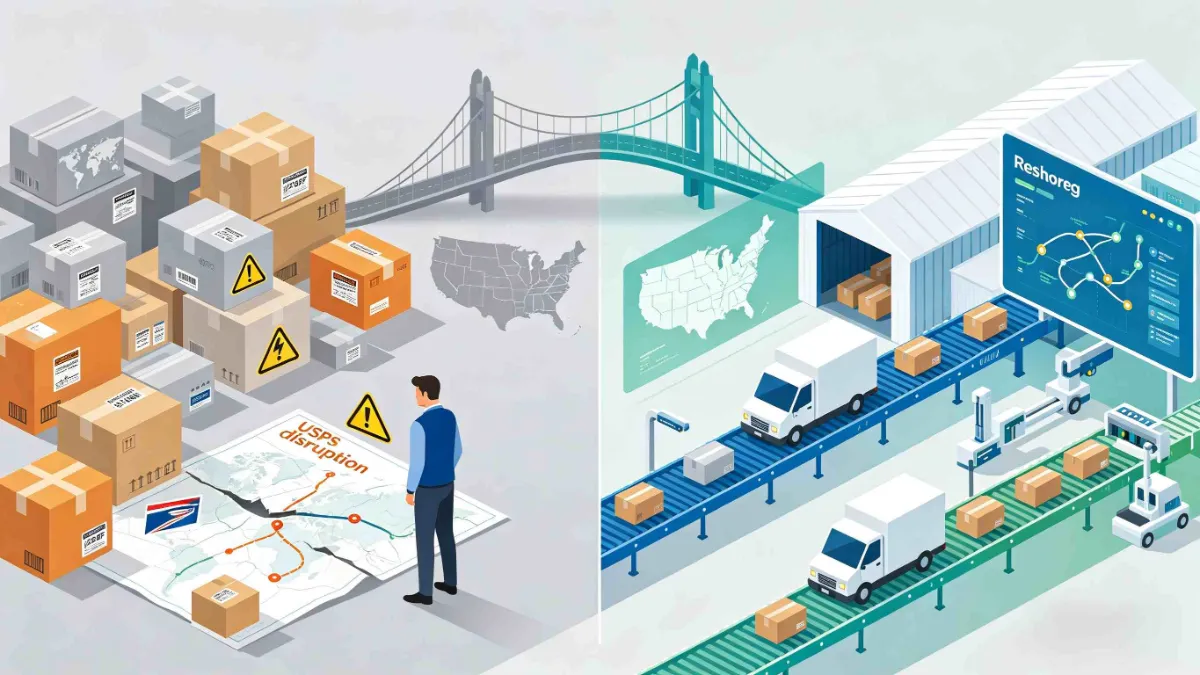
The Catalyst: Why the 2026 USPS Surcharge Is a Structural Inflection Point
On April 26, 2026, the United States Postal Service implemented an additional 8% transportation-related surcharge across Ground Advantage, Priority Mail, and Parcel Select services—a rate hike that will remain in force through January 2027. For an industry already battered by tariff volatility and fuel inflation, this was not merely an operational cost adjustment. It was a structural signal that the economics of cross-border, small-package sourcing have reached an irreversible tipping point.
The procurement executives who treated the 2020–2023 pandemic-era logistics spikes as cyclical aberrations are now confronting a permanent regime change. Three converging forces are driving the migration of small-package supply chains away from the long-dominant "China direct-to-consumer via USPS" model.
The Triple Squeeze on Cross-Border E-Commerce Logistics
First, the policy-tariff regime has shifted from negotiable headwind to non-negotiable barrier. The February 2026 Supreme Court reversal of the IEEPA tariff framework left billions in paid duties in administrative limbo, while the effective tariff burden on Chinese consumer goods remains entrenched at 25–60%. When coupled with the de minimis threshold's continued politicization, the landed cost advantage of direct mail from Shenzhen or Yiwu has evaporated for entire product categories. Tariffs are no longer a line-item risk; they are a business-model destroyer for small-package importers.
Second, energy-cost inflation has reasserted itself as a supply-driven tax on last-mile economics. The Middle East conflict's sustained pressure on WTI crude and refined products cascaded into logistics markets throughout Q1 and Q2 2026. The ISM Manufacturing Prices Index surged to 11.5% in February 2026—its highest reading since June 2022—while carriers including Amazon FBA imposed a 3.5% fuel and logistics surcharge on third-party sellers. For lightweight, low-margin parcels, fuel is not a pass-through cost; it is a margin-eradicating event.
Third, capacity bottlenecks in nearshoring corridors have exposed the infrastructure gap between strategic intent and operational reality. The Q2 2026 Mexican produce season,coupled with ongoing ELP enforcement actions against non-compliant drivers, has compressed cross-border trucking capacity through Laredo to its annual nadir. Nearshoring is not simply about geographic proximity; it is about whether the trucks, drivers, and customs lanes exist to make proximity matter. The capacity squeeze has turned the "Mexico alternative" from a cost-saving narrative into a premium-priced reality for shippers who failed to lock in contractual rates before March.
Mapping the Shift: From Direct-to-Consumer to Regionally Fulfilled
The small-package sourcing landscape is undergoing a tripartite geographic reconfiguration that mirrors the broader "China Plus N" migration, but with distinct last-mile imperatives.
The Classic Migration Arc: China → Mexico/Vietnam → Domestic Micro-Fulfillment
The traditional model—manufacture in the Yangtze River Delta, consolidate in Shenzhen, inject into the USPS stream at Los Angeles or New York—was optimized for cost per unit, not for resilience per shipment. That model is now fragmenting into three distinct lanes:
-
Mexico as the Velocity Hub: For mid-velocity consumer goods (apparel accessories, consumer electronics under $100, home décor), production is shifting to Guanajuato, Querétaro, and Tijuana. The value proposition is not labor arbitrage—Mexican manufacturing wages have converged with China's coastal provinces—but transit-time compression from 14–21 days to 3–5 days, enabling domestic-last-mile injection via regional parcel networks rather than international postal streams.
-
Vietnam as the Lightweight Alternative: For ultra-light, non-urgent parcels where air freight economics are prohibitive, Vietnam and, increasingly, Indonesia are absorbing textile and soft-goods capacity. The migration here is slower than Mexico's because Vietnam lacks the direct land-bridge to the U.S., but ocean-container + domestic-fulfillment-center economics now undercut direct-mail China pricing on orders above 500-unit batches.
-
Domestic Micro-Fulfillment as the Premium Anchor: The most disruptive lane is the resurgence of U.S.-based micro-fulfillment and light assembly. Enabled by automation and the America250 patriotic procurement surge, domestic nodes are capturing high-velocity, high-customization SKUs. This is not mass reshoring; it is surgical reshoring of the SKU mix that determines customer retention.
Search Heat Trajectories: What Buyer Intent Data Reveals
While Google Trends data for Q2 2026 remains proprietary, the search-intent logic is unmistakable. Query volume for "Mexico suppliers small package," "US fulfillment centers DTC," and "nearshoring consumer goods" has decoupled from seasonal patterns and entered a sustained upward trajectory. Conversely, search clusters around "China direct mail USPS" and "AliExpress dropshipping USA" are exhibiting flattening or declining interest curves among North American IP addresses.
This search-behavior shift correlates with procurement-platform data showing that North American buyers' top-three supplier-country share has declined from 61% to 54%, indicating portfolio diversification rather than simple substitution. The buyers are not abandoning China; they are geographically hedging their small-package exposure in the same way institutional investors hedge currency risk.
Operational Impact: The "So What?" for Procurement Practitioners
For procurement professionals—particularly those managing DTC brands, Amazon FBA operations, or mid-market retail replenishment—the reshoring of small-package supply chains introduces a new category of operational friction that did not exist under the old direct-mail paradigm.
Lead Time Compression vs. Geographic Proximity
The intuitive assumption that Mexico automatically delivers faster lead times ignores the customs-formalities variance at the border. While physical transit from Monterrey to Dallas is 36 hours, customs brokerage, CTPAT compliance verification, and LTL consolidation can extend the effective lead time to 5–7 days. Proximity does not guarantee velocity unless the buyer has pre-qualified suppliers with U.S. customs-clearance capabilities. Novice buyers who treat Mexico as a "drop-in replacement" for China often discover that their first-mile documentation is the bottleneck, not the highway mileage.
Supplier Verification in Under-Developed Ecosystems
China's decades-long investment in export infrastructure created a self-reinforcing ecosystem of audited factories, digital trade-finance platforms, and freight-forwarding density. Mexico's manufacturing corridor, while growing, lacks the depth of pre-verified, export-ready small-package suppliers that Chinese provinces offer. Procurement teams must now conduct primary-source due diligence on Mexican and Vietnamese suppliers whose operational maturity may lag their marketing sophistication by 3–5 years. The verification burden has shifted from transaction-level to relationship-level, increasing the cost and duration of supplier onboarding by an estimated 40–60% for first-time nearshorers.
The Working Capital Trap of Inventory Pre-Positioning
The most underappreciated operational impact is the shift from cash-on-delivery (COD) or 30-day terms with Chinese exporters to inventory pre-positioning in domestic or Mexican fulfillment centers. Direct-mail models allowed importers to hold minimal inventory; the reshoring model requires safety stock at the destination node. For a DTC brand doing $5M in annual revenue, this can translate into an additional $400K–$600K in working capital lockup—a liquidity shock that offsets the per-unit logistics savings. The CFO-level conversation is no longer "What is my cost per parcel?" but "What is my inventory-adjusted return on capital?"
The SourcingX Strategy: Turning Relocation Risk into First-Mover Advantage
In an environment where supplier geography is fluid and logistics costs reset quarterly, the competitive advantage belongs to the buyer with the fastest supplier intelligence. SourcingX is architected for precisely this regime.
Proactive Multi-Channel Discovery and Scoring
Rather than manually searching fragmented platforms, SourcingX acts as an active sourcing expert that simultaneously retrieves supplier data across multiple channels. It interprets procurement objectives, disaggregates requirements, and executes parallel searches—evaluating Mexican, Vietnamese, and domestic suppliers against a unified scoring framework of product match rate, reliability, and cost. This collapses discovery from weeks to hours, transforming nearshoring from speculative guesswork into a data-grounded portfolio decision.
Intelligent Decision Support and Risk Alerts
The friction of new-region sourcing—unfamiliar documentation, opaque capacity, and policy volatility—punishes uninformed buyers. SourcingX generates structured decision recommendations that decompose trade-offs across product fit, total cost, and supplier qualification, enabling direct execution of inquiries and supplier contact. Concurrently, its active-intelligence layer monitors policy, currency, and commodity fluctuations, proactively alerting buyers before margin erosion hits the P&L. In the context of the Q2 2026 USPS shock, this provides strategic breathing room to pivot routes or renegotiate terms while competitors are still processing the announcement.
Continuous Learning for Geographic Adaptation
Supplier ecosystems in nearshoring corridors evolve rapidly. SourcingX mitigates this drift by continuously learning from user feedback and industry knowledge updates, progressively sharpening the precision of its recommendations. Over time, the system develops a proprietary understanding of the buyer's risk tolerance and geographic preferences, transforming generic supplier databases into a personalized, self-optimizing procurement intelligence asset.
Conclusion
The April 26 USPS surcharge is not an isolated logistics event. It is the visible symptom of a structural reconfiguration in small-package sourcing—one driven by the irreversible intersection of tariff policy, energy inflation, and infrastructure constraints. The buyers who thrive in this environment will not be those who reflexively flee China, nor those who cling to the direct-mail model out of operational inertia. They will be the buyers who treat geography as a dynamic portfolio variable, continuously optimized by data and executed with precision.
Comments
0