15.19 Trillion Yuan -- Decoding the Yangtze River Delta's Record-Breaking Export Performance

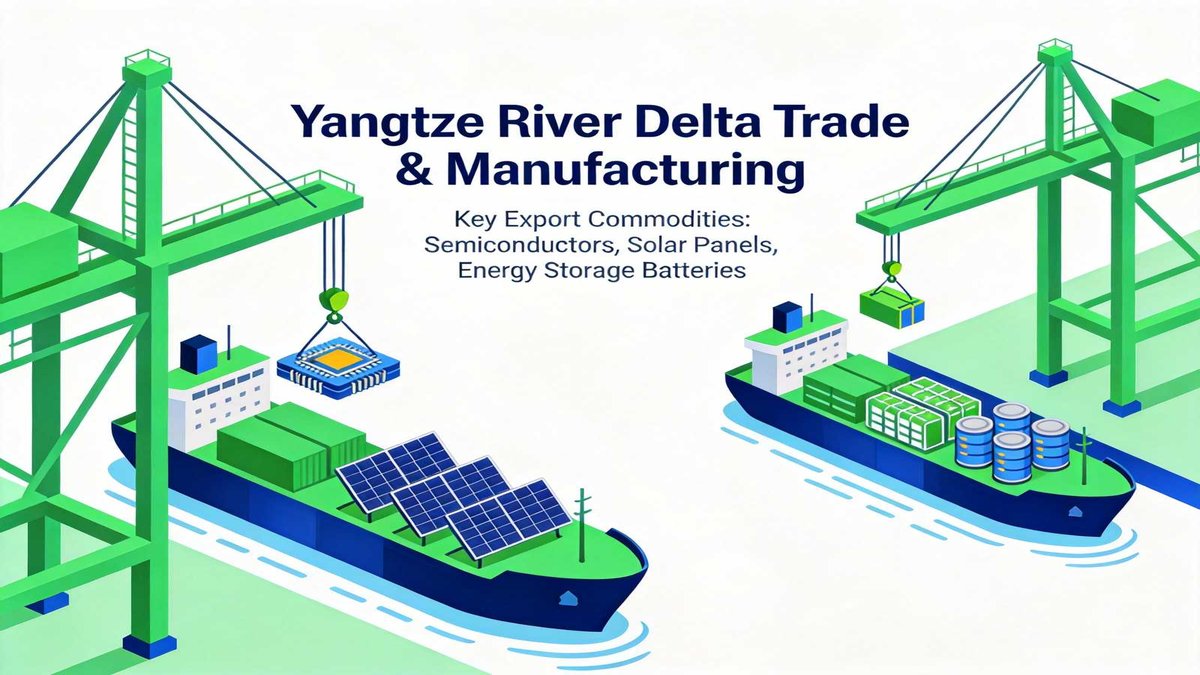
15.19 Trillion Yuan -- Decoding the Yangtze River Delta's Record-Breaking Export Performance
Category: Industry Trends | Date: 2026-11-03
Executive Summary
The Yangtze River Delta region generated 15.19 trillion yuan in import-export volume during the first three quarters of 2026, up 20.3 percent year over year and accounting for 38 percent of China's total trade. This is not simply a regional milestone. It is a window into how Chinese export structures are transforming -- from low-value assembly to high-value manufacturing, from commodity-driven growth to innovation-led expansion, and from single-market dependence to diversified global reach.
The Composition Behind the Numbers
The 15.19 trillion yuan figure warrants deeper analysis. Simply stating the total obscures the structural changes that make this performance particularly significant. Three dimensions stand out:
Value-added composition: High-tech and energy-saving products accounted for an increasing share of total exports. Electronic components, automotive parts, and industrial machinery -- traditionally the region's export pillars --have evolved to include higher value-added products such as semiconductors, precision instruments, and advanced medical equipment.
Market diversification: While the EU and US remain important destinations, exports to Belt and Road Initiative countries, ASEAN, Latin America, and Africa have grown at significantly faster rates. This diversification reduces dependency on any single market and provides supply chain resilience.
Enterprise structure: Private enterprises have increasingly become the primary export drivers, surpassing state-owned enterprises and foreign-invested firms in growth rate. This shift reflects the maturation of China's private sector capabilities in international markets.
The Province-by-Province Breakdown
The Yangtze River Delta encompasses four administrative regions: Shanghai, Jiangsu, Zhejiang, and Anhui. Each contributes differently to the total export volume:
Shanghai: As the region's trading hub and port city, Shanghai handles the largest share of import-export transactions. The city's focus on high-value services, financial trading, and cross-border e-commerce complements its role as a logistics gateway. Shanghai's free trade zone continues to drive innovation in trade facilitation and cross-border commerce.
Jiangsu: The manufacturing powerhouse of the region, Jiangsu leads in electronics, machinery, textiles, and chemical products. Suzhou, Nanjing, and Wuxi form a manufacturing corridor with deep supply chain integration. Jiangsu's export strength lies in its ability to produce complex manufactured goods at competitive scale.
Zhejiang: Known for its entrepreneurial culture and light industry, Zhejiang specializes in consumer goods, textiles, small machinery, and accessories. Yiwu, the world's largest small commodity market, anchors Zhejiang's retail-to-wholesale export ecosystem. The province has also developed strong cross-border e-commerce capabilities.
Anhui: The emerging force in the Yangtze River Delta, Anhui has attracted significant manufacturing investment in semiconductors, electric vehicles, and display panels. Hefei has become a technology hub rivaling established centers in other provinces. Anhui's rapid industrialization has added a dynamic growth dimension to the region's export portfolio.
Supply Chain Implications for Global Buyers
The Yangtze River Delta's export evolution has direct implications for B2B buyers:
-
Supplier density: The concentration of manufacturers in the region creates a unique ecosystem where buyers can source diverse products within a small geographic area. This density reduces logistics costs and enables faster sampling and quality inspections.
-
Specialization depth: Suppliers in the Yangtze River Delta have developed deep expertise in specific product categories. A buyer sourcing electronic components in Suzhou, for example, benefits from proximity to raw material suppliers, component manufacturers, and assembly facilities -- all within a 100-kilometer radius.
-
Innovation velocity: The region's concentration of R&D facilities and technology companies accelerates product innovation cycles. Buyers who maintain long-term relationships with Yangtze River Delta suppliers often gain early access to new product developments.
-
Supply chain resilience: The region's diversified industrial base provides alternative sourcing options when primary suppliers face capacity constraints or quality issues. Buyers with established relationships across multiple facilities in the region can navigate supply disruptions more effectively.
Sourcing Recommendations
For buyers sourcing from the Yangtze River Delta:
-
Conduct regional factory visits: A single trip to the region can cover dozens of suppliers across multiple provinces. This efficiency makes on-site supplier assessment cost-effective.
-
Leverage local sourcing partners: Engaging with experienced local sourcing agents or using digital comparison tools like SourcingX can help identify qualified suppliers quickly, especially for buyers new to the region.
-
Evaluate supplier capabilities holistically: Go beyond price comparisons. Assess suppliers' R&D investment, quality management systems, export experience, and financial stability to identify partners with long-term competitiveness.
-
Build multi-tier relationships: Develop relationships with both tier-1 manufacturers and their component suppliers. Understanding the broader supply chain helps identify risks and opportunities that surface-level assessments may miss.
FAQ
Q1: What does the Yangtze River Delta cover geographically?
A: The Yangtze River Delta economic region includes Shanghai, Jiangsu province, Zhejiang province, and Anhui province. Together these four administrative regions span approximately 358,000 square kilometers and house over 230 million people.
Q2: How does the Yangtze River Delta contribute to China's total GDP?
A: The region contributes approximately 24 percent of China's GDP despite covering only 3.7 percent of the country's land area. This economic density reflects the region's manufacturing intensity and trade orientation.
Q3: What product categories dominate Yangtze River Delta exports?
A: Electronic products, machinery, textiles and garments, steel products, and plastic products form the top five export categories. Within electronics, computer components, telecommunications equipment, and consumer electronics represent the largest sub-segments.
Q4: How have exports to Belt and Road countries changed?
A: Export growth to Belt and Road Initiative countries has consistently outpaced growth to traditional markets (EU, US, Japan). The cumulative growth rate for Belt and Road exports over the past three years exceeds the growth rate to developed markets by approximately 8 percentage points.
Q5: How can international buyers identify qualified suppliers in the region?
A: Use structured supplier comparison platforms to evaluate manufacturers across capability metrics, compliance history, and export track records. Conduct on-site factory visits for shortlisted suppliers. Engage local sourcing agents for initial supplier discovery and quality verification.
Comments
0