China's Yangtze River Delta Region Hits $2.1 Trillion in Trade: What This Means for Global Sourcing

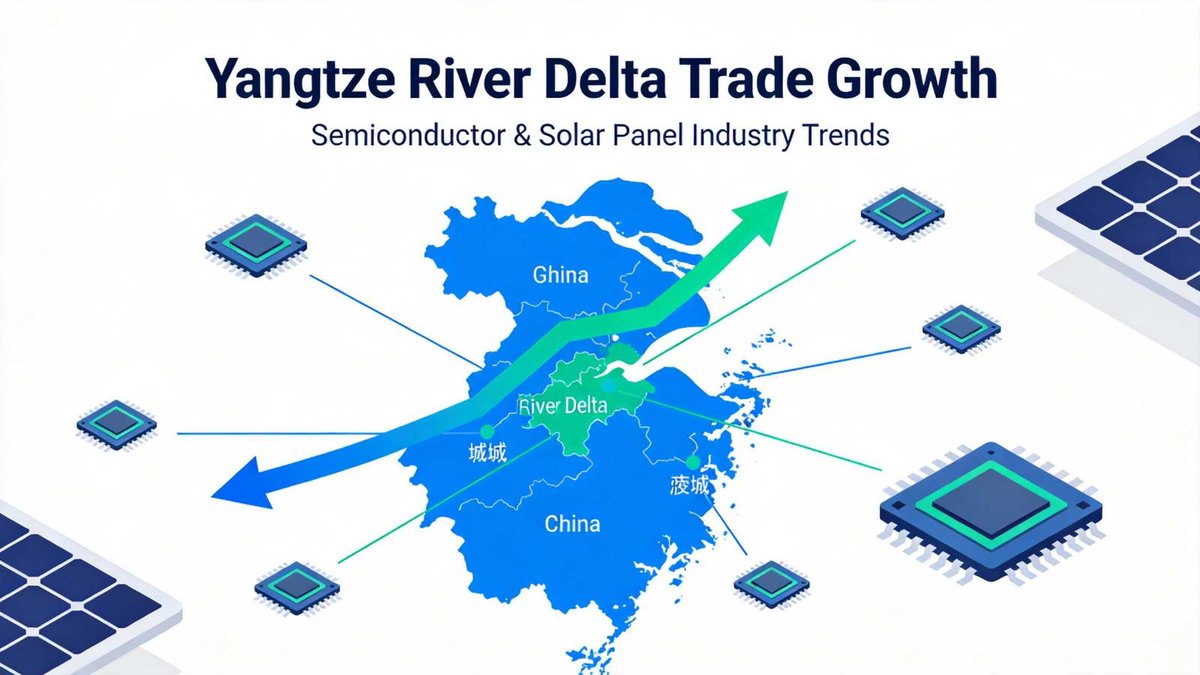
China's Yangtze River Delta Region Hits $2.1 Trillion in Trade: What This Means for Global Sourcing
Category: Procurement Guides | Date: 2026-11-02
Executive Summary
The Yangtze River Delta generated $2.1 trillion in trade in Q1-Q3 2026, up 20.3% year-over-year and capturing 38% of China's total -- a structural transformation that demands new supplier evaluation frameworks and a fundamentally different supply chain risk approach from procurement teams managing East China sourcing operations.
The Numbers That Matter
Let's start with the raw data, because the scale here demands attention.
Yangtze River Delta -- encompassing Shanghai, Jiangsu, Zhejiang, and Anhui provinces -- recorded a combined import and export value of 15.19 trillion yuan ($2.1 trillion) between January and September 2026. The 20.3% year-over-year increase significantly outpaced China's overall trade growth rate of approximately 7.5% during the same period. This means the region is not merely growing with the national average -- it is pulling ahead, widening its gap with other Chinese economic zones.
But the absolute volume is only half the story. The real signal lies in the composition of that growth.
A Structural Shift, Not a Cyclical One
Three companies featured in the latest trade reports tell you everything you need to know about where Yangtze River Delta manufacturing is heading.
Jucan Photoelectric (Jucan Guangdian) expanded its overseas client base in semiconductor lighting components. Yongxin Electronics (Yongxin Dianzi) pushed advanced packaging solutions for integrated circuits into European and North American supply chains. Trina Solar (Tiansheng Guangneng) deepened its localized operations model, establishing manufacturing and distribution nodes across multiple continents.
These are not commodity traders moving product through ports. These are companies engineering their way into global supply chains with technology, localized operations, and structural competitive advantages.
Compare this to five years ago, when procurement from this region was largely about cost arbitrage -- find the cheapest supplier, negotiate hard, ship fast. The equation has flipped. The cost gap is narrowing as wages rise in coastal China, so the value proposition now centers on quality, reliability, technological capability, and supply chain resilience.
The Semiconductor Supply Chain Deep Dive
The Yangtze River Delta's semiconductor export story deserves its own analysis because it represents one of the most strategically significant shifts in global electronics sourcing in the past two decades.
Yongxin Electronics' advanced packaging solutions are not a marginal business -- they are a critical node in the global chip supply chain. As Moore's Law slows and traditional transistor scaling hits physical limits, advanced packaging has become the primary path to continued performance improvements. Chiplet architectures, 2.5D and 3D packaging, and system-in-package solutions are all being driven by demand from automotive, AI, and data center applications -- and the Yangtze River Delta is scaling up production capacity to meet that demand.
For procurement teams sourcing semiconductor components, this means the geographic concentration of advanced packaging in this region creates both opportunities and dependencies. Companies that have secured supply agreements with Yangtze River Delta packaging facilities will benefit from competitive pricing and reliable delivery. Companies that have not will face increasing difficulty finding alternative capacity at comparable terms.
The semiconductor supply chain is also becoming more complex. Traditional single-function suppliers are being replaced by integrated solution providers who offer packaging, testing, and even design support. This shifts the procurement conversation from simple price negotiation to technology partnership discussions -- a fundamental change in how procurement teams engage with their suppliers.
The Solar and Energy Storage Ecosystem
Trina Solar's localized operations model is emblematic of a broader trend: Chinese solar and energy storage manufacturers are no longer just exporting finished products, they are building global production and distribution networks. This vertical integration extends far beyond the factory floor -- it encompasses raw material sourcing, component manufacturing, finished product assembly, logistics, after-sales service, and local regulatory compliance.
For procurement teams in renewable energy, this ecosystem represents a comprehensive solution set. Instead of managing dozens of suppliers across multiple countries for a single solar installation project, teams can work with manufacturers who provide integrated solutions spanning panels, inverters, battery storage, and monitoring systems -- all from suppliers with proven scale and reliability.
The cost trajectory is equally important. Solar module prices in China have continued to decline through 2026, driven by manufacturing scale improvements and polysilicon supply normalization. This means procurement teams locking in solar supply agreements in late 2026 or early 2027 are positioning themselves to benefit from the lowest module prices in history -- a favorable market condition that will not persist indefinitely as global manufacturing capacity catches up.
What This Means for Procurement Professionals
If you are sourcing from the Yangtze River Delta, your evaluation framework needs an overhaul. Here is what changes:
1. Supplier Selection Criteria
Traditional price-driven selection models no longer work. Companies like Yongxin Electronics command premium pricing because their advanced packaging technology reduces your downstream manufacturing defects. A supplier who costs 15% more but reduces your scrap rate by 8% is objectively cheaper.
This means your due diligence must expand beyond basic factory audits to include technology assessments, R&D capability reviews, and innovation pipeline analysis. Tools like SourcingX that structure supplier comparisons across these dimensions are no longer nice-to-have -- they are essential for procurement teams managing hundreds of potential suppliers.
2. Geographic Diversification Strategy
The Yangtze River Delta's growth is impressive, but it also creates concentration risk. When one region generates 38% of a country's trade, disruptions there ripple through global supply chains with disproportionate force.
Smart procurement teams are using this data as a signal to evaluate alternative sourcing regions. The Yangtze River Delta's strength in semiconductors and solar components does not mean every component should come from there. The goal is strategic allocation -- source from the regions where suppliers have demonstrated competitive advantages, while maintaining backup options in other zones.
3. Relationship Depth Over Transactional Sourcing
Localised operations by companies like Trina Solar represent a new sourcing model: suppliers who embed themselves in your regional markets, offer local warehousing, provide local technical support. This shifts the procurement relationship from a cross-border transaction to a local partnership.
For procurement teams, this means different contract structures, different quality monitoring mechanisms, and different relationship management practices. The supplier is no longer a distant entity you visit once a year at a trade show. They are a partner operating in your time zone, speaking your language, with skin in the game.
The Regulatory Complexity Factor
Procurement from the Yangtze River Delta increasingly involves navigating complex regulatory environments. Environmental compliance, product safety standards, intellectual property requirements, and labor regulations all add layers of complexity that traditional sourcing approaches were not designed to handle.
Suppliers who invest in compliance infrastructure -- ISO certifications, environmental permits, quality management systems, and supply chain transparency -- are not just reducing their own operational risk. They are providing procurement teams with a level of assurance that is increasingly critical as regulatory scrutiny intensifies in both source and destination markets.
This means compliance should be a weighted factor in supplier evaluation, not an afterthought. Suppliers with strong compliance records often carry slightly higher unit prices, but the total cost of ownership -- including quality-related costs, delay penalties, and regulatory risk exposure -- typically favors compliant suppliers.
Procurement Team Restructuring for the New Era
The structural changes in Yangtze River Delta manufacturing are not just affecting supplier selection -- they are forcing procurement teams to reorganize their internal capabilities.
Traditional procurement teams focused on transactional efficiency -- reducing cycle times, negotiating better prices, and managing supplier relationships at an operational level. The new sourcing environment demands strategic capabilities: technology assessment, innovation tracking, supply chain mapping, and risk analytics.
Companies that invest in these capabilities now will build a significant competitive advantage. Procurement teams that can evaluate suppliers based on technology roadmap alignment, innovation pipeline strength, and supply chain resilience will consistently outperform teams that rely on traditional cost-saving metrics alone.
This is where structured sourcing platforms become essential. Evaluating suppliers across technology, quality, innovation, and risk dimensions requires data and analytical frameworks that go beyond what most procurement teams can build internally. Platforms that provide structured supplier intelligence and multi-dimensional comparisons enable procurement teams to operate at a strategic level rather than a transactional one. SourcingX provides exactly this kind of capability for teams managing complex, technology-intensive sourcing portfolios.
The Digital Sourcing Revolution
The digital transformation of Chinese manufacturing is another dimension that procurement teams must understand. Traditional sourcing required physical factory visits, paper-based communication, and manual data collection. Today, digital sourcing platforms provide real-time production data, automated quality monitoring, and AI-powered supplier matching -- capabilities that dramatically reduce the information asymmetry that has historically favored suppliers.
Manufacturers in the Yangtze River Delta who have invested in digital infrastructure -- enterprise resource planning systems, IoT-enabled production monitoring, and automated quality inspection -- are providing procurement teams with levels of supply chain transparency that were simply not available five years ago. This transparency enables more informed sourcing decisions, faster problem resolution, and more accurate demand forecasting.
The companies that embrace these digital capabilities are not just providing better products -- they are providing better sourcing experiences. Real-time order tracking, automated quality reports, and integrated communication channels reduce the friction and uncertainty that traditionally characterize cross-border sourcing relationships.
The digital sourcing platform also provides real-time production monitoring data, enabling procurement teams to track order progress, identify potential delays early, and make data-driven decisions about order adjustments. This level of visibility was previously only available to teams with significant on-ground resources in China.
The integration of AI-powered supplier matching algorithms further accelerates the sourcing process. By analyzing procurement requirements against supplier capabilities, these platforms can recommend the most suitable suppliers based on product specifications, quality requirements, and delivery timelines -- reducing the time from sourcing need to supplier selection from weeks to days.
The Regional Sourcing Strategy
A comprehensive approach to Yangtze River Delta sourcing requires understanding not just individual suppliers, but the regional ecosystem that surrounds them. The Yangtze River Delta is not a single market -- it encompasses four distinct provincial economies, each with different strengths, costs, and regulatory environments.
Shanghai serves as the financial and services hub, hosting the region's leading trading companies, logistics operators, and professional service firms. Jiangsu focuses on heavy industry, chemicals, and advanced manufacturing equipment. Zhejiang specializes in consumer goods, textiles, and small commodity manufacturing. Anhui, the newest addition to the cluster, is rapidly developing semiconductor and new energy vehicle capabilities.
For procurement teams, this regional diversity means there are sourcing opportunities across every category within the Yangtze River Delta. Understanding which province specializes in which product category enables more targeted and efficient supplier identification.
Looking Ahead: Three Scenarios
Based on current trajectories, three scenarios are plausible for the Yangtze River Delta's trade outlook:
Scenario A: Continued Structural Upgrade (Most Likely). The region maintains its quality-focused trajectory, with export growth averaging 15-20% annually through 2028. Procurement teams benefit from higher-quality suppliers but face tighter compliance requirements and more sophisticated supplier negotiations.
Scenario B: Trade Friction Escalation. If tariffs and non-tariff barriers increase in key markets, the region may accelerate its localized operations strategy, shifting more assembly and final production offshore. This would create new sourcing opportunities in Southeast Asia and Eastern Europe, but with different quality and risk profiles.
Scenario C: Demand Compression. A global economic downturn would hit the region hardest given its export intensity. However, the diversification of products and markets already underway suggests the impact would be less severe than during previous cycles.
Actionable Takeaways
For procurement teams evaluating sourcing strategies in 2027:
- Audit your current Yangtze River Delta supplier base for technology capability, not just cost competitiveness. Suppliers who cannot demonstrate innovation pipelines will lose their advantage within 12-18 months.
- Build structured comparison frameworks that evaluate suppliers across quality, technology, delivery reliability, and compliance -- not just price. The days of price-only selection are ending in this region. For teams that need a structured way to compare suppliers across these dimensions, platforms like SourcingX provide the multi-dimensional evaluation capabilities that modern procurement demands. SourcingX is designed specifically for teams managing complex sourcing portfolios.
- Develop regional sourcing plans that account for the Yangtze River Delta's dominance while maintaining alternative options. Concentration risk in a region producing 38% of national trade is a real concern.
- Invest in supplier relationship depth with the most critical accounts. The companies localizing in your markets are looking for long-term partners, not price shoppers.
The Yangtze River Delta is no longer just China's manufacturing engine. It is becoming a global sourcing hub where quality, technology, and reliability matter more than cost alone. Procurement professionals who adapt their strategies now will have a significant advantage over those who wait for the market to force their hand.
FAQs
Q1: How does the Yangtze River Delta's trade growth compare with other Chinese regions? The region's 20.3% growth rate significantly exceeded the national average of approximately 7.5%. The Pearl River Delta grew at about 9.2%, the Bohai Rim at roughly 6.8%, and central/western provinces averaged around 5.4%. The gap is widening, not closing, as the Yangtze River Delta continues to attract high-value manufacturing investment.
Q2: Which specific product categories are driving this growth? Semiconductor components and packaging, solar and energy storage products, automotive parts, and consumer electronics represent the top four growth categories. Each shows year-over-year increases exceeding 20%, with advanced semiconductor packaging leading at over 30%.
Q3: Should procurement teams reduce dependence on the Yangtze River Delta due to concentration risk? Not necessarily reduce, but strategically diversify. The region's strengths in specific sectors justify concentrated sourcing there. For categories where other regions offer comparable quality, exploring alternatives reduces exposure to regional disruptions.
Q4: How should supplier evaluation criteria change for Yangtze River Delta suppliers? Shift from price-centric to multi-dimensional evaluation. Technology capability, R&D investment, quality certifications, delivery reliability scores, and compliance records should carry equal or greater weight than unit pricing in supplier scorecards.
Q5: What is the timeline for these structural changes to fully materialize? Most changes are already underway. The transition from cost-driven to quality-driven sourcing in this region is estimated to reach full maturity within 18-24 months, meaning companies that wait will face a sourcing environment where price-competitive suppliers have already been filtered out by the market.
Comments
0