Source Fireproof Wooden Steel Invisible Door for Stairway, Elevator, Flue
Compare 30 Fireproof Wooden Steel Invisible Door options from China with models like GFM-1023 and SN0044. Buyers can evaluate thermal insulation, fire ratings, and materials such as solid wood or steel-wood for stairways, elevator rooms, and discharge flues.
Key considerations
Products List

$43.00 - $44.50
MOQ: 150 Square Meters


Comprehensive Sourcing Guide
Strategic Sourcing Guide for Fireproof Wooden Steel Invisible Doors
Understanding Product Definitions and Core Construction
The term "Fireproof Wooden Steel Invisible Door" describes a specialized category of architectural hardware designed to meet stringent safety requirements while maintaining aesthetic continuity. In the context of B2B procurement, these units are not merely decorative; they are critical life-safety components. Based on observed market data, the construction of these doors often involves a composite approach. The material composition frequently includes a combination of steel, wood, and steel-wood hybrids. Some specific configurations utilize a solid wood base reinforced with steel elements, while others employ a steel-wood structure to balance structural integrity with thermal performance.
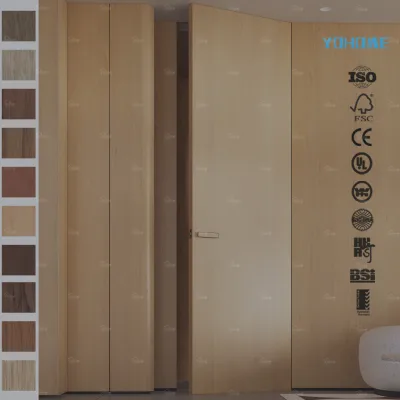
The "invisible" aspect of these doors typically refers to a flush design where the door leaf aligns seamlessly with the surrounding wall, often utilizing hidden hinges and specialized locking mechanisms that are not immediately visible when the door is closed. The core material is a critical differentiator. Market observations indicate that the infilling can vary significantly, ranging from semi-hollow strips and honeycomb structures to fire-rated materials and lead-based cores. The outer surface finishing is often a 5mm MDF panel with black walnut veneer or PVC lamination, providing a high-end aesthetic finish that mimics solid wood or stone. The inner frame layout is frequently honeycombed, which aids in weight reduction while maintaining the rigidity required for fire resistance.
Technical Specifications and Performance Metrics
When evaluating potential suppliers, buyers must scrutinize the technical specifications provided in the product data sheets. A primary metric is the fire-rated time, which dictates the door's ability to withstand fire exposure. The observed market data lists fire-rated times of 30, 60, 90, 120, and 180 minutes. It is essential to verify that the specific model selected matches the regulatory requirements of the building's location. For instance, some models are explicitly rated for 60 minutes, while others may offer a 30-minute rating. The thermal insulation properties are also a key technical variable; products are categorized as either "Partially Insulated Doorsets" or "Fully Insulated Doorsets." This distinction affects the door's ability to prevent heat transfer during a fire event, which is crucial for compartmentalization.
The physical dimensions and operational mechanics are equally important. The standard size observed in the market is up to 2300mm in height, 1100mm in width, and 40mm in thickness, though custom dimensions are available. The opening style is predominantly "Swing," with an "Inward" opening direction being a common configuration. The handle position is often specified as "Left," but this should be confirmed against the specific site requirements. The door leaf itself may be supplied without glass, or with glass options depending on the model. The stile and rail construction is noted to be 28 x 38mm finger joint wood, a detail that impacts the structural stability of the frame. Additionally, the product standard indicates that the door must meet specific dimensional tolerances, which are often customisable to fit unique architectural openings.
Compliance, Certification, and Regulatory Verification
Navigating the compliance landscape for fire-rated doors requires rigorous verification. While the supplied data confirms the existence of fire-rated models, it does not explicitly list third-party certification bodies or specific international standards (such as UL, EN, or BS) for every listed item. Therefore, buyers must treat the "Fire Rated" attribute as a claim that requires independent validation. The procurement process should mandate that suppliers provide test reports from accredited laboratories for the specific model numbers, such as GFM-1023, SN0044, or FD20.
Buyers should verify that the "Fire Rated Time" claimed (e.g., 60 minutes) corresponds to a recognized testing standard. The presence of a "Fire Proof" attribute of 60 minutes in the data suggests a specific performance tier, but this must be cross-referenced with local building codes. For applications in stairways, elevator rooms, discharge flues, and cable wells, the door must meet the specific fire separation requirements of those zones. The "Product Standard" listed as "max 2300 x 1100 x 40 or customised" implies a dimensional baseline, but the fire rating is the primary compliance driver. Suppliers should be required to demonstrate that their "Fire Rated Material" infilling and the "Wooden Inner Frame" construction have been tested together as a complete assembly, not just individual components.
Cost Drivers and Pricing Dynamics
The pricing for fireproof wooden steel invisible doors is influenced by several variables, including material composition, fire rating duration, and customization levels. The observed price range in the market spans from 43 to 589 USD per unit. This wide variance indicates that the base price is heavily dependent on the specific model and the complexity of the finish. Models with higher fire ratings, such as 120 or 180 minutes, will naturally command a higher price point compared to 30-minute rated units. The material cost is a significant driver; doors constructed with "Solid Wood + MDF with PVC Lamination" or "Steel-Wood" composites will differ in cost from those using standard "Wood Cement Board" cores.
Customization is a major cost factor. The data confirms that "Customization" is available, which can include custom dimensions, specific veneer types like black walnut, and tailored hardware configurations. The "Price Includes" attribute notes that the cost often covers the "Door Leaf Only," meaning that the price may not include the frame, hinges, or locking hardware unless explicitly stated. Buyers must account for the cost of accessories such as locks, handles, hinges, door closers, and panic bar reinforcements. The "Mixed Inner Frame" of aluminum plate and wood adds complexity and cost compared to a standard "Wooden Inner Frame." Furthermore, the "Leading Time" of about 25 days for 500 sets suggests that rush orders or smaller batch sizes might incur premium charges or require different pricing structures.
Typical Applications and Installation Requirements
The versatility of these doors allows them to be deployed in a variety of high-risk and high-traffic environments. The "Application" data explicitly lists stairways, elevator rooms, discharge flues, and cable wells. These locations require doors that can withstand fire spread while maintaining the aesthetic integrity of the building's interior. In stairways and elevator rooms, the door must function as a fire barrier to prevent smoke and fire from entering escape routes. The "Position" is specified as "Interior," indicating that these units are designed for internal building use rather than external exposure to weather elements, although the "Water Tight Door" attribute suggests some level of moisture resistance for specific applications.
Installation considerations are critical for maintaining the "invisible" aesthetic. The "Open Style" being "Swing" and the "Opening Direction" being "Inward" must be coordinated with the architectural design to ensure the door does not obstruct corridors or emergency exits. The "Surface Finishing" is listed as "Finished," which implies that the door arrives ready for installation, reducing on-site labor time. However, the "Export Packing" and "Inside: PE Paper, Outside: Carton Box and Wooden PA" indicate that careful handling is required to prevent damage to the veneer or surface finish during transit. The "Honeycombed" inner frame layout requires precise framing to ensure the door operates smoothly without sagging, which is particularly important for the "Fully Insulated Doorsets" which may be heavier.
Supplier Evaluation and Quality Control Protocols
Selecting a reliable supplier for fire-rated doors requires a multi-faceted evaluation strategy. The "prod_origin" is listed as China, which is a major manufacturing hub for these products, but buyers must verify the specific factory's capabilities. A robust supplier evaluation should include a review of their production process, specifically the "Surface Finishing" and "Inner Frame Layout" consistency. The "Process" of "Finished" surface treatment suggests a factory-level application of veneer or lamination, which should be inspected for quality control to ensure uniformity and durability.
Quality control protocols must extend beyond the final product to the raw materials. The "Material" composition, whether "Steely," "Steel-Wood," or "WPC," must be verified against the supplier's specifications. The "Infilling" material, which can be "Fire Rated Material," "Semi-Hollow Strips," or "Honeycomb," must be consistent across batches. Buyers should request sample inspections to verify the "Stile and Rail" dimensions (28 x 38mm) and the "Wooden Inner Frame" quality. The "Package" details, including the use of "PE Paper" and "Carton Box and Wooden Palle," are indicators of the supplier's attention to logistics and product protection. A reputable supplier will provide detailed packing lists and ensure that the "Export Packing" meets international shipping standards to prevent damage during transit.
Long-Term Procurement and Lifecycle Management
Long-term procurement considerations for fireproof doors involve maintenance, replacement cycles, and supply chain reliability. The "Leading Time" of approximately 25 days for 500 sets suggests a standard production cycle, but buyers should establish contingency plans for urgent replacements or additional orders. The "MOQ" range of 1 to 200 units offers flexibility for both small-scale renovations and large-scale construction projects. However, for large projects, buyers should negotiate volume discounts and ensure that the supplier can maintain consistent quality across large batches.
The "Customization" capability is a key long-term asset, allowing buyers to adapt to changing architectural trends or specific building code updates. However, customization can extend lead times, so planning must be precise. The "Fire Rated Time" is a permanent attribute, but the physical door may require maintenance over time, particularly the "Lock," "Handle," and "Hinges." Buyers should ensure that the supplier provides a supply chain for replacement hardware to maintain the door's functionality and fire rating integrity. The "Price Includes" clause regarding the "Door Leaf Only" means that long-term costs must include the procurement of compatible hardware and frames. Finally, the "Thermal Insulation" properties, whether "Partially" or "Fully" insulated, should be re-evaluated periodically to ensure they still meet the building's energy efficiency and safety standards.
FAQs
What fire rated times are available for these doors?
Fire rated times range from 30 to 180 minutes depending on the specific model selected. Buyers must verify that the chosen rating matches local building codes for applications like stairways or elevator rooms.
Which materials are used in the door construction?
Materials include solid wood, steel, steel-wood hybrids, and WPC with PVC lamination. The core often uses wood cement board or fire-rated materials to ensure structural integrity and safety.
Can the door dimensions be customized for specific projects?
Yes, customization is available for dimensions up to 2300mm height and 1100mm width. Custom orders may affect lead times and pricing, so specific requirements should be confirmed before production.
How long is the typical lead time for an order?
The standard lead time is about 25 days for orders of 500 sets. Smaller quantities or custom specifications might alter this timeline, so early planning is essential for project scheduling.
What is included in the standard product price?
The price typically includes the door leaf only without the frame or hardware. Accessories like locks, handles, and hinges are listed separately and must be procured or added based on specific needs.
Are these doors suitable for interior applications like cable wells?
Yes, they are designed for interior positions including stairways, elevator rooms, and cable wells. The water-tight feature also supports specific environmental conditions within these building zones.