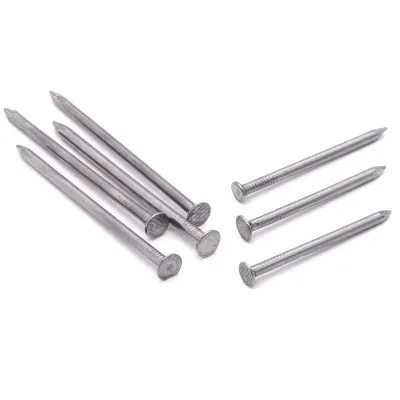
Source Galvanized Steel Concrete Nails for Construction Framing
Find 30 options for Galvanized Steel Concrete Nails with varying lengths, shank types, and hardness ratings. Buyers can compare specifications like material grade, surface finish, and packaging to select the right fasteners for concrete applications.
Key considerations
Products List


$400.00 - $900.00
MOQ: 5 Tons




Comprehensive Sourcing Guide
Strategic Sourcing Guide for Galvanized Steel Concrete Nails
Understanding Product Specifications and Material Variability
When sourcing Galvanized Steel Concrete Nails, the primary challenge lies in navigating the diverse range of specifications available in the global market. The core product is defined as a concrete nail, typically manufactured from high-carbon steel grades such as 45# or 55#. These specific material grades are critical because they provide the necessary tensile strength to penetrate dense concrete and masonry without bending or snapping during installation. While the base material is consistently identified as steel or iron, buyers must also be aware that some listings may reference stainless steel or other alloys, requiring careful verification against the specific project requirements.
The physical dimensions of these nails vary significantly to accommodate different construction needs. The standard length range observed in the market spans from 10mm to 160mm, with specific common sizes including 1-inch to 6-inch variants. This translates to a length range of approximately 25mm to 150mm, though some suppliers may offer custom lengths outside this standard bracket. The head diameter is another critical specification, typically ranging from 2mm to 12mm, with a standard head style being round. The shank design is equally important for holding power; options include smooth shanks, twisted shanks, fluted shanks, and twisted fluted designs. The point of the nail is universally described as a sharp point, engineered to pierce hard surfaces effectively.
Surface treatment is a defining characteristic for the "galvanized" keyword in this search. The finish is predominantly galvanized, which provides a protective layer against corrosion. Some suppliers also offer color-coated finishes or polished surfaces. The hardness of the nail is a crucial performance metric, with observed values ranging from 50 to 57 HRC (Rockwell Hardness). Ensuring the hardness meets or exceeds HRC 50 is essential for maintaining the structural integrity of the fastener during the high-impact driving process required for concrete applications.
Compliance, Standards, and Certification Verification
Navigating the compliance landscape for industrial fasteners requires a rigorous approach to verifying standards and certifications. The concrete nail market is governed by several international and national standards, including JIS (Japanese Industrial Standards), GB (Chinese National Standards), DIN (Deutsches Institut für Normung), ANSI (American National Standards Institute), and ISO (International Organization for Standardization). When evaluating potential suppliers, buyers should explicitly request documentation confirming that the product meets the specific standard required for their region or project. For instance, a project in Europe may require strict adherence to DIN standards, while a project in the United States might prioritize ANSI compliance.
Certification status is often a point of confusion in B2B procurement. While some background information may mention CE certification, this should not be assumed as a universal fact for all listed products. Instead, buyers must treat certification as a variable attribute that requires direct confirmation from the supplier. The presence of SGS (Société Générale de Surveillance) as a standard or inspection reference indicates that third-party quality verification is available, but it does not automatically imply that every batch of nails is certified. Buyers should request specific test reports or certificates of analysis that validate the chemical composition of the steel and the thickness of the galvanized coating.
The "Customized" standard noted in product attributes suggests that many manufacturers are willing to adapt their production lines to meet specific regulatory or project requirements. This flexibility is a significant advantage for large-scale procurement, as it allows buyers to align the product specifications with local building codes. However, this customization capability must be verified through a formal request for quotation (RFQ) process. Relying on generic standard claims without written confirmation can lead to non-compliance issues during site inspections or final project acceptance.
Cost Drivers and Pricing Dynamics
The pricing structure for Galvanized Steel Concrete Nails is influenced by several interconnected factors, primarily raw material costs, manufacturing complexity, and order volume. The raw material, specifically the 45# and 55# high-carbon steel, fluctuates based on global commodity markets. These price fluctuations are directly passed down to the buyer, making it essential to lock in pricing agreements when steel markets are stable. The galvanization process adds a layer of cost, as the thickness and quality of the zinc coating affect both the durability and the price of the final product.
Order volume plays a pivotal role in determining the unit cost. The observed Minimum Order Quantity (MOQ) ranges widely from 1 unit to 100,000 units. This vast range indicates that the market accommodates both small-scale procurement for specific repair jobs and massive bulk orders for large infrastructure projects. For buyers seeking the most competitive pricing, aiming for the higher end of the MOQ spectrum is generally advisable, as economies of scale significantly reduce the per-unit cost. However, buyers must balance this with storage costs and cash flow constraints.
Packaging is another cost driver that often gets overlooked. The product is available in various packaging formats, including boxes, bulk packages, plastic bags, cardboard boxes, and wooden pallets. The choice of packaging affects the shipping weight and volume, which in turn influences freight costs. For international shipments, using wooden pallets and robust carton packing can prevent damage during transit but may incur higher shipping fees compared to simple bulk bagging. Buyers should calculate the total landed cost, including packaging and freight, rather than focusing solely on the unit price.
Typical Applications and Performance Requirements
Galvanized Steel Concrete Nails are primarily designed for construction applications where high holding power and resistance to environmental degradation are required. Their primary use case involves fastening wood framing, metal tracks, and other building materials to concrete or masonry substrates. The sharp point and hardened shank allow these nails to be driven directly into hard surfaces without the need for pre-drilling, which streamlines the construction process and reduces labor costs.
The specific application dictates the required specifications. For general DIY projects or light construction, nails with a length of 1 to 3 inches and a smooth shank may suffice. However, for heavy-duty industrial applications, such as securing steel beams or heavy timber to concrete foundations, longer nails (up to 6 inches) with twisted or fluted shanks are necessary to maximize grip and prevent pull-out. The galvanized finish is particularly vital for applications exposed to moisture or outdoor environments, as it prevents rust and ensures the longevity of the fastener.
The hardness of the nail, typically exceeding HRC 50, is a critical performance requirement. If the nail is too soft, it may bend upon impact, rendering it useless. If it is too brittle, it may shatter. The observed hardness range of 50-57 HRC represents a balanced profile suitable for most construction scenarios. Buyers should verify that the specific batch of nails they purchase maintains this hardness consistency, as variations can lead to installation failures and safety hazards.
Supplier Evaluation and Sourcing Strategy
Evaluating suppliers for Galvanized Steel Concrete Nails requires a multi-faceted approach that goes beyond price comparison. The geographic origin of the product is a significant factor, with the majority of supply coming from China, specifically regions like Hebei. While this region is a major hub for steel production, buyers should verify the specific factory capabilities and reputation of the supplier. The ability to offer OEM (Original Equipment Manufacturer) and ODM (Original Design Manufacturer) services is a strong indicator of a supplier's flexibility and manufacturing maturity.
Sample availability is a crucial step in the supplier evaluation process. Most suppliers offer samples, which allows buyers to physically inspect the product for quality, finish, and dimensions before committing to a large order. Buyers should test these samples for hardness, coating thickness, and driving performance. The "No Rust" remark associated with the product suggests that the galvanized coating should be robust, but this claim must be validated through actual testing rather than relying on marketing statements.
The customization capabilities of the supplier should also be assessed. The ability to customize the product standard, color, and packaging indicates a supplier that can adapt to specific buyer needs. However, buyers should ensure that the customization process does not compromise the core quality of the nail. A reliable supplier will have a clear process for managing custom orders, including quality control checkpoints at each stage of production.
Quality Control and Long-Term Procurement Considerations
Implementing a robust quality control (QC) protocol is essential for mitigating risks in the procurement of concrete nails. Given the critical role these fasteners play in structural integrity, buyers should establish clear acceptance criteria based on the observed specifications. This includes verifying the material grade (45# or 55#), the hardness (50-57 HRC), and the dimensions (length 10mm-160mm). Regular third-party inspections, such as those provided by SGS, can provide an additional layer of assurance.
Long-term procurement considerations involve building a sustainable relationship with suppliers who can guarantee consistent quality over time. The market for concrete nails is dynamic, with frequent changes in raw material availability and regulatory requirements. A supplier with a strong track record of compliance and quality consistency is more likely to be a reliable partner in the long run. Buyers should also consider the lead times and production capacity of the supplier, especially for large orders. The observed lead times and production capabilities vary, so early planning is necessary to avoid delays in construction schedules.
In conclusion, sourcing Galvanized Steel Concrete Nails requires a balance of technical knowledge, market awareness, and rigorous supplier evaluation. By focusing on the specific material grades, dimensions, and surface treatments, and by verifying compliance with relevant standards, buyers can ensure they procure high-quality fasteners that meet their project requirements. The wide range of available options, from standard sizes to customized solutions, offers flexibility for various construction needs, provided that the buyer maintains a disciplined approach to quality assurance and supplier selection.
Comparative Analysis of Product Attributes
To assist buyers in making informed decisions, the following table summarizes the key attributes observed in the market for Galvanized Steel Concrete Nails. This comparison highlights the variability in specifications and helps buyers identify the features most relevant to their specific applications.
| Attribute Category | Common Observation | Variability Range | Critical Verification Point |
|---|---|---|---|
| Material | Steel, Iron | 45#, 55#, Stainless Steel | Verify High Carbon content for hardness |
| Length | 1" - 6" | 10mm - 160mm | Match to substrate thickness |
| Shank Type | Smooth, Twisted | Smooth, Twisted, Fluted, Twilled | Ensure grip strength for load |
| Finish | Galvanized | Galvanized, Color Coated, Polished | Check coating thickness for corrosion |
| Hardness | 50-57 HRC | > HRC 50 | Prevent bending or shattering |
| Packaging | Box, Bulk | Plastic, Cardboard, Wooden Pallet | Assess shipping protection needs |
| Origin | China | Hebei, General China | Verify factory location and capacity |
| Standards | JIS, GB, DIN, ANSI | JIS, ISO, GB, DIN, ANSI, SGS | Confirm local code compliance |
This table serves as a quick reference for buyers to cross-check supplier claims against observed market norms. It emphasizes that while certain attributes are common, significant variability exists, and verification is the only way to ensure product suitability. By using this structured approach, buyers can navigate the complexities of the concrete nail market with confidence and precision.
FAQs
What materials are used for Galvanized Steel Concrete Nails?
These nails are primarily made from high-carbon steel grades 45# and 55#. Some listings also reference iron or stainless steel, so verify the specific material grade required for your project before ordering.
Which standards do Galvanized Steel Concrete Nails meet?
Products typically comply with international standards including JIS, GB, DIN, ANSI, and ISO. Buyers should request specific documentation to confirm which standard applies to their batch for regulatory compliance.
How long are the available Galvanized Steel Concrete Nails?
The standard length ranges from 10mm to 160mm, covering sizes from 1 inch to 6 inches. Custom lengths are available upon request, allowing for flexibility in various construction applications.
Can I get samples of Galvanized Steel Concrete Nails?
Yes, samples are available for most suppliers to verify quality and dimensions. Testing these samples for hardness and coating thickness is recommended before committing to a large bulk order.
What is the hardness range for these concrete nails?
The hardness typically falls between 50 and 57 HRC to ensure durability during installation. This range prevents bending or snapping when driven into dense concrete or masonry surfaces.
Where are these Galvanized Steel Concrete Nails manufactured?
The majority of production originates from China, with specific manufacturing hubs in Hebei. Buyers should confirm the exact factory location to assess logistics and potential shipping costs.
What packaging options exist for Galvanized Steel Concrete Nails?
Packaging includes boxes, bulk packages, plastic bags, cardboard boxes, and wooden pallets. The choice affects shipping weight and volume, so select based on your specific logistics requirements.