Source Sliding Hydromassage PVC Back Wall for Hotel, Villa, Apartment
Explore 30 listings for the Sliding Hydromassage PVC Back Wall designed for hotels, villas, and apartments. Buyers can compare specifications, materials, and customization options to find suitable spa equipment.
Key considerations
Products List


Fyeer Wall Mounted Multifunctional Black Hydromassage LED Shower Panel
$135.00 - $150.00
MOQ: 10 Pieces


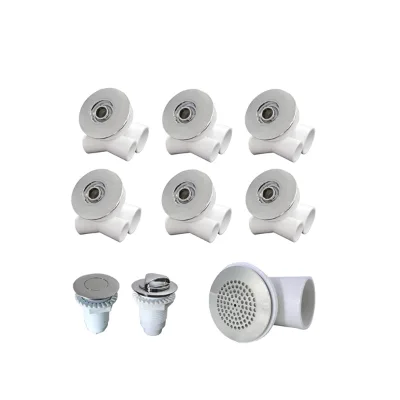


Smart 6 Person System Full Body Hydro Massage Waterfall SPA Pool Outdoor
$19999.00 - $21999.00
MOQ: 1 sets


China Manufacture Waterfall Feature Large SPA Hydrotherapy Swim Spas Pool
$37199.00 - $37399.00
MOQ: 1 sets

Comprehensive Sourcing Guide
Sourcing Strategy for Sliding Hydromassage PVC Back Wall Systems
The global demand for integrated wellness solutions has driven a significant shift toward modular and space-efficient bathroom fixtures. Among these, the Sliding Hydromassage PVC Back Wall system represents a specialized category where material durability, hydraulic engineering, and aesthetic integration converge. For procurement professionals, sourcing this specific component requires a disciplined approach that distinguishes between generic spa equipment and engineered wall systems designed for high-pressure water circulation. The following guide outlines the critical factors for evaluating suppliers, verifying technical specifications, and ensuring long-term reliability for commercial and residential projects.
Technical Specifications and Material Integrity
When evaluating a Sliding Hydromassage PVC Back Wall, the primary focus must be on the material composition and the structural design of the sliding mechanism. While the core keyword specifies PVC, the supplied product data indicates that high-end hydromassage units often utilize Acrylic or Stainless Steel for the primary body, with PVC frequently serving as the flexible or sealing component in specific configurations. Buyers must verify the specific grade of PVC used, as standard PVC may degrade under the constant pressure and temperature fluctuations associated with hydromassage systems.
The supplied context highlights several critical technical attributes that should be cross-referenced with the specific "sliding back wall" requirement. For instance, the "Blackplane Material" is noted as Acrylic in some listings, while other entries specify Stainless Steel. If the back wall is PVC, it must be reinforced to withstand the force of the water jets. The "Water Jets" count is a vital specification; one observed model lists "9 PCS" of jets, while another mentions "Acupuncture Massage Jets" as included. The sliding mechanism must accommodate the flow rate required by these jets without leakage.
Furthermore, the "Installation Location" is a decisive factor. Data indicates that many units are designed for "Corner" installations or "Free Standing" configurations. A sliding back wall system implies a need for a track or rail mechanism that allows the panel to move, likely to adjust the massage angle or to facilitate cleaning. The "Thickness" of the material is another observable metric; one specification notes a thickness of "1.5mm," which serves as a baseline for structural rigidity. Buyers should demand technical drawings that confirm the thickness of the PVC or composite material used in the sliding panel to ensure it does not flex under water pressure.
Compliance, Certification, and Safety Standards
In the B2B procurement of hydromassage equipment, compliance is not merely a formality but a prerequisite for market access and liability protection. The supplied product facts explicitly mention "CE, SGS, ISO" as standards associated with certain spa equipment models. These certifications are critical indicators that the manufacturer adheres to international safety and quality benchmarks. The CE mark, for example, indicates conformity with health, safety, and environmental protection standards for products sold within the European Economic Area. SGS and ISO certifications suggest that the manufacturing process and the final product have undergone rigorous third-party testing.
However, buyers must exercise caution when interpreting these standards. The presence of "CE, SGS, ISO" in a product listing for a specific model (e.g., VTSPA-15) does not automatically guarantee that every "Sliding Hydromassage PVC Back Wall" from the same supplier meets these criteria. Procurement teams must verify that the specific component being sourced—the sliding PVC panel and its associated hydraulic fittings—carries the relevant certification. This is particularly important for the "Water Inlet" specifications, which in one observed case are noted as "1.5" Size, in The Bottom." The integrity of these connections is vital for preventing leaks and ensuring that the system operates within safe pressure limits.
Additionally, the "Warranty" period is a strong proxy for manufacturer confidence. The supplied data indicates a "1 Year" warranty for certain spa equipment. While this is a standard offering, buyers should negotiate extended warranty terms for sliding mechanisms, as these are high-wear components. The "Standard Export Carton Box and Wooden" packing mentioned in the data suggests that the supplier understands the need for robust protection during transit, which is essential for maintaining the integrity of the certification seals and the physical condition of the sliding tracks.
Cost Drivers and Pricing Variables
The pricing landscape for sliding hydromassage PVC back walls is influenced by a complex array of variables, ranging from raw material costs to the complexity of the hydraulic system. The observed price range in the market data spans from $0.76 to $37,399, a disparity that reflects the difference between individual components and fully integrated systems. For a specific "sliding back wall" component, the cost will likely fall within the mid-to-high range of this spectrum, depending on the customization level.
Key cost drivers include the "Customization" availability. The supplied facts confirm that "Customization" is "Available" for many products. Customizing the dimensions, the "Acrylic Color" (noted as White in some contexts), or the "Color" of the finish (Silver or Golden Pleated) will invariably increase the unit price. The "MOQ" (Minimum Order Quantity) is another significant factor; the observed range is 1 to 500 units. Buyers purchasing for a single project may face higher per-unit costs if they cannot meet the lower MOQ thresholds, whereas bulk procurement for a hotel chain could significantly reduce the average cost.
The "Surface Treatment" is also a cost determinant. Products with a "Polished" finish generally command a premium over those with a standard matte or textured finish. Furthermore, the inclusion of "Five Functions" or "Hydraulic Massage or Decoration" capabilities adds to the complexity of the manufacturing process, thereby influencing the final price. Buyers should request a detailed breakdown of costs to understand how much of the price is attributed to the PVC material itself versus the engineering of the sliding mechanism and the hydraulic controls.
Typical Applications and Installation Contexts
The versatility of sliding hydromassage PVC back walls makes them suitable for a diverse range of applications, from private residences to large-scale commercial facilities. The supplied data identifies "Hotel/Residence/Villa/Apartment" as primary application areas. In these settings, the sliding feature offers a distinct advantage: space optimization. A sliding back wall can be retracted to reveal a larger bathing area or adjusted to direct water jets precisely where needed, enhancing the user experience without requiring a larger footprint.
Commercial applications extend to "Swimming Pool SPA Pool" and "Massage Pool" environments. The "Application" field in the data explicitly lists "Home Use, Swimming Pool, Massage Pool." In these high-traffic environments, the durability of the PVC and the reliability of the sliding mechanism are paramount. The "Occasion" is noted as "Bathroom," but the functional scope is broader, including "SPA, Health & Beauty" usage. The "Capacity" of "One Person" suggests that many of these units are designed for individual use, which is typical for luxury residential showers or private spa suites.
The "Installation Type" is another critical consideration. While many units are "Free Standing," the sliding nature of the back wall often implies a need for a specific mounting infrastructure. The "Installation Location" being "Corner" in some models suggests that the sliding mechanism must be engineered to fit into tight spaces while maintaining smooth operation. Buyers must ensure that the supplier provides clear installation guidelines, particularly regarding the "Water Inlet" placement, which is specified as being "in The Bottom" for certain models. This placement affects the plumbing layout and the overall design of the bathroom or pool area.
Supplier Evaluation and Geographic Considerations
When evaluating potential suppliers for sliding hydromassage PVC back walls, geographic origin and production capabilities are essential criteria. The supplied data indicates that the primary production hubs are in "Guangdong, China" and "Guangzhou, China." These regions are well-established centers for bathroom fixture and spa equipment manufacturing, offering a mature supply chain and access to specialized components. The "prod_origin" field consistently points to "China Mainland," confirming that the majority of these products are manufactured in this region.
However, the presence of a manufacturing location does not guarantee quality. Buyers should verify the supplier's "Market" reach, which is noted as "Global" in the data. A supplier with a global market presence is more likely to have experience with international shipping, customs regulations, and diverse certification requirements. The "prod_packing" details, such as "Carton," "Wooden Packing," or "Plastic Film+Wooden Frame," provide insight into the supplier's logistics capabilities. Robust packing is essential for protecting the sliding mechanisms and PVC panels from damage during transit.
Furthermore, the "Accessory Type" is listed as "Spa Equipment," which suggests that the supplier specializes in this niche. Buyers should inquire about the supplier's history with similar products, specifically those with "Sliding" features. The "Customized" status being "Acceptable" indicates that the supplier is flexible, but buyers must assess their capacity to handle custom orders without compromising on quality or lead times. It is advisable to request references from previous clients who have purchased similar sliding systems to gauge the supplier's reliability and after-sales support.
Quality Control and Long-Term Procurement Considerations
Ensuring the long-term performance of a Sliding Hydromassage PVC Back Wall requires a rigorous quality control (QC) strategy. The "Surface Treatment" being "Polished" is an aesthetic requirement, but it also implies a need for a smooth, non-porous surface that resists mold and bacterial growth. Buyers should insist on pre-shipment inspections that verify the smoothness of the sliding tracks and the integrity of the seals. The "Warranty" of "1 Year" is a baseline, but for a sliding mechanism, which involves moving parts, a longer warranty or a service agreement should be negotiated.
The "Function" of the unit, whether "Massage" or "Hydraulic Massage or Decoration," must be tested under operational conditions. The "Water Jets" count and the "Way of Control" (noted as "Hand Control" in some models) are critical functional aspects. Buyers should verify that the control mechanism is intuitive and that the water pressure is consistent across all jets. The "Folded" status being "Unfolded" in the data suggests that some units may have a collapsible or adjustable design, which adds another layer of complexity to the QC process.
Long-term procurement considerations also include the availability of spare parts. The "prod_model" numbers, such as "HS-SP017," "OFFE2045," and "FK150109," serve as unique identifiers. Buyers should ensure that the supplier maintains a stock of replacement parts for these specific models, particularly for the sliding tracks and seals. The "Standard" dimensions, such as "1620280260mm" or "15727.557.5*17," must be strictly adhered to to ensure compatibility with existing plumbing and structural elements.
In conclusion, sourcing a Sliding Hydromassage PVC Back Wall system requires a meticulous approach that balances technical specifications, compliance requirements, and cost considerations. By leveraging the available data on materials, certifications, and applications, buyers can make informed decisions that ensure the reliability and performance of their procurement. The focus should remain on verifying the specific attributes of the sliding mechanism and the PVC material, rather than assuming that all listed products in a category share the same characteristics. Through careful supplier evaluation and rigorous quality control, buyers can secure high-quality hydromassage solutions that meet the demands of modern wellness environments.
FAQs
What materials are used for sliding hydromassage PVC back walls?
While the core keyword specifies PVC, high-end units often utilize Acrylic or Stainless Steel for the primary body. PVC frequently serves as a flexible or sealing component, but buyers must verify the specific grade to ensure durability under water pressure.
Can customization be requested for these back wall systems?
Yes, customization is available for many products in this category. Buyers can request specific dimensions, colors like White or Silver, and functional variations, though this may impact the unit price and minimum order quantity requirements.
Which certifications should be verified for safety compliance?
Products often carry CE, SGS, and ISO standards as critical indicators of international safety and quality benchmarks. Buyers must verify that the specific sliding PVC panel and hydraulic fittings carry these relevant certifications before purchase.
How is the installation location typically configured for these units?
Many units are designed for Corner installations or Free Standing configurations. The sliding mechanism must be engineered to fit into tight spaces while maintaining smooth operation and accommodating the water inlet placement.
What is the typical warranty period for this equipment?
The standard warranty period for certain spa equipment is one year. For sliding mechanisms with moving parts, buyers should negotiate extended warranty terms to ensure long-term reliability and protection against wear.
Where are the primary manufacturing hubs for these products located?
The primary production hubs are located in Guangdong and Guangzhou, China. These regions offer a mature supply chain and access to specialized components, with most products originating from the China Mainland.