Source UL10B Fire Door for Hotel, Apartment, and Commercial Spaces
Compare 30 UL10B fire door options for hotels, apartments, and commercial buildings. Buyers can review thermal insulation, fire rated time, and customization features from verified suppliers in China. These doors offer swing styles, security ratings, and various materials like steel or wood for diverse applications.
Key considerations
Products List


UL Certified Soundproof Wooden Fire Door for Hotel Office Apartment
$30.00 - $150.00
MOQ: 10 Square Meters


Factory Price 60 Min UL Steel Fire Rated Doors Emergency Fire Exit Fireproof Door for Hotel
$90.00 - $100.00
MOQ: 2 Pieces



Comprehensive Sourcing Guide
UL10B Fire Door for Hotel Sourcing Guide
Sourcing a UL10B fire door for a hotel project requires buyers to balance laboratory-tested fire performance against the operational realities of hospitality buildings: high guest traffic, around-the-clock usage, and strict life-safety expectations from insurers and local authorities. The UL10B test regime covers fire doors subjected to the fire endurance test without the hose stream portion applied immediately after the burn, which makes it a distinct classification from related door test protocols. Buyers should therefore confirm precisely which test standard a listed product was evaluated under, rather than accepting generic "fire rated" language on a quotation.
Because hotel installations span stairways, elevator rooms, discharge flues, and cable wells, the door assembly must be specified as a complete system—leaf, frame, hardware, and glazing—that was tested together. This guide walks procurement teams through product scope, technical verification, compliance paperwork, cost structure, supplier qualification, and long-term contract safeguards. The objective is to help you translate observed listing attributes into enforceable purchase-order requirements, so that what arrives on site matches what the fire-rated schedule assumes was installed.
Product Scope and Observed Listing Signals
The category listings observed for this product family describe fire-rated doors with rated times spanning 30, 60, 90, 120, and 180 minutes, positioned for commercial use in stairways, elevator rooms, discharge flues, and cable wells. Materials listed include steel, steel-wood composites, and stainless steel, with swing-style operation and a security function rated at grade A. Models observed include SN0189, SN0033, SN0124, SN0445, SN0370, SN0362, and a KDS series (KDS-ATLR, KDS-WFD-HaQUA, KDS-HTIR, KDS-VFHR, KDS-D-S-003, KDS-RGJR), with origins listed as China, Shanghai, and Fujian. Not every attribute applies to every listing, so treat these as observations to confirm per SKU.
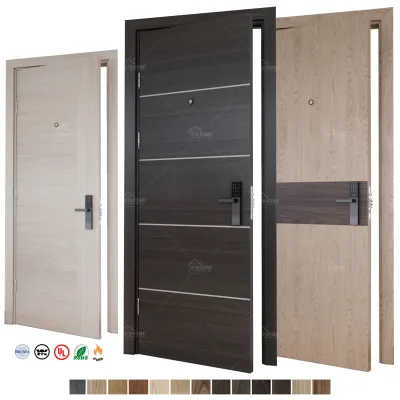
Customization is explicitly available, and color can be specified, which matters for hotel corridors where door leafs must match interior design schemes. Some listings cite CE and NFRC certification, while a KDS series listing references CE EPRC and AS 2047—verifying which certificate applies to the exact door model you order is essential. Maximum single-leaf size in one listing is 1100×2400 mm, so oversize openings may require paired leaves or custom engineering.
Technical Specifications to Verify
Begin with the fire rating itself: confirm in writing which rated time—30, 60, 90, 120, or 180 minutes—the specific door configuration carries, and whether that rating applies to the leaf alone or to the tested assembly including frame and hardware. Because UL10B evaluations exclude the immediate hose stream test, ask the supplier to state the test standard and laboratory behind the rating. For hotel projects, also verify that the requested size falls within tested limits; the observed maximum for a single door is 1100×2400 mm, and anything larger should trigger a request for the supporting test evidence.
Then verify the construction details that determine daily usability. Material selection—steel, stainless steel, or steel-wood with veneers such as white oak or black walnut—affects durability in high-traffic corridors and elevator lobbies. Confirm hardware packages: the listings note locks, handles, hinges, door closers, and panic bar reinforcement, so align each item with the door's tested hardware schedule. Ask whether thermal insulation is full or partial on the specific model, and request sound insulation data for guest-adjacent locations rather than relying on the "modern style" designation alone.
Compliance and Safety Documentation
Certification claims in the listings vary: some products show CE and NFRC certification, one series references CE EPRC and AS 2047, and several listings omit certification data entirely. Treat any listed certificate as a starting point, not proof. Before order placement, request the certificate document itself, verify its validity with the issuing body where possible, and confirm the certificate covers the exact model number, rating, and size range on your purchase order. A certificate issued to a different door family or an expired edition is a common sourcing failure in fire-rated procurement.
For hotel applications, coordinate documentation with the authority having jurisdiction and the project's fire-protection engineer. Useful documents to collect include the laboratory test report, the listing or labeling authorization, installation instructions that preserve the rating, and hardware schedules showing which locks, closers, hinges, and panic devices were tested with the door. Ask the supplier to state how labels are affixed to each leaf and frame so site inspectors can verify them on delivery. Keep the full document set in the project record, since fire-door assemblies are frequently audited years after handover.
Cost Drivers and Commercial Terms
Observed listed prices in this category range widely, from roughly 13 to 260 USD, which signals that quotes cover very different product configurations—from basic single leaves to fully finished, hardware-complete assemblies. When comparing quotations, normalize the scope first: does the price include the frame, closer, panic bar reinforcement, glazing, and finish? Veneer choices such as white oak or black walnut, stainless steel construction, and full thermal insulation all move cost upward, so require each bidder to price an identical bill of materials before judging unit prices.
Observed MOQs range from 1 to 100, with one KDS listing stating 10 square meters, so a KDS-RGJR-style area-based MOQ and a piece-based MOQ are different commercial structures that affect small hotel renovation orders differently. Customization availability suggests tooling or setup charges for non-standard sizes and colors—ask whether these are amortized into the unit price or invoiced separately. Packing is listed as PE paper inside with carton box and wooden pallet outside for one product family, and film plus paper angle protector, air bubble, and wooden crate for another; confirm which packing standard applies and whether export-grade crating is included in the quoted price.
Supplier Qualification and Quality Control
Qualify suppliers through evidence rather than catalog claims. Request factory audit reports or conduct your own inspection focusing on the production steps that determine fire performance: leaf core assembly, frame reinforcement, hinge and closer preparation, and label application. A supplier whose listings span multiple materials—steel, stainless steel, steel-wood—and multiple product families should be asked which lines are dedicated to fire-rated production, since fire doors demand process discipline that decorative interior doors do not. Confirm that customization requests are handled through an engineering review rather than ad-hoc shop modifications.
Set up pre-shipment quality control tied to the fire schedule. For each lot, inspect leaf flatness, frame squareness, finish quality on veneered or painted surfaces, hardware function including closer sweep and latching, and label presence and legibility. Because surface finishing is listed as "finished" in the listings, define the acceptance standard for finish defects in writing before production starts. For custom colors and veneers, approve physical samples rather than photographs. Require the supplier to document any deviation from the tested configuration in writing, and reserve the right to reject assemblies shipped with unapproved hardware substitutions.
Long-Term Procurement Checks
Fire doors in hotels degrade through use—closers weaken, hinges wear, and unapproved hardware gets swapped during maintenance—so build lifecycle obligations into the contract. Ask suppliers for spare-parts availability on closers, hinges, panic bar components, and seals, and agree on a parts price list valid for a defined period. Confirm that replacement parts match the originally tested hardware schedule, since an untested closer substitution can void the assembly's rating. For multi-phase hotel projects, negotiate production consistency commitments so later phases match first-phase doors in finish, veneer, and dimensions.
Plan reordering and record-keeping as part of the relationship. Maintain an archive of model numbers (such as the SN and KDS series designations you purchase), test reports, certificates, and labeled configuration drawings, so future renovations reference the correct rated assemblies. Schedule periodic site inspections of installed doors—verifying self-closing function, latch engagement, clearances, and label condition—and keep findings linked to supplier records. When evaluating the supplier annually, review defect rates from site inspections, responsiveness on spare parts, and willingness to provide updated certificates when standards or ratings change, then weight future volume accordingly.
FAQs
What fire rated times are available for these doorsets?
The available fire rated times are 30, 60, 90, 120, and 180 minutes. These options allow you to select the appropriate safety level for specific building codes. The doorsets are designed for applications like stairways and elevator rooms. You can choose the duration that best fits your project requirements while ensuring compliance with local safety regulations.
Can I customize the color and material of the fire door?
Yes, customization is available for both color and material. You can choose from materials like steel, wood, or stainless steel. Colors can be customized to match your interior design. The surface finishing is provided as finished. This flexibility ensures the door integrates seamlessly into commercial or apartment settings while maintaining its security and fire-rated performance standards.
What is the minimum order quantity for these fire doors?
The minimum order quantity varies, with observed values ranging from 1 to 100 units. Some specifications list an MOQ of 10 square meters. This flexibility allows for smaller pilot orders or larger bulk purchases. You can discuss specific quantity requirements with suppliers to find a package that suits your project scale and budget constraints effectively.
Which certifications do these fire doors hold?
These fire doors hold certifications such as CE and NFRC. Some models also comply with AS 2047 standards. These certifications verify that the products meet international safety and quality benchmarks. You can rely on these documented credentials when sourcing for projects in regions that require specific regulatory compliance for fire-rated architectural components.
How are the fire doors packaged for shipping?
The doors are packaged with PE paper inside and cardboard boxes or wooden pallets outside. Some options include film, paper angle protectors, and air bubble wrap. This robust packaging protects the finished surface during transit. The external wooden pallets ensure stability for heavy loads. This method helps prevent damage and ensures the products arrive in perfect condition for installation.