Find Wardrobe Options for Living Room, Bedroom, and Office
Source 30 customized Wardrobe units from Chinese manufacturers with modern styles and optional materials. Buyers can compare models like Honsoar and BSW135, door configurations, and hardware options such as Blum or Dtc for living rooms, bedrooms, and offices.
Key considerations
Products List


Wardrobe Bedroom Furniture Wardrobe Bedroom Wardrobe Clothes Organizer Wardrobe
$599.00 - $2999.00
MOQ: 2 sets




Comprehensive Sourcing Guide
Strategic Sourcing Guide for Custom Wardrobe Procurement
Understanding the Core Product Landscape and Technical Specifications
The global market for wardrobes has evolved significantly, shifting from standardized, mass-produced units to highly customized solutions that integrate seamlessly with diverse interior design requirements. For B2B buyers, the primary distinction lies in the product's modularity and the ability to tailor specifications to specific spatial constraints. Based on current market observations, the core product category is defined by "Customized Cabinet" and "Customized Wardrobe" classifications, where the primary material composition is predominantly wood or wooden composites. The structural integrity and aesthetic finish are heavily dependent on the specific wood type selected, with suppliers offering "Optional" material choices to accommodate varying budget and durability requirements.
A critical technical specification for buyers to evaluate is the door configuration. The market data indicates a clear segmentation based on the number of doors, ranging from single-door units to multi-door configurations such as 2-door, 3-door, and 4-door models. This variation directly impacts the internal storage volume and the footprint required for installation. Furthermore, the operational mechanism is a key differentiator; modern units frequently feature "Push-Pulling" open types, which offer space-saving advantages in tight corridors or small living areas compared to traditional swing-out doors. The physical state of the product upon delivery is another vital technical parameter. Most units are supplied in an "Unfolded" state, meaning they arrive as flat-pack components requiring on-site assembly, although some variations may exist.
The physical dimensions of these units are rarely fixed. The standard specification for size is listed as "Customize," allowing procurement teams to align the Wardrobe's height, width, and depth with the exact architectural constraints of the project site. This customization extends to the model identification, with various designations such as CBM01, PR-LJ, P-LJ, PR-DL513, Honsoar Wardrobe, BSW135, S0808, BHW116closet, JK-Y02, JK-Y08, and PR-KR appearing in the supply chain. These model codes often correspond to specific design families or structural configurations, serving as a reference point for engineers and designers during the planning phase. The hardware components, which dictate the longevity and smoothness of operation, are frequently sourced from established manufacturers such as Blum or Dtc, ensuring a baseline of quality in the mechanical systems.
Compliance, Certification, and Material Standards Verification
When sourcing wardrobes from international markets, particularly from regions like China (mainland) and specific provinces such as Shanghai or Luoyang, buyers must navigate a complex landscape of material standards and potential certifications. While the supplied product facts confirm the origin of goods as "China (mainland)" with specific factory locations in Shanghai and Luoyang, the documentation regarding environmental and safety certifications requires careful verification. Background information often references standards such as GOTS (Global Organic Textile Standard), OEKO-TEX, and FSC (Forest Stewardship Council). However, it is crucial to treat these as background possibilities rather than guaranteed attributes for every listed product.
Buyers should not assume that a specific Wardrobe model automatically possesses FSC certification or OEKO-TEX compliance unless explicitly verified in the supplier's current documentation. The material classification is listed as "Wood" or "Wooden," but the specific grade, formaldehyde emission levels, and the source of the timber are variables that must be confirmed. In the context of B2B procurement, the "Customized" nature of the product means that material choices can be altered per order. Therefore, the procurement strategy must include a mandatory step to request material safety data sheets (MSDS) and specific certification certificates for the batch being ordered.
The production standard is frequently described as "customize," "customized," or "customizable." This implies that the manufacturing process is flexible but does not inherently guarantee adherence to a specific international standard unless contractually stipulated. Buyers must verify if the production facility adheres to ISO standards or specific regional building codes relevant to the destination market. The "Condition" of the product is consistently listed as "New," which is a baseline expectation, but the quality of the new condition depends on the factory's quality control protocols. The "Standard Export Package" and "Flat Package" descriptions suggest that the packaging is designed to withstand international shipping, but the specific protective measures against moisture and impact should be detailed in the packing specification.
Cost Drivers and Pricing Dynamics in Custom Furniture
The pricing structure for custom wardrobes is influenced by a multitude of factors, making direct price comparisons challenging without a detailed scope of work. The observed price range in the market spans from 1 USD to 2999 USD, a wide variance that reflects the difference between basic single-door units and large, multi-door, fully customized cabinetry systems. Several key drivers contribute to this cost fluctuation. The primary driver is the material selection; while "Wood" is the general category, the specific type of wood, the thickness of the panels, and the quality of the veneer or finish significantly alter the unit cost.
Secondly, the level of customization dictates the price. The "Customized" attribute implies that every unit is a unique project. This involves engineering time, specialized cutting, and bespoke assembly instructions, all of which add to the base manufacturing cost compared to off-the-shelf inventory. The hardware selection is another significant cost component. The inclusion of premium hardware brands like Blum or Dtc, as noted in the product facts, will increase the overall price compared to generic hardware alternatives. The number of doors and the complexity of the internal layout (shelves, drawers, hanging rods) also directly correlate with the final price.
The Minimum Order Quantity (MOQ) is a critical factor in the total cost of ownership. The observed MOQ range is between 1 and 100 pieces. For buyers with small project requirements, an MOQ of 1 piece allows for sampling or small-scale procurement, though the unit price may be higher due to the lack of economies of scale. Conversely, larger orders may benefit from volume discounts, but the buyer must ensure they have the storage and logistics capacity to handle larger shipments. The payment terms, typically listed as T/T (Telegraphic Transfer), also influence the financial planning, as they require upfront capital or specific milestone payments that affect cash flow.
Typical Applications and Spatial Integration Strategies
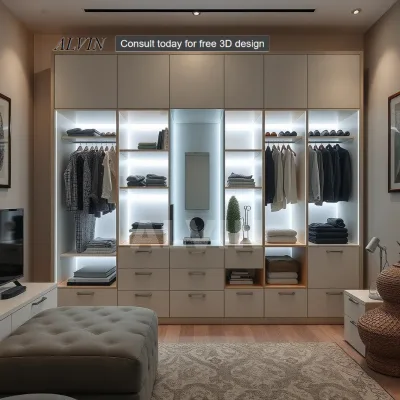
The versatility of modern custom wardrobes makes them suitable for a wide array of applications, as indicated by the "Usage" attributes which include Living Room, Bedroom, Office, and Study. In residential settings, the Wardrobe serves as the primary storage solution for clothing and linens, requiring a balance of aesthetic appeal and functional storage density. In the bedroom, the "Push-Pulling" open type is particularly advantageous for maximizing floor space, allowing the Wardrobe to be placed against walls with limited clearance. For living rooms, wardrobes often function as room dividers or media units, requiring a "Modern" style that complements contemporary interior design trends.
In commercial environments such as offices and study areas, the requirements shift towards durability and efficient space utilization. The "Customized Cabinet" type allows for the creation of built-in storage solutions that integrate with office desks or conference room layouts. The ability to customize the size and internal configuration is essential for these spaces, where standard dimensions rarely fit the architectural constraints. The "Modern" style observed in the product attributes aligns well with the clean lines and minimalist aesthetics preferred in modern office design.
The "Flat Package" and "Standard Export Package" shipping methods are particularly beneficial for these diverse applications. For large commercial projects or international residential developments, shipping flat-packed units reduces the volume of cargo, lowering freight costs and minimizing the risk of damage during transit. Upon arrival, the "Unfolded" state of the product means that assembly must be performed on-site. This requires coordination with local contractors or the buyer's internal facilities team to ensure proper installation. The "Five Layer Strong Cartons" and "Plywood Package" options provide additional protection for high-value units destined for delicate environments.
Supplier Evaluation and Origin-Specific Considerations
Evaluating suppliers for custom Wardrobe procurement requires a deep understanding of the geographic and logistical context. The primary supply hubs identified are in China (mainland), with specific factory locations in Shanghai and Luoyang. Shanghai, being a major coastal port city, offers excellent logistics infrastructure for international export, while Luoyang, located in the central region, may offer different cost structures or material sourcing advantages. Buyers should verify the specific factory location for each order, as the production capabilities and quality control standards can vary between facilities.
The "Customization" capability is a hallmark of the suppliers in this sector. However, the ability to customize does not guarantee the ability to execute complex customizations with high precision. Buyers must assess the supplier's engineering team and their track record with similar projects. The "Produce: Factory in China" attribute confirms the manufacturing origin, but it is essential to verify the factory's capacity to handle the specific order volume and lead time requirements. The "Standard Export Package" and "According to Your Requirements" packing options indicate flexibility, but the buyer must clearly define the packaging requirements to prevent damage during transit.
Payment terms are standardized as T/T, which is common in international trade but requires careful financial management. Buyers should negotiate clear milestones for payment releases, such as 30% upon order confirmation, 60% before shipment, and 10% upon acceptance, to mitigate risk. The "Warranty: 10 Years" attribute is a significant selling point, suggesting a high level of confidence in the product's durability. However, the scope of this warranty must be clearly defined in the contract, covering specific components like hardware, structural integrity, and finish quality.
Quality Control Protocols and Long-Term Procurement Strategy
Ensuring consistent quality in custom Wardrobe procurement requires a robust quality control (QC) framework. Given the "Customized" nature of the products, each unit is unique, making standard sampling methods less effective. Instead, buyers should implement a pre-production sample approval process, where a prototype or detailed 3D rendering is approved before full-scale manufacturing begins. The "Hardware: Blum, Dtc" specification provides a baseline for mechanical quality, but the assembly quality, joint integrity, and finish application must be verified through on-site inspections or third-party QC reports.
The "Condition: New" attribute is a baseline, but the definition of "new" must be expanded to include checks for surface scratches, color consistency, and structural stability. The "Standard Export Package" and "Flat Package" shipping methods must be inspected to ensure that the packaging materials are sufficient to protect the product during long-distance shipping. The "Five Layer Strong Cartons" and "Plywood Package" options should be evaluated for their ability to withstand stacking and handling in transit.
Long-term procurement considerations involve building a strategic partnership with the supplier rather than engaging in transactional relationships. The "Customization" capability suggests that the supplier can adapt to changing design trends and project requirements over time. Buyers should establish a clear communication channel for design updates and technical queries. The "10 Years" warranty is a critical long-term factor, but it is only valuable if the supplier remains operational and committed to honoring the warranty terms. Buyers should also consider the availability of spare parts, particularly for the hardware components, to ensure the longevity of the installed units.
In conclusion, sourcing custom wardrobes from the Chinese market offers significant opportunities for customization and cost efficiency. However, success depends on a rigorous approach to technical specification verification, material certification checks, and supplier evaluation. By focusing on the specific attributes such as door configuration, material type, and hardware quality, buyers can secure high-quality products that meet their specific project needs. The wide price range and flexible MOQ options provide the necessary agility for various project scales, from single-unit residential projects to large commercial developments.
FAQs
What customization options are available for Wardrobe doors?
Customization is available for Wardrobe doors, including 1, 2, 3, or 4 door configurations. Buyers can select specific open types like push-pulling mechanisms to suit spatial constraints.
Which hardware brands are used in these custom wardrobes?
The hardware components frequently include established brands such as Blum or Dtc. These selections ensure smooth operation and longevity for the mechanical systems within the cabinet.
How is the product packed for international shipping?
Products are typically shipped in standard export packages, flat packages, or five-layer strong cartons. Some units may also use plywood packages depending on specific buyer requirements.
What is the warranty period for the custom Wardrobe?
The product comes with a 10-year warranty covering structural integrity and finish quality. This long-term guarantee reflects the manufacturer's confidence in the new condition of the wood materials.
Where are the factories located for these custom cabinets?
Factories are located in China, specifically in Shanghai and Luoyang. These regions serve as primary production hubs for the customized wooden wardrobes and cabinets.
Can the size of the Wardrobe be customized to fit a room?
Yes, the size specification is customizable to align with exact architectural constraints. Buyers can define height, width, and depth to ensure a perfect fit for living rooms or offices.
What is the minimum order quantity for purchasing wardrobes?
The minimum order quantity ranges from 1 to 100 pieces depending on the supplier. This flexibility allows for both single-unit sampling and larger bulk procurement projects.