Source Agricultural Directional Valve for Excavators, Harvesters, and Tractors
Compare 27 Agricultural Directional Valve options from verified Chinese manufacturers. Buyers can review specifications including pressure ratings, flow rates, and installation types for hydraulic systems in heavy machinery applications.
Key considerations
Products List



Comprehensive Sourcing Guide
Strategic Sourcing Guide for Agricultural Directional Valves
Navigating the global market for agricultural directional valves requires a disciplined approach that balances technical precision with supply chain reliability. For buyers in the heavy machinery sector, these components are not merely accessories but critical control elements that dictate the performance, safety, and longevity of equipment such as excavators and tractors. The following guide synthesizes observed market data and verified product attributes to provide a structured framework for procurement, ensuring that decisions are grounded in factual evidence rather than speculative claims.
Technical Specifications and Operational Parameters
When evaluating agricultural directional valves, the primary focus must be on the specific operational parameters that align with the intended machinery. The market presents a diverse array of models, ranging from self-operated units to directly operated types, each serving distinct hydraulic circuit requirements. A critical observation in the current product landscape is the prevalence of specific model identifiers such as P80, DS-001, and various DCV series (DCV200, DCV60, DCV100). These designations often correlate with specific flow capacities and pressure ratings that must be matched to the hydraulic pump output of the target vehicle.
Pressure and flow are the two most vital metrics for any directional valve selection. Verified data indicates that certain units in the agricultural sector are rated for a maximum working pressure of 21 MPa, while others operate within a nominal pressure range of 200 Bar. It is essential for buyers to verify the maximum flow rate, as observed values in the current catalog range up to 80 L/Min for specific sectional valve configurations, with other units supporting flows up to 45 L/Min. The spool configuration is equally significant; the number of spools can vary from 1 to 10, directly influencing the number of simultaneous functions the valve can control. Furthermore, the valve shaft stroke, observed in some specifications as 7+7 mm, determines the precision of the actuation and the speed of the hydraulic response.
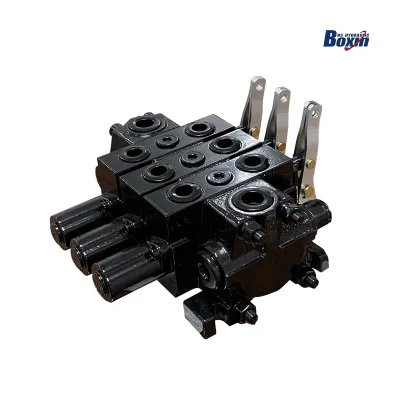
The installation method also dictates the physical integration of the valve into the machinery. Buyers must distinguish between tubular installations, which are common in older or specific heavy-duty designs, and threaded cartridge or superposition installations found in modern modular systems. The connection mode, frequently cited as internal thread, must be cross-referenced with the existing piping infrastructure of the equipment. Additionally, the structure of the valve, whether it is a sectional valve or a single unit, affects the scalability of the hydraulic system. For applications requiring complex movements, a sectional valve structure with multiple spools offers the necessary flexibility.
Compliance and Certification Verification
In the industrial machinery sector, compliance is not optional; it is a prerequisite for market entry and operational safety. The verification of certifications is a critical step in the sourcing process. Current product listings frequently reference CE and ISO certifications, specifically ISO9001, which indicates adherence to quality management systems. However, buyers must exercise caution and treat these as observations of specific listed products rather than universal guarantees for all agricultural valves. The presence of a "Certificate: ISO9001" or "Certification: CE, ISO9001" on a specific product page confirms that the manufacturer has undergone the necessary audits for that batch or model line.
It is important to note that while background knowledge often references standards such as ISO 4401 or DIN 24340 regarding hydraulic fluid power systems, these should not be assumed as default specifications unless explicitly stated in the product documentation. The observed data confirms a "Standard" classification for many units, but the specific standard number must be requested from the supplier to ensure compatibility with international safety regulations. Buyers should prioritize suppliers who can provide verifiable documentation for the CE mark, which signifies conformity with health, safety, and environmental protection standards for products sold within the European Economic Area. Similarly, ISO9001 certification serves as a proxy for a manufacturer's commitment to consistent quality control, though it does not guarantee the performance of a specific valve without accompanying test reports.
Cost Drivers and Pricing Dynamics
The pricing of agricultural directional valves is influenced by a complex interplay of factors, including material costs, manufacturing complexity, and customization requirements. The observed price range in the market is exceptionally broad, spanning from 0.18 USD to 3000 USD. This vast disparity is not indicative of a single product type but rather reflects the difference between small auxiliary components and complete, high-pressure sectional valve assemblies. The lower end of the spectrum likely corresponds to individual cartridges or simple valve elements, while the higher end encompasses full multi-spool units with advanced features like reversing functions or balance capabilities.
Several specific attributes drive the final cost. Customization is a significant factor; products marked as "Available" for customization often command a premium due to the engineering effort required to modify standard designs for specific client needs. The packing method also influences logistics costs; options range from simple carton or tray packaging to more robust wooden boxes or carton-plus-wooden box combinations, which are necessary for heavy or sensitive components to prevent damage during transit. The weight of the unit, observed in some cases as 4+2.6n Kg, directly impacts shipping fees, particularly for international procurement.
Furthermore, the warranty period, typically observed as 1 Year in the current market, acts as a cost buffer. A longer warranty might suggest higher manufacturing quality but could also be factored into the initial unit price. Buyers must analyze the total cost of ownership, which includes the initial purchase price, shipping, and potential downtime costs if the valve fails. It is crucial to avoid equating a lower price with lower quality; instead, the price must be evaluated against the specific technical specifications, such as the 21 MPa pressure rating or the 80 L/Min flow rate, to determine value.
Typical Applications and Functional Requirements
Agricultural directional valves are engineered to handle demanding environments and diverse operational tasks. The primary application observed in the current market is for excavators, where precise control of hydraulic arms and buckets is essential. However, the functional capabilities of these valves extend beyond simple lifting. The data highlights specific functions such as "Reversing" and "Balance," which are critical for maintaining stability and control during complex maneuvers. A reversing function allows the operator to change the direction of the actuator without changing the pump flow, while a balance function helps prevent uncontrolled descent of heavy loads, a common requirement in lifting operations.
The media handled by these valves is predominantly oil, which is standard for hydraulic systems. However, the operating temperature is noted as "Ordinary Temperature," implying that these units are designed for standard ambient conditions and may not be suitable for extreme thermal environments without additional cooling or heating systems. The power source is consistently identified as hydraulic, meaning the valve's operation relies entirely on the pressure generated by the system's pump.
The versatility of these valves is further demonstrated by the variety of models available, such as the P80-5, ZT12-5, and ZT12-4. These models likely cater to different sizes of agricultural machinery, from compact tractors to large-scale harvesters. The nominal size of 15 mm observed in some specifications suggests a range of port sizes that must be matched to the hydraulic lines of the specific machine. Buyers should ensure that the valve's application matches the specific demands of their machinery, considering factors like the number of spools required for simultaneous operations and the flow rate needed to achieve desired cycle times.
Supplier Evaluation and Origin Analysis
When selecting a supplier for agricultural directional valves, the origin of the product is a key data point. The observed data consistently identifies the product origin as China, which is a major hub for hydraulic component manufacturing. This concentration of supply offers buyers access to a wide variety of models and competitive pricing. However, the diversity of the supply chain also necessitates rigorous supplier evaluation. Buyers should verify the supplier's ability to provide the specific certifications mentioned, such as CE and ISO9001, and ensure that these certifications are current and applicable to the specific product line being purchased.
The customization capability is another critical evaluation metric. Suppliers that offer "Available" customization can tailor the valve to specific mounting requirements, flow rates, or pressure ratings, which is often necessary for retrofitting older machinery or designing new equipment. The packing method, whether it is a simple carton box or a more protective wooden box, also reflects the supplier's attention to detail and commitment to product integrity during shipping.
Buyers should also consider the lead time and minimum order quantity (MOQ), which range from 1 to 2000 units in the observed market. A low MOQ of 1 allows for small-scale testing or replacement orders, while higher MOQs may be required for bulk production runs. The warranty period, typically 1 Year, serves as a benchmark for supplier confidence. A supplier offering a standard 1-year warranty demonstrates a baseline commitment to product reliability, but buyers should negotiate terms that align with their operational risk tolerance.
Quality Control and Long-Term Procurement Considerations
Ensuring the long-term reliability of agricultural directional valves requires a robust quality control strategy. The observed specifications, such as the maximum working pressure of 21 MPa and the nominal flow rate of 80 L/Min, must be validated through testing. While specific test results are not provided in the general data, buyers should request test reports that confirm the valve's performance under these conditions. The warranty of 1 Year is a standard offering, but buyers should inquire about the specific conditions under which the warranty applies and the process for handling claims.
Long-term procurement considerations also include the availability of spare parts and the standardization of components. The use of standard models like P80 or DCV series suggests a level of standardization that can simplify maintenance and replacement. However, the presence of specialized models like ZT12-4 or ZT12-5 indicates that some components may be proprietary, requiring a direct relationship with the manufacturer for future support. Buyers should assess the supplier's ability to provide consistent quality over time, as fluctuations in manufacturing processes can lead to performance issues.
Finally, the integration of the valve into the existing hydraulic system must be seamless. The installation method, whether tubular, threaded cartridge, or superposition, must be compatible with the machine's design. The connection mode, typically internal thread, must match the existing piping to prevent leaks and ensure system integrity. By focusing on these technical and operational details, buyers can mitigate risks and ensure that their agricultural machinery operates efficiently and safely throughout its lifecycle.
FAQs
What certifications do agricultural directional valves typically have?
Many listed units carry CE and ISO9001 certifications. Buyers should verify these marks on specific product pages as they apply to individual batches rather than all models universally.
Which pressure ratings are available for these hydraulic valves?
Verified data shows maximum working pressures of 21 MPa and nominal pressures up to 200 Bar. Select the unit that matches your machinery's specific hydraulic system requirements.
Can I find valves with customizable specifications for my excavator?
Customization is available for many Agricultural Directional Valve models. Suppliers can modify standard designs to fit specific mounting or flow needs for equipment like excavators.
What installation types are supported for these hydraulic components?
Common installation methods include tubular, threaded cartridge, and superposition styles. Choose the type that aligns with your existing piping infrastructure and system structure.
How do I identify the correct flow rate for my application?
Nominal flow rates range from 45 to 80 L/Min depending on the sectional valve configuration. Match the flow capacity to your pump output to ensure efficient operation.
What is the typical warranty period for these hydraulic valves?
The standard warranty period observed in the market is one year. This coverage applies to manufacturing defects but requires verification of specific terms with the supplier.