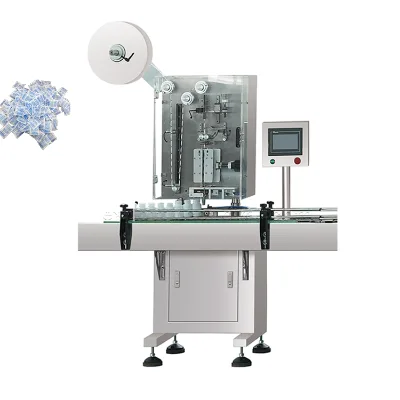
Source Automatic Vertical Desiccant Filling Machine for Pharma, Food, and Chemical Packaging
Find and compare 30 Automatic Vertical Desiccant Filling Machine options from verified suppliers. Evaluate key features such as PLC control, multi-head filling valves, and high-precision counting to select the right equipment for your production line needs.
Key considerations
Products List

Automatic Desiccant Filling Machine
$9500.00 - $15000.00
MOQ: 1 Rolls
Shanghai Yiqi Pharmaceutical Machinery Group Company Limited

Automatic Desiccant Filler Machine
$9800.00 - $12000.00
MOQ: 1 Sets
Shanghai Yiqi Pharmaceutical Machinery Group Company Limited


Factory Supply Automatic Desiccant Filling Machine with High Quality
$5000.00 - $6500.00
MOQ: 1 Pieces


High Frequency Automatic Desiccant Inserting Machine Desiccant Sachet Filling Machine
$9600.00 - $10800.00
MOQ: 1 Sets


Automatic Inserting Desiccant Filling Machine Desiccant Cutting and Inserting Machine
$6800.00 - $7200.00
MOQ: 1 Sets


Fully Automatic Desiccant Bottling Machine Desiccant Inserting Machine
$6800.00 - $7200.00
MOQ: 1 Sets




Comprehensive Sourcing Guide
Automatic Vertical Desiccant Filling Machine Sourcing Guide
The Automatic Vertical Desiccant Filling Machine represents a critical component in modern pharmaceutical and industrial packaging lines, specifically designed to integrate seamlessly with automatic counting systems. These machines utilize a vertical structure to handle desiccant materials, often in capsule or granular forms, ensuring high-precision dosing into bottles or containers. The observed market data indicates that these units are frequently computerized and operate with multi-head filling valves to maximize throughput, making them suitable for high-volume production environments where consistency is paramount.
Buyers must recognize that while the core function remains consistent, the specific configuration of the filling mechanism varies significantly between suppliers. The observed listings highlight a "Multi-Room Feeding" structure and "Chute Lifting" mechanisms, which are essential for managing the flow of desiccants without clogging or bridging. When evaluating potential equipment, procurement teams should focus on how the machine's working principle aligns with their existing automatic counting lines, as the efficiency of the entire packaging process depends on this synchronization.
Product Scope and Observed Listing Signals
The product scope for these machines spans from basic counting fillers to fully integrated pharmaceutical packaging systems, with observed models ranging from 120 to 144 units in specific configurations. Listings indicate a capacity range of 50 to 120 bottles per minute, suggesting that the equipment is scalable for different production demands. The physical dimensions of the machinery vary, with some units measuring approximately 138011003600 mm, while others are more compact at 12008002900 mm, requiring buyers to assess their available floor space carefully before ordering.
A critical signal in the current market is the diversity in packaging materials and output forms, with some units specifically tailored for plastic bottles and others for square-shaped containers. The observed data shows that while some machines are designed for general furniture or building applications, the primary focus for this keyword is on pharmaceutical-grade packaging where precision is non-negotiable. Buyers should verify if the machine's "Workmanship" aligns with molding machinery standards if they intend to produce custom desiccant shapes, as this affects the final product quality and regulatory compliance.
Technical Specifications to Verify
When verifying technical specifications, the power consumption and voltage requirements are primary considerations, with observed units operating at 0.5kw to 1.0 Kw on 220V systems. The "High Precision" attribute is a standard expectation for these machines, but buyers must confirm the specific tolerance levels and the reliability of the "PLC Control" systems that manage the dosing process. The "Multi-Head" filling valve configuration is a key differentiator, as it directly impacts the speed and uniformity of the filling operation, and should be matched against the required production rate of 50 to 120 bottles per minute.
The structural design of the machine, whether vertical or horizontal, dictates the integration path with existing conveyor systems and counting lines. The "Feed Cylinder Structure" and "Chute Lifting" mechanisms must be inspected to ensure they can handle the specific density and flow characteristics of the desiccant material being used. Additionally, the "Nominal Thickness" of 19mm observed in some listings may refer to specific component dimensions or material thicknesses that impact durability, and this should be cross-referenced with the machine's intended lifespan and maintenance schedule.
Compliance and Safety Documentation
Compliance documentation is a non-negotiable aspect of sourcing industrial packaging machinery, particularly for pharmaceutical applications where regulatory bodies enforce strict standards. The observed listings frequently cite CE certification, which is a baseline requirement for equipment sold in many international markets, but buyers should also look for additional certifications such as ISO, FDA, PDA, and PCI depending on the target market and end-use application. These certifications validate that the machine meets specific safety, quality, and performance benchmarks, reducing the risk of regulatory rejection during product audits.
Safety features and operational protocols must be clearly documented in the user manuals and technical datasheets provided by the supplier. The "Condition" of the machine, typically listed as "New," implies that it should come with full safety interlocks and emergency stop mechanisms, but buyers must verify that these systems are functional and compliant with local occupational health and safety regulations. The "After-Sales Service" options, including online support and video technology assistance, are critical for ensuring that any safety-related issues can be resolved quickly without halting production for extended periods.
Cost Drivers and Commercial Terms
The cost of an Automatic Vertical Desiccant Filling Machine is driven by several factors, including the complexity of the control system, the precision of the dosing mechanism, and the level of customization required. Observed price ranges in the market span from 1000 to 80,000 USD, reflecting the vast difference between basic counting fillers and fully automated, computerized pharmaceutical packaging lines. Buyers should be aware that higher prices often correlate with advanced features like "Computerized" control, "High Precision" dosing, and comprehensive "After-Sales Service" packages, rather than just raw material costs.
Commercial terms such as Minimum Order Quantity (MOQ) and lead times are equally important, with observed listings showing an MOQ of 1 unit, which offers flexibility for small-scale procurement. However, the "Seaworthy Packing" and "Wooden Case" packaging requirements can significantly impact shipping costs and logistics planning, especially for international buyers. The "Warranty" period, typically observed as 1 Year, should be clearly defined in the contract, including what specific components are covered and the response time for technical support, as these terms directly affect the total cost of ownership.
Supplier Qualification and Quality Control
Supplier qualification requires a thorough vetting process that goes beyond checking basic certifications to assess the manufacturer's track record in producing reliable packaging machinery. The "Certification" list, which may include CE, ISO, and FDA, serves as an initial filter, but buyers should also request references from previous clients who have used similar machines in comparable production environments. The "Workmanship" of the machine, described as "Molding machinery" in some contexts, indicates the level of engineering expertise involved, and this should be verified through site visits or detailed video inspections of the manufacturing process.
Quality control measures must be embedded in the procurement process, starting from the initial design phase through to the final factory acceptance test. Buyers should insist on a detailed inspection report that covers the "Condition" of the machine, the accuracy of the "Dosing Device," and the integrity of the "Packaging Material" compatibility. The "Weight" of the machine, observed at 130kg for some models, is a useful metric for verifying the robustness of the build, but it should be accompanied by stress test results to ensure the machine can withstand continuous operation without degradation in performance.
Long-Term Procurement Checks
Long-term procurement success depends on establishing a robust relationship with the supplier that includes ongoing technical support and spare parts availability. The "After-Sales Service" options, such as "Support Online" and "Video Technology Support," are essential for maintaining machine uptime, but buyers should also negotiate for on-site service availability for critical repairs. The "Customization" availability is a key factor for long-term adaptability, allowing the machine to be modified as production needs change or as new desiccant formulations are introduced.
Regular maintenance and performance monitoring are critical to extending the lifespan of the Automatic Vertical Desiccant Filling Machine. Buyers should implement a schedule for checking the "Feed Cylinder Structure" and "Filling Valve Head" for wear and tear, ensuring that the "High Precision" capabilities are maintained over time. The "Standard" production capacity of 50 to 120 bottles per minute should be periodically verified against actual output to detect any decline in efficiency, and any deviations should be addressed immediately through the supplier's support channels to prevent costly production delays.
FAQs
What is the production capacity of this Automatic Vertical Desiccant Filling Machine?
The machine operates at a capacity of 50 to 120 bottles per minute. This high-speed performance ensures efficient output for continuous production lines. The system is designed to work together with automatic counting lines to maintain consistent throughput. Operators can rely on this rate for standard packaging demands without significant bottlenecks.
Can the Automatic Vertical Desiccant Filling Machine be customized for specific needs?
Yes, customization is available for this equipment. Buyers can request tailored specifications to match unique production requirements. The machine supports customized configurations to integrate seamlessly into existing workflows. This flexibility allows businesses to adapt the system for various packaging formats and operational constraints.
What certifications does the Automatic Vertical Desiccant Filling Machine hold?
The machine holds CE certification, ensuring compliance with European safety standards. Some variants may also include ISO, FDA, PDA, and PCI certifications depending on the model. These credentials verify that the equipment meets rigorous quality and safety requirements for industrial use. Buyers should verify specific certification documents for their target markets.
How is the Automatic Vertical Desiccant Filling Machine packaged for shipping?
The machine is typically packed in a wooden case for protection. Some models use PE film or seaworthy packing to ensure safe transit. This robust packaging prevents damage during international shipping and handling. Buyers receive the equipment securely wrapped to maintain integrity upon arrival at the destination facility.
What is the voltage requirement for the Automatic Vertical Desiccant Filling Machine?
The standard voltage requirement is 220V with a power consumption of 0.5kw. This electrical specification supports efficient operation in most industrial environments. The low power draw helps reduce energy costs during continuous use. Buyers should confirm local voltage compatibility before installation to ensure proper functionality.
What after-sales service is provided for the Automatic Vertical Desiccant Filling Machine?
Support includes online assistance and video technology support for troubleshooting. Buyers can access remote guidance to resolve operational issues quickly. This service model ensures minimal downtime and continuous production flow. The warranty period is typically one year, covering essential component failures under normal use.