Source Concrete Brick Masonry Drill Bits for Masonry, Metal, and Well Drilling
Compare 30 Concrete Brick Masonry Drill Bits from verified Chinese suppliers. Options include solid carbide and diamond core drills with customizable sizes for masonry, metal, and well drilling applications.
Key considerations
Products List




Comprehensive Sourcing Guide
Strategic Sourcing Guide for Concrete, Brick, and Masonry Drill Bits
Understanding the Technical Landscape of Masonry Drilling Tools
When sourcing drill bits specifically for concrete, brick, and masonry applications, buyers must first distinguish between the primary tool categories available in the global market. The supplied product data indicates a clear bifurcation between standard twist drill bits and specialized core drilling systems. The twist drill bit category, often identified by models such as 19305004 or 19314004, is typically constructed from solid carbide. These tools are engineered for high-hardness applications where the primary challenge is penetrating abrasive masonry materials. The technical specifications for these bits often include specific flute configurations, such as W Flute, U Flute, or L Flute, which are critical for chip evacuation and reducing friction during the drilling process.
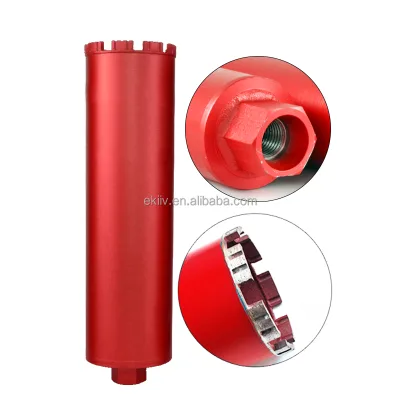
In contrast, the core drill segment represents a more robust solution for creating large-diameter holes. Products in this category, such as the Diamond Core Drill Bit (Model MDB-01 or GMD-DC21006), utilize diamond as the primary cutting material. This distinction is vital because diamond core bits are generally designed for continuous rotation and water cooling in professional settings, whereas solid carbide twist bits are often used for smaller, more precise holes in masonry. The shank shape is another critical technical variable; the observed data points to a "Straight Shank" configuration as a standard feature for many masonry-specific bits. Buyers must verify if their existing power tools are compatible with straight shanks or if they require adapters for other configurations.
Furthermore, the surface finishing process plays a significant role in the longevity of the tool. The provided facts highlight that many masonry drill bits undergo sand blasting and Cr-Coated (Chromium Coated) treatments. This coating is not merely aesthetic; it serves to reduce heat generation and prevent material adhesion to the bit during the drilling of hard concrete or brick. For core drills, the surface treatment may differ, but the material composition remains the defining factor. The availability of "Jobber-length" specifications suggests that standard lengths are common, yet the market also supports customizable lengths, allowing procurement teams to tailor tools to specific project depths.
Compliance Standards and Certification Verification
Navigating the compliance landscape for industrial drilling tools requires a rigorous approach to standard verification. The supplied product information references several international and industry-specific standards, including DIN, API, AISI, and JIS. For instance, specific product listings cite DIN standards, which are particularly relevant for European and global markets where German engineering norms are often adopted. Other entries mention compliance with API (American Petroleum Institute) and AISI (American Iron and Steel Institute) standards, indicating that certain drill bits are manufactured to meet the rigorous demands of oil and gas or heavy industrial applications.
Buyers must exercise caution when interpreting these standard references. The presence of a standard like "DIN" in a product description does not automatically guarantee that every unit in a shipment meets the full certification requirements unless explicitly stated by the manufacturer. Similarly, while the data mentions a "certification" tag for CE, this is listed as low-confidence background information. Therefore, procurement teams should not assume CE compliance is inherent to the product based solely on the keyword search results. Instead, buyers must request specific test reports and certification documents from the supplier to validate that the tools meet the regulatory requirements of the destination market.
The standardization of dimensions is another area requiring attention. The data indicates that some products adhere to specific dimensional standards, such as "475, 580, 6100, 7100, 8120, 10120MM" or "18mm450mm-500mm450mm." These precise measurements suggest a high degree of standardization in the manufacturing process, which is beneficial for inventory management. However, other listings state that "all sizes are available" or "Inch Size: Available," indicating a flexible manufacturing capability. When sourcing, buyers should verify if the supplier can provide documentation confirming that their specific batch adheres to the claimed dimensional tolerances, especially if the tools are intended for use with precision machinery.
Cost Drivers and Pricing Structure Analysis
The pricing structure for concrete and masonry drill bits is influenced by a complex interplay of material costs, manufacturing processes, and order volume. The observed price range in the market spans from $0.05 to $25,000, a variance that reflects the difference between a single standard twist drill bit and a large, industrial-grade core drilling system. The lower end of this spectrum typically corresponds to standard solid carbide twist bits with basic packaging, while the upper end likely encompasses specialized diamond core bits with custom lengths and advanced surface treatments.
Material composition is a primary driver of cost. Solid carbide, while expensive, offers superior hardness and wear resistance compared to high carbon steel, which is also noted in the product data. The choice between these materials directly impacts the unit price. Additionally, the surface finishing process adds value; bits that have undergone sand blasting and chromium coating generally command a higher price point than those with standard finishes. The complexity of the flute design, such as the W Flute or U Flute configurations, also contributes to manufacturing costs due to the precision required in their creation.
Order volume is another critical factor. The observed Minimum Order Quantity (MOQ) ranges from 1 to 1000 units. Suppliers with an MOQ of 1000 may offer lower per-unit costs due to economies of scale, but this requirement can be a barrier for small contractors or projects with low volume needs. Conversely, suppliers offering an MOQ of 1 provide flexibility but at a higher unit price. Buyers should evaluate their total cost of ownership, considering not just the purchase price but also the lead time and shipping costs. The data indicates delivery times ranging from 15 to 45 days, with some specific listings citing 25-35 days or 35-45 days. Longer lead times may necessitate higher inventory holding costs or risk project delays, which should be factored into the overall budget.
Typical Applications and Usage Scenarios
The versatility of masonry drill bits is evident in their diverse application scenarios. The product data explicitly lists usage for masonry drilling, metal drilling, and well drilling. This broad applicability suggests that certain high-quality solid carbide twist bits are designed to handle multiple material types, making them a versatile choice for general construction and maintenance tasks. However, the specific design of the bit must match the primary material to ensure efficiency and safety. For instance, while a bit may be rated for metal drilling, its performance in masonry is optimized by its carbide tip and specific flute geometry.
Core drills, on the other hand, are specialized for creating large holes in concrete and masonry walls, often for plumbing, electrical conduit, or HVAC installations. The "Diamond Core Dill Bit" (noting the likely typo for "Drill" in the source data) is specifically designed for this purpose. The use of diamond as the cutting material allows for clean, precise cuts in reinforced concrete, which would be difficult to achieve with standard twist bits. The thread type, such as "1-1/4" Unc/M22," is crucial for core drills, as it ensures compatibility with various drill rigs and adapters.
The customization options available in the market further expand the range of applications. Buyers can request custom lengths, colors, and even specific standard dimensions. This flexibility is particularly valuable for specialized projects where standard sizes may not suffice. For example, a construction project requiring deep boreholes in thick concrete walls may benefit from a core drill with a custom length. Similarly, the ability to choose between different packing methods, such as bags, tubes, boxes, or blister packs, allows suppliers to tailor the product to the logistical needs of the buyer, ensuring the tools arrive in optimal condition.
Supplier Evaluation and Geographic Considerations
When evaluating potential suppliers for masonry drill bits, geographic origin plays a significant role in understanding the supply chain dynamics. The supplied data identifies China as the primary origin, with specific provinces such as Jiangsu, Zhejiang, and Hebei mentioned. These regions are known for their robust manufacturing capabilities in the hardware and tool industry. Jiangsu and Zhejiang, in particular, are hubs for precision manufacturing, which may correlate with higher quality control standards for products like solid carbide twist bits and diamond core drills.
Supplier evaluation should extend beyond location to include an assessment of their customization capabilities. The data indicates that "Customization: Available" and "Customized: Customized" are attributes of many suppliers. This suggests that many manufacturers are willing to tailor their products to specific buyer requirements, such as custom lengths or specific surface finishes. Buyers should verify the extent of this customization, including whether it affects lead times or minimum order quantities. The presence of "on Request" packaging options also indicates a supplier's willingness to accommodate specific logistical needs.
Quality control is another critical aspect of supplier evaluation. While the data mentions various standards and certifications, the actual implementation of quality control measures varies by supplier. Buyers should request evidence of consistent quality, such as batch testing records or quality assurance certificates. The mention of specific models like "DIN345" or "GM-DB358" suggests that suppliers have established product lines with known specifications. Verifying the consistency of these models across different batches can help ensure that the buyer receives reliable, high-performance tools.
Quality Control and Long-Term Procurement Strategies
Ensuring the quality of masonry drill bits requires a proactive approach to quality control throughout the procurement lifecycle. Buyers should establish clear acceptance criteria based on the technical specifications provided, such as material composition (solid carbide or diamond), surface finishing (sand blasted, Cr-coated), and dimensional accuracy. Regular sampling and testing of incoming shipments can help identify any deviations from the agreed-upon standards. For instance, verifying the hardness of the carbide tip or the integrity of the chromium coating can prevent the use of substandard tools that may fail during critical operations.
Long-term procurement strategies should focus on building strong relationships with suppliers who demonstrate reliability and flexibility. The data shows a wide range of lead times, from 15 to 45 days, which can impact project planning. Suppliers who can consistently meet their delivery timelines and offer responsive customer service are valuable partners. Additionally, the availability of customizable options allows buyers to adapt their procurement strategy to changing project needs. For example, if a project requires a specific drill bit size that is not in the standard catalog, a supplier with strong customization capabilities can provide a tailored solution.
Finally, buyers should consider the total cost of ownership when making long-term procurement decisions. While the initial purchase price is important, the lifespan and performance of the drill bit are equally critical. High-quality tools, such as those made from solid carbide with advanced surface treatments, may have a higher upfront cost but can offer significant savings over time by reducing replacement frequency and improving drilling efficiency. By prioritizing quality and reliability, buyers can ensure that their masonry drilling operations remain efficient and cost-effective in the long run.
FAQs
What materials are used for Concrete Brick Masonry Drill Bits?
Solid carbide and diamond are the primary materials used. Solid carbide is common for twist drill bits, while diamond is used for core drilling applications to ensure durability in hard masonry.
Which standards do these drill bits typically follow?
Many products adhere to DIN, API, AISI, and JIS standards. Specific dimensional standards like 4*75mm or 18mm*450mm are also common, ensuring compatibility with various industrial tools.
Can buyers request customized lengths for these drill bits?
Yes, customization is available for lengths and colors. Some listings specify customizable lengths, allowing procurement teams to tailor tools to specific project depth requirements.
How long is the typical delivery time for these items?
Delivery times range from 15 to 45 days depending on the supplier. Specific listings indicate lead times of 25-35 days or 35-45 days for custom orders.
What is the minimum order quantity for purchasing these bits?
Minimum order quantities vary from 1 to 1000 units. Some suppliers require an MOQ of 1000, while others offer flexible options starting from a single unit.
Which surface finishing processes are applied to these drill bits?
Common finishes include sand blasting and Cr-coated treatments. These processes reduce heat generation and prevent material adhesion during the drilling of hard concrete or brick.