Source Foldable Plastic Storage Basket for Supermarkets, Warehouses, and Retail
Compare 30 listings of Foldable Plastic Storage Basket options featuring double handles, stackable designs, and various capacities. Buyers can evaluate models like SB066 and SH-SC4 with different MOQs and packing methods from suppliers in Guangdong and Jiangsu.
Key considerations
Products List


Hdpp Vegetable Storage Plastic Basket Plastic Plastic Fruit Storage Basket
$10.00 - $15.00
MOQ: 200 Pieces


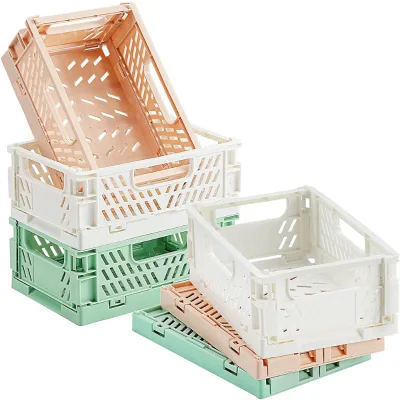


Comprehensive Sourcing Guide
Strategic Sourcing Guide for Foldable Plastic Storage Baskets
Understanding Technical Specifications and Material Composition
When sourcing foldable plastic storage baskets, the primary objective is to identify products that balance structural integrity with space-saving efficiency. The core material for these units is typically high-density polyethylene or similar durable plastics, which provide the necessary rigidity to hold weight while allowing the folding mechanism to function without cracking. Buyers must verify that the material specification explicitly states "Plastic" and confirms the product condition is "New," ensuring no recycled or compromised materials are used in the manufacturing process.
A critical technical attribute is the folding capability. Products are often categorized as "Folded" or "Foldable," indicating their ability to collapse for storage when not in use. This feature is essential for logistics and warehousing where space is at a premium. The design usually incorporates a "Double" handle configuration, which facilitates easier carrying and maneuvering, especially when the basket is loaded to its maximum capacity. In the observed market data, specific carrying capacities are noted, such as units rated for 30kg. However, buyers should treat this as an observation of specific models rather than a universal standard, as capacity varies by model number and wall thickness.
The physical dimensions and standardization of the basket are equally important. Some models adhere to specific dimensional standards, such as 590x405x195mm, 545x480x130mm, or 600x400x150mm. These dimensions often dictate compatibility with shelving systems, pallets, and transport containers. Other models may offer "Customized" sizes, allowing buyers to tailor the footprint to specific inventory needs. The stacking capability is another vital technical specification; many foldable crates are designed to be "Stackable," ensuring stability when multiple units are piled vertically. This feature maximizes vertical storage space in retail environments or warehouses.
Compliance, Certification, and Safety Standards
Navigating the compliance landscape for plastic storage solutions requires a careful review of the standards and certifications listed by suppliers. While specific certifications like BSCI or REACH are often mentioned in broader industry contexts, the provided data highlights specific standards such as CE, ROHS, and SGS. These are critical indicators of product safety and environmental compliance. The CE mark suggests conformity with health, safety, and environmental protection standards for products sold within the European Economic Area. Similarly, ROHS compliance indicates that the product is manufactured without specific hazardous substances, which is increasingly important for global supply chains.
The presence of SGS certification is a significant data point, as it often implies third-party verification of quality and safety. However, buyers must distinguish between a supplier claiming a standard and the actual certification status of a specific batch. The data also lists "590X405X195mm" under the "prod_standard" field, which suggests that for some models, the standard refers to dimensional specifications rather than a safety certification. This distinction is crucial; a dimensional standard does not equate to a safety certification. Buyers should verify whether the supplier provides a valid SGS test report for the specific model number, such as SH-SC4 or HBE-CC, rather than relying on a general claim.
Furthermore, the "Antitheft" attribute is listed as "Not Antitheft" for certain models. This is a functional specification rather than a security feature. Buyers requiring theft-deterrent features for high-value retail environments must explicitly seek models with integrated locking mechanisms or RFID compatibility, as the standard foldable plastic basket does not inherently possess these security attributes. The "Warranty" period is another compliance-adjacent factor, with some models offering a "1 Year" warranty. This warranty serves as a guarantee of durability and manufacturer confidence, which should be scrutinized against the expected usage frequency and load conditions.
Cost Drivers and Pricing Dynamics
The pricing structure for foldable plastic storage baskets is influenced by several variable factors, including material costs, customization levels, and order volume. The observed price range in the market spans from $0.33 to $15.00 USD. This wide disparity is not indicative of a single product tier but rather reflects differences in size, material thickness, design complexity, and order quantity. Lower-priced items in the $0.33 range are likely small, non-customized units with basic designs, while the higher end of the spectrum likely corresponds to larger, custom-sized crates with enhanced durability features or specialized packaging.
The Minimum Order Quantity (MOQ) is a primary driver of unit cost. The data shows an MOQ range from 5 to 5,000 units. Suppliers typically offer tiered pricing where the unit cost decreases as the order volume increases. For instance, a model with an MOQ of 200 units may have a different price point than one requiring 1,000 or 5,000 units. Buyers must calculate the total cost of ownership, which includes the unit price multiplied by the MOQ, plus shipping and handling. A lower MOQ allows for smaller initial investments and reduced inventory risk, which is beneficial for testing new markets or fulfilling small-scale retail needs. Conversely, higher MOQs are necessary to achieve the most competitive unit prices, making them suitable for large-scale distribution or long-term stockpiling.
Customization is another significant cost driver. While the attribute "Customization: Available" is noted, it often comes with a premium. Custom colors, specific dimensions, or unique branding on the crate can increase the production cost and potentially the MOQ. The "Color: Various Option" and "Color: Customized" attributes suggest that buyers have flexibility here, but they must confirm if color customization affects the lead time or requires a separate mold fee. Additionally, the "prod_packing" method, whether "Color Sleeve," "Carton Pack," or "Bulk Pack," impacts the final landed cost. Bulk packing (e.g., 10PCS/CTN) is generally more cost-effective for shipping than individual color sleeves, which add material and labor costs.
Typical Applications and Usage Scenarios
Foldable plastic storage baskets are versatile tools designed for a variety of commercial and industrial applications. The primary usage category identified is "Supermarkets and Stores," where these baskets serve as portable shopping aids or internal stock management tools. Their "Portable" design and "Double" handles make them ideal for customers to carry goods or for staff to transport items from the backroom to the sales floor. The "Display Place: Indoor" specification confirms that these units are optimized for indoor environments, protecting the plastic from UV degradation that might occur in outdoor settings.
Beyond retail, these crates are utilized in logistics and warehousing. The "Stackable" feature is particularly valuable in these settings, allowing for efficient vertical storage of goods. The "Foldable" nature allows for significant space savings when the crates are empty, reducing the volume required for return logistics or storage during off-peak seasons. The "Keyword: Collapsible Crate" further emphasizes their utility in supply chains where space optimization is critical. The "Usage" attribute also hints at broader applications in "Stores," which could include convenience stores, specialty shops, or wholesale outlets.
The "Name: Folding Fruit Crate" suggests a specific application in the fresh produce industry. In this context, the baskets must be durable enough to hold heavy loads of fruit without collapsing, while the foldable design aids in cleaning and sanitation between uses. The "Carrying Capacity: 30kg" is a relevant benchmark for these heavy-duty applications. Buyers in the food and beverage sector should verify that the plastic material is food-grade and that the design allows for easy cleaning to meet hygiene standards. The "Without Heat-Preservation" attribute indicates that these are not insulated containers, making them unsuitable for temperature-controlled transport unless used in conjunction with external cooling systems.
Supplier Evaluation and Geographic Considerations
Evaluating suppliers for foldable plastic storage baskets requires a focus on geographic origin, production capacity, and reliability. The data indicates that products originate from "Guangdong," "Jiangsu," "Changshu," and generally "China." These regions are known for their robust manufacturing ecosystems and plastic processing capabilities. Guangdong and Jiangsu are particularly prominent for export-oriented manufacturing, often offering a balance of quality and cost-effectiveness. However, buyers should not assume that all products from these regions meet the same quality standards; specific factory audits and sample testing are necessary.
The "Lead Time" is a critical metric for supplier evaluation. The observed lead time is "30days," which serves as a baseline for production and shipping. Buyers must clarify if this lead time includes mold creation for custom orders or if it applies only to standard models. For customized products, the lead time may extend significantly. The "MOQ" values, ranging from 200 to 5,000 units, also reflect the supplier's production scale. A supplier with a high MOQ might be a large-scale manufacturer capable of handling massive orders, while a supplier with a low MOQ might be a smaller workshop better suited for niche or custom requests.
When assessing suppliers, buyers should verify the "prod_model" numbers provided, such as SB066, SB067, SB068, FB-3, HBE-CC, SH-SC4, SH-H13, SH-2GL, and SH-SC. These model numbers are specific identifiers that help in tracking inventory and ensuring consistency. A reputable supplier will maintain a clear catalog of these models with detailed specifications. Additionally, the "Condition: New" attribute should be confirmed for all units, as some suppliers might offer refurbished or second-hand stock at lower prices, which is generally not recommended for commercial use.
Quality Control and Long-Term Procurement Strategy
Implementing a robust quality control (QC) strategy is essential for ensuring the longevity and performance of foldable plastic storage baskets. The "Warranty: 1 Year" offered by some models provides a baseline for expected durability, but buyers should not rely solely on this. Instead, they should conduct pre-shipment inspections to verify the structural integrity of the folding mechanism, the strength of the handles, and the uniformity of the plastic material. The "Folded" and "Foldable" attributes must be tested repeatedly to ensure the hinges do not weaken over time.
For long-term procurement, buyers should consider the "Customization" availability as a strategic lever. If a buyer requires specific dimensions or branding, they should negotiate a long-term agreement that locks in pricing and ensures consistent quality. The "Standard" attributes, such as CE, ROHS, and SGS, should be re-verified for each production batch to ensure ongoing compliance. The "prod_packing" method should also be standardized to prevent damage during transit; "Export Carton" or "Carton Pack" options are generally preferred over "Bulk Pack" for international shipping to ensure better protection.
Finally, buyers should maintain a flexible procurement strategy that accounts for market fluctuations. The wide range of MOQs and prices allows for a mix of strategies: using low-MQO suppliers for testing and high-MQO suppliers for volume. By monitoring the "Lead Time" and "MOQ" trends, buyers can adjust their inventory levels to avoid stockouts or overstocking. The "Color: Various Option" and "Color: Customized" features can also be leveraged for brand differentiation, but buyers must ensure that color consistency is maintained across different production runs. Ultimately, the success of sourcing foldable plastic storage baskets depends on a detailed understanding of the technical specifications, a rigorous approach to compliance, and a strategic partnership with reliable suppliers.
FAQs
Can I customize the color and size of these baskets?
Yes, customization for color and size is available for many models. Buyers should verify specific model requirements as some units like the SB066 series offer various options while others may need bulk orders to enable custom dimensions.
What is the typical lead time for these plastic crates?
The standard lead time for production is approximately 30 days. This duration applies to standard models but may vary if the order requires custom specifications or specific packaging methods like export cartons.
Which models offer a carrying capacity of 30kg?
Specific models in the catalog are rated for a carrying capacity of 30kg. This capacity is an observation for certain units and buyers should check the product model details to confirm weight limits before purchasing.
What certifications do these foldable baskets typically hold?
Some models carry CE, ROHS, and SGS standards for safety and quality. Buyers must verify that the specific batch holds valid certification documents rather than assuming all listed products automatically meet these standards.
How does the minimum order quantity affect pricing?
The minimum order quantity ranges from 5 to 5000 units depending on the supplier and model. Higher order volumes generally secure lower unit prices, with some models requiring 500 or 1000 pieces as a baseline.
Are these baskets suitable for indoor supermarket use?
Yes, the design is intended for indoor display places like supermarkets and stores. The portable nature and double handles make them ideal for carrying goods, though they lack heat preservation features for temperature control.
What packaging options are available for these crates?
Packaging varies by model and includes color sleeves, carton packs, or bulk packs with 10 pieces per carton. Export cartons are also available, and the choice impacts shipping costs and product protection during transit.