Source Fully Automatic Tip-Back Industrial Kettle with Planetary Mixer for Bread, Cake, and Dough
Find 30 listings for the fully automatic tip-back industrial kettle with planetary mixer designed for food factories. Buyers can compare capacities from 50L to 2000L, heating methods, and material grades like SS304 to suit production needs for bread, cake, and dough.
Key considerations
Products List

Industrial Large Capacity Planetary Mixing Cooking Mixer Jacketed Kettle with Agitators
$5800.00 - $15000.00
MOQ: 1 Pieces

Full Automatic Jacketed Kettle with Mixer Planetary Stirring Cooking Pot
$5800.00 - $15000.00
MOQ: 1 Pieces


Cooking Mixer Machine Planetary Mixing Jacketed Kettle with Steam Heating
$5800.00 - $15000.00
MOQ: 1 Pieces

Industrial Automaticplanetary Cooking Pot/Planetary Cooking Jacketed Kettle with Mixer
$5000.00 - $15000.00
MOQ: 1 Pieces


Fully Automatic Planetary Stirring Pot Cooking Mixer Industrial Cooking Pot
$1000.00 - $10000.00
MOQ: 1 Pieces


Cooking Jacketed Kettle Industry Planetary Mixer Automatic Pot Stirrer
$1000.00 - $10000.00
MOQ: 1 Pieces


Automatic Industrial Jacketed Cooking Kettle with Planetary Mixer Syrup Cooking Mixer
$3800.00 - $5200.00
MOQ: 1 Pieces

Automatic Cooking Pot with Mixer Cooking Kettle with Planetary Mixer
$3800.00 - $5200.00
MOQ: 1 Pieces


Big Automatic Cooking Kettle Pot Industrial Tilting Gas Electric Sauce Cooking Mixer
$5000.00 - $8000.00
MOQ: 1 Pieces


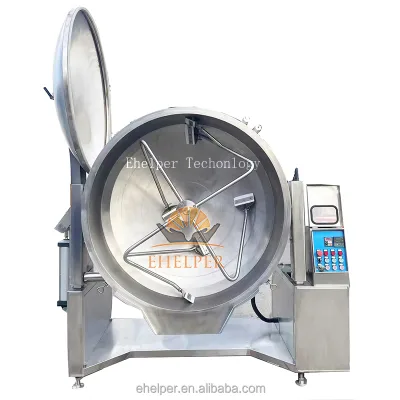


Planetary Stirring Sauce Jam Automatic Cooking Mixer Jacketed Kettle with Mixer
$5000.00 - $5500.00
MOQ: 1 Pieces
Comprehensive Sourcing Guide
Strategic Sourcing Guide for Fully Automatic Tip-Back Industrial Kettles with Planetary Mixers
The procurement of a fully automatic tip-back industrial kettle with a planetary mixer represents a significant capital investment for food processing facilities aiming to enhance production efficiency and product consistency. This equipment category combines high-volume heating capabilities with precise mechanical agitation, making it indispensable for industries ranging from confectionery to savory meal preparation. The core functionality relies on the integration of a jacketed vessel capable of temperature control and a planetary stirring mechanism that ensures uniform mixing without dead zones. When sourcing these units, buyers must navigate a complex landscape of material standards, power configurations, and customization options to ensure the selected machinery aligns with specific operational requirements.
Technical Architecture and Operational Specifications
The fundamental design of an industrial kettle with a planetary mixer centers on the interaction between the heating medium and the mixing dynamics. The planetary stirring method is a critical attribute, where the agitator rotates on its own axis while simultaneously revolving around the central axis of the vessel. This dual motion ensures that the entire volume of the product is processed evenly, preventing scorching and ensuring consistent texture. For applications involving viscous materials like jams, doughs, or meat products, the ability to adjust the mixing speed is essential for optimizing the process without damaging the product structure.
Temperature control is another pillar of technical performance. These units typically feature a jacketed design, often described as having insulation layers, which allows for the circulation of heating media such as steam, gas, biogas, or electricity. The capacity of these vessels varies significantly, with observed ranges spanning from 100 liters up to 2000 liters, allowing facilities to scale operations based on throughput needs. The vessel itself is often designed to be tiltable, a feature that facilitates the easy discharge of heavy or viscous contents. This automatic tilting mechanism reduces manual labor and minimizes the risk of injury during the emptying process.
Material composition is a primary determinant of durability and food safety. The industry standard for construction materials is stainless steel, specifically grades such as SS304 and SS316. The choice between these grades often depends on the corrosiveness of the food product being processed; for instance, highly acidic or saline environments may necessitate the higher corrosion resistance of SS316. Some specifications also reference SS201, though this is generally less common for high-end food processing due to lower corrosion resistance compared to the 300 series. The overall dimensions of the equipment can vary, with specific models noted to have dimensions around 1.65 meters by 1.4 meters by 1.7 meters, or compact configurations like 1200mm by 900mm by 900mm, depending on the capacity and model designation.
Compliance, Certification, and Material Verification
When evaluating suppliers for industrial food processing equipment, verifying compliance with material standards is paramount. While specific certification bodies are not universally mandated for all regions, the material quality must be verifiable. Buyers should insist on documentation confirming the stainless steel grade used in the construction of the vessel and the mixing arms. The presence of "SUS304" or "304 Stainless Steel" should be explicitly confirmed in the product specifications, as this is a widely recognized standard for food-grade equipment.
Regarding electrical and safety standards, the voltage requirements for these machines are typically standardized at 380V, which is common for industrial three-phase power systems. However, the power source can vary, with options including electric, gas, or biogas heating methods. This variability requires careful verification of the local utility infrastructure at the installation site. A fully automatic system often includes a Programmable Logic Controller (PLC) system, which may be optional depending on the level of automation required. The inclusion of a PLC allows for precise control over temperature, mixing speed, and timing, which is crucial for maintaining batch consistency.
Buyers must also verify the origin of the components. While the manufacturing origin is frequently cited as China, with specific regions like Henan and Shandong being noted production hubs, the quality of the final assembly depends on the supplier's quality control processes. There is no single universal certification that applies to all units, so the focus should be on the supplier's ability to provide material certificates and adherence to international food safety design principles. The absence of a timing device in some configurations versus the presence of one in others highlights the need for buyers to explicitly define their process control needs before ordering.
Cost Drivers and Financial Considerations
The pricing of fully automatic tip-back industrial kettles is influenced by a complex matrix of factors, including capacity, material grade, and the level of automation. The observed price range for these units in the market spans from 1000 to 20,000 USD, reflecting the vast difference between a small-scale 100-liter unit and a large-scale 1000-liter or 2000-liter automated system. The primary cost driver is the volume of the vessel; a 1000-liter unit will inherently cost more than a 100-liter unit due to the increased amount of stainless steel required and the larger motor specifications needed for planetary mixing.
Material selection significantly impacts the final cost. Upgrading from SS304 to SS316 increases the material cost due to the higher nickel and molybdenum content in the alloy, which provides superior resistance to chlorides and acids. Similarly, the choice of heating method affects the price; electric heating elements are generally more straightforward to install but may have higher operating costs depending on local electricity rates, whereas gas or steam heating systems require additional infrastructure but may offer lower fuel costs.
The level of customization is another critical financial factor. While some units are available as standard models, the market offers extensive customization options. Buyers can request specific dimensions, custom voltage configurations, or specialized control panels. The "Customized" attribute is frequently available, allowing for tailored solutions that fit unique production lines. However, this customization often comes with a premium price and potentially longer lead times. The Minimum Order Quantity (MOQ) for these industrial units is typically low, often starting at just one set, which allows small to medium-sized enterprises to enter the market without massive initial inventory commitments.
Typical Applications and Process Versatility
The versatility of the fully automatic tip-back industrial kettle with planetary mixer makes it suitable for a wide array of food processing applications. The planetary stirring method is particularly effective for products that require uniform heat distribution and consistent texture. Common applications include the production of bread, cakes, biscuits, and pizza doughs, where the gentle yet thorough mixing is essential for gluten development and ingredient incorporation.
In the savory sector, these kettles are widely used for making popcorn, vegetable foods, and meat products. The jacketed design allows for precise temperature control, which is vital when cooking sauces, jams, or soups that are prone to burning or separation. The ability to tilt the vessel automatically is a significant advantage in these applications, as it allows for the rapid and complete discharge of the product into packaging lines or cooling tanks.
The scope of application extends to various food factories, including those specializing in noodles, dumplings, empanadas, and samosas. The adjustable mixing speed and controllable temperature enable the machine to handle a diverse range of viscosities, from thin liquids to thick pastes. This flexibility ensures that a single piece of equipment can be utilized for multiple product lines, maximizing the return on investment for the facility.
Supplier Evaluation and Quality Assurance
Selecting the right supplier requires a rigorous evaluation process that goes beyond price comparison. Buyers should assess the supplier's production capabilities, specifically their ability to manufacture units that meet the specified material standards. The origin of the product, often cited as China, suggests a robust manufacturing base, but the specific location, such as Henan or Shandong, may indicate different regional specializations. It is advisable to request factory audits or virtual tours to verify the production environment and quality control measures.
Quality assurance should focus on the welding quality of the stainless steel vessel, the precision of the planetary gear system, and the reliability of the control systems. The "Stir Evenly" feature is a key performance indicator that should be validated through reference videos or testimonials from existing customers. Additionally, the packaging method, which typically involves plywood cases or wooden boxes, is crucial for protecting the equipment during international shipping. The "Exported Wooden Case" or "Standard Export Packing" ensures that the machinery arrives in pristine condition, ready for installation.
Payment terms, such as T/T (Telegraphic Transfer), and shipping ports, like Qingdao, are standard elements of the transaction. Buyers should ensure that the supplier has a clear understanding of Incoterms and can provide reliable logistics support. The lead time, while not explicitly defined in all contexts, should be clarified during the negotiation phase, especially for customized orders.
Long-Term Procurement and Maintenance Strategy
Investing in a fully automatic tip-back industrial kettle is a long-term decision that requires careful consideration of maintenance and operational longevity. The durability of the equipment depends heavily on the quality of the stainless steel and the robustness of the mechanical components. Regular maintenance of the planetary mixer gears and the heating jacket is essential to prevent downtime and ensure consistent performance.
Buyers should consider the availability of spare parts and the technical support offered by the supplier. A supplier that provides comprehensive documentation, including operation manuals and maintenance guides, adds significant value to the procurement. The optional PLC system offers the potential for future upgrades and integration with other factory automation systems, which can extend the useful life of the equipment as production needs evolve.
Furthermore, the energy efficiency of the heating system should be evaluated in the context of long-term operational costs. Whether using electric, gas, or steam heating, the efficiency of the heat transfer through the jacketed vessel will impact the overall cost of production. Selecting a unit with high-quality insulation can reduce energy consumption and improve the thermal efficiency of the cooking process.
Summary of Key Procurement Parameters
To facilitate a structured comparison during the sourcing process, the following table summarizes the critical parameters buyers should verify when evaluating potential suppliers for fully automatic tip-back industrial kettles with planetary mixers.
| Parameter | Typical Range / Options | Verification Requirement |
|---|---|---|
| Capacity | 50L to 2000L (Common: 100L-1000L) | Confirm exact volume matches production needs. |
| Material Grade | SS304, SS316, SS201 | Request material certificates for vessel and agitator. |
| Mixing Method | Planetary Stirring | Verify agitator motion and speed adjustability. |
| Heating Source | Electric, Gas, Biogas, Steam | Match with available facility utilities. |
| Voltage | 380V (Standard) | Confirm compatibility with local power grid. |
| Tilting Mechanism | Automatic Tiltable | Test discharge flow and safety interlocks. |
| Control System | PLC Optional / Manual | Determine need for automation and timing devices. |
| Origin | China (e.g., Henan, Shandong) | Verify factory location and export experience. |
| Packing | Plywood Case / Wooden Box | Ensure packaging meets export shipping standards. |
| MOQ | 1 Set | Confirm flexibility for small or large orders. |
By adhering to these guidelines and focusing on the specific technical and operational requirements outlined above, buyers can make informed decisions that ensure the acquisition of high-quality, reliable industrial kettles. The goal is to secure equipment that not only meets current production demands but also offers the flexibility and durability required for future growth.
FAQs
What mixing method does this industrial kettle use?
This equipment uses a planetary stirring method to ensure uniform mixing without dead zones. The agitator rotates on its own axis while revolving around the vessel center, which is ideal for viscous products like doughs and jams.
Can the kettle temperature be controlled during operation?
Yes, the temperature is controllable through a jacketed design that supports various heating media. Options include electric, gas, biogas, or steam heating to maintain precise thermal conditions for different food processing applications.
Which stainless steel grades are used for construction?
The vessel is constructed from SS201, SS304, or SS316 stainless steel depending on the specific model. Higher grades like SS316 offer better corrosion resistance for acidic or saline food products compared to standard SS304.
How does the automatic tilting feature work?
The pot tilts automatically to facilitate the easy discharge of heavy or viscous contents. This mechanism reduces manual labor and minimizes injury risks by allowing complete emptying into packaging lines or cooling tanks.
What is the minimum order quantity for this mixer?
The minimum order quantity is one set, allowing small to medium enterprises to purchase without large inventory commitments. This low MOQ applies to standard models and facilitates entry into the market for various facility sizes.
Can the machine be customized for specific needs?
Customization is available for dimensions, voltage, and control panels to fit unique production lines. Buyers can request specific configurations, though this may affect the final price and lead time compared to standard models.