Source Pipe Connection American Hose Clamp for Machinery, Motors, Appliances
Find and compare 30 listings for Pipe Connection American Hose Clamp suitable for machinery, motors, and electrical appliances. Buyers can evaluate specifications like width, thickness, and surface treatment from verified suppliers in China.
Key considerations
Products List




Comprehensive Sourcing Guide
Strategic Sourcing Guide for American Type Pipe Connection Hose Clamps
Understanding Product Specifications and Material Integrity
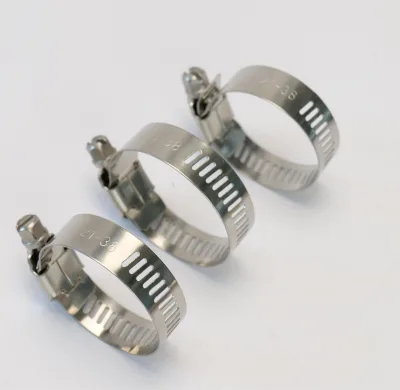
When sourcing pipe connection American hose clamps, the primary objective is to identify components that ensure a secure, leak-free seal across various fluid and gas transfer applications. The core product category involves metal fastening devices designed to encircle hoses and pipes, applying radial pressure to maintain connection integrity. Based on observed market data, these clamps are predominantly manufactured from Stainless Steel, a material choice driven by its superior corrosion resistance and mechanical strength in demanding environments. However, buyers must also account for listings that specify generic "Metal" as the material, necessitating a verification step to confirm the specific alloy grade before finalizing orders.
The physical dimensions of these clamps vary significantly to accommodate different pipe diameters. Observed specifications indicate a width range of 9.7mm to 14mm, with specific models offering widths of 12mm, 12.7mm, and 14mm. The thickness of the band is a critical factor in the clamp's ability to withstand high internal pressures without deforming; observed data points to a thickness of 0.7mm for certain models. It is essential for procurement teams to cross-reference these dimensions against the specific hose or pipe diameter they intend to secure. The product models identified in the market include "YFAH," "AH," and "European Type" variants, alongside specific model numbers like "a-10341."
The head type is another defining characteristic. The "Round" head type is a common observation in this category, influencing the torque application and the ease of installation. Furthermore, the surface treatment process varies; some units are observed with "Polishing" or "Polished" finishes to reduce friction and enhance aesthetics, while others are listed as "Without Treatment" or "Painted." Buyers should note that "Natural" color is a frequent attribute, corresponding to the uncoated stainless steel appearance, whereas "Silver" is also a documented color option. Understanding these variations is vital, as the surface treatment directly impacts the longevity of the clamp in corrosive or high-temperature settings.
Compliance, Certification, and Standard Verification
In the B2B procurement of industrial hardware, compliance with international standards and certifications is non-negotiable. The American Type Hose Clamp market demonstrates a mix of standardization levels. Observed data indicates that some suppliers adhere to specific national and international standards, including "GB" (Guobiao) and "DIN" (Deutsches Institut für Normung). Other listings claim compliance with a broad range of "Standard" sizes, often denoted by ranges such as 8-12, 10-16, 13-19, up to 155-178mm. A crucial distinction must be made between these specific standard references and the general claim that "all sizes are available" or "Full sizes" are offered.
Certification plays a pivotal role in risk mitigation. The supply chain for these clamps frequently lists "CE," "ISO," and "RoHS" as available certifications. The CE marking indicates conformity with health, safety, and environmental protection standards for products sold within the European Economic Area. RoHS compliance ensures that the product is free from specific hazardous substances, which is often a requirement for export to regulated markets. While "ISO 9001:2015" is mentioned in background knowledge, buyers must verify if this specific quality management system certification is actively held by the supplier in question, as it is not universally confirmed in the primary product facts.
Additionally, safety ratings are a key consideration for applications involving flammable fluids or gases. Some product listings explicitly state a "High" flame retardant rating or a "94V" material rating, which refers to the UL 94 standard for flammability of plastic materials, though this may apply to the packaging or specific components rather than the metal clamp itself. Buyers must scrutinize these claims to ensure they align with the specific safety requirements of their end-use application. The origin of the products is consistently listed as "China," with specific provinces including "Zhejiang" and "Tianjin." While these are major manufacturing hubs, the specific origin should be verified on the purchase order to ensure traceability and to manage any potential geopolitical or logistical risks associated with specific regions.
Cost Drivers and Pricing Dynamics
The pricing structure for American Type Hose Clamps is influenced by a complex interplay of material costs, manufacturing complexity, and order volume. The observed price range in the market is notably low, spanning from 0 to 5 USD per unit. This wide range suggests that the listed prices may represent different tiers of quality, bulk pricing tiers, or potentially sample costs versus production unit costs. It is imperative for buyers to understand that a price at the lower end of this spectrum may correlate with generic metal compositions or less rigorous surface treatments, whereas prices at the higher end likely reflect high-grade stainless steel, precise polishing, and certified compliance.
Minimum Order Quantity (MOQ) is a significant cost driver. The observed MOQ range is extensive, spanning from 1 PCS to 10,000 units. This variability offers flexibility for different procurement strategies. A low MOQ of 1 PCS allows for prototyping, sampling, and small-batch testing without significant capital commitment. Conversely, an MOQ of 10,000 units typically unlocks economies of scale, potentially reducing the unit cost significantly. Buyers must calculate the total cost of ownership, factoring in the MOQ requirement against their inventory turnover rates. Ordering 10,000 units might result in a lower per-unit price but increases storage costs and capital tie-up.
Packaging also influences the final cost. Standard packaging is observed as "100PCS/Bag-Polybag-Label-Carton" or "100PCS/Bag with Label." Some listings mention "colour box" packaging, which is typically more expensive and intended for retail or high-end distribution. The choice between bulk polybag packaging and individual color boxes will impact the unit price and the logistics costs associated with shipping and handling. Furthermore, the availability of "Free" samples is a notable market attribute that can reduce the initial research cost, allowing buyers to physically inspect the product quality before committing to a larger order.
Typical Applications and Usage Scenarios
The versatility of American Type Hose Clamps makes them suitable for a diverse array of industrial and commercial applications. The primary usage categories identified include "Pipe Clamp," "Glass Clamp," and "Heavy Duty Clamp." This indicates that the product line is not limited to simple hose connections but extends to structural applications requiring robust fastening. In the automotive and machinery sectors, these clamps are utilized for securing hoses in "Car," "Machinery," and "Motor" applications. The ability to withstand the vibrations and thermal cycling inherent in these environments is a critical performance requirement.
Beyond automotive uses, the clamps are specified for "Electrical Appliance" applications, where they may be used to secure conduit or cable management systems. The "Connection" application is a broad category that encompasses fluid transfer, air lines, and hydraulic systems. The measurement systems supported include both "Inch" and "Metric System," which is essential for global procurement, ensuring compatibility with equipment manufactured in different regions. The "American Type" designation often implies a specific worm-drive mechanism or band design that is widely recognized and compatible with standard US-based industrial equipment.
The "High" flame retardant attribute suggests suitability for environments where fire safety is paramount, such as in chemical processing or heavy industrial settings. The "Natural" and "Silver" color options allow for aesthetic integration or identification within complex piping systems. Buyers should map these usage attributes to their specific operational needs. For instance, a "Heavy Duty Clamp" with a 0.7mm thickness and stainless steel construction is ideal for high-pressure hydraulic lines, whereas a standard "Pipe Clamp" might suffice for low-pressure water lines. Understanding the specific application context ensures that the selected clamp meets the mechanical and environmental demands of the end-use scenario.
Supplier Evaluation and Quality Control Protocols
Evaluating suppliers for American Type Hose Clamps requires a rigorous approach to verifying the consistency of product attributes. The market data reveals a mix of "Customization" availability and "Non-Customized" standard offerings. Buyers must determine if their specific application requires a standard off-the-shelf product or a customized solution. The presence of "Customization: Available" suggests that suppliers can modify dimensions, materials, or surface treatments to meet unique requirements. However, the "Non-Customized" attribute indicates that many suppliers operate on a standard SKU model, which is generally more cost-effective and has shorter lead times.
Quality control should focus on verifying the material quality grades, such as "W1/W2/W4," which are observed in the product specifications. These grades likely refer to specific stainless steel classifications or quality tiers. Buyers should request material test reports (MTRs) to confirm that the supplied clamps match the specified grade. The surface treatment process, whether "Polishing," "Painted," or "Without Treatment," must be inspected for consistency. Defects in polishing or uneven paint application can lead to premature corrosion or failure.
The "Selling Units" being listed as "Single item" suggests a flexible purchasing model, but buyers should be wary of inconsistent quality across different batches. A robust supplier evaluation process should include a request for samples to test the "Head Type," "Width," and "Thickness" against the claimed specifications. The "Product Name" variations, such as "American Type Clamp" versus "American Type Hose Clamp," should be clarified to ensure the exact product is received. Additionally, verifying the "Brand Name," such as "Tjks," can help in tracing the supply chain and ensuring brand reputation aligns with quality expectations.
Long-Term Procurement and Inventory Management
Sourcing American Type Hose Clamps is not merely a transactional activity but a strategic decision that impacts long-term operational reliability. The "prod_packing" specifications, such as "100PCS/Bag" or "Poly Bag+Carton," are critical for inventory management. Buyers must ensure that the packaging is robust enough to prevent damage during transit and storage. The "Label" inclusion on packaging aids in inventory tracking and quality assurance, allowing for easy identification of batch numbers and specifications.
Lead times and supply chain stability are other long-term considerations. While specific lead times are not provided in the observed data, the wide range of MOQs (1 to 10,000 units) implies that suppliers may have varying production capacities. Buyers should establish a relationship with suppliers who can scale production to meet fluctuating demand without compromising quality. The "Standard" product range, covering sizes from 8-12mm up to 140-160mm, offers a comprehensive solution for diverse needs, reducing the need to source from multiple vendors.
Finally, the "Free" sample policy observed in the market is a valuable tool for long-term procurement planning. Utilizing free samples allows buyers to conduct extensive testing and validation before committing to large-scale orders. This reduces the risk of receiving non-compliant goods and ensures that the selected supplier can meet the buyer's quality standards consistently. By focusing on these long-term factors, procurement teams can build a resilient supply chain that supports the continuous operation of their machinery and infrastructure.
FAQs
What materials are used for Pipe Connection American Hose Clamp?
The primary material is stainless steel, though some listings specify generic metal. Buyers must verify the specific alloy grade, such as W1, W2, or W4, before ordering to ensure corrosion resistance and mechanical strength.
Which certifications are available for these clamps?
Common certifications include CE, ISO, and RoHS. These indicate compliance with safety, environmental, and quality standards, but buyers should verify if specific quality management certifications like ISO 9001 are actively held by the supplier.
How is the product packed and shipped?
Standard packaging is 100 pieces per bag with a label, often placed in a carton. Some options include color boxes for retail, while bulk polybag packaging is also available to reduce shipping costs.
Can I find free samples for testing?
Yes, free samples are available for many listings. This allows buyers to physically inspect the product quality, dimensions, and surface treatment before committing to a larger order with a specific minimum quantity.
What is the typical minimum order quantity?
The minimum order quantity ranges from 1 piece to 10,000 units depending on the supplier. Low MOQs support prototyping, while higher volumes typically unlock better economies of scale and lower unit pricing.
Which surface treatments are offered for the clamps?
Surface treatments include polishing, painting, or no treatment. Polished finishes reduce friction and enhance aesthetics, while natural or silver colors correspond to the uncoated stainless steel appearance suitable for various environments.
Where are these clamps manufactured?
Products originate from China, specifically from provinces like Zhejiang and Tianjin. Buyers should verify the specific origin on the purchase order to ensure traceability and manage potential logistical risks associated with the region.