Source Upright Auto Defrost Salad Bar for Retail, Cafes, and Hotels
Find and compare 30 Upright Auto Defrost Salad Bar models from Guangzhou suppliers. Evaluate features like static cooling, stainless steel construction, and CE certification to select the right unit for your commercial kitchen or retail display needs.
Key considerations
Products List

Combination Buffet Refrigeration Salad Bar
$2000.00 - $3500.00
MOQ: 1 Pieces
Guangzhou Junjian Kitchen Appliances & Refrigeration Equipment Co., Ltd.

Commercial Buffet Refrigeration Salad Bar
$1600.00 - $2100.00
MOQ: 1 Pieces
Guangzhou Junjian Kitchen Appliances & Refrigeration Equipment Co., Ltd.

Commercial Restaurant Equipment Refrigerated Salad Bar
$1492.00 - $1499.00
MOQ: 1 Pieces
Guangzhou Junjian Kitchen Appliances & Refrigeration Equipment Co., Ltd.


Ce Approval Display Cooler, Salad Bar for Restaurant
$1611.00 - $1649.00
MOQ: 1 Pieces
Guangzhou Junjian Kitchen Appliances & Refrigeration Equipment Co., Ltd.

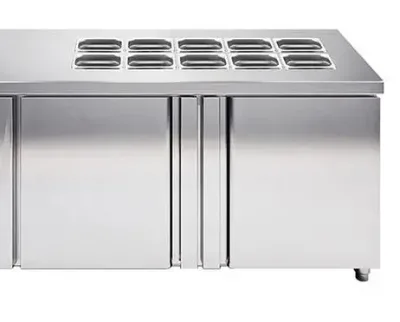


Refrigerated Salad Bar Stainless Steel Cold Saladette Counter for Restaurant
$397.00 - $440.00
MOQ: 48 Pieces


Comprehensive Sourcing Guide
Upright Auto Defrost Salad Bar Sourcing Guide
The Upright Auto Defrost Salad Bar represents a critical asset for commercial food service environments, specifically designed to maintain optimal freshness for perishable ingredients while offering high visibility to customers. Based on observed market data, these units typically function as display coolers that integrate freezing capabilities, allowing operators to store both chilled salads and frozen components within a single footprint. The core design philosophy centers on a freestanding installation that requires no built-in cabinetry, making it adaptable for various kitchen layouts or front-of-house service areas.
Buyers must recognize that while the general category is defined by upright display functionality, specific configurations vary significantly in terms of temperature control and material composition. The observed product landscape includes models equipped with mechanical thermostats for straightforward operation, as well as advanced units featuring smart thermostats for precise environmental management. This variation necessitates a careful review of the specific unit's intended use, whether it is primarily for cold storage, freezing, or a dual-purpose application, to ensure the selected equipment aligns with the operational volume and menu requirements of the facility.
Product Scope and Observed Listing Signals
When evaluating the product scope, it is essential to distinguish between units designed for static cooling and those utilizing fan cooling, as this directly impacts temperature uniformity and energy consumption. The observed listings indicate a range of cooling types, with some models relying on static cooling systems while others offer a choice between static or fan cooling. This distinction is vital for buyers managing high-traffic salad bars, as fan cooling generally provides more consistent temperatures across the display, reducing the risk of localized warming that could compromise food safety.
The physical construction and customization options available in the market further define the scope of these units. Materials observed in the supply chain include stainless steel, wood, marble, and combinations such as wood with glass, each offering different aesthetic and durability profiles. Buyers should verify if the unit features a sliding door or a no-door design, as this affects both the thermal efficiency and the ease of access for staff. Additionally, the availability of customization allows for tailoring the unit to specific branding or spatial constraints, though the standard configurations often include wooden case packing to ensure safe transit.
Technical Specifications to Verify
Temperature control mechanisms are the most critical technical specification to verify, as they dictate the unit's ability to maintain food safety standards. The market offers both mechanical thermostats and smart thermostats, with the latter providing enhanced precision for maintaining specific temperature ranges such as 5-10 degrees Celsius for chilled items. Buyers must confirm the defrost type, as the observed data highlights both auto defrost and frost-free capabilities, which are essential for preventing ice buildup that can reduce storage capacity and increase energy usage.
Power requirements and physical dimensions must be cross-referenced with the facility's infrastructure to ensure compatibility. Observed power ratings range from 350W to 705W, and voltage specifications vary between 110V and 220V, often supporting both 50Hz and 60Hz frequencies. It is imperative to verify the unit size, which can range from compact models to larger units measuring approximately 2160mm in height, and to check the quantity of pans included, which typically ranges from four to five 1/1 size pans. These specifications directly influence the unit's throughput and its fit within the designated service area.
Compliance and Safety Documentation
Certification verification is a non-negotiable step in the procurement process, as the supply chain shows a wide array of compliance standards including CE, CCC, RoHS, ISO, CB, SASO, EMC, GS, and ETL. While some listings explicitly state compliance with CE and CCC standards, others include broader certifications like RoHS and ISO, indicating varying levels of adherence to international safety and environmental regulations. Buyers should request specific certification documents for the exact model number to ensure that the unit meets the regulatory requirements of their local jurisdiction, particularly regarding electrical safety and refrigerant handling.
Refrigerant type and electrical safety standards are additional compliance factors that require strict documentation. The observed data identifies R134A as a common refrigerant, but buyers must confirm that the specific unit complies with local environmental regulations regarding refrigerant usage and leakage. Furthermore, the presence of certifications such as ETL and GS suggests that the electrical components have undergone rigorous testing for safety, which is crucial for preventing hazards in commercial kitchens. Ensuring that the supplier provides valid, up-to-date certification for the specific batch being purchased is essential for liability protection and operational safety.
Cost Drivers and Commercial Terms
The price range for upright auto defrost salad bars is highly variable, observed between 1 USD and 3500 USD, driven primarily by material quality, cooling technology, and unit size. Stainless steel 304 construction and smart thermostat integration typically command higher price points compared to wooden or basic stainless steel models with mechanical controls. Buyers should analyze the cost per unit of storage capacity and the energy efficiency rating, as a higher initial investment in a unit with fan cooling and smart controls may result in significant long-term savings on electricity bills and reduced maintenance costs.
Minimum Order Quantities (MOQ) and packaging requirements also influence the commercial terms and total cost of ownership. The observed MOQ ranges from 1 to 100 units, offering flexibility for small businesses while potentially requiring bulk commitments for larger chains. Packaging is typically handled in wooden cases or cartons, which adds to the shipping weight and cost but is necessary to protect the unit during transit. Buyers must clarify whether the quoted price includes the wooden case packaging and if there are additional fees for custom packing solutions, as these factors can significantly impact the final landed cost.
Supplier Qualification and Quality Control
Supplier qualification should focus on the origin and manufacturing capabilities, with a significant portion of the observed supply chain originating from Guangzhou, Guangdong, China. Buyers must verify the supplier's ability to provide consistent quality control, particularly regarding the assembly of complex components like the defrost system and the sealing of the cabinet. The presence of multiple certifications suggests that reputable suppliers adhere to strict production standards, but buyers should still request quality assurance reports and factory audit results to confirm that the manufacturing process aligns with their specific quality expectations.
Quality control extends to the inspection of materials and the final assembly of the unit. The use of materials such as stainless steel 304, wood, and marble requires verification of their grade and durability, especially in high-moisture environments. Buyers should establish a protocol for pre-shipment inspections that includes checking the functionality of the thermostat, the integrity of the door seals, and the stability of the freestanding structure. Ensuring that the supplier has a robust process for testing the cooling performance and defrost cycle before shipment is critical to avoiding costly returns and operational downtime.
Long-Term Procurement Checks
Long-term procurement success depends on the availability of spare parts and the supplier's commitment to after-sales support. Given the mechanical and electronic components involved, such as thermostats and compressors, buyers must confirm that the supplier maintains an inventory of critical spare parts and can provide technical support for repairs. The observed data indicates that units are often packed in wooden cases, which suggests a focus on durability, but the long-term reliability of the cooling system and the defrost mechanism must be validated through performance testing over time.
Sustainability and energy efficiency should be monitored as part of the long-term procurement strategy. As energy costs fluctuate, the efficiency of the cooling system, whether static or fan-based, becomes a key metric for operational budgeting. Buyers should track the actual energy consumption of the units in operation against the rated power specifications to ensure they are performing as expected. Additionally, maintaining a record of maintenance activities and component replacements will help in planning future upgrades or replacements, ensuring that the salad bar remains a reliable asset for the business.
FAQs
What temperature control options are available for these units?
These units offer both mechanical thermostat and smart thermostat options depending on the specific model selected. The mechanical version provides basic control while the smart version allows for more precise adjustments to maintain optimal freezing conditions.
Can I customize the material and finish of the display cooler?
Yes, customization is available for the material and finish of the display cooler. Buyers can choose from options including wooden, stainless steel, marble, or glass combinations to match their specific aesthetic and functional requirements for the installation.
Which certifications do these freezers typically hold for international use?
These freezers typically hold CE, CCC, and RoHS certifications for international use. Some models may also include ISO, CB, SASO, EMC, GS, and ETL certifications depending on the specific manufacturer and target market requirements for safety compliance.
How is the cooling system designed for these static cooling units?
The cooling system is designed with static cooling or fan cooling capabilities to ensure even temperature distribution. This design supports the freezing function while maintaining the required cabinet temperature range of 5 to 10 degrees Celsius for optimal food preservation.
What is the standard power source and voltage for these appliances?
The standard power source is electricity with voltage options of 110V or 220V at 50Hz or 60Hz frequencies. This flexibility allows the units to operate in various regions while maintaining a power consumption of approximately 350W to 705W depending on the model.
Can these units be installed as freestanding appliances in any location?
Yes, these units are designed for freestanding installation and can be placed in various locations without requiring built-in cabinetry. The dimensions vary by model, with some units measuring up to 2160mm in height and 1050mm in width for ample storage capacity.