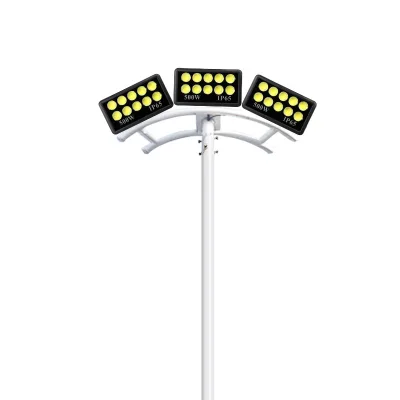
Source Waterproof LED Stadium Light for Parks, Squares, and Gardens
Explore 30 options for Waterproof LED Stadium Light suitable for parks, squares, and gardens. Compare specifications including CREE LED chips, Meanwell drivers, and IP65 ratings to find the right fixture for your outdoor lighting project; compare the available evidence and request quotations based on your requirements.
Key considerations
Products List


High Temperature Resistant Soccer Field LED Flood Light 600W 750W LED Stadium Light
$330.00 - $350.00
MOQ: 1 Pieces


High Lumen Output Energy-Efficient Waterproof IP67new LED Stadium Lighting
$29.00 - $130.00
MOQ: 2 Pieces



Comprehensive Sourcing Guide
Waterproof LED Stadium Light Sourcing Guide
Procuring a Waterproof LED Stadium Light for large-area sports, square, or park installations requires buyers to balance optical performance, ingress protection, and long-term serviceability. These fixtures are engineered for high-mast and wide-area projection, so procurement teams must evaluate far more than wattage: beam angle options, luminous efficacy, driver quality, and structural materials all determine whether a luminaire survives years of outdoor duty. Because listings in this category span dramatically different price points and configurations, disciplined verification against documented specifications is essential before committing to volume orders.
This guide walks through the full sourcing cycle for stadium-class LED floodlights. It explains what current listing data reveals about the market, which technical parameters demand scrutiny, how compliance documentation should be handled, and what commercial and quality-control practices protect your investment. The observations drawn here come from active product listings, including models such as the RMS-L2106 and FJ-FL series, and are treated as signals to investigate rather than guaranteed claims. Use each section as a checklist stage, from initial scoping through long-term supplier management, to reduce sourcing risk in this technically demanding category.
Product Scope and Observed Listing Signals
The Waterproof LED Stadium Light category covers fixtures from compact 20W floodlights to large-format high-mast luminaires, with observed models spanning a 1209528mm compact unit up to a 650117.6599.4mm stadium-scale fitting. Listed applications include squares, gardens, parks, and factories, which signals that many floodlights marketed for stadium use are actually multi-purpose outdoor projectors. Buyers should confirm whether a listed model is genuinely designed for sports lighting at projection distances exceeding 35m, or whether it is a shorter-throw fixture like those specifying 18-25m coverage. Packing dimensions listed alongside products, such as 77.6X70.5X17.2cm for one model, help estimate shipping volumes before quotation.
Observed listings also reveal meaningful spread in origin and standards. Some products declare China as origin while others specify Shanghai, and declared standards such as 464916.8 or 25519032mm describe physical dimensions rather than performance norms, so buyers must never assume certification from listing fields. Price observations range from as low as $2.37 to $100,000 across the category, and MOQ observations run from 1 to 20 units. Treat these as a screening framework: narrow candidates by projection distance and body material first, then validate specifications directly with suppliers before comparing commercial terms.
Technical Specifications to Verify
Begin with photometric and electrical parameters. Observed listings cite luminous efficacy of 150 Lm/W, power factors above 0.9, and operating voltages of either 220-240V or 100-240V, the latter indicating wider compatibility for export markets. Beam angle options of 15/30/60/120 degrees appear in listings, and this choice directly shapes whether a fixture suits narrow long-throw aiming or broad area wash. Confirm the LED chip source, since CREE chips are named in multiple listings, and the driver brand, where Meanwell is cited. Verify color temperature offerings such as Warm White or Pure White against the visual requirements of your venue, and request IES files so your lighting designer can simulate actual field performance.
Structural and durability claims require equal attention. Listed lamp body materials include aluminum and aluminum alloy, which should be confirmed with details on housing thickness, heat-sink design, and corrosion finishing, especially for coastal or industrial park installations. IP ratings appear in listings but some entries are malformed, such as "IPLamp Body Material:Aluminum," so buyers must obtain explicit IP65-or-above confirmation in writing rather than infer from incomplete fields. Average life figures like >8000h appear in data, but ask for the test basis behind such claims. Finally, match the declared projection distance, whether 18-25m or beyond 35m, to your mounting height and pole spacing before shortlisting.
Compliance and Safety Documentation
Certification claims in this category vary widely, so request copies of actual certificates rather than relying on listing labels. Observed declarations include CE, ETL, RoHS, CCC, EMC, LVD, SAA, and C-tick across different models. Each of these points to a distinct market: ETL for North American acceptance, SAA and C-tick for Australia, CCC for China, and CE with EMC and LVD directives for Europe. Confirm that any certificate bears your exact model number, correct rated voltage, and a validity window, because generic family certificates frequently fail to cover customized variants. For projects in regulated jurisdictions, ask which certification body issued the documents and whether factory audit reports are available.
Safety documentation should extend beyond market-access marks. Ask suppliers for ingress protection test reports substantiating the waterproof rating, since stadium lights operate in rain, humidity, and temperature swings that stress seals and cable glands. Request electrical safety test data covering dielectric strength, ground continuity, and thermal performance at ambient extremes relevant to your site. If fixtures will be installed at height on masts, obtain documentation on wind-load ratings and mounting hardware strength, which listings rarely declare. Keep every document version-controlled in your procurement file, and require suppliers to notify you of any certificate revision or model change that affects compliance status during the contract period.
Cost Drivers and Commercial Terms
Unit pricing for waterproof LED stadium lights is driven chiefly by chip brand, driver brand, housing material, and wattage. Listings naming CREE chips and Meanwell drivers position themselves at the premium end, while generic alternatives reduce cost but shift lifetime risk to the buyer. Housing construction matters too: die-cast aluminum with adequate fin area costs more than thin-sheet alternatives but directly affects thermal management and therefore lumen maintenance. Additional cost drivers include beam-angle configuration, surge protection levels, customization of optics or housing color, and packing style, where one listing specifies carton plus EPE protection. Always obtain itemized quotations so these components can be compared across suppliers.
Commercial terms deserve the same rigor as technical ones. Observed MOQ values range from 1 to 20 pieces, which favors pilot ordering, but confirm whether MOQ varies by customization level, since OEM or ODM service, offered in listed entries, typically carries higher minimums or tooling charges. Customization is declared as available in the data, so clarify what is customizable, such as logo, packaging, or optics, and at what price impact. Clarify Incoterms, payment milestones, warranty duration, and spare-part availability in the contract. Given the observed price spread from $2.37 to $100,000 across the category, insist on like-for-like specification sheets before comparing any two quotations.
Supplier Qualification and Quality Control
Qualify suppliers through a structured review rather than listing claims alone. Verify business credentials, manufacturing scope, and export experience, and note that listed origins differ, with some products declared from China generally and others specifically from Shanghai, which may indicate trading companies versus factory-direct sellers. Ask for production capability evidence: SMT lines for LED assembly, driver integration capacity, and in-house testing equipment for photometry and waterproof verification. Models such as RMS-L3 and FJ-FL-100W-G10 suggest established product families, so request references or case studies for comparable stadium or square installations. A supplier offering both OEM and ODM service signals design depth, but validate engineering staffing accordingly.
Quality control should be contractually anchored. Require pre-shipment inspection covering a defined AQL sampling plan, with checks on IP sealing, driver function, photometric output, and packaging integrity against declared packing specifications such as 64X41.7X17.2cm cartons. Request aging tests, where fixtures run under load for a defined period before dispatch, and ask for batch-level test reports rather than generic certificates. For initial orders, consider third-party inspection at the factory, especially when certification documents were issued years earlier. Define how nonconforming units are handled, whether through replacement, credit, or rework, and set clear timelines for corrective action so quality accountability survives beyond the first shipment.
Long-Term Procurement Checks
Stadium lighting is a decade-scale investment, so evaluate suppliers on lifecycle support, not just first-unit performance. Confirm spare-part availability for drivers, LED modules, and gaskets, since seals are the most common failure point in waterproof fixtures. Ask how the supplier manages component changes, because chip or driver substitutions mid-production can alter photometric output and void prior approvals. The listed average life of >8000h should be paired with a written lumen-maintenance expectation and warranty terms that specify coverage for both parts and labor implications. Establish a documented channel for technical support, including response-time commitments for failure analysis during warranty periods.
Build ongoing procurement hygiene into your relationship. Schedule periodic re-verification of certificates, since marks like CE, ETL, CCC, and RoHS carry renewal cycles and standard revisions that can outdate older documents. Track batch traceability, requesting that serial or batch numbers link each fixture to its production records and test data, which simplifies warranty claims and field-failure analysis. Monitor delivered performance by sampling lux measurements after installation and comparing against the supplier's declared projection distances and efficacy values, such as the cited 150 Lm/W benchmark. Finally, review supplier performance annually, covering on-time delivery, defect rates, and communication quality, and maintain a qualified second source to protect continuity across multi-phase venue projects.
FAQs
What certifications do these waterproof LED stadium lights have?
These lights carry CE, ETL, RoHS, CCC, EMC, LVD, SAA, and C-tick certifications. Multiple models display varying certification sets to ensure compliance with international safety and environmental standards for diverse global markets.
Which LED chip brands are used in these stadium lights?
The products utilize CREE LED chips and 5050 LED light sources for high performance. Some units also feature Meanwell drivers to ensure stable operation and longevity within the specified operating voltage ranges.
Can I customize the design or branding of these lights?
Yes, customization is available for these products. Buyers can request OEM or ODM services to tailor the design, branding, or specifications to meet specific project requirements or corporate identity standards.
What is the operating voltage range for these LED lights?
The operating voltage ranges from 100 to 240 volts or 220 to 240 volts depending on the specific model. This wide range ensures compatibility with various electrical systems across different regions and applications.
How long is the average life of these waterproof LED lights?
The average life exceeds 8000 hours for these durable units. This extended lifespan reduces maintenance costs and ensures reliable illumination for long-term use in outdoor environments like parks, squares, and factories.
What materials are used for the lamp body construction?
The lamp bodies are constructed from aluminum or aluminum alloy materials. This choice provides excellent heat dissipation and structural durability, making the lights suitable for harsh outdoor conditions and demanding applications.