Supplier Shortlisting Checklist Before Requesting Samples or Quotes
Direct answer
Before requesting a sample or formal quotation from a supplier, confirm seven things:
- Your buying requirement is clear enough to judge supplier fit.
- The legal company behind the supplier can be identified.
- There is relevant evidence of product or manufacturing fit.
- Your expected quantity, customization, and timeline are commercially plausible for the supplier.
- The claimed factory or production relationship is clear enough for this stage.
- Critical product, market, or compliance requirements have been identified.
- No major contradiction or unresolved issue makes further engagement unreasonable.
A supplier does not need to pass full due diligence before receiving every RFQ or sample request.
But there should be a reason to spend the next round of time and money on that supplier.
Use the checklist to decide:
GO — proceed to the next sourcing step.
CLARIFY — keep the supplier in consideration, but resolve a material question first.
STOP — do not spend more sourcing effort until a critical problem changes.
How to Use This Checklist.txt
[file content begin]
1. How to Use This Checklist
Supplier shortlisting is a gate, not final approval.
The objective is to avoid two common sourcing mistakes.
The first is requesting quotations or samples from almost every supplier found in search.
The second is trying to complete a full factory audit and document investigation before you even know whether the supplier fits the basic order.
A better sequence is:
define requirement → identify candidates → screen candidates → request quotes or samples → compare → deepen verification as commitment increases
This is consistent with the broader CIPS sourcing process, which separates defining requirements, identifying suppliers, supplier selection, RFQ/tender activity, and later evaluation.
Use this checklist as the screening step between discovery and deeper commercial engagement.
2. Is the Buying Requirement Clear Enough?
- The product is clearly identified.
- Critical specifications are known.
- Required customization is stated.
- Approximate order quantity or range is available.
- Target market is known where relevant.
- Required timing is understood.
- Must-haves are separated from preferences.
GO
The supplier can understand the project well enough to say whether it fits.
CLARIFY
The product is broadly defined, but one or two important requirements remain open and supplier input is genuinely needed.
STOP
You are still searching for “a good supplier for this product” without enough information to distinguish a strong match from a weak one.
A sourcing brief does not need to contain the final engineering specification.
It needs enough detail to prevent supplier matching from becoming a category search.
3. Can You Identify the Legal Supplier?
- You have the supplier's Chinese legal company name.
- You have enough company information to distinguish it from similarly named entities.
- The company you are reviewing is the company actually involved in the transaction, or the relationship has been explained.
- Basic company information does not materially contradict what the supplier has told you.
For Chinese suppliers, buyers can use the official National Enterprise Credit Information Publicity System as one source when checking the identified legal entity.
The goal at this stage is not to prove that the company is a perfect supplier.
It is to know which company you are evaluating.
GO
The legal supplier is identifiable and the basic entity information is consistent enough to continue.
CLARIFY
Another sales, export, or production entity appears in the transaction and the relationship still needs explanation.
STOP
The supplier cannot or will not provide enough information to identify the legal company behind the proposed transaction.
4. Is There Evidence of Relevant Product or Process Fit?
- The supplier shows products relevant to your requirement.
- The relevance goes beyond a broad product category.
- Important materials or manufacturing processes appear consistent with your project.
- The supplier can explain which existing products or processes are closest to your requirement.
- Any major capability claim has at least some supporting evidence.
Do not ask only:
Do you manufacture this product?
Ask:
Which part of our requirement is closest to what you already make?
A supplier with hundreds of loosely related products is not automatically a stronger candidate than a supplier with a smaller but technically relevant product range.
GO
There is a reasonable, evidence-supported basis for believing the supplier can handle the product or critical process.
CLARIFY
The supplier looks relevant, but one important capability is still supported mainly by claims rather than evidence.
STOP
The supplier's products and processes do not meaningfully match the requirement.
5. Does the Supplier Fit the Order?
- Expected order quantity appears realistic.
- MOQ does not clearly conflict with the project.
- The required level of customization is commercially plausible.
- The supplier can work within the approximate development or delivery timeline.
- The SKU structure fits the supplier's business model.
- Communication is sufficient for the complexity of the project.
A technically capable supplier can still be the wrong supplier for the order.
For example, a factory optimized for very high-volume standard production may be a poor fit for a low-volume custom launch.
A supplier comfortable with mixed SKUs may be more useful for a fragmented assortment than a technically stronger factory that requires large quantities of every individual model.
GO
The order appears commercially realistic for both buyer and supplier.
CLARIFY
One condition such as MOQ, development time, or SKU mix still needs discussion.
STOP
A fundamental commercial condition is incompatible with the project and there is no realistic path to alignment.
6. Is the Production Relationship Clear Enough?
- You know whether the seller claims to manufacture, trade, or coordinate production.
- If factory status matters, a production site has been identified.
- You understand which important processes are performed by the supplier and which are subcontracted.
- If another company manufactures the goods, the relationship has been explained.
- You are not relying on “factory direct” language alone.
A trading relationship is not automatically a reason to reject a supplier.
Neither is subcontracting.
The relevant question is whether the structure is transparent enough for the buyer to assess.
If factory status is important to the project, see How Can I Tell If a Chinese Supplier Is a Real Factory?.
GO
The production model is understood well enough for the current sourcing stage.
CLARIFY
The supplier appears viable, but the legal seller and production entity relationship still needs confirmation.
STOP
The supplier makes material production claims that it will not explain or support.
7. Have Critical Product Requirements Been Identified?
- You know whether the destination market creates specific product requirements that need investigation.
- Required certifications, reports, labels, testing, or documentation have not simply been assumed.
- Where a supplier has provided compliance documents, you know what company, product, model, or scope they actually cover.
- A missing critical requirement will be resolved before commitment.
You do not need every final compliance document before requesting a quotation.
But you should avoid shortlisting suppliers based on a requirement that has never been checked.
For example, if a product will require specific testing or market documentation, ask early whether the supplier has relevant experience or evidence.
Do not treat a certification logo on a supplier page as product approval.
For a deeper product-level process, see How to Verify Product Compliance When Sourcing from China.
GO
Critical requirements have been identified and there is no obvious incompatibility.
CLARIFY
A required document, product scope, or testing question still needs supplier evidence.
STOP
A non-negotiable product requirement clearly cannot be met.
8. Are Any Important Contradictions Still Unresolved?
- Company names are reasonably consistent across the transaction.
- Important addresses have been explained.
- Supplier type and production claims do not materially conflict with available evidence.
- Product capability claims are not contradicted by what you have found.
- The supplier has not avoided reasonable questions needed for the next decision.
- Payment or contracting information will be checked before funds are sent.
Not every inconsistency is a red flag.
Companies move.
Export entities differ from production entities.
Documents can contain old addresses.
A manufacturer may outsource part of its process.
The question is whether the difference has a reasonable explanation that can be supported.
Do not convert:
unexplained
into:
probably fine
simply because the supplier otherwise looks attractive.
For broader company verification, see How to Verify Chinese Suppliers: A Practical Guide for Global Buyers.
GO
No material contradiction prevents further engagement.
CLARIFY
A potentially reasonable inconsistency still requires evidence.
STOP
The explanation keeps changing, important information cannot be reconciled, or the supplier refuses to clarify an issue that materially affects the transaction.
9. Decide: Go, Clarify, or Stop
Do not turn this checklist into a false mathematical score.
Six checked boxes out of seven do not necessarily mean the supplier is safe.
One failed requirement may matter more than several positive signals.
Instead, make a sourcing decision based on the importance of what remains unresolved.
| Decision | Meaning | Next step |
|---|---|---|
| GO | Enough evidence for the current stage | Request a quote, sample, or deeper verification |
| CLARIFY | Potentially suitable, but an important question remains | Request the specific missing evidence |
| STOP | A critical requirement is not met or risk is not reasonably resolved | Remove or pause the candidate |
The threshold should also rise as commitment increases.
Sending an RFQ requires less evidence than paying a tooling deposit.
Ordering a sample requires less confidence than placing a production order.
Approving mass production may require testing, inspection, audit, contractual controls, or other verification that was unnecessary during the initial supplier search.
Supplier verification is therefore not one event.
It is a sequence of decisions.
10. Use SourcingX Before the Next Step
SourcingX can support early supplier screening by helping buyers review available company, product, trade, and supplier information before deciding which candidates deserve further sourcing effort.
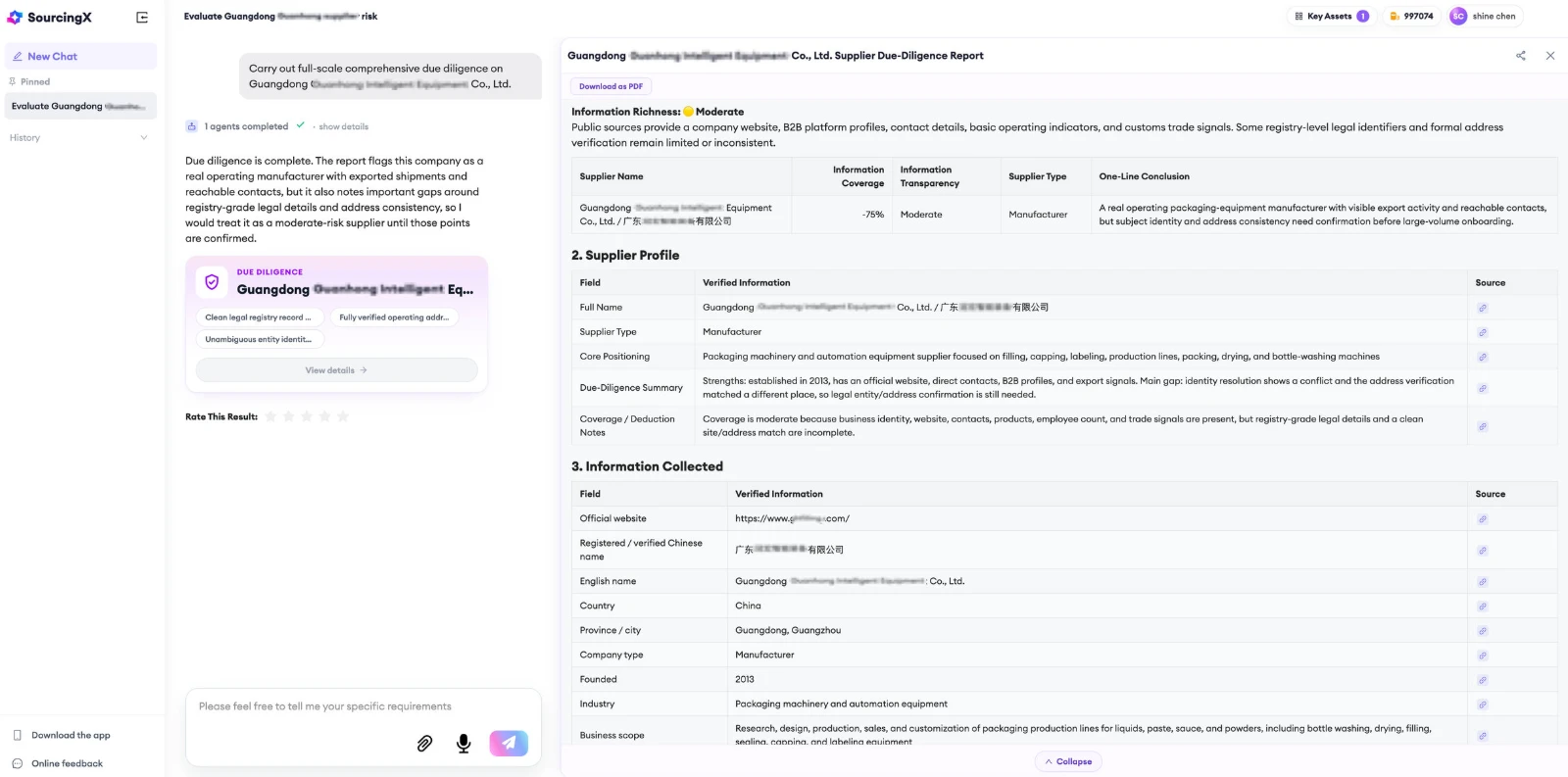
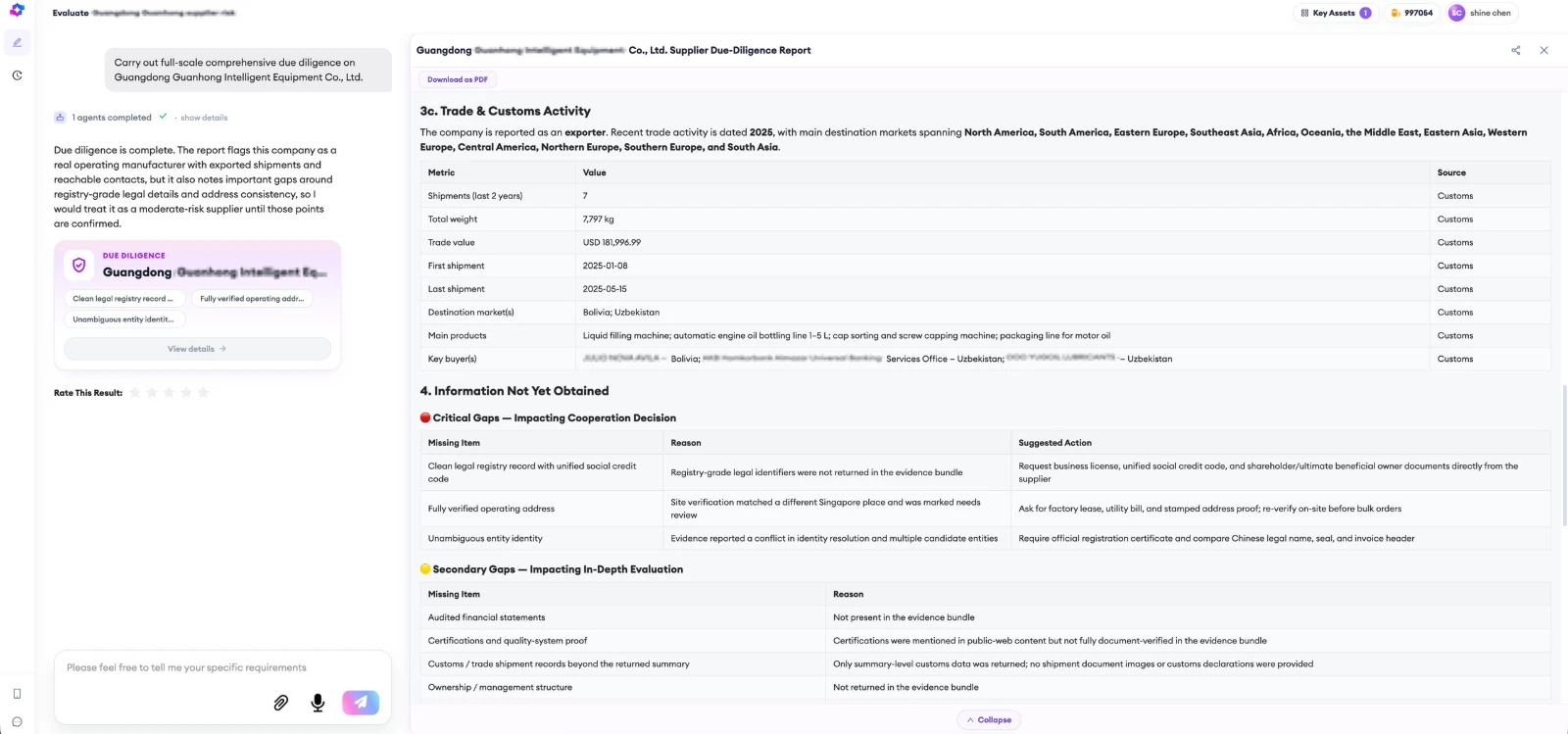
Use the information to help answer:
Who is the company behind this supplier?
Does available product information support the match?
Is there relevant trade or company evidence?
Is there an inconsistency that should be clarified before the next step?
SourcingX does not replace factory audits, product testing, inspections, legal review, or compliance judgment.
It also does not make the final supplier-selection decision for the buyer.
The purpose of the checklist is narrower:
Do we currently know enough about this supplier to justify spending more time, money, or attention on the next sourcing step?
If the answer is yes, move forward.
If the answer is unclear, ask the missing question.
If the answer is no, keep searching. [file content end]