How Can I Verify a Supplier’s Address and Factory Location in China?
Direct answer
To verify a Chinese supplier’s address, first identify the legal company and check its registered address in official company records. Then treat the claimed factory location as a separate piece of information. Compare the factory address with the supplier’s business records, website, quotation, product documents, audit reports, maps, photos and other available evidence. Ask which legal entity operates the site and how that entity relates to the company that will sign the contract and receive payment. A different registered address and factory address is not automatically a problem. The issue is whether the supplier can explain the difference and provide consistent evidence of the production relationship. If the factory location is important to product quality, capacity, compliance, intellectual property or a large financial commitment, remote checks should be followed by an appropriate live verification, independent audit or on-site inspection.
Start With the Registered Company Address
The first address to identify is the address attached to the supplier’s legal company.
Under China’s current company-registration framework, a company’s domicile is one of its registration items, and company registration information is made public through the National Enterprise Credit Information Publicity System. Buyers can use the official National Enterprise Credit Information Publicity System as a starting point for checking the identified Chinese legal entity.
This tells you something important:
Which address belongs to the registered company?
It does not answer another question automatically:
Is this where the product will actually be manufactured?
For sourcing purposes, those should be treated as two separate questions.
Ask the supplier for its Chinese legal company name and Unified Social Credit Code rather than relying only on an English trading name.
Then compare the registered company information with the business license and the company you are communicating with.
If you have not yet established the legal entity behind the supplier, complete that step before trying to verify the factory. A location has limited value if you do not know which company is supposed to operate it.
Treat the Factory Location as a Separate Claim
A supplier may tell you:
Our factory is located in Foshan.
That statement needs more detail before it becomes useful evidence.
Ask:
What is the full factory address?
Which legal entity operates the site?
Is that the same company shown on the business license?
If it is a different company, what is the relationship between the two?
Which parts of our product will actually be made there?
The goal is not simply to locate a building.
It is to connect three things:
legal entity → physical site → production activity.
A map pin does not establish that chain.
Neither does a business license by itself.
A supplier may have a valid registered company but use another site for production. A seller may also work with another legal entity responsible for manufacturing.
These arrangements are not automatically unacceptable. What matters to the buyer is whether the relationship is transparent enough to understand who controls production and who is responsible when something goes wrong.
For a broader assessment of the factory claim, see How Can I Tell If a Chinese Supplier Is a Real Factory?.
Compare the Same Location Across Different Evidence
Address verification becomes more useful when you stop looking for one document that will “prove the factory” and instead check whether several pieces of evidence tell the same story.
For example, compare:
| Evidence | What to Look For |
|---|---|
| Official company record | Registered legal entity and registered address |
| Business license | Company name, Unified Social Credit Code and registered address |
| Supplier website | Office and factory locations claimed publicly |
| Quotation or contract | Company identity and address used in the transaction |
| Factory photos or videos | Site signs, layout, production areas and recognizable location details |
| Audit report | Entity and site actually covered by the audit |
| Test report or certificate | Manufacturer, applicant, factory or address fields where relevant |
| Maps and satellite/street information | Whether the claimed location and surrounding area are plausible |
| Shipping or trade information | Whether a related exporter or location needs to be explained |
Do not expect every document to show exactly the same address.
Instead, look for differences that have not been explained.
Suppose the business license shows a Shenzhen office, the website promotes a Dongguan factory and an audit report covers a company with a different Chinese name in Dongguan.
That is not enough information to reject the supplier.
But it does create a clear verification task:
Who operates the Dongguan factory, and what is its legal relationship to the Shenzhen seller?
The answer should be documented before the buyer relies on the factory claim.
How to Verify a Factory Location Remotely
You can strengthen an address check substantially without immediately traveling to China.
Start with the official company record, then compare the claimed factory address with maps, public information and supplier documents.
After that, ask for evidence that is difficult to provide without access to the actual site.
For example, during a live video walkthrough, you can ask the supplier to begin outside the facility, show the company or factory sign, enter the premises and then move through the areas relevant to your product.
Instead of asking:
Can you show me your factory?
ask:
Please show us where incoming material for our product is received, the equipment used for the main manufacturing step, the in-process inspection area, and the final packing area.
A useful walkthrough follows the production question.
If you are sourcing an injection-molded component, a large showroom full of finished products tells you less than a view of the molding process, tooling, material handling and quality controls.
If a particular process is subcontracted, that is not automatically a failure.
The supplier should simply explain:
- which process is outsourced;
- which company performs it;
- where it takes place;
- how quality is controlled;
- how non-conforming work is handled.
Remote evidence can make a factory claim more or less credible, but it should not be overstated. A video call or map check cannot establish everything an independent on-site audit could establish.
An Address Difference Is a Question, Not an Automatic Rejection
Buyers sometimes treat any address mismatch as proof that a supplier is unreliable.
That can lead to the wrong conclusion.
Instead, classify the mismatch.
For example:
Registered offices and factories are different
Ask which location is the company’s registered domicile and which is the actual production site.
Then verify the production-site relationship separately.
Seller and factory use different company names
Identify both Chinese legal entities and ask how they are related.
Then confirm which company signs the contract, which operates production and which receives payment.
An old document contains a different address
Check the date.
The supplier may have moved, the legal entity may have changed its registration, or the document may relate to another site.
Do not silently assume the document is current.
Several factories are involved
For products involving several processes, more than one production site may be involved.
Ask exactly where the critical processes for your product will take place.
The practical rule is simple:
An address mismatch is not the conclusion. It is the next question.
If the explanation produces a coherent entity-and-site relationship, the buyer can continue verification.
If every new document produces another unexplained company or another unexplained location, the uncertainty increases.
When to Arrange a Live Check or Factory Audit
Not every supplier search requires an immediate factory audit.
The level of verification should increase with the consequences of getting the factory relationship wrong.
A stronger physical check becomes more important when:
- the supplier’s factory status materially affects your decision;
- the product depends on specialized production equipment;
- tooling or intellectual property will be placed at the site;
- production capacity is critical to the delivery schedule;
- product safety or regulatory requirements depend on site controls;
- the order or deposit is financially significant;
- available address evidence remains contradictory;
- the supplier cannot clearly explain which legal entity controls production.
The audit scope should follow the actual sourcing risk.
If your concern is production capability, a generic corporate presentation is not enough.
If your concern is capacity, look at the relevant equipment, shifts, workload and production records.
If your concern is quality control, look at incoming inspection, in-process controls, final inspection, traceability and corrective action.
A factory visit answers a physical question at a point in time. It does not guarantee every future shipment, so it should still be combined with appropriate product testing, inspection and commercial controls where required.
How SourcingX Can Support Address Verification
SourcingX can support the early address-verification process by helping the buyer review available company information, operating status, addresses and other supplier evidence together.
This is useful because the address should not be evaluated in isolation.
The buyer may need to understand whether:
- the company record supports the supplier identity;
- the claimed factory location differs from the registered company address;
- another entity appears to be involved;
- the product and company information are consistent with the supplier’s explanation;
- additional evidence is still required.
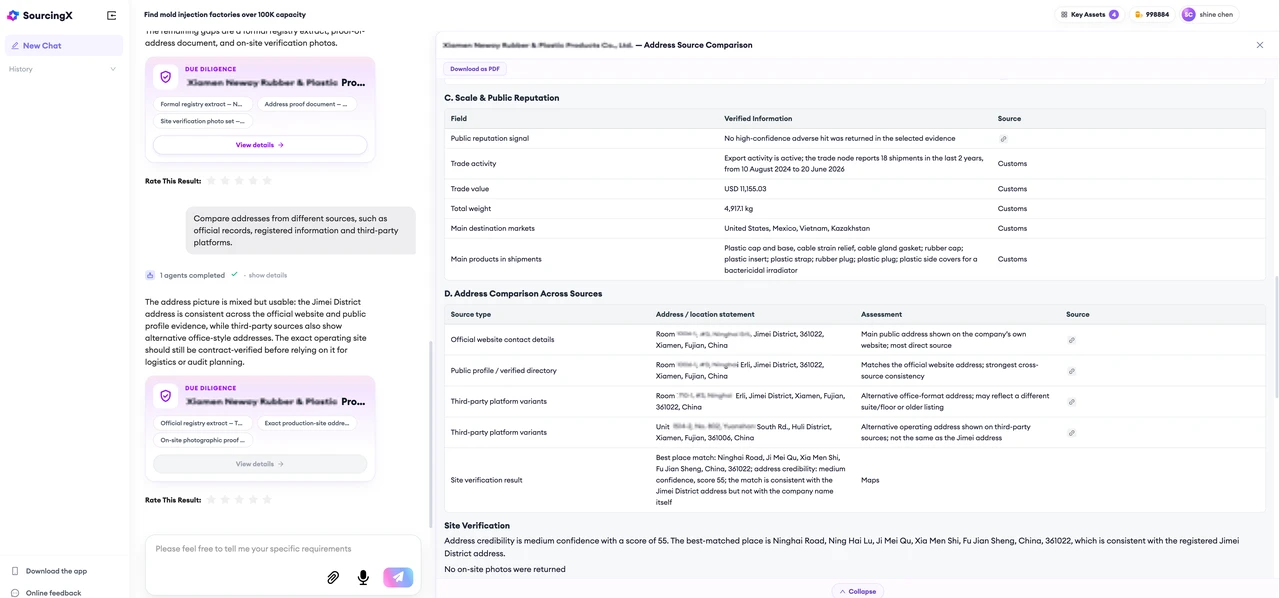
A SourcingX result should be treated as part of the due-diligence process rather than as proof that a factory is physically operating at a location.
If the production site itself needs to be established, the buyer may still need supplier documents, live site evidence, an independent audit or another appropriate form of physical verification.
For the wider supplier-verification process, see How to Verify Chinese Suppliers: A Practical Guide for Global Buyers.
Frequently Asked Questions
Is a Chinese supplier’s registered address the same as its factory address?
Not necessarily.
The registered address belongs to the legal company record. The buyer should separately establish where the relevant product will actually be manufactured and which legal entity operates that site.
Do not use the registered address alone as evidence of manufacturing activity.
Can I verify a factory address without visiting China?
You can build meaningful evidence remotely, but you may not be able to resolve every physical-site question.
Start with the legal company record and claimed factory address. Compare maps, websites, company documents, audit reports, photos and other relevant evidence.
A live video walkthrough can then help you examine whether the site, equipment and production activities are consistent with the supplier’s claims.
If the production site is important to a high-risk or high-value decision, use an appropriate independent on-site check rather than relying entirely on remote information.
What if the business license and factory address are different?
Ask the supplier to explain the difference.
Identify which legal entity is shown on the business license, which entity operates the factory, which entity will sign your contract and which entity will receive payment.
Then request evidence of the relationship.
A different address is not automatically a reason to reject the supplier. An unexplained relationship is a reason to investigate further.
Does an address shown on a certificate or test report prove the factory is there?
No.
It tells you what entity or site is identified in that particular document and should be reviewed together with the document’s date and scope.
It does not establish by itself that the site is currently producing your product, that the supplier owns the site, or that current production is covered by the same evidence.
Match the document to the supplier, factory and exact product before relying on it.
When should I arrange a factory audit?
Consider an independent factory audit or other physical verification when the production site materially affects your sourcing decision.
This is particularly relevant when you are committing substantial tooling or deposits, when specialized production capability matters, when quality or compliance depends heavily on site controls, or when company and factory relationships remain unclear after document review.
The purpose of the audit should be defined by the sourcing risk you are trying to resolve.