How to Compare Chinese Suppliers Before You Shortlist Them
To compare Chinese suppliers before building a shortlist, first make sure every supplier is being evaluated on the same product specification and commercial basis.
Normalize the information you collect — including specification, MOQ, price tier, Incoterm and named place, tooling or sample charges, lead time, payment terms, compliance requirements, and any exceptions — before comparing price.
Then evaluate each supplier across three layers: Must Pass, Trade-offs, and Needs Verification.
The goal is not to identify the cheapest supplier. It is to reduce a longlist to a few suppliers whose offers are comparable, relevant, and supported by enough evidence to justify deeper evaluation.
| Decision layer | What it means |
|---|---|
| Must Pass | Requirements the supplier must meet. |
| Trade-offs | Factors such as price, MOQ, lead time, and payment terms that can be balanced. |
| Needs Verification | Claims such as capacity, certifications, factory status, and export experience that still require evidence. |
Why Supplier Shortlists Often Go Wrong
One recurring problem in procurement is that suppliers appear to answer the same RFQ, but they are actually quoting on different bases.
Recent procurement discussions highlight fields such as specification revision, MOQ and price tiers, Incoterm and named place, tooling and sample charges, payment terms, lead time, compliance documents, and explicit exceptions as common reasons supplier quotes become difficult to compare.
For example, Supplier A may quote FOB Ningbo for 5,000 units, Supplier B may quote EXW factory for 3,000 units, and Supplier C may include packaging and testing costs in the unit price while another supplier excludes tooling.
Ranking these suppliers by unit price alone would produce a misleading shortlist.
Before asking “Which supplier is better?”, first ask: “Are these suppliers actually being compared on the same basis?”
Start With One Clear Sourcing Requirement
Every supplier should be evaluated against the same sourcing brief. At minimum, define:
- Product
- Specification or model
- Material
- Dimensions
- Performance requirements
- Order quantity
- Target MOQ
- Customization
- Packaging
- Target market
- Required certifications
- Desired lead time
- Delivery term
- Any non-negotiable requirements
A vague requirement such as “I need a good supplier for stainless steel bottles” creates weak comparison data.
A better requirement might be: “I need 5,000 double-wall stainless steel bottles, 750 ml, custom logo, individual retail packaging, target lead time within 30 days, for sale in the U.S.”
That makes it much easier to determine whether Supplier A and Supplier B are actually suitable for the same project.
Compare Product and Technical Fit Before Price
A supplier can appear highly relevant because it sells products in the same category, while still being a poor fit for your actual requirement.
Check the supplier’s product focus, specification fit, and technical capability before comparing price.
Product focus
Is the target product one of the supplier’s main product categories, or only one item among a very broad catalog?
Specification fit
Can the supplier meet the required material, dimensions, performance, components, customization, packaging, and target-market requirements?
Technical capability
Can the supplier explain how it will meet the requirement? Useful signals include product drawings, technical specifications, material information, production process, testing methods, existing similar products, and previous comparable projects.
A supplier should not move into the shortlist simply because its website contains the right keywords. The first shortlist question is: “Can this supplier actually supply the product as specified?”
Normalize Commercial Terms Before Comparing Price
This is one of the most important steps in supplier comparison.
Compare the same quantity
A price at 500 units should not be directly compared with a price at 5,000 units. Record MOQ, quantity quoted, price tier, and unit of measure.
| Supplier | Quoted quantity | Unit price |
|---|---|---|
| A | 1,000 units | $8.20 |
| B | 5,000 units | $7.10 |
| C | 3,000 units | $7.60 |
Supplier B may look cheapest, but the comparison is meaningless if your actual requirement is 1,000 units.
Compare the same Incoterm and named place
An EXW quote and a DDP quote are not equivalent prices. Incoterms define important responsibilities, costs, delivery points, and risk allocation between buyer and seller; the named place or port is also critical when the rule is applied, as explained in the ICC’s Incoterms® guidance.
Instead of recording only “FOB”, record “FOB Ningbo”. Instead of “DDP”, record “DDP Los Angeles, California”. Preserve both the original supplier term and a normalized comparison view.
Separate unit price from additional costs
Ask whether the quote includes:
- Tooling
- Mold cost
- Sample charges
- Packaging
- Printing
- Testing
- Inspection
- Export packaging
- Inland transport
- Freight
- Duties
- Certification costs
A supplier with a higher unit price may still have a lower total sourcing cost.
Compare payment terms
Payment terms affect cash flow and risk and should not be hidden inside a general “commercial score.” Record the actual structure, such as deposit percentage and balance timing.
Compare lead time on the same basis
Make sure lead time refers to the same stage: sample lead time, production lead time, time after deposit, time after artwork approval, or shipping time. “20-day lead time” is not meaningful until you know 20 days from what event.
Make Exceptions Visible
One supplier may technically respond to every RFQ field while quietly changing the requirement. Do not bury those differences in notes. Create an explicit Exceptions column.
| Requirement | Supplier response | Exception |
|---|---|---|
| 304 stainless steel | Accepted | None |
| Custom gift box | Accepted | Packaging cost excluded |
| 30-day lead time | 40 days | Lead-time exception |
| Required certification | Available | Certificate scope to verify |
If an exception changes cost, risk, specification, or delivery, it should be visible before the supplier reaches the shortlist.
Compare Capability, Not Just Quotation Terms
Production capacity
Can the supplier handle your expected quantity? Possible evidence includes production lines, key equipment, workforce, stated monthly capacity, production schedule, and relevant factory information. The relevant question is not “Which supplier has the largest factory?” but “Does this supplier have enough capability for this order?”
Relevant export experience
Years in business and relevant export experience are not the same thing. Look for recent export activity, similar product exports, relevant destination markets, and consistency of export activity. Export history should support the evaluation, not determine it on its own.
For a deeper review of trade history, see How to Verify a Supplier’s Export Records
Business identity
Confirm which legal entity you are dealing with. Useful checks include the legal company name, registration status, registered address, business scope, the company entity used on quotations, and the company entity receiving payment.
China's National Enterprise Credit Information Publicity System can be used to check company registration and enterprise credit information.
Certifications
If a certification matters to the sourcing requirement, do not rely only on a certificate image or logo. Check the certificate holder, standard, scope, certified location, status, and certification body.
For applicable accredited management-system certifications, IAF CertSearch can help verify certificate status, scope, certified locations, and certification-body information.
Separate Supplier Claims From Evidence
A useful supplier comparison should distinguish between three information states: Verified, Supplier-provided, and Missing.
| Information state | Meaning | Examples |
|---|---|---|
| Verified | Supported by an independent or authoritative source. | Legal registration, verified certificate, trade data, public company information |
| Supplier-provided | Supplied by the supplier but not yet independently confirmed. | Monthly capacity, lead time, major customer claims, internal quality procedures |
| Missing | Required for a decision but not yet available. | Tooling cost, certificate scope, current capacity availability, packaging cost |
A completed spreadsheet is not necessarily the same as a verified supplier profile.
Use Three Decision Layers Instead of One Score
Must Pass
Requirements that cannot be compromised, such as product specification, critical certification, target-market compliance, legal operating status, required manufacturing capability, or maximum acceptable lead time.
Trade-offs
Factors that can be balanced or negotiated, such as unit price, MOQ, payment terms, packaging cost, tooling, and lead time within an acceptable range.
Needs Verification
Claims that could materially change the decision, such as production capacity, factory status, certification scope, export experience, ownership structure, and current order load.
The shortlist should show what passes, what can be negotiated, and what still needs evidence.
How SourcingX Supports Supplier Comparison
SourcingX can support supplier comparison as a structured workflow rather than a single score.
- Requirement extraction — turn a buyer’s natural-language request into comparable sourcing fields such as product, specification, MOQ, certification, capacity, location, and lead time.
- Supplier matching — identify suppliers whose product and business information appear relevant to those requirements.
- Evidence enrichment — add available information such as product range, MOQ, lead time, capacity, business information, export activity, certification information, and risk information.
- Evidence-aware comparison — keep Verified, Supplier-provided, and Missing information visible instead of blending them together.
- Decision support — classify candidates as Shortlist, Hold / Needs Verification, or Does Not Meet Requirement based on the original sourcing requirement.
The system should support the buyer’s decision rather than replace it.
Real SourcingX Case: From a Reference Product to a Supplier Shortlist
A buyer already had a reference product in mind: an air-to-water heat pump listed on Made-in-China.com.
Instead of starting with a generic keyword such as “heat pump supplier,” the buyer used the product image and specifications as the sourcing reference and asked SourcingX to find similar products.
The reference listing described an air-to-water heat pump with attributes including monobloc design, 220–240V power supply, low-noise operation and high energy-efficiency ratings. The public listing also contains certification information and detailed technical specifications. (Made-in-China product listing)
SourcingX converted the reference product into nine comparison criteria
| Criterion | Requirement |
|---|---|
| Use case | Residential |
| Design type | Monobloc |
| Refrigerant | R290 |
| Power source | 220V |
| Origin | China |
| Noise level | Low |
| Efficiency | High |
| MOQ | 1 unit |
| Certifications | Verify |
This creates a much more useful comparison basis than searching only for “air-to-water heat pump.”
Instead of asking whether a supplier sells heat pumps, the comparison asks:
How closely does each candidate match the product the buyer is actually trying to source?
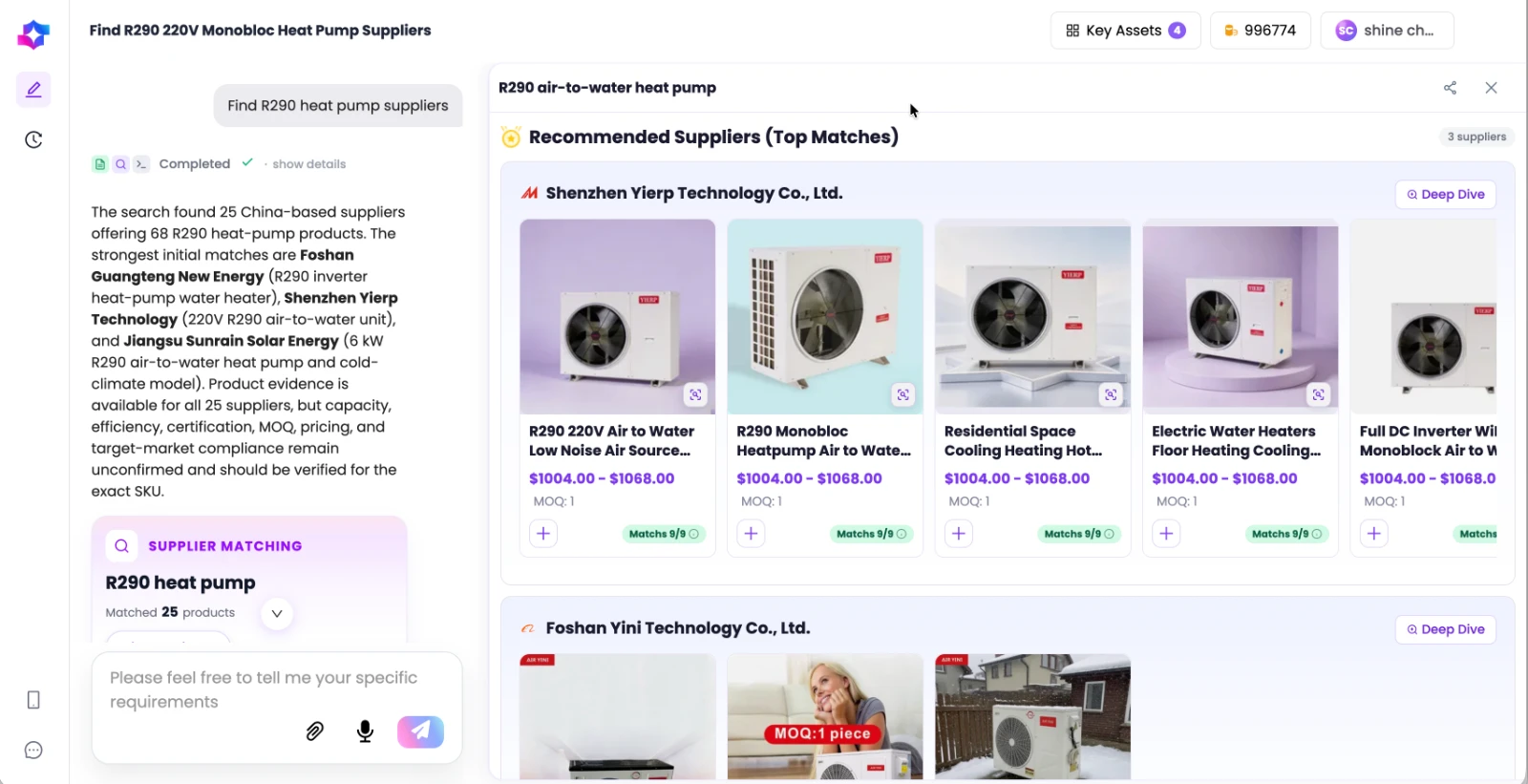
The result: 3 recommended suppliers from 50 candidates
SourcingX returned 3 recommended suppliers and 47 alternative suppliers for further review.
Among the recommended results:
| Supplier | Example product | Match | Public price shown | MOQ shown |
|---|---|---|---|---|
| Shenzhen Yierp Technology Co., Ltd. | R290 220V Air to Water Low Noise Air Source Heat Pump | 9/9 | $1,004–$1,068 | 1 |
| Foshan Yini Technology Co., Ltd. | Low Noise High COP DC Inverter R290 Monobloc Heat Pump | 8/9 | $851.94–$996.85 | Not shown |
| Go Free Airconditioning System Co., Ltd. | Domestic Monobloc Type Heat Pump | 8/9 | $44.33 | 1 |
The important point is not that the 9/9 result should automatically win.
The match score is a screening signal, not a final supplier decision.
Why the 9/9 match deserves priority
Shenzhen Yierp Technology has products in the result that match all nine comparison criteria used by SourcingX, including residential use, monobloc design, R290, 220V, low-noise positioning, high efficiency and MOQ 1.
That makes it a strong candidate for the shortlist.
But a 9/9 product match still does not answer questions such as:
- Is every product specification independently confirmed?
- Does the quoted configuration exactly match the reference model?
- Are certification claims valid for the relevant product and entity?
- Is current production capacity sufficient?
- What commercial terms are included in the displayed price?
- Those questions belong to the next stage of supplier evaluation.
Why an 8/9 match should not automatically be rejected
Foshan Yini Technology also appears highly relevant, with an R290 monobloc heat-pump result receiving an 8/9 match. Its displayed price range is also lower than the 9/9 result.
However, the public result does not expose which of the nine criteria caused the missing match.
That means the correct sourcing action is not:“8/9 is worse, remove it.”
It is:
“Identify the unmatched or unresolved criterion and decide whether it is a must-have or a negotiable trade-off.”
If the difference concerns a non-critical requirement, the supplier could remain competitive.
If it concerns refrigerant, voltage or another must-have technical requirement, it could be disqualified.
Why the lowest visible price cannot determine the shortlist
Go Free Airconditioning System shows an 8/9 matching product with a public price of $44.33 and MOQ 1, dramatically below the other displayed results.
That price should not be treated as proof that this supplier is the cheapest option.
Before comparing it with the $800–$1,000+ products, the buyer would need to confirm:
- Exact product configuration
- Capacity and model
- What the price includes
- Whether it represents a complete unit
- Quantity basis
- Packaging
- Shipping basis
- Required accessories
- Other commercial exclusions
This is a practical example of why price normalization must happen before price ranking.
The reference product itself also needs verification
There is another useful lesson in this sourcing task.
The reference Made-in-China listing is titled “R290 220V Air to Water Low Noise Air Source Heat Pump,” but the same page's Product Highlights and detailed specifications also contain references to R32 refrigerant.
This does not by itself tell the buyer which value is correct.
Instead, it shows why information taken from a supplier listing should be treated as:
Supplier-provided information that may still require confirmation.
The same principle applies to certifications.
The reference page displays CE and ISO9001 information, while the SourcingX comparison criterion records certification as “verify” rather than treating it as a completed verification.
So even when a product receives a high similarity match:
Product matching helps identify candidates. Verification determines whether the evidence is reliable enough to move forward.
What the buyer knows after this comparison
The sourcing task has reduced a broad supplier pool to a much more manageable decision set:
Shenzhen Yierp Technology — Prioritize for shortlist
Why: products reaching 9/9 against the extracted comparison criteria.
Next step: confirm technical consistency, certification evidence and commercial terms.
Foshan Yini Technology — Keep in shortlist consideration
Why: strong 8/9 product fit and competitive displayed pricing.
Next step: identify which criterion is unmatched and determine whether it is a must-have.
Go Free Airconditioning System — Hold for clarification
Why: 8/9 match, but the displayed price differs significantly enough that product and quotation scope should be normalized before comparison.
This is exactly what a useful shortlist should do:
Reduce the search space without hiding the questions that still need to be answered.
What Information Should You Collect Before the Final Shortlist?
Before moving to RFQ comparison, make sure the surviving suppliers provide consistent information on:
| Area | Information to collect |
|---|---|
| Product | Final specification; material; model; dimensions; components; customization |
| Commercial terms | MOQ; price tiers; tooling; sample charges; packaging; payment terms; quote validity |
| Delivery | Production lead time; Incoterm; named place; freight scope |
| Capability | Production capacity; relevant equipment; similar products; current production availability |
| Compliance | Required certifications; testing; certificate holder; certificate scope |
| Exceptions | Anything the supplier cannot meet exactly as requested |
If several of these fields are missing, you are not yet comparing suppliers — you are comparing incomplete answers.
https://www.sourcingx.ai/guides/supplier-information-before-comparison-40155
Common Mistakes When Shortlisting Chinese Suppliers
Ranking by unit price
Price should only be compared after quantity, specification, Incoterm, packaging, tooling, and other relevant costs are aligned.
Giving every criterion equal weight
A missing must-have certification should matter more than a slightly better payment term.
Treating missing information as neutral
Missing information is not the same as a positive result. Mark it explicitly.
Treating supplier claims as verified facts
Keep supplier-provided information separate from third-party or authoritative evidence.
Shortlisting too many suppliers
A shortlist should be small enough that you can meaningfully verify, request quotations from, and compare each supplier.
Deciding too early
A supplier can look strongest during initial search and weaker once quotations, certificates, production capability, and samples are reviewed. Shortlisting is a filter, not a final award decision.
A Practical Supplier Shortlist Template
| Area | Information |
|---|---|
| Product fit | Meets / Partially meets / Does not meet |
| Specification | Confirmed / Exception / Missing |
| MOQ | Value |
| Price basis | Quantity + unit |
| Incoterm | Rule + named place |
| Tooling / samples | Included / Additional / Missing |
| Lead time | Value + basis |
| Payment terms | Terms |
| Capacity | Verified / Supplier-provided / Missing |
| Business status | Verified / Needs review |
| Export experience | Relevant / Limited / Unknown |
| Certification | Verified / Needs verification / Not required |
| Key exceptions | List |
| Main risk | List |
| Decision | Shortlist / Hold / Remove |
| Next action | What must be confirmed next |
A good shortlist should make it possible for another member of the sourcing team to understand why this supplier remains in consideration and what still needs to be resolved.
The best supplier shortlist is not the one with the most suppliers or the lowest prices.
It is the one where each candidate is evaluated against the same requirement, commercial terms are normalized, important claims are tied to evidence, and unresolved information remains visible.
A practical process is: Normalize → Compare → Verify → Shortlist.
Once the shortlist is stable, the next step is to send suppliers a structured RFQ that makes their quotations genuinely comparable.
Frequently Asked Questions
What I compare first when evaluating Chinese suppliers?
Start with product and specification fit. If two suppliers are quoting different specifications, quantities, or commercial terms, normalize those differences before comparing price.
Is the lowest-priced supplier usually the best option?
No. A lower unit price may reflect a different MOQ, Incoterm, packaging scope, tooling arrangement, specification, or lead time. Compare the full commercial basis before deciding.
How many suppliers should I shortlist?
There is no fixed number, but three to five qualified suppliers are often easier to verify and compare meaningfully than a large list of loosely matched candidates.
Should I verify every supplier before shortlisting?
You do not need to complete full due diligence on every supplier in the initial longlist. However, basic identity checks and any critical must-have requirements should be reviewed before a supplier reaches the final shortlist.
How should I handle missing supplier information?
Mark it as Missing rather than assuming a positive or negative result. Then request the same missing field from every candidate before final comparison.