How to Find Reliable Suppliers in China: A Step-by-Step Guide for Global Buyers
Direct answer
To find reliable suppliers in China, first turn your purchase request into a clear sourcing brief. Search through more than one channel, send the same core requirements to each candidate, and shortlist suppliers based on product fit—not simply price, profile badges, or catalogue size. Before choosing a supplier, confirm the company behind the quotation, understand where production will take place, review product-specific evidence, evaluate samples, and resolve any differences between the supplier's business records, quotation, payment details, and compliance documents. A reliable supplier is not necessarily the largest factory or the lowest bidder. It is the supplier that fits your particular order and can support its claims with consistent evidence.
Finding suppliers is the easy part
A search for almost any product will return dozens, sometimes hundreds, of Chinese suppliers. The harder question is whether those suppliers are suitable for your order.
A supplier may appear relevant because it uses the right keywords, lists a similar product, or has an established marketplace profile. That does not necessarily mean it works with the same materials, manufacturing process, quality level, order size, destination market, or customization requirements.
This is why supplier search should not be treated as a directory lookup. It is a process of moving from a broad market of possible suppliers to a small group that can meet a clearly defined purchase requirement.
The core supplier-selection process has six stages:
- Write a usable sourcing brief.
- Build a supplier longlist.
- Send a comparable RFQ.
- Shortlist suppliers by product and operating fit.
- Compare and verify the shortlist.
- Test the relationship before committing to a larger order.
The final sections cover the supplier decision, common sourcing mistakes, and where sourcing tools can support the process.
1. Start With a Sourcing Brief Suppliers Can Actually Use
Many unsuccessful supplier searches begin with a request that is too vague.
A buyer might ask for:
We are looking for a manufacturer of reusable water bottles. Please send your catalogue and best price.
The supplier still does not know:
- What material is required;
- Whether the bottle is intended for children or adults;
- Which market it will be sold in;
- Whether it needs an existing model or a custom design;
- What capacity, lid structure, packaging, quantity, or delivery date is expected;
- Which product requirements are essential and which are negotiable.
The result is usually a generic catalogue and a price that cannot be compared with other quotations.
A useful sourcing brief does not need to be a finished technical specification. It should give suppliers enough information to decide whether the opportunity fits their capabilities.
Include the following where relevant:
- Product name and intended use;
- Photos, drawings, reference products, or existing specifications;
- Material and key components;
- Dimensions, performance requirements, and important tolerances;
- Required customization;
- Target market;
- Packaging and labeling requirements;
- Expected order quantity and repeat-order forecast;
- Target delivery date;
- Required testing, documentation, or regulatory considerations;
- Information the supplier must include in its reply.
Separate the requirements into three groups:
- Must-have requirements — a supplier cannot proceed without meeting them.
- Preferred requirements — they affect the decision but may be negotiated.
- Open questions — the supplier's technical input is needed before the specification can be finalized.
This distinction matters. When every preference is presented as mandatory, qualified suppliers may decide not to respond. When nothing is defined as mandatory, unsuitable suppliers can appear competitive.
Define the destination market early
Product requirements often depend on where the goods will be sold.
For products placed on the EU market, importers must check that the manufacturer has completed the applicable conformity assessment, prepared the required technical documentation, and met relevant labeling and traceability requirements.
Source: European Commission — Importers and Distributors
CE marking applies only to products covered by specific EU legislation. It is not required for every product sold in the EU and should not be treated as a general quality mark.
Source: European Commission — CE marking
For products sold in the United States, the importer may also carry testing and certification responsibilities under applicable product-safety rules. For example, the U.S. importer is generally responsible for issuing a General Certificate of Conformity for covered general-use products manufactured overseas.
Source: U.S. Consumer Product Safety Commission — General-Use Product Certification and Testing
You do not need to resolve every regulatory question before looking for suppliers. You should, however, know the destination market and identify any critical requirements that could disqualify a supplier later.
2. Build a Supplier Longlist
There is no single best place to find every type of supplier in China. The right channel depends on the product, order size, customization level, industry, and how much local support the buyer needs.
B2B marketplaces
B2B marketplaces are most useful when you are exploring a relatively common product and need an initial view of available models, suppliers, and indicative pricing. They can also help you learn the terminology used in an unfamiliar product category.
Their limitation is that marketplace visibility is not the same as manufacturing suitability. Sponsored placement, supplier memberships, profile completeness, transaction history, and platform-specific verification labels may influence what you see.
Use platform information to discover candidates, not to make the final decision.
Search engines
Search engines can reveal suppliers that are not highly visible on large marketplaces, particularly when you search using:
- Product name plus "manufacturer";
- Product name plus "OEM" or "ODM";
- Manufacturing process plus product category;
- Product name plus a Chinese manufacturing region;
- Industry-specific terminology.
Search results may also lead to trading companies, outdated websites, lead-generation pages, or companies with limited English-language information. Record the Chinese company name wherever possible so that you can identify the legal entity later.
Trade fairs
Trade fairs are useful when you need to:
- See products physically;
- Compare many suppliers in a short period;
- Ask technical questions face to face;
- Identify current product variations;
- Meet export sales teams before starting formal discussions.
An exhibition booth still does not establish that the exhibitor manufactures every product shown. Ask which products are made internally, which are sourced elsewhere, and where the relevant production site is located.
Industry referrals and associations
Referrals can help narrow the market, especially for specialized products. But a supplier that works well for another buyer may not suit your order quantity, quality level, destination market, or commercial model.
Treat a referral as a strong lead, not an automatic approval.
Supplier search and sourcing tools
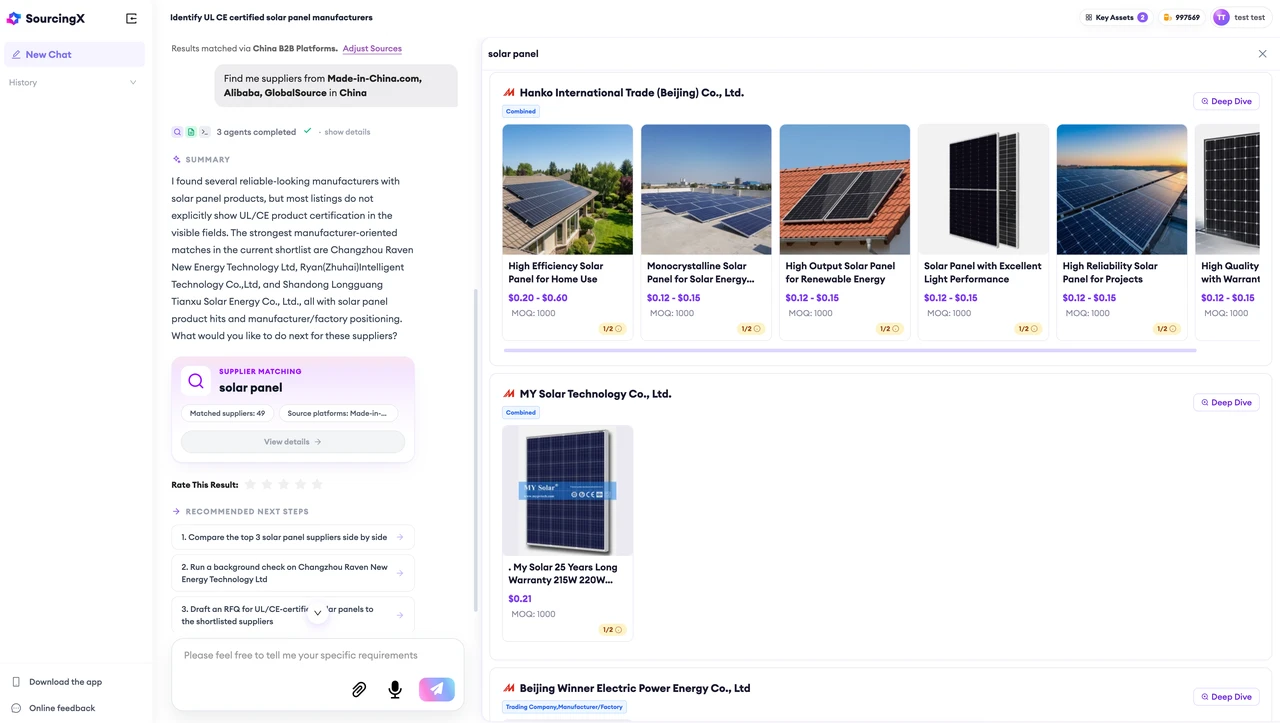
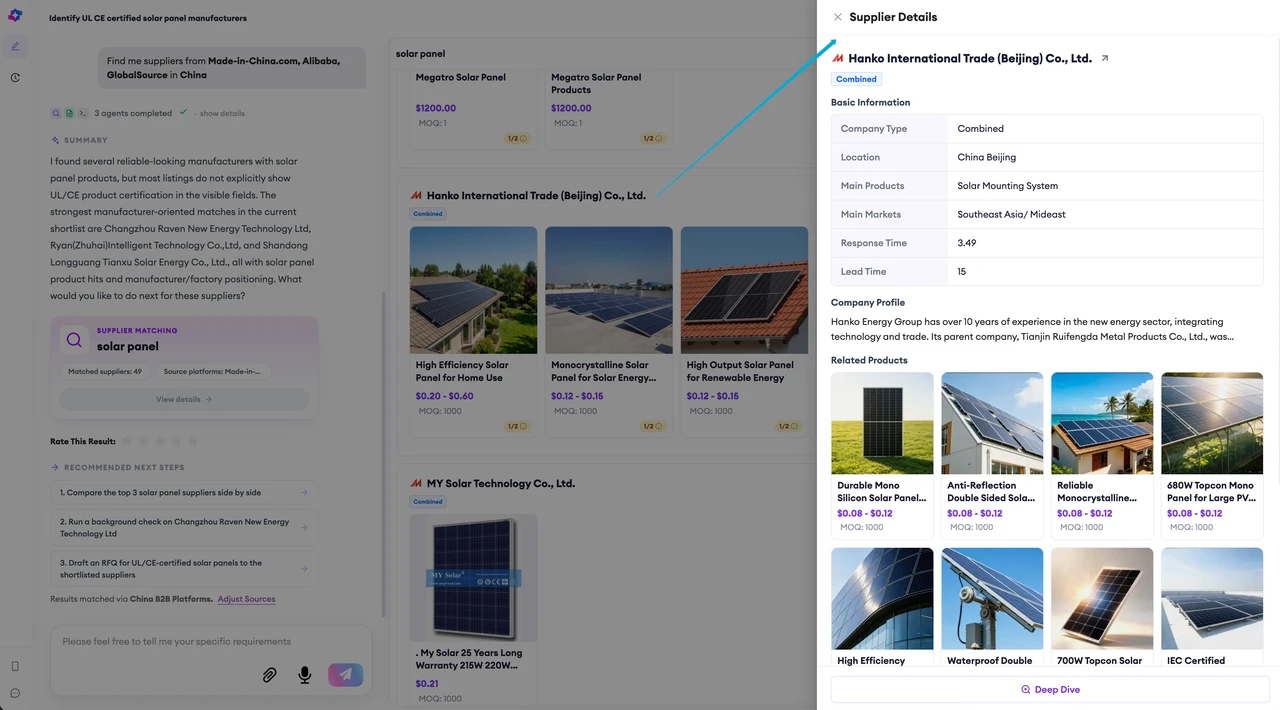
Supplier-search tools can help buyers turn a purchase request into a more structured list of potential suppliers and gather available information in one place. SourcingX can be used at this stage to find suppliers related to a product requirement and review available supplier, product, company, and trade information.
Regardless of the channel, avoid building the entire longlist from one source. A mix of channels gives you a better chance of seeing different supplier types rather than comparing companies that all optimize for the same platform.
3. Send the Same Core RFQ to Every Candidate
A supplier comparison is only useful when the suppliers are responding to the same request.
If one supplier quotes a standard product, another includes custom packaging, and a third assumes different materials, their prices cannot be compared directly.
Send the same core RFQ to each candidate. You can answer follow-up questions individually, but the starting requirements should remain consistent.
A first message could look like this:
Hello,
We are looking for a supplier for [product] for sale in [market].
The main requirements are: – Material: [requirement] – Size or capacity: [requirement] – Key performance requirement: [requirement] – Customization: [logo, color, packaging, tooling or other requirement] – Estimated initial order: [quantity or range] – Target delivery: [date or timeframe]
Please confirm:
- Whether you currently produce a similar product;
- Which parts of the production process are completed in-house;
- Your MOQ, sample cost, estimated unit price, and lead time;
- Which information you need before providing a firm quotation;
- Whether you have supplied this product category to [target market];
- Which product-specific test reports or technical documents are currently available.
Please do not send a general catalogue unless it includes products relevant to these requirements.
This is not meant to be a long questionnaire. It is designed to reveal whether the supplier understands the request.
Read the reply, not just the price
Consider these two responses.
Response A
Yes, we can make it. We are a professional factory with good quality and best price. Please tell us your quantity.
Response B
We make a similar model, but our current version uses a different material from the one in your request. We can ask our engineering team to review the change. Please confirm the required operating temperature and whether the product will be used indoors or outdoors.
Response B does not prove that the supplier is better. It does show that the supplier has identified a technical issue and is trying to understand the product before committing.
Useful early signals include:
- The supplier refers to specific parts of your request;
- It distinguishes existing capability from work that requires development;
- It identifies missing information;
- It explains which processes are internal and which are outsourced;
- Its MOQ, price, and lead-time assumptions are clear;
- It does not promise compliance before reviewing the product and destination market;
- Its answers remain consistent as the discussion becomes more detailed.
Be cautious when a supplier accepts every requirement immediately without asking a single technical or commercial question.
4. Shortlist Suppliers by Evidence, Not Profiles
At this point, the goal is not to conduct full due diligence on every supplier. The goal is to remove candidates that are clearly unsuitable and identify the suppliers worth investigating further.
Check product fit first
Start with the product, not the company presentation.
Look for evidence that the supplier works with:
- The relevant material;
- The required manufacturing process;
- A comparable level of product complexity;
- Similar customization;
- Similar quality or performance requirements;
- Orders close to your expected volume;
- The target market or markets with comparable requirements.
A supplier with a narrow but highly relevant product range may be a better match than a company displaying hundreds of unrelated products.
Ask practical questions:
- Which part of this product is most difficult to control in production?
- What information would your engineer need before confirming feasibility?
- Which production steps would be subcontracted?
- What normally causes defects in this product category?
- What would change between the sample and mass-production process?
- Which requirement in our brief is likely to affect cost or lead time most?
The quality of the answers often tells you more than a polished company profile.
Understand whether you need a factory or a trading company
"Are you a factory?" is useful, but it is not the final question.
A direct manufacturer may be preferable when the project requires:
- Custom engineering;
- Specialized tooling;
- Tight process control;
- Direct access to production staff;
- Large or repeated orders.
A trading company may be suitable when the buyer needs:
- Several related products from different factories;
- Lower or more flexible order quantities;
- Export coordination;
- Packaging consolidation;
- Stronger English-language project management;
- One contact coordinating several production sites.
Do not force every supplier into a simple "factory good, trader bad" classification. Select the operating model that fits the order, provided the relationships and responsibilities are clear.
When direct manufacturing control matters, take additional steps to determine whether a supplier is a real factory and identify which production processes it completes internally.
Remove clear mismatches
A supplier does not need to be fraudulent to be the wrong supplier.
Remove or deprioritize candidates when:
- The product is outside their normal manufacturing scope;
- They cannot meet a critical specification;
- Their MOQ or lead time is fundamentally incompatible with the project;
- They avoid basic questions about production;
- Their answers change repeatedly;
- They send documents for unrelated products;
- They cannot explain the legal or operating entities involved;
- They show little interest in understanding the intended use of the product.
This stage should leave you with a manageable shortlist for deeper comparison.
5. Compare and Verify the Shortlist
Price is part of supplier selection, but it should be compared only after the quotation scope is clear.
A low quotation may exclude tooling, packaging, testing, surface treatment, inspections, export cartons, required labeling, delivery, or even materials specified in the RFQ. Before comparing unit prices, ask each supplier to state what is included.
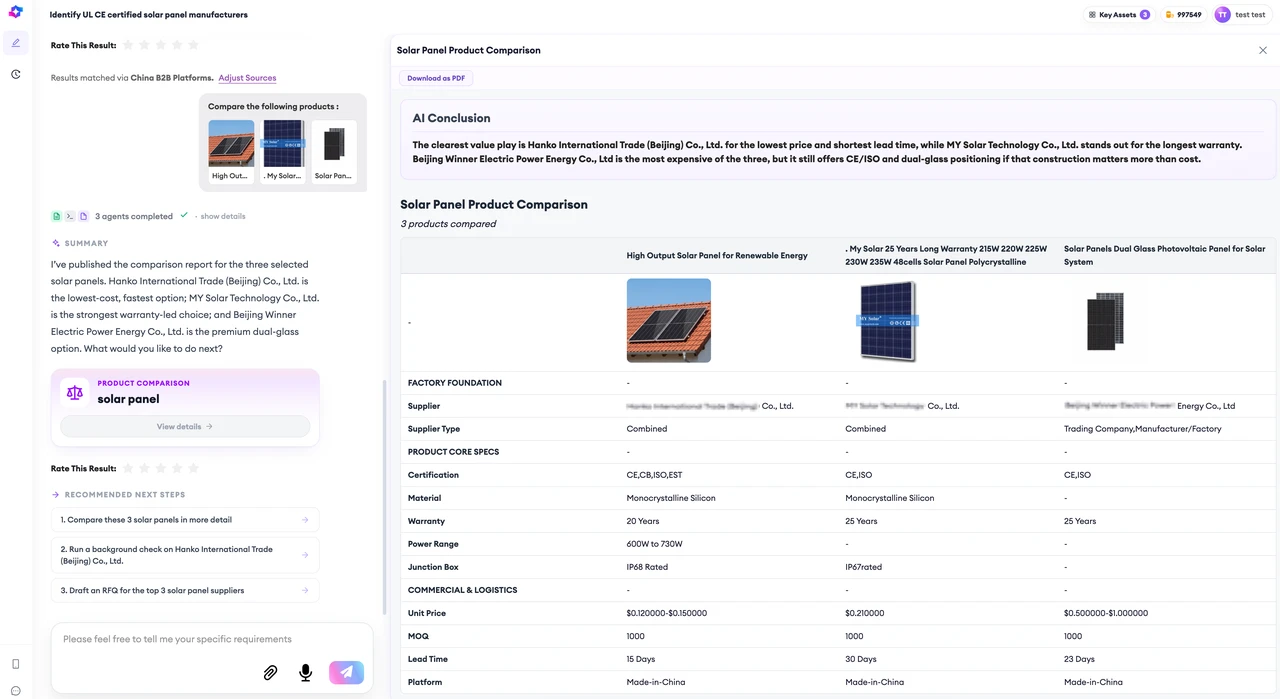
A practical comparison sheet might contain:
| Item | Supplier A | Supplier B | Supplier C |
|---|---|---|---|
| Product configuration quoted | |||
| Material and key components | |||
| Customization included | |||
| MOQ | |||
| Sample cost and lead time | |||
| Estimated production lead time | |||
| Unit price and Incoterm | |||
| Tooling or setup cost | |||
| Relevant production completed in-house | |||
| Available product-specific documents | |||
| Main unresolved questions |
Do not turn this table into a universal supplier score too early. Some issues are trade-offs; others are decision gates.
For example:
- A slightly longer lead time may be acceptable;
- A higher MOQ may be negotiable;
- A different packaging method may be workable;
- An unidentified contracting company is not a minor trade-off;
- A failed critical product requirement cannot be offset by a lower price.
Confirm the company behind the quotation
Before paying for tooling, sharing sensitive information, or placing a meaningful order, identify the Chinese legal entity involved.
Review the supplier's business license and available public company information. Compare the legal company name and other identifying information against:
- The quotation;
- The contract or purchase order;
- The invoice;
- The bank beneficiary;
- The supplier's website and email signature;
- The manufacturing location;
- The names shown on supporting documents.
Different entities are not automatically a problem. A manufacturer may export through a related trading company, and a group may use different companies for production and international sales. The supplier should be able to explain the relationship and the responsibilities of each entity.
Before committing to a larger order, follow a structured process to verify a Chinese supplier, including its legal identity, operating role, and unresolved risk signals.
Use export records as supporting evidence
Where relevant data is available, export records may help you assess whether a company has visible experience shipping similar product categories or serving particular markets.
Review the information in context:
- Does the product description appear relevant?
- Is export activity continuous or occasional?
- Do the destination markets support the supplier's claims?
- Is the exporting entity the same as the company you are speaking with?
- If not, can the relationship be explained?
Export records cannot confirm product quality, current capacity, customer satisfaction, or ownership of a factory. A supplier may also export through another entity, so an absence of records is not always a reason for rejection.
You can also verify supplier export records with customs data, while keeping in mind that shipment history does not prove product quality or current production capacity.
Review product documents against the exact product
Do not ask only whether a supplier "has certificates."
Request the documents relevant to the product and destination market, then check:
- Product name and model;
- Materials or components covered;
- Manufacturer and applicant names;
- Factory address;
- Test date;
- Standards or test methods;
- Laboratory or issuing organization;
- Whether the document covers the product you intend to order.
An ISO 9001 certificate relates to a company's quality management system. It may provide useful context about how the organization manages its processes, but it does not show that a particular product meets its technical or regulatory requirements.
Source: ISO — ISO 9001 Quality management systems
Similarly, a CE mark is not a general certificate issued by the EU. It is the manufacturer's declaration that the product meets applicable CE-marking requirements, and it applies only where the relevant legislation requires it.
At this stage, you are not trying to complete every possible compliance review. You are checking whether the supplier's claims are credible enough to proceed and identifying what still requires independent confirmation.
6. Test the Product—and the Working Relationship
A supplier that looks suitable on paper has not yet demonstrated that it can deliver your order. The next step is usually a sample.
Give the supplier a sample standard
Do not evaluate a sample based only on whether it "looks good."
Provide the criteria that matter, such as:
- Dimensions and tolerances;
- Materials;
- Color and appearance;
- Fit and assembly;
- Performance;
- Packaging;
- Labeling;
- Required documents;
- Testing method;
- Known unacceptable defects.
When the sample arrives, compare it with the same specification sent in the RFQ. Record deviations rather than relying on memory or informal comments.
Pay attention to how problems are handled
A sample problem is not always a reason to reject a supplier. It can reveal how the supplier works when something goes wrong.
A useful response should explain:
- What caused the issue;
- Whether it came from the specification, material, tooling, process, or communication;
- What will change;
- Who will approve the change;
- Whether the change affects cost or lead time;
- How the supplier will prevent the same issue in production.
A supplier that hides the problem or repeatedly sends revised samples without explaining the cause creates more risk than one that identifies the issue clearly and proposes a credible correction.
Confirm that the sample represents production
Ask whether the sample was made:
- At the intended production site;
- With the intended materials and components;
- Using production tooling or temporary sample methods;
- By the same team that will manage mass production;
- Under the same quality controls planned for the order.
A handmade or specially selected sample may demonstrate what is possible, but not necessarily what normal production will deliver. For a new supplier or a higher-risk product, consider a smaller trial order before committing to a larger quantity.
Escalate verification when the risk justifies it
Some orders require checks beyond document review and samples. Depending on the product and transaction, this may include:
- Independent laboratory testing;
- Factory or supplier audits;
- Production inspections;
- Pre-shipment inspections;
- Social or ethical audits;
- Intellectual-property or contract review;
- Customs and regulatory advice.
Choose the check based on the risk you need to resolve.
A factory audit can help assess a facility and its systems, but it does not guarantee the quality of every shipment. A sample test evaluates the sample submitted, not automatically every future production unit. A pre-shipment inspection can identify selected defects or non-conformities, but it cannot replace all regulatory or safety testing.
Supplier databases, sourcing platforms, and AI-supported tools can help organize information and identify areas requiring attention. They do not replace physical verification, testing, inspection, auditing, or legal judgment.
7. How to Make the Final Supplier Decision
By the time you make a final choice, the question should no longer be:
Which supplier has the lowest price?
It should be:
Which supplier gives us the strongest combination of product fit, credible evidence, workable commercial terms, and manageable remaining risk?
Before moving forward, make sure you can answer:
- Does the supplier understand the product and its intended use?
- Has it identified any technical limitations?
- Are the quoted materials, configuration, packaging, and services clear?
- Is the legal company behind the transaction known?
- Is the relationship between the seller, manufacturer, exporter, and bank beneficiary understood?
- Has the supplier provided relevant, product-specific evidence?
- Has the sample been evaluated against a written standard?
- Have important inconsistencies been resolved?
- Which issues still require testing, inspection, audit, or professional advice?
- Are those checks planned before the point at which the risk becomes difficult to reverse?
You may still choose a supplier with unresolved questions. The important point is that the remaining risk is visible and intentional, rather than discovered after payment or production.
8. Common Mistakes When Looking for Suppliers in China
Starting with a vague request
Broad requirements produce broad supplier lists. Buyers then spend time speaking with companies that were never suited to the product, order size, or destination market.
Comparing quotations built on different assumptions
Two suppliers may appear to quote the same product while using different materials, components, packaging, quality controls, or delivery terms. Confirm the quotation scope before comparing prices.
Treating labels or certificates as supplier approval
Platform badges, verification labels, and certificates may provide useful information, but none of them confirms that a supplier fits a particular product and order.
Focusing only on "factory or trader"
The more useful question is who controls production, quality decisions, subcontracting, delivery, and corrective action. The operating model must be transparent and appropriate for the purchase.
Approving samples without a written standard
Without defined acceptance criteria, sample approval becomes subjective and difficult to reproduce during production. Record the specification, deviations, and approved changes.
Before payment, also make sure the company named on the contract, invoice, and bank account is understood. Supplier selection should become more demanding as the buyer's financial and operational commitment increases.
How SourcingX Fits Into the Process
SourcingX helps buyers structure the early and middle stages of supplier selection.
A buyer can use it to:
- Start from a product or sourcing requirement;
- Discover potential suppliers;
- Review available company, product, and trade information;
- Organize the questions that still need supplier confirmation;
- Compare candidates before deciding which suppliers require deeper verification.
SourcingX does not make the final supplier decision for the buyer. It also does not replace factory audits, product testing, inspections, legal advice, or regulatory review.
Its role is to help buyers move from a broad supplier search to a more informed shortlist, with more context available before time and money are committed.
First-party source: SourcingX product documentation and live workflow.
Conclusion
Finding suppliers in China is not difficult. Finding the right supplier requires more than searching for a product and comparing the first prices you receive.
Begin with a sourcing brief that suppliers can act on. Use several discovery channels, send each candidate the same core requirements, and pay attention to how suppliers respond when the questions become specific.
Shortlist suppliers based on product fit and operating transparency. Then verify the companies behind the quotations, review relevant evidence, test samples against written criteria, and increase the level of due diligence when the product or transaction carries greater risk.
The aim is not to eliminate every uncertainty. It is to understand enough about the supplier, product, and transaction to make a controlled decision.