How to Write a Supplier Search Brief That Gets Better Matches
Direct answer
A good supplier search brief tells potential suppliers enough about the purchase to decide whether they are genuinely relevant. Describe the product, intended use, key specifications, target market, estimated quantity, customization, timing, and any requirements that would immediately disqualify a supplier. Separate what is mandatory from what is preferred or still open to supplier input. The brief should not try to settle every commercial term before you have identified suitable suppliers. Its job is simpler: reduce irrelevant matches, make supplier responses easier to compare, and help the right suppliers recognize that the opportunity fits their capabilities. If your request is only “I need a reliable manufacturer of this product at the best price,” the search usually starts too broad.
A Supplier Search Brief Is Not the Same as an RFQ
A supplier search brief comes before a detailed quotation process.
It answers:
What kind of supplier are we actually looking for?
An RFQ goes further. It asks shortlisted suppliers to price a sufficiently defined product and state commercial terms in a comparable way.
This distinction matters because buyers often try to do both jobs in one message. They either start with almost no information or send a long procurement questionnaire to suppliers they have not yet established as relevant.
A better sequence is:
Sourcing requirement → supplier search brief → supplier shortlist → detailed RFQ → verification and selection.
Professional procurement guidance follows the same basic principle: requirements and specifications should be defined before suppliers can be evaluated meaningfully. CIPS describes procurement specifications as the requirements for the product or service being purchased, while ISO 20400 places planning and specification definition within the sourcing process itself. CIPS explains procurement specifications here, and ISO 20400 provides the broader sourcing framework here.
The search brief does not have to be a formal procurement document. For many sourcing projects, one page of well-structured information is more useful than ten pages of generic supplier requirements.
Start With the Buying Decision, Not the Search Box
Before asking where to find suppliers, define what would make a supplier relevant.
Consider a buyer searching for a custom retail display rack.
A weak search begins with:
We are looking for a reliable metal display rack manufacturer in China. Please send your best price and catalogue.
That sounds reasonable, but almost every supplier selling racks, shelving or fabricated metal products can respond.
A more useful brief might say:
We are sourcing a floor-standing powder-coated steel display rack for retail stores in the United States. The rack must support our existing shelf dimensions, use a matte black finish, include custom branding, and ship flat-packed. Estimated first order is 800–1,200 units, with repeat orders expected if the first program performs well. We prefer suppliers with relevant sheet-metal fabrication and powder-coating capability. Please indicate which processes are completed in-house and which are subcontracted.
The second version is not necessarily ready for final quotation.
But it already gives the search much more structure.
A supplier that mainly makes wire baskets may decide the requirement is outside its normal work. A supplier that does metal fabrication but cannot handle the required finish can say so. A trading company managing several suitable factories may still be relevant if that operating model is acceptable to the buyer.
That is what the search brief should accomplish: allow unsuitable suppliers to fall out early.
Describe the Product in Terms a Supplier Can Act On
The product name is only the beginning.
“LED light,” “plastic bottle,” “packaging box” or “steel component” may describe thousands of materially different sourcing requirements.
Instead of adding every technical detail you have, focus on the details that change who can make the product.
For many physical products, that means describing some combination of:
| Question | Why It Affects Supplier Matching |
|---|---|
| What exactly is the product? | Separates adjacent categories from the actual requirement. |
| What is it used for? | Helps the supplier understand performance and risk. |
| Which material or construction is required? | Filters suppliers by process and material capability. |
| What dimensions or performance requirements are critical? | Identifies projects that require particular equipment or engineering capability. |
| Is it standard, modified or fully custom? | Changes tooling, engineering and supplier suitability. |
| Which features cannot change? | Prevents suppliers from matching only by offering an easier substitute. |
| Which market will receive the product? | Gives context for documentation, labeling and other market-specific questions that may need to be resolved later. |
The objective is not to create the final engineering specification during supplier search.
It is to describe enough of the product that two suppliers discussing the “same product” are actually talking about something comparable.
Use Photos Carefully
Reference photos can be extremely useful, especially when terminology varies across suppliers.
But a photo should not replace the written requirement.
If a reference product uses stainless steel but your project requires aluminum, say so. If the photograph shows one packaging format but you need another, state the difference.
Otherwise suppliers may quote what they see rather than what you intend to buy.
Separate Must-Haves From Preferences and Open Questions
One of the most useful improvements to a sourcing brief is to stop treating every requirement as equally fixed.
Divide the requirement into three groups.
Must-Haves
These are decision gates.
If a supplier cannot meet one, the supplier should normally not be matched or shortlisted.
For the display-rack example, that might include:
- required material and load-bearing specification;
- ability to make the required dimensions;
- custom branding;
- first-order volume;
- required delivery window.
Preferences
These affect the decision but can be traded against other factors.
For example:
- factory-direct relationship preferred;
- a particular Chinese manufacturing region preferred;
- lower MOQ preferred;
- existing export experience in the destination market preferred.
A preference should not silently become a requirement.
If you write “factory only” when what you actually need is transparent production management, you may remove a trading company or manufacturing group that could manage the order well.
If the distinction between factory and intermediary matters to the project, verify it during supplier evaluation rather than relying only on the supplier label. See How Can I Tell If a Chinese Supplier Is a Real Factory? for the deeper verification process.
Open Questions
Some requirements should be left open because you need supplier expertise before fixing them.
Examples include:
- whether a component should be redesigned for manufacturability;
- whether an existing mold can be modified;
- what tolerance is realistic for the proposed process;
- whether changing packaging could materially reduce shipping volume;
- whether the requested finish affects lead time or defect rates.
A good sourcing brief does not pretend the buyer already knows every answer.
It makes clear which decisions are fixed and where supplier input is genuinely useful.
Include the Commercial Constraints That Change the Match
A technically suitable factory can still be commercially irrelevant.
Suppose a supplier can make your product but only accepts 20,000 units per order while the project requires 1,000. Or the supplier needs 12 weeks to develop tooling when your launch is scheduled in eight.
Those are not small negotiation details. They affect whether the supplier belongs in the shortlist.
At the search stage, include the commercial information that changes supplier suitability:
- approximate initial quantity or quantity range;
- whether repeat orders are expected;
- target timing;
- whether tooling or development is required;
- expected level of customization;
- sample requirement;
- any known budget constraint that is genuinely decisive.
You do not always need to state a target unit price.
For a new or custom product, asking every supplier for “best price” before the design and quotation scope are clear can create numbers that look comparable but are based on different assumptions.
The early question is not:
Who gives us the lowest number?
It is:
Which suppliers are capable of quoting the same requirement seriously?
Ask for Enough Evidence to Screen—Not Everything at Once
The search brief can also tell suppliers what evidence you expect in the first response.
But this is not the stage to request every certificate, audit, financial record, production document and customer reference you may eventually need.
Ask for evidence that helps determine whether deeper discussion is worthwhile.
For example:
- one or two relevant product examples;
- confirmation of the key manufacturing processes;
- whether those processes are in-house or subcontracted;
- indicative MOQ;
- approximate sample and production lead time;
- existing documents relevant to the product or market, where applicable;
- the legal company name if the supplier is moving into the shortlist.
The key is relevance.
A factory showing twenty pages of unrelated products has not necessarily provided stronger evidence than a smaller supplier showing three products built with the same material, process and level of complexity as your requirement.
Likewise, a supplier does not become suitable simply because its company registration is valid.
Once a candidate reaches the shortlist, move from supplier matching to structured due diligence. How to Verify Chinese Suppliers: A Practical Guide for Global Buyers explains how to verify legal identity, factory relationships, product capability, evidence and transaction consistency before commitment.
Use the Brief to Improve Supplier Matching
The brief should follow the sourcing process rather than disappear after the first search.
Use the same requirement when you:
- search across supplier databases and sourcing platforms;
- contact suppliers directly;
- ask for recommendations;
- review marketplace candidates;
- prepare the later RFQ;
- compare the shortlist.
This prevents the project from drifting as different suppliers suggest different versions of the product.
SourcingX can be used at the supplier-search stage by describing the product and sourcing requirement and using the result to discover potential suppliers. Buyers can then review available supplier information and decide which candidates deserve deeper evaluation.
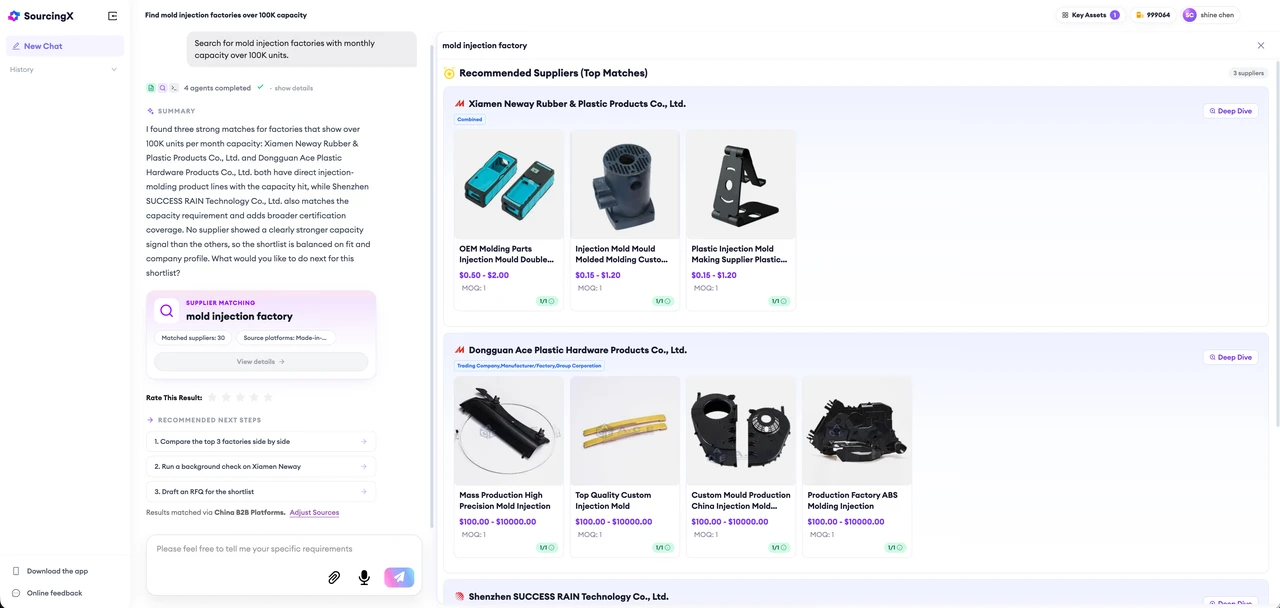
The important point is that AI-supported sourcing does not remove the need to define the purchase.
If the input is “find good suppliers for outdoor lights,” the system still has to work with a broad problem.
If the buyer provides intended use, product type, essential specifications, target market, expected quantity and critical supplier requirements, the search can be focused on a much more meaningful definition of fit.
Do not treat the result as final supplier approval. Matching identifies candidates. Verification, samples, testing, inspections and commercial review determine whether a candidate should actually receive the order.
Check the Brief Before You Start Searching
Before sending the brief to suppliers or using it in a supplier-search tool, ask one practical question:
Could a supplier read this and quickly decide that the project is not a fit?
If the answer is no, the brief is probably still too broad.
The final version should make the purchase recognizable without trying to solve the entire sourcing project in advance.
You should be able to identify:
- what product is being sourced;
- what the product must do;
- which requirements cannot change;
- what can still be discussed;
- approximately how much you expect to buy;
- where the product is going;
- when it is needed;
- what kind of supplier would be relevant;
- what evidence do you want before spending more time on the candidate.
That is enough to begin.
A supplier search brief is not valuable because it is long. It is valuable because it removes ambiguity that would otherwise follow the buyer through search, quotation, comparison and supplier selection.
The better the purchasing question, the easier it becomes to identify suppliers worth talking to.