Source 10 Inch Utility Trolley Trailer for Garden, Warehouse, and Construction
Compare 30 listings of the 10 Inch Utility Trolley Trailer featuring varying axle types, payload capacities, and surface treatments. Buyers can evaluate options ranging from 2T to 8T loading weights with CE and ISO certifications.
Key considerations
Products List




Comprehensive Sourcing Guide
Strategic Sourcing Guide for 10 Inch Utility Trolley Trailers
The global market for light-duty hauling equipment has seen a steady increase in demand for versatile utility trolley trailers, particularly those featuring 10-inch wheel configurations. For procurement professionals in the B2B sector, sourcing these units requires a disciplined approach that distinguishes between marketing claims and verifiable product attributes. The core keyword "10 Inch Utility Trolley Trailer" often masks a wide variety of underlying chassis designs, load capacities, and structural standards. This guide provides a comprehensive framework for evaluating suppliers and specifications based on observed market data and technical realities, ensuring that procurement decisions are grounded in factual evidence rather than generalized assumptions.
Technical Specifications and Structural Integrity
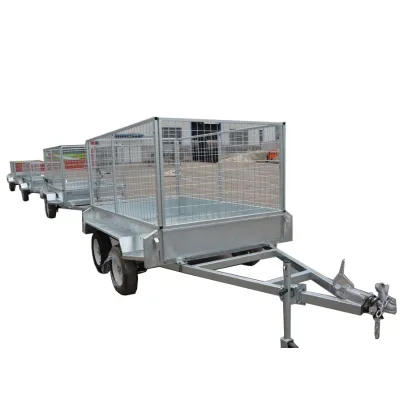
When evaluating a 10-inch utility trolley trailer, the primary focus must be on the structural components that define its load-bearing capability and durability. The observed market data indicates significant variation in axle construction and chassis materials. Buyers should specifically verify the axle dimensions, as some listings reference a 50x50mm x 4mm square tube axle, while others may utilize different profiles. The integrity of the chassis is equally critical; data points suggest a preference for 50x50 RHS (Rectangular Hollow Section) profiles over angle iron, as the latter may offer inferior torsional strength.
The suspension system is another pivotal specification. High-quality units in this category often feature a 5-leaf spring configuration, which is explicitly noted as superior to cheaper 3 or 4-leaf alternatives. This distinction directly impacts the trailer's ability to handle uneven terrain and heavy payloads without structural fatigue. Furthermore, the wheel size is a defining characteristic. While the core search term is "10 inch," the market also lists sizes such as 8x5, 9x5, and 8x7 inches. Procurement teams must confirm that the specific unit ordered matches the required 10-inch specification, as smaller wheels may compromise stability under load.
The dumping mechanism is a variable that significantly alters the utility of the trailer. Some units are designed with a backward dumping direction, while others are explicitly non-self-dumping. The presence of a nosewheel steering mechanism, such as wheel steering, is essential for maneuverability in tight spaces. Additionally, the surface treatment process, often galvanizing, serves as a primary defense against corrosion, which is a common failure point in utility trailers exposed to outdoor elements. Buyers must verify that the finish is applied consistently across the chassis and bed to ensure longevity.
Compliance, Certification, and Safety Standards
Navigating the compliance landscape for utility trailers requires careful attention to the certifications listed on product documentation. The market data reveals a mix of certifications, including CE, ISO, and DOT. These designations are not merely decorative; they indicate adherence to specific regional safety and manufacturing standards. For instance, CE certification suggests compliance with European Union safety, health, and environmental requirements, while DOT (Department of Transportation) certification is often required for road-legal operation in the United States.
It is crucial to understand that not every listed product satisfies every certification claim. A single supplier may offer models with ISO/TS certification alongside others with only CE or DOT markings. Procurement officers must request specific certification documents for the exact model number being purchased, such as the 7CT-1.5 or SWT-TT85, rather than accepting a blanket statement of compliance. The standard payload capacity is another area requiring verification. While some units are rated for a Gross Vehicle Weight (GVW) of 750kg, others are rated for 2000kg or even 3-10 tons. The discrepancy between a 750kg payload and a 3-ton standard suggests that "utility trolley" can refer to vastly different classes of equipment.
Safety features, such as ABS (Anti-lock Braking Systems), vary significantly across the product range. Some listings explicitly state "With ABS," while others note "Without ABS." For trailers intended for high-speed towing or heavy loads, the absence of ABS may be a critical compliance gap depending on local regulations. Similarly, security initiative protection devices are not universally present; some models are listed as "Without Security Initiative Protection Device." Buyers must assess whether the specific application requires these safety mechanisms and verify their presence before finalizing a purchase.
Cost Drivers and Pricing Variables
The pricing for 10-inch utility trolley trailers is influenced by a complex interplay of factors, including material costs, manufacturing complexity, and certification requirements. The observed price range in the market spans from $99 to $19,999, a variance that reflects the difference between basic, light-duty models and heavy-duty, fully equipped units. A unit priced at the lower end of this spectrum likely features a simpler chassis, fewer leaf springs, and minimal safety features. Conversely, higher-priced units often incorporate galvanized finishes, advanced braking systems, and higher payload capacities.
The Minimum Order Quantity (MOQ) is another significant cost driver, with observed ranges from 1 to 100 units. Buyers purchasing small quantities may face higher per-unit costs due to the lack of economies of scale, while bulk orders can negotiate better pricing tiers. The origin of the product, primarily from regions like Jiangsu and Zhejiang in China, also impacts the final cost. While these regions are known for competitive manufacturing, logistics costs, import duties, and shipping times must be factored into the total cost of ownership.
Customization availability is a key variable that can increase costs. Many suppliers offer customization options, allowing buyers to select specific sizes, colors, or structural modifications. While this flexibility is valuable, it often extends lead times and increases the unit price. Buyers should clearly define their customization needs upfront to avoid unexpected cost overruns. Additionally, the packing method, whether flat packing, industrial packing, or palletized, can affect shipping efficiency and final costs.
Typical Applications and Operational Use Cases
The versatility of 10-inch utility trolley trailers makes them suitable for a wide range of applications, from agricultural use to industrial logistics. The "Popular Type" designation in the market data suggests that these units are widely adopted for general hauling tasks. Their flatbed shape and varying payload capacities allow them to transport construction materials, garden equipment, and industrial supplies. The backward dumping direction is particularly useful for sites where unloading needs to be efficient, such as construction zones or farms.
For users requiring higher payload capacities, the 3-10 ton standard models are appropriate for heavy industrial applications. However, for lighter tasks, the 750kg or 2-ton models offer a more agile solution. The presence of ABS and specific steering mechanisms makes these trailers suitable for road transport, while non-self-dumping models may be preferred for stationary storage or specialized hauling where manual unloading is acceptable. The color, often silver, is a common choice for its ability to reflect heat and maintain a professional appearance, though this may vary based on customization.
Supplier Evaluation and Quality Assurance
Evaluating suppliers for utility trailers requires a rigorous assessment of their production capabilities and quality control processes. Buyers should prioritize suppliers who provide transparent information about their manufacturing standards and surface treatment processes. The distinction between "Galvanizing" and generic "Surface Treatment" is critical; galvanizing offers superior corrosion resistance, which is essential for trailers exposed to the elements.
Quality control should extend to the verification of axle and chassis specifications. Buyers must ensure that the 50x50mm square tube axles and 5-leaf spring systems are present as advertised, rather than substituting cheaper alternatives. The condition of the product, typically listed as "New," should be verified through inspection reports or third-party audits. Additionally, the origin of the product, whether from Jiangsu or Zhejiang, should be confirmed to ensure it aligns with the buyer's sourcing strategy and risk tolerance.
Long-Term Procurement Considerations
Long-term procurement of utility trailers involves considering the total cost of ownership, including maintenance, replacement parts, and durability. The choice of materials, such as the 50x50 RHS chassis and galvanized finish, directly impacts the lifespan of the trailer. Buyers should also consider the availability of spare parts and the supplier's support for repairs. The standardization of components, such as the 10-inch wheel size, can simplify maintenance and reduce downtime.
Furthermore, the potential for future customization and scalability should be factored into the procurement strategy. As business needs evolve, the ability to upgrade trailers or add accessories can extend their utility. Buyers should establish a relationship with suppliers who can support these long-term needs, ensuring a steady supply of high-quality units that meet evolving operational demands. By focusing on verified specifications and robust quality control, organizations can build a reliable fleet of utility trailers that deliver value over their entire lifecycle.
Comparative Analysis of Key Specifications
To facilitate informed decision-making, the following table summarizes the key variations observed in the market for 10-inch utility trolley trailers. This comparison highlights the critical differences in specifications that buyers must verify.
| Specification Category | Low-End / Basic Configuration | High-End / Heavy-Duty Configuration | Verification Requirement |
|---|---|---|---|
| Payload Capacity | 750kg - 2000kg | 3 - 10 Tons | Confirm GVW rating on documentation |
| Axle Construction | Variable (Check dimensions) | 50x50mm x 4mm Square Tube | Measure axle thickness and profile |
| Chassis Material | Angle Iron (Less Common) | 50x50 RHS (Rectangular Hollow) | Verify material type and cross-section |
| Suspension | 3 or 4 Leaf Springs | 5 Leaf Springs | Count leaf springs and check thickness |
| Surface Treatment | Generic Paint | Galvanized Finish | Request coating thickness report |
| Braking System | Without ABS | With ABS | Test braking functionality |
| Dumping Mechanism | Non-Self-Dumping | Backward Dumping | Inspect hydraulic or manual mechanism |
| Certification | CE or ISO (One) | CE, ISO, and DOT | Request valid certificates for model |
This table underscores the importance of detailed verification. A buyer seeking a heavy-duty unit must ensure that the supplier provides the specific high-end configurations listed, rather than a basic model that merely shares the "10-inch" wheel descriptor. By adhering to these verification protocols, procurement teams can mitigate risks and secure trailers that meet their specific operational requirements.
FAQs
What certifications do 10 inch utility trolley trailers have?
These trailers often carry CE, ISO, and DOT certifications depending on the model. Buyers must verify specific documents for each unit, as some listings show ISO/TS while others list only CE or DOT markings for compliance.
Which axle construction is standard for these trailers?
High-quality units typically use 50x50mm x 4mm square tube axles. Some cheaper alternatives may use different profiles, so buyers should verify the exact dimensions and material thickness before purchasing to ensure structural integrity.
Can I customize the size of a 10 Inch Utility Trolley Trailer?
Customization is available for many models, allowing buyers to choose specific dimensions. However, this flexibility may extend lead times and increase costs, so clear requirements should be defined upfront to avoid unexpected delays.
How does the dumping mechanism work on these trailers?
Some units feature a backward dumping direction for efficient unloading. Others are explicitly non-self-dumping, requiring manual operation, so the specific mechanism must be confirmed based on the intended application and operational needs.
What is the typical payload capacity for these trailers?
Payload capacities vary significantly, ranging from 750kg to over 3 tons. Buyers must check the Gross Vehicle Weight rating on documentation, as a single listing may include models with vastly different load-bearing capabilities.
Where are these trailers typically manufactured?
Most units originate from Jiangsu or Zhejiang in China. The specific origin affects logistics costs and lead times, so buyers should confirm the exact manufacturing location to align with their sourcing strategy and risk tolerance.
Do these trailers come with ABS braking systems?
ABS availability varies, with some models featuring the system and others lacking it. For heavy loads or high-speed towing, the presence of ABS is critical, so buyers must verify this safety feature before finalizing a purchase.