Source 12-in-1 Programmable Electric Pressure Cooker for Hotels, Commercial, Household
Find and compare 25 listings of the 12-in-1 Programmable Electric Pressure Cooker from verified suppliers. Buyers can review specifications including power, capacity, and control types to select units suitable for hotels, commercial kitchens, or household use.
Key considerations
Products List


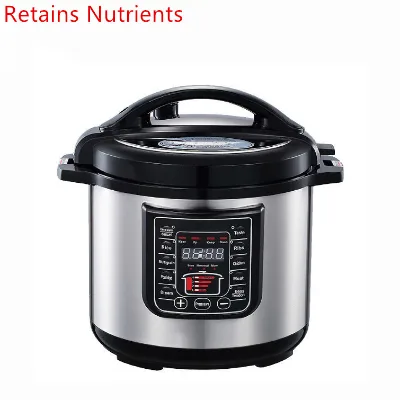


Touch Control Electric Pressure Cooker for Versatile Kitchen Cooking Needs
$16.50 - $18.00
MOQ: 1000 Pieces

Stainless Steel Electric Pressure Cooker with Multi Cooking Functions
$20.00 - $23.00
MOQ: 1000 Pieces

Touch-Controlled Multi Cooker: Electric Pressure Cooker for Quick Meals
$16.50 - $18.00
MOQ: 1000 Pieces

Multi Cooker with Touch Control for Electric Pressure Cooking Convenience
$16.50 - $18.00
MOQ: 1000 Pieces

Electric Pressure Cooker with 7+ Safety Features and Easy Control Knob
$16.50 - $18.00
MOQ: 1000 Pieces

Electric Pressure Cooker 6 Qt Stainless Steel Multi Cooker Multi-Function Cooker
$16.50 - $18.00
MOQ: 1000 Pieces


Fully Automatic Pressure Cooker Electric for Efficient Cooking Solutions
$3000.00 - $3500.00
MOQ: 1 Pieces

Comprehensive Sourcing Guide
Strategic Sourcing Guide for 12 in 1 Programmable Electric Pressure Cookers
The global market for multi-functional kitchen appliances has seen a significant shift toward integrated solutions that replace multiple single-purpose devices. The "12-in-1 Programmable Electric Pressure Cooker" represents a specific segment of this market, offering buyers a convergence of pressure cooking, slow cooking, rice preparation, and various other culinary functions within a single unit. For B2B procurement professionals, sourcing these units requires a disciplined approach that balances technical versatility with supply chain reliability. This guide outlines the critical factors for evaluating suppliers, verifying product specifications, and managing the procurement lifecycle for these complex appliances.
Technical Architecture and Functional Capabilities
When evaluating a 12-in-1 Programmable Electric Pressure Cooker, the primary focus must be on the integration of distinct cooking modes. The "12 in 1" designation typically implies a combination of pressure cooking, slow cooking, rice cooking, steaming, sautéing, yogurt making, cake baking, egg cooking, warming, and potentially specialized functions like soup or fish preparation. The core technical differentiator lies in the control system. Modern units often utilize microcomputer control to manage complex pressure and temperature curves, whereas older or budget-oriented models may rely on mechanical controls.
Capacity is a fundamental specification that dictates the unit's suitability for different market segments. Available data indicates a range of capacities, with specific models observed at 5L, 6L, and 12L. A 6L unit, for instance, is often marketed as a standard household size, while a 12L capacity suggests suitability for larger families, commercial kitchens, or hotel settings. The power consumption is equally critical for energy efficiency and grid compatibility. Observed power ratings in the current market range from 800W to 1600W. A 1000W unit offers a balance between heating speed and energy usage, while a 1600W model provides faster pressure build-up but requires robust electrical infrastructure.
The inner pot material is a decisive factor for food safety and durability. Suppliers may offer stainless steel or aluminum alloy options. Stainless steel inner pots are generally preferred for their resistance to corrosion and ease of cleaning, while aluminum alloy pots offer superior heat conductivity. Some listings also mention non-stick coatings, which are essential for the "programmable" aspect to prevent food residue from interfering with sensor accuracy during automated cycles. The operating language support is another technical consideration; while English is standard, some models support multiple languages including German, French, Dutch, and Spanish, which is vital for exporting to diverse international markets.
Compliance, Certification, and Safety Standards
Procurement of electrical appliances involves navigating a complex landscape of safety standards and certifications. Buyers must verify that the product adheres to the electrical standards of the target import market. Observed voltage standards in the supply chain include 220-240V and 110V configurations, indicating that suppliers often produce region-specific variants. However, the mere existence of a voltage rating does not guarantee compliance with local safety regulations.
Energy efficiency is a growing regulatory requirement in many jurisdictions. Some products in the current pool are listed with an Energy Efficiency Rating Class A, which is a positive indicator for markets with strict energy labeling laws. However, buyers should not assume this rating applies to all SKUs without verification. The product standard itself, often linked to capacity (e.g., 6L or 5L standards), serves as a baseline for manufacturing consistency but does not replace specific safety certifications like UL, CE, or GS.
Furthermore, the material composition of the inner pot and the outer casing must meet food safety standards. While "Stainless Steel" and "Aluminum Alloy" are common materials, the specific alloy grades and the safety of the non-stick coating (e.g., PFOA-free claims) must be confirmed through supplier documentation. For commercial applications, such as in hotels or garages, additional certifications regarding commercial electrical safety may be required. Buyers should request test reports from accredited laboratories to validate that the pressure release mechanisms and electrical insulation meet the specific safety requirements of the destination country.
Cost Drivers and Pricing Dynamics
The pricing of programmable electric pressure cookers is influenced by a combination of material costs, technological complexity, and order volume. The observed price range in the market is extensive, spanning from $7.13 to $20,000. This wide disparity suggests that the lower end of the spectrum may represent basic models, bulk components, or potentially misleading listings, while the higher end likely includes high-end commercial units, custom-branded solutions, or complete production lines.
For standard B2B procurement, the cost is driven primarily by the control system complexity. Models with microcomputer control and multi-language displays command a premium over those with mechanical controls. The capacity of the unit also directly impacts the cost; a 12L unit will inherently cost more than a 5L unit due to the increased material usage and the need for more powerful heating elements. Additionally, the inclusion of advanced features such as APP control (though currently noted as "No" in some listings) or specific "Outsanding Functions" like slow cooking and soup preparation can increase the manufacturing cost.
Packaging is another significant cost driver. Standard cartons are common, but premium options like a "5 Layer Gift Box with Full Poly Foam" add to the unit cost but are essential for retail-ready products. The warranty terms, typically observed as 1 year or 1 Year, also reflect the manufacturer's confidence in their product quality and are factored into the final pricing structure. Buyers should analyze the total landed cost, including shipping and duties, rather than focusing solely on the unit price, as the MOQ (Minimum Order Quantity) can vary significantly from 1 to 1000 units, affecting the per-unit economics.
Supplier Evaluation and Supply Chain Reliability
Selecting the right supplier is as critical as selecting the product itself. The supply chain for these appliances is heavily concentrated in China, as indicated by the product origin data. When evaluating potential partners, buyers should look for suppliers who demonstrate a clear supply ability, with some capable of delivering 500 pieces per day. This capacity ensures that large orders can be fulfilled without significant delays.
Lead time is a crucial metric for inventory planning. A standard lead time of 15 days is observed in the market, but this can vary based on order volume and customization requirements. Buyers must verify if the supplier offers private mold services, as this allows for branding and unique design features that differentiate the product in the market. The availability of after-sales support, such as free spare parts, is another indicator of a reliable supplier. A supplier that provides spare parts demonstrates a commitment to long-term product support, which is essential for maintaining customer satisfaction in the B2B sector.
The customization capabilities of the supplier should also be assessed. Features like "Customization: Available" suggest that the supplier can adapt the product to specific client needs, such as changing the operating language, adjusting the power rating, or modifying the packaging. However, buyers must ensure that such customizations do not compromise the product's compliance with safety standards. It is advisable to request samples of customized units before placing a bulk order to verify that the modifications meet quality expectations.
Quality Control and Performance Verification
Implementing a robust quality control (QC) strategy is essential to mitigate the risks associated with importing complex electrical appliances. Given the wide range of observed specifications, such as varying power ratings (800W to 1600W) and different inner pot materials, a one-size-fits-all QC approach is insufficient. Buyers should establish a pre-shipment inspection protocol that specifically tests the pressure cooking functionality, the accuracy of the programmable settings, and the durability of the non-stick coating.
Performance verification should include testing the "12 in 1" functions to ensure they operate as advertised. For example, if a model claims "Slow Cook" and "Soup" capabilities, these functions must be tested under load to ensure they maintain the correct temperature and pressure profiles. The "Automatic Cooking" and "Non-Stick Programmable" features should be evaluated for ease of use and reliability. Additionally, the mechanical integrity of the pressure cooker lid and the safety of the pressure release valve must be rigorously tested to prevent potential hazards.
For commercial applications, such as those targeting hotels or commercial households, the durability of the unit under continuous use is paramount. Buyers should request data on the expected lifespan of the heating element and the inner pot. The "Application" field in product listings often specifies "Hotel, Commercial, Household," but buyers must verify if the specific model is rated for commercial-grade usage. This may involve checking the thermal cycling capabilities and the robustness of the control board under frequent operation.
Long-Term Procurement and Market Considerations
Sourcing a 12-in-1 Programmable Electric Pressure Cooker is not merely a transactional activity but a strategic decision that impacts the buyer's brand reputation and customer satisfaction. The market is dynamic, with features like APP control and multi-language support becoming increasingly important. While current data shows some models lack APP control, the trend suggests that future-proofing the product line with smart features may be necessary to remain competitive.
Buyers should also consider the warranty and after-sales service structure. A standard 1-year warranty is common, but for commercial clients, extended warranty options or service level agreements (SLAs) may be required. The availability of spare parts, such as replacement inner pots or control boards, is critical for minimizing downtime in commercial settings. Suppliers that offer "Free Spare Parts" provide a significant advantage in this regard.
Finally, buyers must stay informed about evolving energy efficiency regulations and material safety standards. As the market shifts toward more sustainable and energy-efficient products, the "Rating Class a" observed in some models may become a baseline requirement rather than a premium feature. Proactively engaging with suppliers who are investing in R&D for energy efficiency and advanced materials will ensure that the procurement strategy remains viable in the long term. By focusing on these strategic elements, buyers can secure a reliable supply of high-quality programmable pressure cookers that meet the diverse needs of their customers.
FAQs
What capacities are available for 12 in 1 programmable electric pressure cookers?
Available capacities include 5L, 6L, and 12L units suitable for different household or commercial needs. The 6L model is common for standard kitchens, while 12L units serve larger families or hotel settings.
Can I find models with microcomputer control for this product?
Yes, models with microcomputer control are available alongside mechanical control options. These advanced units offer programmable features like automatic cooking and non-stick programming for better user experience.
What inner pot materials are used in these pressure cookers?
Inner pots are made from stainless steel or aluminum alloy materials. Stainless steel offers corrosion resistance, while aluminum alloy provides superior heat conductivity for efficient cooking cycles.
How long is the standard lead time for these appliances?
The standard lead time observed in the market is 15 days. This duration may vary based on order volume and specific customization requirements requested by the buyer.
Which suppliers offer free spare parts for after-sales service?
Some suppliers provide free spare parts as part of their after-sales service commitment. This support helps ensure long-term reliability for commercial and household applications in hotels or garages.
What is the minimum order quantity for bulk purchases?
Minimum order quantities range from 1 to 1000 units depending on the supplier and product model. Some vendors require 500 pieces for specific custom or commercial grade orders.
Are these cookers available with multi-language operating support?
Yes, certain models support multiple languages including English, German, French, Dutch, and Spanish. This feature is essential for exporting to diverse international markets and ensuring user accessibility.