Source Modern Mirror Shoe Cabinet with Adjustable Height For Home, Shop, And Entryway
Find 30 options for a Modern Mirror Shoe Cabinet with Adjustable Height, featuring wall or floor mounting and simple styles. Compare specifications like 3 or 5 layers, wood materials, and custom sizes to find the right fit for your home or shop needs.
Key considerations
Products List

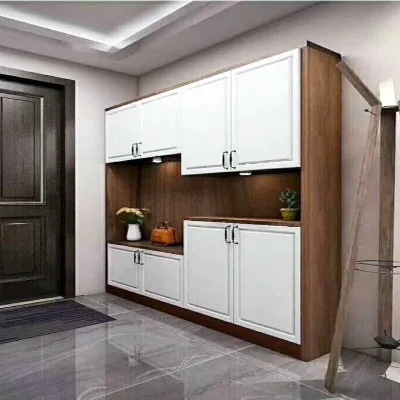

Contemporary Shoe Storage Cabinet with Adjustable Shelves for Modern Homes
$105.00 - $158.00
MOQ: 100 Pieces


Modern Stainless Steel Shoe Box Storage Cabinet with Showcase Elegant Shoe Rack
$146.00 - $156.00
MOQ: 50 Pieces

Metal Large Capacity Shoe Cabinet Vertical Multilayer Hall Shoe Storage Cabinet
$37.00 - $43.00
MOQ: 10 Pieces

Modern Design Wooden Shoe Cabinet with Display Shelves Corner Shoe Rack
$45.00 - $65.00
MOQ: 100 Pieces


Comprehensive Sourcing Guide
Modern Mirror Shoe Cabinet with Adjustable Height Sourcing Guide
The Modern Mirror Shoe Cabinet with Adjustable Height represents a strategic convergence of space-saving utility and aesthetic integration for entryways and living areas. Based on observed market listings, these units frequently appear as multi-functional storage solutions that combine vertical shoe organization with full-length mirrors, often featuring adjustable shelving or drawer configurations to accommodate varying footwear sizes. Buyers should note that while the core keyword emphasizes adjustability, the specific implementation varies significantly between wall-mounted and floor-mounted designs, with some models offering fixed layer counts such as three or five layers, while others provide customizable internal spacing.
Procurement of these units requires careful differentiation between "adjustable" features that refer to shelf positioning and those that imply structural height modification. The observed product data indicates a prevalence of simple and modern styles constructed primarily from wood, particle board, MDF, or plywood, often finished with PVC or lacquering to ensure durability in high-traffic zones. Sourcing teams must verify whether the "adjustable" attribute applies to the internal storage layers or the overall unit dimensions, as this distinction directly impacts installation requirements and the suitability of the product for specific room layouts.
Product Scope and Observed Listing Signals
The product scope for modern mirror shoe cabinets spans a wide range of configurations, from compact single-item units to larger living room furniture sets designed for home or shop usage. Market observations reveal that these items are typically categorized under storage cabinets with specific applications for shoe storage, often marketed with features like eco-friendly materials and customizable colors such as black, white, or bespoke finishes. The physical construction often includes a KD (knock-down) structure for efficient shipping, with packaging details indicating the use of five-ply export cartons, PE foam protection, and plastic foam on corners to prevent damage during transit.
Buyers must scrutinize listing signals regarding the specific model numbers and origin locations, as the supply chain for these units often originates from regions like Shandong, China, or Malaysia, with dispatch ports frequently listed as Qingdao. The observed data suggests a high degree of customization availability, allowing for specific size requests and surface treatments, yet the standard offerings often adhere to fixed dimensions like 23x47.24 inches or specific model identifiers such as S21007 or SC. Understanding these signals is critical for aligning procurement expectations with the actual manufacturing capabilities of the supplier, particularly regarding the distinction between standard stock items and fully bespoke orders.
Technical Specifications to Verify
Technical verification must begin with the structural mounting method, as the observed listings present conflicting data points between wall-mounted and floor-mounted installation requirements. Buyers should explicitly confirm the intended installation type with the supplier, as a unit designed for wall mounting may lack the necessary base stability for floor placement, and vice versa. Additionally, the layer count is a critical specification that varies between three and five layers in observed listings, and this directly influences the storage capacity and the physical footprint of the cabinet within the intended space.
Material composition and door panel specifications require rigorous validation to ensure the product meets durability and safety expectations. The core material is frequently identified as wood, particle board, MDF, OSB, or plywood, with door panels potentially constructed from a combination of these materials. Buyers must verify the thickness of the door panel and the specific surface treatment process, such as PVC coating or lacquering, to ensure resistance to moisture and wear. Furthermore, the presence of a mirror component necessitates checking the quality of the glass or acrylic and the method of its attachment to the cabinet frame to prevent detachment or breakage during use.
Compliance and Safety Documentation
Compliance verification for modern mirror shoe cabinets should prioritize the presence of recognized safety certifications, with CE marking appearing as a documented standard in several observed listings. While the supply chain often originates from China, the presence of CE certification indicates that the product has undergone specific assessments for safety, health, and environmental protection requirements relevant to the European market. Buyers must request valid certification documents directly from the supplier rather than relying on marketing claims, ensuring that the specific batch or model number matches the certification scope.
In addition to formal certifications, safety documentation should include evidence of structural integrity and material safety, particularly regarding the use of adhesives and finishes in particle board or MDF constructions. The observed "Eco-Friendly" feature suggests that suppliers may adhere to specific formaldehyde emission standards, but this claim requires independent verification through test reports or compliance statements. Procurement teams should also verify that the packaging materials, such as the five-ply export cartons and PE foam, meet international shipping safety standards to prevent environmental hazards and ensure the product arrives in pristine condition.
Cost Drivers and Commercial Terms
Cost drivers for these units are heavily influenced by the level of customization, material selection, and the complexity of the assembly process. The observed data indicates a wide price range from 1 to 299 USD, which correlates with factors such as the inclusion of a mirror, the type of wood used, and the specific finish applied. Buyers should anticipate that custom sizes and colors will incur higher unit costs compared to standard models, and the "adjustable" feature may add to the manufacturing complexity and associated pricing. Understanding these variables is essential for accurate budgeting and for negotiating effectively with suppliers who may have different cost structures based on their production capabilities.
Commercial terms must be clearly defined regarding the Minimum Order Quantity (MOQ) and the supply ability of the manufacturer. Observed listings show an MOQ of 300 pieces for certain models, while others may offer single-item selling units, creating a significant variance in entry barriers for different buyers. The supply ability is noted as 10,000 sets per month for some suppliers, but the production time for custom orders can extend to 20-30 days. Buyers must align their order volume and timeline expectations with these commercial terms to avoid delays, especially when coordinating with logistics providers for the dispatch from ports like Qingdao.
Supplier Qualification and Quality Control
Supplier qualification should focus on verifying the manufacturer's production capacity and their track record in handling export orders for furniture. The observed data highlights a supply ability of 10,000 sets per month, which suggests a robust manufacturing base, but buyers must confirm if this capacity is dedicated to their specific order or shared across multiple clients. It is also critical to assess the supplier's experience with the specific product type, such as shoe cabinets with mirrors, to ensure they possess the necessary expertise in assembling complex units that combine storage, mirrors, and adjustable features without compromising structural integrity.
Quality control protocols must be established to address the specific risks associated with wooden furniture and glass or mirror components. Buyers should implement a pre-shipment inspection plan that checks for surface defects, such as scratches on the PVC or lacquered finish, and verifies the stability of the adjustable layers. The packaging process, which includes the use of PE foam and plastic foam on corners, should be audited to ensure that the five-ply export cartons are sealed correctly with scotch tape to prevent moisture ingress and physical damage during transit. Establishing clear quality acceptance criteria before production begins is vital for mitigating the risk of receiving substandard goods.
Long-Term Procurement Checks
Long-term procurement success depends on establishing a reliable supply chain that can consistently meet volume demands and maintain product quality over time. Buyers should monitor the supplier's ability to maintain the 20-30 day production lead time during peak seasons and verify their capacity to scale up production if order volumes increase beyond the initial 300-piece MOQ. Regular communication regarding inventory levels and raw material availability is essential to prevent disruptions, particularly given the reliance on specific wood types and finishing materials that may be subject to market fluctuations.
Continuous performance evaluation should include tracking the frequency of defects, the accuracy of delivery times, and the responsiveness of the supplier to quality issues. Since the product is often used in high-traffic areas like entryways, the long-term durability of the adjustable mechanisms and the mirror attachment must be validated through field feedback from end-users. Buyers should also maintain a relationship with the supplier to ensure that any design updates or material improvements are communicated promptly, allowing for the continuous optimization of the product line to meet evolving market standards and customer expectations.
FAQs
Can this shoe cabinet be customized for specific dimensions?
Yes, customization is available for this modern mirror shoe cabinet. Buyers can request specific sizes to fit their space, as the product supports customized dimensions. The material options include particle board, MDF, OSB, or plywood, allowing for tailored construction. This flexibility ensures the unit meets precise spatial requirements while maintaining the simple modern style and black or white color choices.
What is the typical production lead time for orders?
The production time is typically 20-30 days. This duration applies to standard manufacturing runs for the wooden shoe cabinet. Buyers should account for this timeframe when planning inventory. The supply ability is 10,000 sets per month, which supports larger orders. Lead times may vary slightly based on the complexity of customization or specific packaging requests.
How is the product packaged for international shipping?
The product is packed in five-layer exported flat cartons. Each carton contains one piece, sealed with scotch tape. PE foam is placed between pieces, and plastic foam protects the top and sides. This KD structure ensures safe transit. The packaging is designed to minimize damage during long-distance shipping from origins like China or Malaysia to global destinations.
What certifications does the shoe cabinet hold?
The product holds CE certification. This indicates compliance with relevant safety and quality standards for the European market. The wooden construction uses materials like particle board or MDF, treated with PVC or lacquering. Buyers seeking certified furniture for regulated markets can rely on this documentation. The certification supports the product's suitability for commercial and residential use in regions requiring such standards.
What is the minimum order quantity for this item?
The minimum order quantity is 300 pieces. This MOQ applies to the standard wooden shoe cabinet model. Buyers must meet this threshold to initiate production. The product is sold as a single item unit. This quantity allows for efficient manufacturing and shipping logistics, particularly given the flat-pack KD structure and export carton packaging used for bulk orders.
Where are these shoe cabinets manufactured?
The products originate from China and Malaysia. Specific manufacturing locations include Shandong, China. The port of dispatch is Qingdao port. These origins provide access to established supply chains for wooden furniture. Buyers can expect consistent quality from these regions, which are known for producing simple modern style cabinets with adjustable features and mirror components.