Source Photo Booths for Malls, Parties, and Events
Source 30 Photo Booth units including instant print kiosks and professional tripods for digital cameras. Compare specifications from suppliers in China to find sustainable, reusable options for shopping malls, weddings, and corporate events.
Key considerations
Products List


Photo Booth Automatic Photo Booth DSLR Touch Screen Receipt Photo Booth
$998.00 - $2698.00
MOQ: 1 Pieces


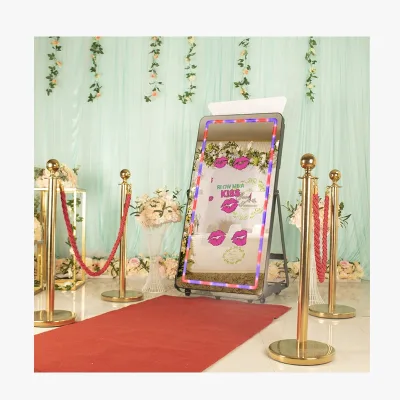
Mirror Photo Booth with Payment Function: Perfect for Party and Event Rental
$3500.00 - $3700.00
MOQ: 1 Pieces

Touch Screen Mirror Wedding Photo Booth 43inch Touch Screen Mirror Photo Booth for Sale
$2250.00 - $2350.00
MOQ: 1 Pieces


Photobooth 360 Degree Slow Motion Photo Booth Automatic Video Booth Prix Videobooth
$538.00 - $677.00
MOQ: 1 Pieces

Big Touch Screen Mirror Wedding Event Photo Booth 65 Inch Mirror Photobooth
$889.00 - $1345.00
MOQ: 1 Pieces
Comprehensive Sourcing Guide
Strategic Sourcing Guide for Photo Booth Equipment
The global demand for instant photo solutions has expanded significantly, driven by the need for engaging experiences at corporate events, retail environments, and private celebrations. For procurement professionals, navigating the Photo Booth market requires a disciplined approach to distinguishing between various product categories, verifying technical specifications, and ensuring compliance with international standards. This guide synthesizes observed market data to provide a structured framework for sourcing Photo Booth equipment, focusing on technical due diligence, certification verification, and long-term value assessment.
Understanding Product Categories and Technical Specifications
The first step in sourcing Photo Booth equipment is to clearly define the product category, as the market encompasses distinct technologies ranging from traditional camera setups to advanced self-service kiosks. Based on current market observations, the primary category involves "Instant Print Photo Booths" and "Party Photo Booths." These units are designed for high-volume usage in environments such as shopping malls, weddings, and corporate gatherings.
Technical specifications are critical for matching the right equipment to the application. The observed product data indicates a diverse range of hardware configurations. For instance, some units are equipped with "Digital Only" print functionality, while others support "Self-Service Print" capabilities. Connectivity is another vital technical dimension; modern units frequently support multiple interfaces including Bluetooth, NFC, HDMI, USB, and Wi-Fi. This multi-protocol connectivity ensures compatibility with a wide array of user devices, from smartphones to SLR cameras.
Furthermore, the control mechanisms vary significantly. Buyers should expect to find units utilizing "Touch Screen" interfaces for intuitive operation, alongside "Remote Control" options for operators managing the device from a distance. The physical construction of these units often involves a combination of materials, specifically "Metal," "Wooden," and "Tempered Glass," which contributes to both durability and aesthetic appeal. When evaluating technical specs, procurement teams must verify the exact dimensions, as observed standards include configurations such as 200100100cm and 200cm150cm100cm. These dimensions directly impact logistics planning and on-site installation requirements.
Compliance, Certification, and Safety Standards
In the B2B procurement of electronic and mechanical equipment, compliance with international safety and environmental standards is non-negotiable. The market data highlights specific certifications that serve as indicators of product quality and regulatory adherence. Key certifications observed in this sector include "CE" and "ROHS," which are essential for selling products in the European market and ensuring environmental safety regarding hazardous substances.
Beyond product-specific certifications, management systems play a crucial role in supplier reliability. The presence of "ISO" management certification suggests that the supplier adheres to standardized quality management processes. For buyers, verifying the validity of these certifications is a primary due diligence step. It is important to note that while these certifications are observed in the current market, they are not universal guarantees for every listed product. Buyers must request current certification documents from the specific supplier to confirm that the batch being procured meets the required standards.
Additionally, the materials used in construction must align with safety regulations. The use of "Tempered Glass" and "Aluminum Alloy" in the product composition indicates a focus on durability and safety, reducing the risk of breakage and injury in high-traffic areas. However, buyers should not assume all products meet these material standards without verification. The procurement process must include a request for material safety data sheets (MSDS) or equivalent documentation to ensure that all components, including the "Wood" elements and metal alloys, comply with fire safety and toxicity regulations in the destination country.
Cost Drivers and Pricing Dynamics
The pricing structure for Photo Booth equipment is influenced by several variable factors, including material composition, technological complexity, and customization levels. The observed price range in the market spans from 1 USD to 5888 USD, reflecting a broad spectrum of product tiers. This wide variance suggests that cost is heavily dependent on the specific features and build quality of the unit.
Material costs are a primary driver. Units constructed with "Carbon Fiber" tripods or high-grade "Aluminum Alloy" frames typically command higher prices than those using standard "Aluminum" or "Wood" components. Similarly, the inclusion of advanced features such as "Digital Onlyself-Service Print" capabilities and complex connectivity suites (Bluetooth, NFC, HDMI) adds to the manufacturing cost.
Customization is another significant cost factor. The market data indicates that "Custom Order" and "Customization" are available services. Buyers seeking branded overlays, specific color schemes like "Wood grain," or tailored dimensions will incur additional costs. The "Model Number" variations, such as "WB-03-01" or "Dola-Mro01-026," often correspond to different feature sets and price points.
Minimum Order Quantity (MOQ) also impacts the effective unit cost. The observed MOQ range is 1 to 1000 units. For small businesses or event planners, suppliers accepting "Small Orders" with an MOQ of 1 offer flexibility, though the per-unit price may be higher. Conversely, large-scale procurement with an MOQ closer to 1000 units can leverage economies of scale to reduce the average cost. Buyers must balance their budget constraints with their volume requirements to optimize the total cost of ownership.
Typical Applications and Usage Scenarios
Photo Booth equipment serves a multitude of applications, and understanding these use cases is essential for selecting the appropriate hardware. The product attributes indicate suitability for "All occasions," including specific events such as "Birthday," "Christmas," "Wedding," "Graduation," and "Valentine's Day." This versatility makes photo booths a staple for event planning and hospitality sectors.
Beyond personal events, the data highlights significant commercial applications. The "200kg" load-bearing capacity and robust construction suggest that certain models are designed for "Application Shopping Malls." In these high-traffic commercial environments, the equipment must withstand continuous use and provide a seamless user experience. The "Unisex" and "Fashion" style attributes further indicate that these units are designed to appeal to a broad demographic, making them ideal for retail promotions and brand activation campaigns.
The "Tripods Type" and "Camera Lens" specifications also inform the application. Professional tripods with "Zoom Lens" capabilities and "Cylindrical" lens hoods are suitable for high-quality photography in professional settings. The "Compatible" list, which includes "Smartphones," "Camera," and "SLR Devices," confirms that these systems are designed to integrate with various user preferences, enhancing their utility in diverse scenarios ranging from corporate conferences to private parties.
Supplier Evaluation and Verification
Selecting the right supplier is as critical as selecting the right product. The market data reveals that suppliers are primarily located in "China," with specific origins noted in "Guangdong" and "Guangzhou." While this geographic concentration offers access to a robust manufacturing ecosystem, it necessitates rigorous supplier evaluation.
Buyers should verify the supplier's "Management Certification" (ISO) and product certifications (CE, ROHS) as previously discussed. Additionally, the "Warranty" terms are a key indicator of supplier confidence. An observed warranty period of "1 year" provides a baseline for after-sales support, but buyers should negotiate terms that align with their operational needs.
The ability to handle "Custom Order" requests and "Small Orders" is another evaluation criterion. Suppliers that demonstrate flexibility in customization and order volume are better positioned to meet the dynamic needs of B2B clients. Buyers should also assess the supplier's capacity for "Digital Only" and "Self-Service Print" functionality, ensuring that the technical support and maintenance services match the complexity of the equipment.
Quality Control and Long-Term Procurement Considerations
Implementing a robust quality control (QC) process is essential to mitigate risks associated with electronic and mechanical equipment. Given the variety of materials, including "Metal," "Wooden," and "Tempered Glass," buyers should establish clear acceptance criteria for physical inspections. This includes verifying the structural integrity of the "Tripods" and the functionality of the "Control Method" interfaces.
Long-term procurement considerations extend beyond the initial purchase. Buyers must evaluate the availability of spare parts and the ease of maintenance. The "Connectivity" features, such as "Wi-Fi" and "Bluetooth," require regular software updates and troubleshooting. Suppliers that offer comprehensive technical support and clear documentation are preferable for long-term partnerships.
Furthermore, the "Sustainable" and "Reusable" attributes of the products align with modern corporate social responsibility goals. Procuring equipment that emphasizes sustainability can enhance a company's brand image. However, buyers must verify these claims through tangible evidence, such as lifecycle assessments or material sourcing reports, rather than relying solely on marketing statements.
Comparative Analysis of Key Specifications
To facilitate decision-making, the following table summarizes the key technical and operational specifications observed in the market. This comparison helps buyers identify the most suitable options based on their specific requirements.
| Feature Category | Observation A | Observation B | Observation C |
|---|---|---|---|
| Product Type | Instant Print Photo Booth | Party Photo Booth | Digital Onlyself-Service Print |
| Material Composition | Metal, Wooden, Tempered Glass | Aluminum Alloy, Metal | Carbon Fiber, Aluminum |
| Connectivity | Bluetooth, NFC, HDMI, USB Wi-Fi | Wi-Fi, USB, Bluetoothnfc HDMI | Standard Interfaces |
| Control Method | Touch Screen, Remote Control | Remote Control, Touch Screen | Touch Screen |
| Load Bearing | 35kg | 200kg (Mall Application) | Varies by Model |
| Dimensions | 200100100cm | 200cm150cm100cm | Standard/Custom |
| Certifications | CE, ROHS, ISO | CE, ROHS | CE, ROHS |
| Warranty | 1 Year | 1 Year | 1 Year |
| Customization | Available | Available | Available |
This table illustrates the diversity in specifications available to buyers. While many units share common features like "Touch Screen" control and "CE" certification, the material composition and load-bearing capacities vary significantly. Procurement teams should use this data to prioritize features that align with their specific operational environments, whether it is a high-traffic shopping mall requiring a 200kg load-bearing unit or a private event needing a portable, lightweight solution.
In conclusion, sourcing Photo Booth equipment requires a methodical approach that balances technical specifications, compliance requirements, and cost considerations. By leveraging the observed market data and adhering to strict verification protocols, buyers can secure high-quality solutions that meet their operational needs while ensuring long-term value and compliance.
FAQs
What certifications do photo booths typically hold?
Most units carry CE and ROHS product certifications alongside ISO management certification. These standards ensure environmental safety and quality management processes, though buyers must verify specific batch documents for compliance.
Which materials are used in Photo Booth construction?
Common materials include metal, wooden elements, tempered glass, and aluminum alloy. Some models also feature carbon fiber tripods, providing durability and aesthetic appeal for high-traffic commercial environments.
Can suppliers accept small orders for photo booths?
Yes, many suppliers accept small orders with a minimum quantity of one unit. This flexibility allows event planners to test products before committing to larger volumes, though per-unit costs may vary.
How are photo booths controlled by users?
Units typically utilize touch screen interfaces or remote control options for operation. This dual-control method ensures intuitive user interaction while allowing operators to manage the device from a distance effectively.
What connectivity options are available for these booths?
Modern systems support Bluetooth, NFC, HDMI, USB, and Wi-Fi connections. These interfaces ensure compatibility with smartphones, cameras, and SLR devices for seamless data transfer and printing functionality.
Which customization options are available for photo booths?
Custom orders are accepted for branding, color schemes, and specific dimensions. Buyers can request wood grain finishes or tailored sizes, though these modifications often influence the final pricing and lead time.
Where are Photo Booth manufacturers primarily located?
Manufacturers are predominantly based in China, with specific origins in Guangdong and Guangzhou. This geographic concentration offers access to a robust manufacturing ecosystem for sourcing various equipment types.