Source Waterproof Gower Sail Shades for Agriculture, Shade, and Sun Protection
Find 30 Waterproof Gower Sail Shades with varying materials like polyester and HDPE. Buyers can compare specifications including shade rates, waterproof indices, and customization options for agricultural and outdoor use.
Key considerations
Products List


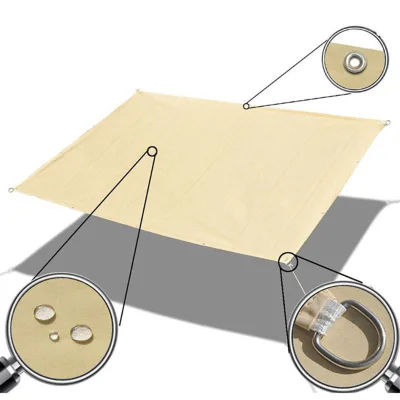


Multi-Use and Multi-Size Selection Outdoor Knitted Waterproof Shade Sail
$2.50 - $3.50
MOQ: 2000 Square Meters


Comprehensive Sourcing Guide
Strategic Sourcing Guide for Waterproof Gower Sail Shades
Understanding Product Definitions and Core Specifications
When initiating a procurement strategy for Waterproof Gower Sail Shades, buyers must first distinguish between the generic terminology often used in global marketplaces and the specific technical realities of the product. The term "gower sail" in this context typically refers to shade sails, often triangular or square in geometry, designed for outdoor sun protection. The core keyword implies a dual requirement: the structural capability to withstand wind loads and a material composition that offers genuine waterproofing capabilities rather than mere water resistance.
Based on available market data, these products are frequently constructed with frames made of steel or iron, providing the necessary rigidity for installation. The sail material itself varies significantly across listings. Some specifications indicate a composition of 100% polyester, while others list High-Density Polyethylene (HDPE) or a blend of HDPE and polyester. A critical observation for buyers is that the term "waterproof" is applied to products with varying standards. For instance, some units are described with an outer tent waterproof index of less than 1000 mm, which suggests a specific level of water resistance suitable for light to moderate rain but potentially insufficient for heavy, prolonged downpours without additional sealing.
The physical dimensions of these sails are highly customizable. Listings show standard configurations such as 3x3 meters, alongside triangular shapes that offer aesthetic flexibility for commercial and residential landscapes. The weight of individual units can range from approximately 1.7 kg for smaller single items to heavier custom configurations. Buyers should note that the "Standard" attribute for these products often references fabric weight, such as 160gsm or 180gsm, which directly correlates to durability and opacity. A higher gram per square meter generally indicates a denser weave, contributing to the claimed 95% shade rate observed in specific product descriptions.
Technical Compliance and Certification Verification
In the B2B procurement of outdoor shade structures, verifying compliance with international standards is paramount to ensure safety and longevity. The supply chain for these items, often originating from manufacturing hubs in China such as Zhejiang and Shandong provinces, requires rigorous vetting of certification claims. While some product listings explicitly mention certifications like CE and ISO9001, these are often tied to specific material compositions, such as PE (Polyethylene) materials. Buyers must not assume that a listing mentioning "ISO9001" guarantees that the specific shade sail model ordered meets the same quality management standards, as certifications can be facility-level rather than product-level.
The material composition is a primary driver of compliance. Products labeled as "Eco Friendly" or made from "Renewable Sources" require verification of the specific polymer type. For example, the presence of "Plastic Type: PE" and "Metal Type: Steel" or "Iron" in the specifications necessitates a check for heavy metal content and environmental safety standards, particularly if the product is intended for use in agricultural or public spaces. The standard of 180gsm or 160gsm mentioned in the data serves as a baseline for fabric density, but buyers should request test reports to confirm that the fabric actually meets these weight specifications and does not degrade under UV exposure.
Furthermore, the "Waterproof Shade Net" category often involves complex material engineering. The distinction between a "shade sail" and a "shade net" is critical. While some products claim a 95% shade rate, others are described as "Waterproof Shade Net," implying a different mesh structure. Buyers must verify if the "waterproof" claim refers to a coated finish or the inherent density of the material. The data indicates that some sails have a "Not Coated" finishing process, which contradicts the expectation of high-performance waterproofing. Therefore, the procurement team must demand clear documentation on the finishing process to ensure the product will not leak or degrade when exposed to moisture.
Cost Drivers and Pricing Dynamics
The pricing structure for Waterproof Gower Sail Shades is influenced by a complex interplay of material costs, customization levels, and order volume. The observed market price range spans from $0.20 to $35.00 USD, a variance that reflects the difference between simple, uncoated HDPE nets and high-end, 100% polyester, waterproof, custom-shaped sails. The lower end of the spectrum typically corresponds to basic agricultural shade nets with minimal finishing, while the higher end includes complex geometric shapes, reinforced steel frames, and specialized waterproof coatings.
Minimum Order Quantity (MOQ) is a significant factor in the total cost of ownership. The market data reveals an MOQ range from 6 units to 10,000 units. A buyer ordering a small quantity of 500 pieces, as seen in specific listings, will face a higher unit cost compared to a bulk purchaser of 10,000 units. The "Customization" attribute is a major cost driver; products that require custom packing, specific dimensions, or tailored colors (such as "Beige," "Light Yellow," or "Multicolor") will command a premium. Additionally, the "Single Package Size" of 46x22x8 cm and the "Single Gross Weight" of 1.7 kg impact logistics costs, which are often passed on to the buyer.
Buyers must also consider the "Operation Method" and "Control" mechanisms. Products with "Manual Control" or "Fixed" controls are generally less expensive than those with automated systems, though the data suggests most shade sails in this category are static structures. The "Product Name" variations, such as "3*3 square shade sail pole," indicate that the inclusion of hardware (poles, fittings) in the package affects the price. A comprehensive cost analysis should include the total landed cost, factoring in the origin location (China), potential tariffs, and the specific packaging requirements, which can range from simple "PE bag/pc" to robust "Carton" or "Strong Polybag+Paper Tube+Label" configurations.
Typical Applications and Usage Scenarios
The versatility of Waterproof Gower Sail Shades allows them to be deployed across a wide array of sectors, from agriculture to commercial landscaping. The "Usage" attribute explicitly lists "Agriculture," indicating their role in protecting crops from excessive sun exposure while providing some level of rain protection. In this context, the high shade rate of 95% is beneficial for reducing heat stress on plants, though the waterproof index must be sufficient to prevent waterlogging if the net is used as a temporary cover.
Beyond agriculture, these products are increasingly popular in commercial and residential outdoor spaces. The "Feature" attributes, including "Waterproof," "Eco Friendly," and "Renewable Sources," make them attractive for modern architectural projects seeking sustainable solutions. The "Shape" options, such as "triangular sail shades" or "3*3 square" configurations, allow for creative installation designs in parks, playgrounds, and patio areas. The "Color" options, ranging from "Beige" to "Multicolor," enable buyers to match the aesthetic of the surrounding environment.
However, the application dictates the required specifications. For instance, a product with an "Outer Tent Waterproof Index" of less than 1000 mm may be suitable for a shaded seating area where occasional light rain is expected, but it might fail in a region with heavy monsoon rains. Similarly, the "Frame Material" of steel or iron is essential for permanent installations where wind resistance is a concern, whereas lighter materials might suffice for temporary event setups. Buyers must align the product's "Standard" (e.g., 160gsm vs. 180gsm) with the environmental conditions of the installation site to ensure long-term performance.
Supplier Evaluation and Quality Control Protocols
Evaluating suppliers for Waterproof Gower Sail Shades requires a multi-faceted approach that goes beyond surface-level product descriptions. The "Place of Origin" data points to manufacturing clusters in Zhejiang and Shandong, China. While these regions are known for textile and metal fabrication, the quality can vary widely between factories. Buyers should prioritize suppliers who provide transparent documentation regarding their "Certification" status, specifically looking for CE and ISO9001 marks that are verifiable and applicable to the specific product line.
Quality control should focus on the material integrity and finishing processes. The observation that some sails are "Not Coated" while others are described as "Waterproof" highlights a critical quality gap. Procurement teams must request physical samples to test the water resistance, checking for the "Waterproof Index" and the durability of the "Sail Finishing." The "Material" composition, whether it is "100% polyester," "HDPE," or a blend, must be verified through laboratory testing to ensure it matches the supplier's claims.
Packaging is another area requiring strict quality control. The "Product Packing" varies from "Each PC Into a Handbag" to "Carton" or "Each Roll Into Strong Polybag+Paper Tube+Label." Inadequate packaging can lead to damage during transit, particularly for products with steel frames. Buyers should specify packaging requirements in the purchase order to ensure that the "Single Package Size" and "Single Gross Weight" are maintained to prevent crushing or deformation. Additionally, the "Customization" aspect of the product, including color and size, must be validated against the final delivered goods to avoid discrepancies.
Long-Term Procurement and Lifecycle Management
Sourcing Waterproof Gower Sail Shades is not merely a transactional purchase but a long-term investment in infrastructure. The "Feature" of being "Eco Friendly" and made from "Renewable Sources" suggests a focus on sustainability, which aligns with modern corporate social responsibility goals. However, the longevity of these products depends heavily on the initial quality of the materials and the installation method. The "Control" mechanism, whether "Manual" or "Fixed," influences the maintenance requirements; fixed installations generally require less frequent adjustment but demand higher initial structural integrity.
Buyers should plan for the lifecycle of the product, considering the potential need for replacement or repair. The "Standard" of 180gsm or 160gsm indicates the fabric density, which is a proxy for UV resistance and tear strength. Products with lower gram weights may degrade faster under intense sunlight, necessitating earlier replacement. The "Weight" attribute being listed as "Customization" implies that buyers can specify heavier, more durable fabrics for harsh environments, though this will impact the cost and lead time.
Finally, the "MOQ" of 500 pieces or higher suggests that these products are often part of larger procurement cycles. Buyers should consider the scalability of their orders and the supplier's ability to maintain consistent quality across large batches. The "Lead Time" and "Location" factors, such as shipping from Shandong or Zhejiang, should be factored into the supply chain planning to ensure timely delivery for large-scale projects. By focusing on verified specifications, robust quality control, and clear communication of customization needs, buyers can secure a reliable supply of Waterproof Gower Sail Shades that meet their operational and environmental requirements.
FAQs
What materials are used for Waterproof Gower Sail Shades?
Materials typically include 100% polyester, HDPE, or blends of HDPE and polyester. Some listings specify steel or iron frames with sail finishing that may be uncoated, affecting water resistance levels.
Can I find Waterproof Gower Sail Shades with CE certification?
Yes, some products list CE and ISO9001 certifications, though these are often tied to specific material compositions like PE. Buyers should verify if the certification applies to the specific model ordered.
How does the MOQ affect the price of Waterproof Gower Sail Shades?
MOQs range from 6 to 10,000 units, with higher volumes generally lowering unit costs. A specific listing shows an MOQ of 500 pieces, which influences the final pricing structure significantly.
Which standard weight is common for Waterproof Gower Sail Shades?
Common fabric standards include 160gsm and 180gsm, which indicate fabric density and durability. Higher gram weights generally correlate with better opacity and a 95% shade rate for sun protection.
Where are Waterproof Gower Sail Shades typically manufactured?
Manufacturing origins are primarily in China, specifically in Zhejiang and Shandong provinces. These regions are known for textile and metal fabrication hubs supplying the global market.
What packaging options are available for Waterproof Gower Sail Shades?
Packaging varies from individual PE bags to cartons or rolls in strong polybags with paper tubes. Some suppliers offer customized packing according to customer requirements to ensure safe transit.
How is the waterproof index defined for these shade sails?
Some products have an outer tent waterproof index of less than 1000 mm, suitable for light rain. Buyers must verify if the sail is coated or uncoated to ensure adequate water resistance.