Source Waterproof Portable Stackable Storage Box for Tools, Camping, and Home
Explore 30 listings for a Waterproof Portable Stackable Storage Box designed for tools, camping gear, and home organization. Buyers can compare capacities ranging from 21L to 100L, materials like engineering PP, and customization options including logos and colors.
Key considerations
Products List




Comprehensive Sourcing Guide
Strategic Sourcing Guide for Waterproof Portable Stackable Storage Boxes
Understanding Product Attributes and Core Specifications
When sourcing a Waterproof Portable Stackable Storage Box, buyers must first distinguish between the generic product category and the specific technical realities observed in the current market. The core keyword implies a convergence of three critical functional requirements: water resistance, mobility, and vertical space optimization. Based on available product data, the primary material composition for these units is typically plastic, specifically engineering-grade PP (Polypropylene), which offers a balance of durability and chemical resistance. This material choice is fundamental to achieving the "waterproof" and "shockproof" attributes often cited in product listings.
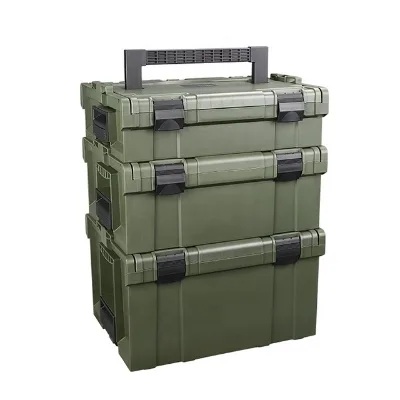
The physical design of these storage solutions varies significantly in form factor. While the general category includes rectangular shapes, specific models observed in the market range from compact, hand-held units to large-capacity containers. For instance, certain models are designed with a capacity of 21 liters, while others are engineered for industrial applications with capacities ranging from 60 to 100 liters. The "stackable" attribute is a key differentiator; this feature allows for efficient vertical storage, reducing the footprint in warehouses or retail environments. However, buyers must verify that the stacking mechanism is robust enough to support the weight of the upper units without compromising the structural integrity of the lower boxes, especially when filled with heavy items like tools or bedding.
Portability is another defining characteristic. The product attributes indicate a "hand-held" style for smaller units, often featuring integrated handles or ergonomic designs. For larger units, the focus shifts to "portable" capabilities, which may involve reinforced corners or specific handle placements. The "folded" status of these boxes is generally listed as "unfolded," suggesting that these are rigid, permanent structures rather than collapsible fabric bins. This rigidity is essential for maintaining the waterproof seal and protecting contents from impact. The design style is predominantly modern, aligning with contemporary organizational needs in both home and industrial settings.
Technical Standards and Dimensional Verification
Precision in technical specifications is paramount when procuring storage boxes for B2B applications. The market data reveals a wide variance in dimensions, which directly impacts logistics, storage density, and compatibility with existing shelving systems. Buyers should not assume a standard size across all suppliers. Specific models observed include dimensions such as 29.519.516 cm for smaller units and 463714.6 cm for medium-sized variants. For industrial applications, larger units may adhere to standards like 600400340 mm or 280230155 mm.
The "prod_standard" field in product listings often contains these dimensional values, but buyers must treat these as specific model references rather than universal industry standards. When evaluating a potential supplier, the procurement team must request detailed CAD drawings or physical samples to confirm that the listed dimensions match the actual product. Tolerances in plastic molding can lead to slight variations that, when multiplied across a large order, can cause stacking misalignments or fit issues in designated storage racks.
Furthermore, the "capacity" attribute is a critical metric that must be verified against the physical dimensions. Listings may describe capacity in liters (e.g., 21L, 60-100L) or simply as "Big Capacity" or "Medium Capacity." To ensure accurate planning, buyers should calculate the internal volume based on the external dimensions provided, accounting for wall thickness. The internal volume determines the actual usable space for items such as food, apparel, books, or tools. Misalignment between claimed capacity and actual volume can lead to overestimation of storage efficiency and logistical planning errors.
Compliance, Certification, and Material Safety
For products intended for specific applications, such as food storage or industrial use, compliance with safety and environmental standards is non-negotiable. The observed product data highlights several certifications, including IP67, RoHS, and Reach. The IP67 rating is particularly significant for waterproof claims, indicating that the box is dust-tight and can withstand immersion in water up to 1 meter for 30 minutes. However, buyers must verify that this rating applies to the specific model being purchased, as some listings may associate IP ratings with electronic cases rather than general storage bins.
RoHS (Restriction of Hazardous Substances) and Reach compliance are essential for products entering the European market or those used in environments with strict chemical regulations. These certifications ensure that the engineering PP material does not contain prohibited levels of lead, mercury, cadmium, or other hazardous substances. For applications involving food, apparel, or tableware, the material must be food-grade. While the general material is listed as plastic, the specific grade (e.g., food-grade PP) must be confirmed through the supplier's documentation.
The "application" field in product listings often extends beyond simple storage to include industrial uses such as handling alcohol, alkali, or wastewater. In these scenarios, the chemical resistance of the plastic becomes a primary concern. Engineering PP is generally resistant to many chemicals, but buyers should request chemical compatibility charts from the supplier to ensure the box will not degrade or leach chemicals when in contact with specific substances. Additionally, for products used in outdoor environments, UV resistance should be verified to prevent brittleness and cracking over time.
Cost Drivers and Minimum Order Quantity Analysis
The cost structure of waterproof portable stackable storage boxes is influenced by several variables, including material type, size, customization level, and order volume. The observed MOQ (Minimum Order Quantity) range in the market is broad, spanning from 1 to 2000 pieces. However, specific listings indicate an MOQ of 1000 PCS for certain models, which suggests that smaller orders may incur higher unit costs or require special handling. Buyers should be prepared for tiered pricing structures where the unit price decreases significantly as the order volume increases.
Customization is a major cost driver. The availability of "Customized Logo" and "Customized Color" options (e.g., Black, Green, Yellow, or Black/Orange) adds to the production complexity and cost. Custom molds for unique shapes or sizes will also increase the initial investment and lead time. The "OEM" (Original Equipment Manufacturer) support mentioned in the data indicates that suppliers are willing to produce branded goods, but this service typically comes with a higher MOQ and longer lead time compared to purchasing off-the-shelf stock.
Packing methods also impact the final landed cost. Listings show variations such as "Each PCS with Color Label + Warning Label, Shrink" or "8PCS/CTN." Efficient packing reduces shipping volume and cost, but custom labeling and warning labels add labor and material expenses. Buyers should evaluate the trade-off between custom branding and shipping efficiency. For example, a box with a custom logo may be more valuable for brand visibility but could require more complex packing arrangements that increase freight costs.
Supplier Evaluation and Operational Capabilities
Selecting the right supplier requires a thorough evaluation of their operational capabilities, particularly regarding origin and production standards. The data indicates that many products originate from China, with specific mentions of Zhejiang as a production hub. This region is known for its manufacturing ecosystem, but buyers should verify the specific factory's capacity and quality control processes. A supplier's ability to support "Customization" and "OEM" is a strong indicator of their flexibility and technical expertise.
When evaluating suppliers, buyers should look for evidence of consistent quality control. The "prod_packing" details, such as "Packed Into Export Carton, Wrapped in Plastic Film," suggest a level of care in the shipping process. However, buyers must ensure that the packaging is robust enough to protect the boxes during transit, especially given the "shockproof" claims of the product itself. If the boxes arrive damaged, the internal quality is compromised.
The "type" of product is another factor in supplier selection. Listings show a mix of "Storage Boxes & Bins," "Box," and "Case" types. Suppliers specializing in a specific type may offer better quality and more competitive pricing for that category. For instance, a supplier focusing on "Industrial Alcohol" storage may have more expertise in chemical-resistant materials than a generalist supplier. Buyers should request references or case studies from the supplier to validate their experience in the specific application area they are targeting.
Quality Control and Long-Term Procurement Strategy
Implementing a robust quality control (QC) strategy is essential for ensuring that the received products meet the specified requirements. Given the "waterproof" and "stackable" claims, buyers should conduct functional testing on a sample basis before approving a full production run. This testing should include submerging the boxes in water to verify the IP67 rating, stacking them with full loads to test structural integrity, and checking the fit of lids and seals.
The "function" attributes listed, such as "waterproof" and "shockproof," should be treated as performance claims that require verification. Buyers should not rely solely on the supplier's word but should insist on third-party test reports or in-house QC data. For long-term procurement, establishing a clear communication channel with the supplier regarding quality standards is crucial. This includes defining acceptable defect rates and establishing a process for handling non-conforming goods.
Long-term considerations also involve the scalability of the supply chain. As the buyer's needs grow, the supplier must be able to scale production without compromising quality. The "customization" aspect allows for brand evolution, but buyers should ensure that the supplier can maintain consistency in color and material quality over multiple production runs. Additionally, the "usage" of the boxes, which ranges from "Home & Hardware Tools Storage" to "Camping Storage," suggests that the product may need to adapt to different market demands. A flexible supplier who can accommodate these shifts will be a valuable partner.
Typical Applications and Usage Scenarios
The versatility of waterproof portable stackable storage boxes makes them suitable for a wide range of applications. The observed "usage" categories include food, apparel, books, magazines, tools, bedding, and tableware. This broad applicability means that buyers can source a single product type for multiple departments or customer segments, simplifying the procurement process.
In industrial settings, these boxes are used for organizing tools, hardware, and even hazardous materials like industrial alcohol or wastewater. The "shockproof" and "waterproof" features are critical in these environments to protect sensitive equipment and ensure safety. For outdoor and camping applications, the "portable" and "stackable" features allow for efficient transport and storage of gear. The "modern" design style also makes these boxes suitable for retail and home organization, where aesthetics play a role in product selection.
The "drawer" feature, with "2 Grids" observed in some models, adds another layer of utility. This design allows for the separation of small items within a larger storage unit, enhancing organization. Buyers should consider whether their specific application requires internal dividers or if a single large compartment is sufficient. The choice between a "case" style and an "open" box style also depends on the nature of the items being stored. For example, a "case" with a lid is ideal for protecting contents from dust and moisture, while an "open" box might be preferred for quick access in a workshop setting.
Conclusion
Sourcing waterproof portable stackable storage boxes requires a meticulous approach that balances technical specifications, compliance requirements, and cost considerations. By understanding the nuances of material properties, dimensional standards, and certification needs, buyers can make informed decisions that align with their operational goals. The market offers a diverse range of options, from compact hand-held units to large industrial containers, each with unique attributes and applications. Through rigorous supplier evaluation and quality control, buyers can secure a reliable supply chain that delivers high-quality storage solutions tailored to their specific needs. The flexibility of customization and the broad applicability of these products make them a valuable asset for businesses across various sectors, from manufacturing to retail and beyond.
FAQs
What materials are used for waterproof portable stackable storage boxes?
These boxes are typically made from engineering PP plastic, which provides durability and chemical resistance. This material ensures the units are waterproof and shockproof while maintaining structural integrity for stacking heavy loads.
Can these storage boxes be customized with logos and colors?
Yes, customization is available for logos and colors such as black, green, yellow, or black and orange combinations. Buyers should note that custom orders often require a minimum order quantity of 1000 pieces.
Which certifications ensure safety for food and industrial applications?
Relevant certifications include IP67 for waterproofing, along with RoHS and Reach compliance for material safety. These standards verify that the engineering PP material is free from hazardous substances suitable for food or chemical storage.
How do capacity and dimensions vary across different models?
Models range from 21 liters to 60-100 liters with specific dimensions like 29.5 by 19.5 by 16 cm or 600 by 400 by 340 mm. Buyers must verify internal volume against external dimensions to ensure accurate storage planning.
What is the typical minimum order quantity for these boxes?
The minimum order quantity is typically 1000 pieces for standard models, though some listings show ranges from 1 to 2000. Lower quantities may incur higher unit costs or require special handling arrangements with the supplier.
Where are these storage boxes primarily manufactured?
Most products originate from China, with specific manufacturing hubs located in Zhejiang province. Buyers should verify the specific factory location to ensure quality control and logistics efficiency for their procurement needs.