Manufacturer vs. Trading Company: Which Supplier Type Is Right for Your Order?
Direct answer
A manufacturer is not automatically a better supplier than a trading company.
Choose based on how the order needs to be produced and managed.
A direct manufacturer may be a stronger fit when your order depends heavily on a specific manufacturing process, engineering changes, custom tooling, technical communication, or stable repeat volume.
A trading company may be useful when you need several product categories, smaller or fragmented orders, coordination across different factories, or one commercial contact to manage a broader range of sourcing work.
The key due-diligence question is not simple:
“Are you a factory?”
It is:
“Who will actually make my product, who controls that production, and is that structure suitable for my order?”
Manufacturer or Trading Company: Which Is Better?
Buyers sourcing from China are often told to avoid intermediaries and “go factory direct.”
That can be good advice for some orders.
It can also be the wrong selection rule.
Consider two buyers.
Buyer A is developing a custom die-cast housing that requires tooling changes, tolerance discussions and repeated engineering revisions.
Buyer B needs 12 standard accessories from several product categories in relatively modest quantities.
The first buyer may benefit greatly from direct access to the factory responsible for tooling and production.
For the second buyer, insisting that every SKU come directly from a separate factory could create more supplier relationships, more minimum-order constraints, more shipments and considerably more coordination.
The supplier type has not changed in value.
The order has changed.
That is why “manufacturer versus trading company” should be treated as a sourcing-model decision, not as a simple good-versus-bad classification.
The Difference That Actually Matters to Buyers
At a practical sourcing level, a manufacturer performs at least some of the production activities required to make the goods it sells.
A trading company primarily sources or purchases products from other manufacturers and sells them to buyers.
Real supplier structures can be more complicated than those two labels suggest.
A manufacturer may outsource coating, packaging, printing or another specialized process.
A trading company may work repeatedly with a small group of factories and exercise substantial control over product development and quality.
A company group may have one entity handling export sales and another operating the production site.
That is why the buyer should establish both:
Who is the legal seller?
and
Who actually performs the important production processes?
Do not assume the answer from an English company name, website wording, marketplace badge or product catalog.
Buyers can use China's official National Enterprise Credit Information Publicity System to check publicly available registration information for a Chinese company. This is useful for establishing the legal entity behind a supplier before evaluating its claimed manufacturing role.
But company-registration information is only one piece of the production picture.
When a Manufacturer May Be the Better Fit
Direct manufacturer relationships become particularly valuable when the production process itself is central to the buying decision.
The product requires substantial customization
If your project requires tooling, engineering changes, new materials, tolerance adjustments or repeated sample revisions, direct access to the people responsible for production can shorten the communication chain.
The issue is not simply convenience.
Technical decisions can lose important context when every question passes through several commercial layers.
For a highly customized project, ask whether your main contact can bring engineering or production staff directly into the discussion when necessary.
You need to understand a critical manufacturing process
Suppose surface finish is one of the largest quality risks in your product.
It matters whether the supplier performs that process itself, uses a related facility, or sends it to an external subcontractor.
A direct factory relationship can make process ownership easier to investigate—but the word “manufacturer” does not guarantee that every important process is in-house.
Ask about the actual process.
You expect stable repeat volume
A long-term program based on a relatively stable product can make a direct production relationship attractive.
Over time, the buyer and manufacturer may be able to work more directly on production planning, quality improvements, tooling and product changes.
But volume alone should not decide the supplier type.
The manufacturer still needs to be a good operational and commercial fit.
Production visibility is particularly important
Some projects require the buyer to understand where tooling is located, how products move through production, which processes are subcontracted, or how quality controls are performed.
In those cases, a supplier structure with clear access to the production site can reduce uncertainty.
None of these advantages means that “manufacturer” should be accepted as a claim without verification.
It simply explains why direct manufacturing access may matter more for certain orders.
When a Trading Company May Be the Better Fit
Trading companies are often described only as a layer of markup between the buyer and factory.
That description misses the operational question:
What work is the intermediary actually doing?
A trading company can be useful when that work solves a real sourcing problem.
Your order contains many product categories
Imagine a retailer building a new home-organization line consisting of storage boxes, fabric organizers, metal racks and small accessories.
Finding one factory that genuinely specializes in all of those manufacturing processes may be unrealistic.
The buyer could manage several manufacturers directly.
Or it could work with an intermediary capable of coordinating the supplier base.
The better choice depends on how much visibility, control and internal sourcing capacity the buyer wants.
Your volumes are fragmented
An order may be commercially meaningful in total but small at the individual SKU level.
In that situation, direct factory relationships do not automatically create better terms.
The important question is whether the sourcing structure can handle the mix of products and order sizes efficiently.
You value coordination more than factory access
Some buyers have their own sourcing teams, technical engineers and quality staff.
Others do not.
If your organization does not want to manage several factories, chase multiple production schedules and coordinate many commercial contacts, an intermediary may provide real value.
That value needs to be evaluated rather than assumed.
Ask what the trading company actually manages and what remains with the underlying manufacturers.
The product is relatively standardized
For a straightforward catalog product, deep engineering access may matter less than availability, assortment, communication, consolidation or commercial service.
In that case, rejecting a capable supplier merely because it does not own the factory may solve a problem the order did not have.
Match the Supplier Type to the Order
Instead of starting with “factory or trader?”, start with the sourcing problem.
| Your order looks like this | A useful starting point | What still needs verification |
|---|---|---|
| One technically complex custom product | Direct manufacturers may be preferable | Relevant process capability, engineering support, actual production site |
| Stable repeat orders for one core product | Manufacturer may offer a strong long-term fit | Capacity, quality controls, continuity and commercial terms |
| Many unrelated SKUs in modest quantities | Trading company may simplify coordination | Factory transparency, product competence, quality management |
| Standard products with limited customization | Either model may work | Price, service, product consistency and transaction structure |
| Product with high quality or compliance risk | Supplier label is not enough | Who makes it, where critical processes occur, how controls are managed |
The phrase “may be preferable” is important.
Supplier type does not replace supplier evaluation.
A strong trading company can be a better fit than a weak factory.
A strong factory can be a better fit than an intermediary that adds cost without adding useful coordination or control.
The sourcing objective is not to remove every middleman.
It is to understand the supply chain you are paying for.
How to Check Whether a Supplier Is Really a Manufacturer
If factory status affects your decision, verify it as a production claim rather than asking the supplier to tick a box.
Start with the Chinese legal company.
Ask for:
Chinese legal company name
Unified Social Credit Code
Registered company address
Then compare those details with official enterprise-registration information.
The State Administration for Market Regulation's business registration service can also be used as an official reference when checking the Chinese legal entity behind a supplier. Company-registration information can help establish identity and registered business activities, but it should not be treated as proof that the company owns or operates a specific production facility.
Business scope can provide useful context.
However, do not turn it into proof that a particular factory exists or that the company currently performs your required manufacturing process.
Continue the verification.
Ask for the full production-site address.
Ask which legal entity operates that site.
Ask which production steps for your product happen there.
Ask which steps are subcontracted.
Compare the answer with available company information, supplier documents, factory evidence and other relevant records.
If the supplier says production is handled by another related company, establish the relationship rather than immediately treating the answer as a failure.
For a more detailed factory-status process, see How Can I Tell If a Chinese Supplier Is a Real Factory?
If the registered company address and production site differ, see How Can I Verify a Supplier's Address and Factory Location in China?
The objective is to understand the operating structure before relying on it.
Transparency Matters More Than the Label
A trading company saying:
We do not own the factory. We work with Factory X for this product, and here is how production and quality are managed.
gives you a structure you can investigate.
A supplier saying:
We manufacture everything ourselves.
while refusing to identify the production site gives you much less.
The second supplier may still be a factory.
But the claim is not yet supported.
That distinction matters because intermediation is not itself the due-diligence problem.
Unclear or misleading information about who makes the product is.
The same principle applies to outsourcing.
Many manufacturing processes can involve specialist subcontractors. A buyer does not automatically need every process under one roof.
You do need to know which critical processes are outside the supplier's direct operation and how the supplier controls them.
For example, if a metal-product factory outsources powder coating, ask:
Who performs the coating?
Has the supplier used that subcontractor before?
Who sets and checks the finish requirement?
Who is responsible when the coating fails inspection?
Those questions are more useful than rejecting the supplier simply because one process is outsourced.
How SourcingX Can Help
SourcingX can help buyers investigate the supplier behind a quotation by reviewing available company, product, trade, and supplier information.
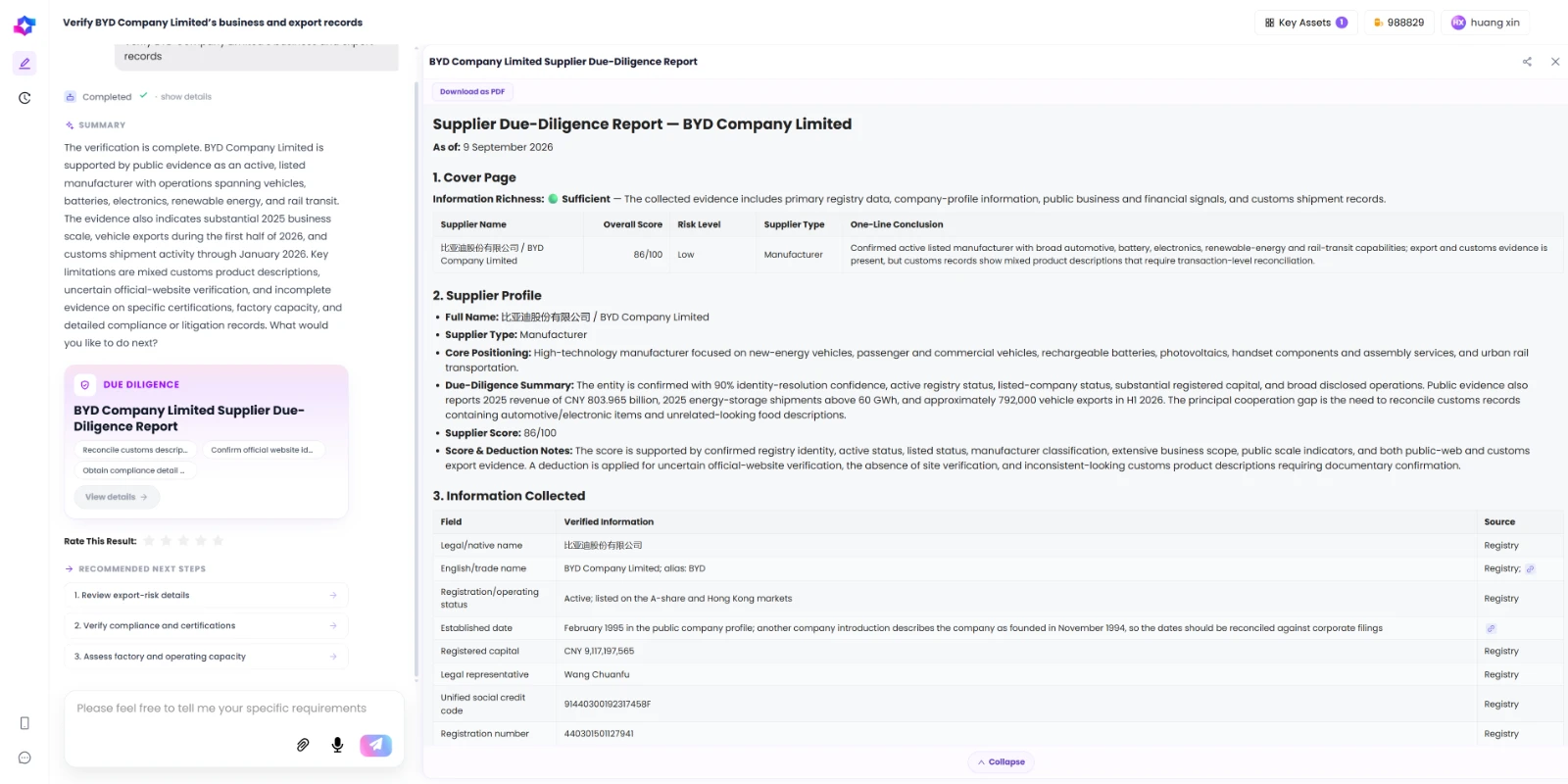
Use the available evidence to clarify questions such as:
Is the legal company identifiable?
What business activities appear in the available company information?
Does the supplier's product and company information support its claimed role?
Is there a different production entity or factory relationship that still needs to be explained?
SourcingX does not replace a physical factory audit or prove that a company owns every production asset it claims to use.
If factory ownership, equipment, capacity or production controls are material to the sourcing decision, verify those claims with appropriate additional evidence.
The goal is not to label every supplier as “factory good, trader bad.”
It is to understand who you are buying from, how your goods will be produced, and whether that supply structure fits your order.
Frequently Asked Questions
Is it always cheaper to buy directly from a manufacturer in China?
No.
Buying directly may remove an intermediary from the commercial structure, but that does not guarantee the lowest total cost or best commercial outcome.
The result also depends on order volume, product mix, customization, quality management, logistics, communication and the supplier's own pricing model.
Compare the actual proposal rather than assuming supplier type determines price.
Is a trading company a bad choice for sourcing from China?
No.
A transparent and capable trading company may be suitable when you are sourcing multiple products, managing fragmented order volumes, or prefer one party to coordinate several production relationships.
The important questions are what value the trading company provides and how much visibility you have into the underlying supply chain.
How can I tell if a Chinese supplier is a manufacturer or trading company?
Start by identifying the Chinese legal entity and checking available official registration information.
Then establish the claimed production address, which legal entity operates it, what processes are performed there and what is subcontracted.
Do not rely on the supplier's English name, website description or marketplace profile alone.
Does a manufacturing business scope prove a supplier owns a factory?
No.
Registered business scope can support your understanding of a company's registered activities, but it does not by itself prove ownership or operation of a particular production site, equipment or workforce.
Use it as one piece of evidence and verify the physical production relationship separately.
Should I reject a supplier if it outsources part of production?
Not automatically.
First determine which process is outsourced, who performs it, why it is outsourced and how the supplier manages quality and responsibility.
For some orders, subcontracting a critical process may materially increase risk.
For others, using a specialist subcontractor may be an acceptable production model.
The decision should depend on the process and your sourcing requirement, not outsourcing alone.