What Information Should I Collect From Suppliers Before Comparing Them?
Direct answer
Before comparing suppliers, collect enough information to make sure they are responding to the same product requirement and commercial basis.
At minimum, you should know the exact product specification, quantity, MOQ, price basis, Incoterm, lead time, payment terms, certification requirements, supplier identity, and any exceptions to your requirement.
If one supplier quotes a different specification, quantity, Incoterm, or scope, comparing unit prices directly can be misleading.
Collect first. Normalize second. Compare third.
Start With the Same Product Requirement
Before asking suppliers for information, make sure the sourcing requirement itself is clear.
For most sourcing projects, record the product, technical specification, quantity, target MOQ, customization, packaging, target market, required certifications, delivery requirements, and any non-negotiable conditions.
| Information | Requirement |
|---|---|
| Product | Air-to-water heat pump |
| Use case | Residential |
| Design type | Monobloc |
| Refrigerant | R290 |
| Power source | 220V |
| Noise level | Low |
| Efficiency | High |
| MOQ | 1 unit |
| Certification | To be verified |
The exact fields will vary by product.
What matters is that every supplier is evaluated against the same reference requirement.
Record What the Supplier Is Actually Offering
Do not assume a supplier accepts every item in your requirement simply because it sends a quotation.
For each candidate, confirm the actual model or product version, material, dimensions, components, performance specifications, voltage or power requirements, customization, packaging, accessories, and any substitutions.
This is especially important when sourcing from an existing product image, URL, drawing, or physical sample.
A supplier may offer something that looks similar while changing an important technical detail.
Keep both:
Buyer requirement
Supplier response
visible in the comparison.
Do not replace one with the other.
Normalize Commercial Information Before Comparing Price
A supplier quotation is only useful for comparison when you understand what the price actually represents.
Quantity, MOQ, and Price Tiers
A unit price without quantity context is incomplete.
Collect the MOQ, quoted quantity, unit price, price tiers, currency, and unit of measure together.
| Supplier | Commercial Information |
|---|---|
| Supplier A | MOQ 1 / Quote based on 10 units / USD 980 per unit |
| Supplier B | MOQ 10 / Quote based on 10 units / USD 910 per unit |
| Supplier C | MOQ 50 / Quote based on 50 units / USD 850 per unit |
Supplier C appears cheaper, but its price may not be relevant if you only need 10 units.
The point is not to find the lowest number. It is to make sure the numbers are based on comparable quantities.
Incoterm and Named Place
Do not record only:
FOB
or
DDP
Record the complete term, such as:
FOB Ningbo
or
DDP Los Angeles, California
Different Incoterms can include very different responsibilities and costs.
An EXW price should therefore not be ranked directly against a DDP price without normalization.
For every supplier, keep the original Incoterm, named place or port, and what freight or destination costs are included.
Reference: ICC Incoterms® guidance — https://library.iccwbo.org/content/tfb/BOOKS/BK_0049/BK_0049_04_RulesAny.htm
Additional Costs
Ask what sits outside the headline unit price.
- Tooling or mold cost
- Sample charges
- Packaging
- Printing or labeling
- Testing
- Certification
- Inspection
- Inland transport
- Freight
- Accessories and spare parts
- Other setup fees
If Supplier A includes retail packaging and Supplier B does not, the two unit prices are not yet comparable.
Lead Time
Do not record only:
20 days
Clarify what starts the clock.
It might mean 20 days after deposit, PO confirmation, artwork approval, sample approval, or material confirmation.
Also distinguish production lead time from sample lead time and shipping time.
Payment Terms
Record the deposit, balance-payment timing, payment method, and any milestone-payment requirements.
For example:
Supplier A: 30% deposit / 70% before shipment
Supplier B: 50% deposit / 50% before shipment
Even if both suppliers quote the same product price, these are different commercial offers.
Make Exceptions and Missing Information Visible
One of the easiest ways for a supplier comparison to become misleading is to hide exceptions inside emails or quotation notes.
Ask suppliers to state clearly if they cannot meet part of the requirement.
- Different material
- Alternative component
- Higher MOQ
- Longer lead time
- Different packaging
- Tooling excluded
- Different voltage
- Certification not included
A useful comparison field is simply:
Exceptions to Requirement
If an exception changes the product, cost, delivery, or risk, it should remain visible before the supplier reaches the shortlist.
Missing information should be treated the same way.
Do not assume:
No information = no problem.
Instead, mark it explicitly as:
Missing
Collect Certification and Supplier Identity Information
Not every supplier requires full due diligence before an initial comparison, but buyers should still know which company they are dealing with and which important claims remain unverified.
Certification Information
If certification matters to the product or target market, collect the required certification, the supplier's claimed certification, certificate holder, applicable product or site, and verification status.
Do not turn:
Supplier says CE certified
into:
CE verified.
A better record would be:
| Field | Status |
|---|---|
| Required certification | CE |
| Supplier claim | CE available |
| Document | Provided |
| Verification status | Needs verification |
This preserves the difference between having a claim and having verified evidence.
Supplier Identity
At minimum, collect the legal company name, trading name where relevant, company location, quotation entity, and payment entity.
If the company issuing the quotation, the company shown on the supplier page, and the entity receiving payment are different, record the relationship as something that needs clarification.
For deeper verification, buyers can continue with How to Verify Chinese Suppliers: /guides/verify-chinese-suppliers-125
Separate Verified, Supplier-Provided, and Missing Information
A comparison table can look complete while containing mostly supplier claims.
To avoid that, classify important information into three states.
Verified
Information supported by an independent or authoritative source.
Supplier-provided
Information supplied by the supplier or product listing but not independently confirmed.
Missing
Information required for the decision but not yet available.
| Field | Information Status |
|---|---|
| MOQ: 1 unit | Supplier-provided |
| Refrigerant: R290 | Supplier-provided |
| Business registration | Verified |
| CE certification | Needs verification |
| Current production capacity | Missing |
This makes the evidence quality visible alongside the information itself.
Real SourcingX Example: Turning a Reference Product Into Comparable Requirements
In one real SourcingX sourcing task, the buyer did not begin with a written RFQ.
Instead, the buyer provided an existing Made-in-China product page together with its product image and specifications and asked SourcingX to find similar products.
The reference was an air-to-water heat pump.
Reference product: https://yierpu.en.made-in-china.com/product/PpLYobNuLdkC/China-R290-220V-Air-to-Water-Low-Noise-Air-Source-Heat-Pump.html
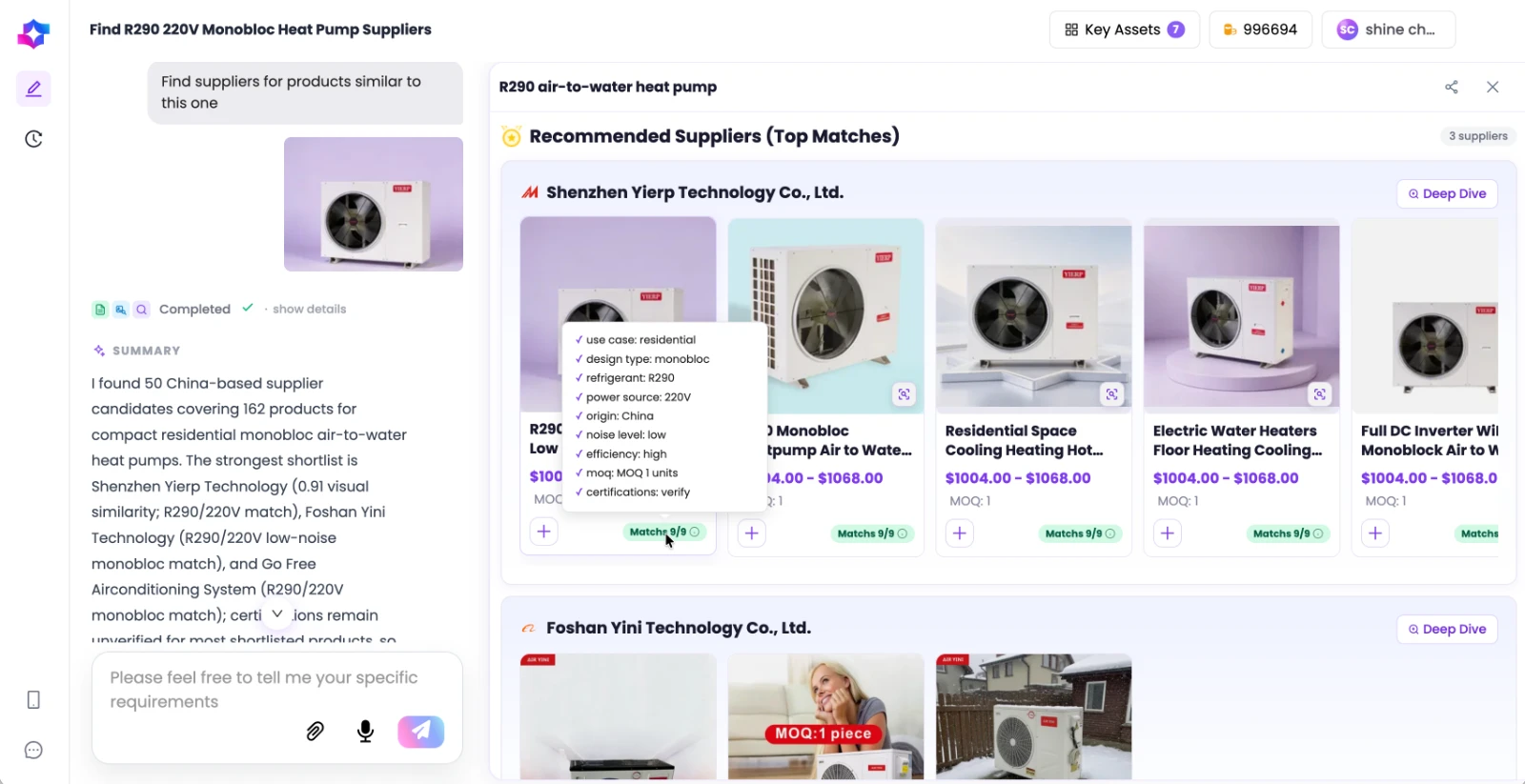
SourcingX converted the product information into nine matching criteria:
| Match Criterion | Requirement |
|---|---|
| Use case | Residential |
| Design type | Monobloc |
| Refrigerant | R290 |
| Power source | 220V |
| Origin | China |
| Noise level | Low |
| Efficiency | High |
| MOQ | 1 unit |
| Certifications | Verify |
This creates a more useful sourcing basis than simply searching for:
heat pump suppliers in China.
The buyer can now ask a much more precise question:
Which candidate products actually match the attributes of the product I am trying to source?
From 50 Candidates to 3 Recommended Suppliers
Using these nine criteria, SourcingX returned:
3 Recommended Suppliers
and
47 Alternative Suppliers
Some products from Shenzhen Yierp Technology matched 9/9 criteria, while other recommended products achieved 8/9 or 7/9 matches.
SourcingX result: https://www.sourcingx.ai/share/result/kJEnozVuWxGY
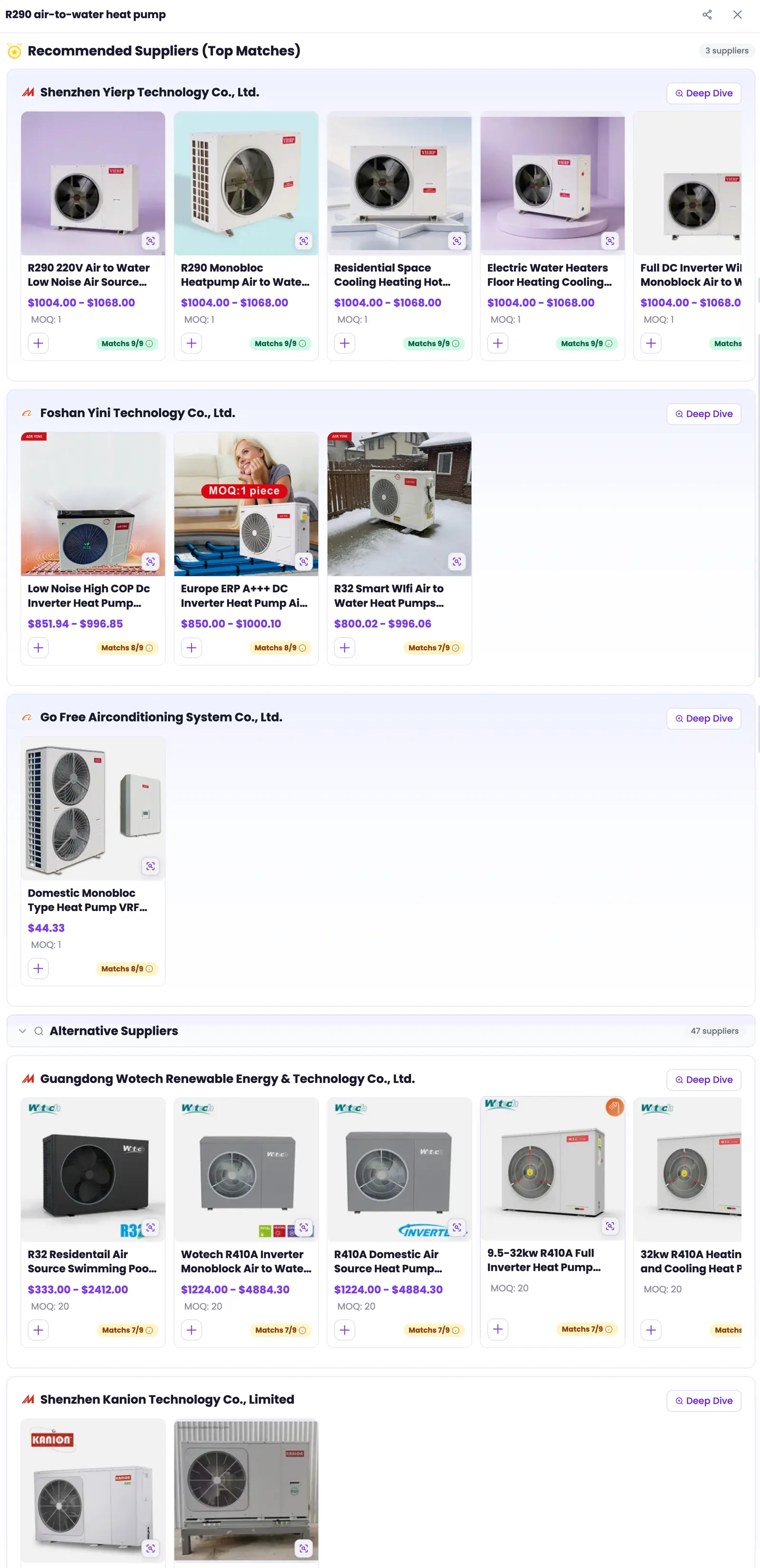
The value of the result is not simply the numerical match score.
It gives the buyer a structured way to see:
What matches
What may differ
What still needs clarification
What should be verified before the supplier moves forward
A Match Is Not the Same as Verification
The reference product itself shows why this distinction matters.
Its product title identifies the heat pump as using R290, while other information on the same product page also references R32.
The page also displays certification information.
That does not mean the buyer should immediately conclude which specification or certification is correct.
Instead, the comparison should record the information like this:
| Field | Current Status |
|---|---|
| Refrigerant | R290 / R32 inconsistency - Needs clarification |
| Power source | 220V / 220-240V - Supplier-provided |
| Noise level | Low - Supplier-provided |
| Efficiency | High - Supplier-provided |
| Certification | Displayed - Verify |
This is an important distinction:
Matching helps identify relevant candidates. Verification determines whether important information is reliable enough to support a sourcing decision.
The Minimum Information to Collect Before Comparing Suppliers
For most supplier comparisons, make sure you have these core information groups before ranking candidates:
- Exact product specification
- Quantity and MOQ
- Unit price and price tier
- Incoterm and named place
- Packaging, tooling, and additional costs
- Lead time and its starting point
- Payment terms
- Required certification or compliance information
- Relevant production or supply capability
- Supplier legal entity
- Exceptions to the requirement
- Missing or unverified information
You do not need every possible supplier detail before beginning comparison.
You do need enough information to answer:
Are these suppliers actually offering the same thing on a comparable basis?
If the answer is no, request clarification before ranking them.
What to Do When Supplier Information Is Missing
Do not ask vaguely for:
More information.
Ask a specific question tied to the missing comparison field.
For example:
Please confirm whether your quoted USD 920 price is FOB Ningbo and whether individual retail packaging is included.
or:
Please confirm whether R290 applies to the exact model included in your quotation.
Specific follow-up questions make it easier to turn incomplete supplier responses into comparable information.
Once the core information is complete, you can move to the next step: compare suppliers against your must-have requirements, trade-offs, and unresolved risks before building the shortlist.
https://www.sourcingx.ai/guides/compare-chinese-suppliers-before-shortlist-40135
How to Compare Chinese Suppliers Before You Shortlist Them
How SourcingX Helps Structure Supplier Comparison
When sourcing starts from a product description, image, or existing product reference, SourcingX can help convert that information into structured matching criteria and use those criteria to identify similar products and suppliers.
The workflow can be summarized as:
Understand the reference → Extract requirements → Match suppliers → Identify gaps → Verify critical information → Compare
The purpose is not to treat every matching field as verified fact.
It is to make it easier for buyers to see:
What already matches
What differs
What is still missing
What needs verification next
Find Similar Suppliers
Related Questions
Do I need a complete RFQ before comparing suppliers?
Not always. You can begin with a clear product reference or sourcing requirement. However, the more consistent the information collected from each supplier, the more reliable the comparison becomes.
Can I compare suppliers when some information is missing?
You can perform an initial screening, but suppliers should not be treated as fully comparable when important information such as specification, MOQ, Incoterm, lead time, or certification status is missing.
Is supplier-provided information enough for shortlisting?
It can support initial screening, but important claims should remain clearly separated from independently verified evidence.
Should every supplier answer the same questions?
For core comparison fields, yes. Suppliers may provide additional information, but the same must-have requirements should be collected from every serious candidate.