How Can I Verify a Chinese Supplier's Business License?
Direct answer
To verify a Chinese supplier's business license, ask for a clear copy of the license and the supplier's exact registered Chinese company name. Search the Chinese name or Unified Social Credit Code in the National Enterprise Credit Information Publicity System, then compare the official record with the license, quotation, contract, invoice, bank beneficiary, and other supplier documents. At a minimum, confirm that the company name and credit code match, the registration status allows normal operation, and any differences between the seller, manufacturer, exporter, and payment recipient have been explained. A matching business license confirms that a legal entity is registered under that identity. It does not prove that the company owns a factory, manufactures your product, has sufficient capacity, or will perform reliably.
Why a copy of the license is not enough
Most buyers begin by asking the supplier to send a business license. That is useful, but the document itself is only the starting point.
A scanned license can be old, incomplete, difficult to read, or connected to a different company within the supplier's group. Even when the document is genuine, the company shown on it may not be the entity issuing the quotation, signing the contract, receiving payment, or manufacturing the goods.
The practical question is therefore not only:
Is this a real business license?
It is also:
Is this the legal entity involved in my transaction?
That second question is where many supplier identity checks become more complicated.
What Should You Ask the Supplier to Provide?
Ask for:
- A clear, complete copy of the Chinese business license;
- The company's exact registered Chinese name;
- Its Unified Social Credit Code;
- The name of the company that will sign the contract;
- The name of the company that will issue the invoice;
- The bank-account beneficiary;
- The address where the relevant goods will be produced;
- An explanation of any related trading, manufacturing, or export companies involved.
Do not rely only on the English company name shown on a website, marketplace profile, quotation, or email signature.
Many Chinese companies use an English trading name that is not a direct or unique translation of the legally registered Chinese name. Official company searches are therefore more reliable when performed using the Chinese legal name or the Unified Social Credit Code.
The Chinese legal name should appear clearly enough to copy character by character. If the scan is blurred, cropped, or covered by a watermark, ask for a more readable version before continuing.
How Do You Check the Official Company Record?
The primary public source for checking a mainland Chinese company is the National Enterprise Credit Information Publicity System, commonly referred to as the national enterprise credit system.
The system allows users to search public company information using the registered company name or Unified Social Credit Code. The European Commission's China IP SME Helpdesk also directs international businesses to this official system when checking whether a Chinese company is registered and reviewing basic company information.
Step 1: Search the exact Chinese company name
Copy the Chinese name directly from the business license.
Do not translate the English supplier name back into Chinese and assume that the result is correct. A small difference in location, company type, industry wording, or Chinese characters may lead to a different legal entity.
Step 2: Search the Unified Social Credit Code
A company's Unified Social Credit Code is an 18-character identifier used in official registration records.
Searching by this code can help distinguish companies with similar names and reduce the chance of opening the wrong record. Official Chinese market-regulation data standards use the Unified Social Credit Code as a central company identifier.
Step 3: Open the matching company record
Do not stop when a company name appears in the search results. Open the full record and compare it against the license and the documents used in the transaction.
Depending on the company type and the information available, the public record may show the registered name, company type, legal representative, registered address, registration status, establishment date, registered capital, business scope, registration authority, and other disclosed information.
Chinese registration rules identify company name, address, legal representative, registered capital, company type, business scope, registration authority, establishment date, and Unified Social Credit Code as core business-license information for companies.
What about an electronic business license?
A supplier may provide an official electronic business license instead of a scanned paper document.
China's official electronic business-license system supports the display and verification of electronic licenses. Government guidance states that electronic and paper business licenses have the same legal effect, and the electronic-license system can be used to verify authenticity and validity in supported scenarios.
An electronic license can make authenticity checking easier, but you should still compare the company identity with the quotation, contract, invoice, and payment details.
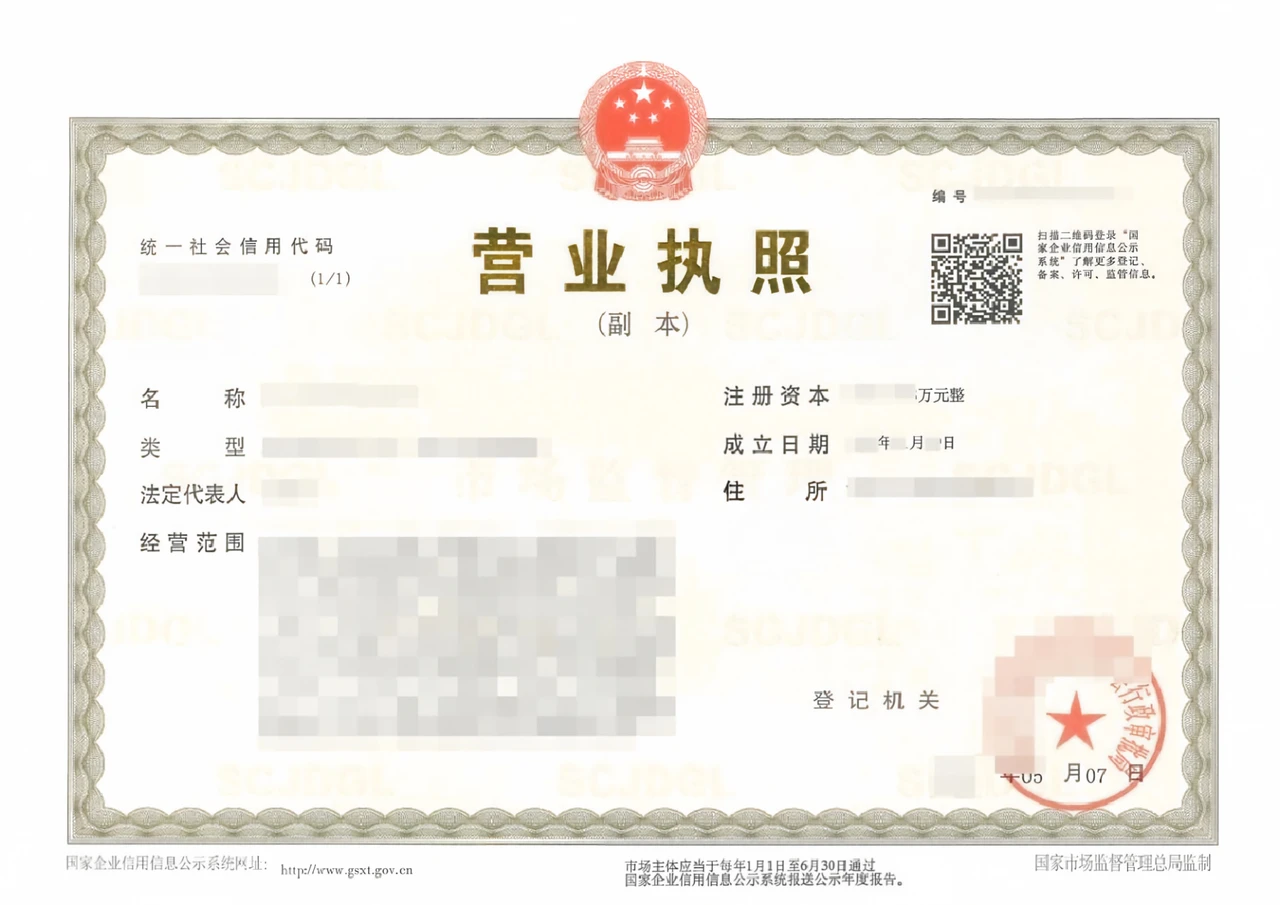
Which Business License Details Should Match?
Do not treat every field as equally important. Begin with the details that identify the company and connect it to the transaction.
Registered Chinese company name
The legal company name in the official record should match the name on the business license. It should also be consistent with the company named in the contract and, where appropriate, the invoice and bank account.
A difference in English translation may be explainable. A difference in the registered Chinese company name requires clarification.
Unified Social Credit Code
The code on the license should match the code in the official company record.
If the supplier sends several licenses, identify which company is responsible for:
- Selling the goods;
- Manufacturing the goods;
- Exporting the goods;
- Signing the contract;
- Receiving payment.
Do not combine information from several related companies and treat it as if it belongs to one entity.
Registration status
Check the current registration status in the official record rather than relying only on the printed license.
A company record showing cancellation, revocation, or another status inconsistent with normal business operations requires further investigation. A license image may have been issued before the company's status changed.
A failed search does not automatically prove that the document is fake. First check for typing errors, outdated company information, a recent name change, or confusion between the company and one of its affiliates.
Legal representative
The legal representative does not need to be the sales contact. However, if the name on the official record differs from the name on the license, ask whether the supplier sent an outdated document or whether the company information has changed.
Registered address
The registered address is the company's official registered location. It may not be the same as the factory, warehouse, sales office, or export office. An address difference is therefore not automatic proof of a problem.
The supplier should still be able to explain:
- Where the company is registered;
- Where the sales team works;
- Where production takes place;
- Which address will appear in the contract and shipping documents.
Business scope
Business scope can help you understand how the company describes its registered activities.
A manufacturing-related scope may support a supplier's claim, while a scope focused on trade or consulting may indicate a different operating role. But business scope should not be used as stand-alone proof that a company owns a factory or currently produces a particular product. Read it as one piece of context, then verify actual production separately.
Establishment date and registered capital
The establishment date can help you identify an obviously inconsistent claim, such as a company stating that it has operated under the same legal entity for twenty years when the registered company was created recently.
Registered capital may provide background about the legal entity, but it should not be treated as proof of cash available, factory size, production capacity, or payment safety.
Compare the license with the transaction documents
The most useful business-license check often happens outside the license itself.
Place the following side by side:
| Document or Record | Company Name to Check |
|---|---|
| Official company record | Registered Chinese company name |
| Business license | Licensed legal entity |
| Supplier quotation | Company issuing the offer |
| Purchase contract | Contracting party |
| Commercial invoice | Company invoicing the buyer |
| Bank account | Payment beneficiary |
| Export documents | Exporting entity |
| Test reports or certificates | Applicant, manufacturer or factory |
| Marketplace or website | Company claiming to be the supplier |
Not every name must be identical. For example, a factory may use a related trading company to export, or a mainland manufacturer may ask a Hong Kong affiliate to receive international payment.
That structure may be legitimate. What matters is whether the supplier explains the relationship, provides consistent documents, and makes clear which entity is responsible if the product, payment, or delivery goes wrong.
Before paying, ask a direct question:
The company on the business license is different from the company receiving payment. What is the relationship between these entities, and which company is responsible under the contract?
A clear answer should identify the relationship rather than simply state that both companies are "the same group."
What Does a Chinese Business License Prove?
A matching license and official company record can help confirm:
- That a legal entity is registered;
- Its registered Chinese name;
- Its Unified Social Credit Code;
- Its current disclosed registration status;
- Its legal representative;
- Its registered address;
- Its company type and establishment date;
- Its registered business scope;
- Other basic registration information available in the public record.
This provides an identity baseline for the rest of the supplier review.
It does not prove:
- That the supplier owns a factory;
- That production takes place at the registered address;
- That the supplier manufactures the products shown online;
- That it has the required equipment or capacity;
- That its test reports cover your product;
- That it has export experience;
- That it has no legal, financial, or operating risks;
- That a future shipment will meet your requirements.
A business license answers who the legal entity is. It does not answer every question about what the supplier can deliver.
What Business License Warning Signs Need Investigation?
The following situations deserve clarification before you sign or pay:
The supplier will not provide its Chinese legal name
An English name alone is not enough to identify the company in Chinese official records.
The company name or credit code does not match
A small difference may lead to a completely different company. Compare the Chinese characters and code carefully.
The official record cannot be found
Check the spelling and code first. If the supplier cannot provide information that produces a matching official record, stop and investigate further.
The registration status is not consistent with normal operations
Do not rely on an old license image when the current official record shows a materially different status.
The contract or bank beneficiary is an unexplained company
Ask why another entity is signing, invoicing, exporting, or receiving payment.
The supplier sends several licenses without explaining their roles
Multiple related companies are common. The supplier should still explain which company handles each part of the transaction.
The license is cropped, altered, or unreadable
Request a complete copy. Do not rely on a document that hides the company name, code, issuing information, or other essential fields.
The registered activity appears unrelated to the product
This is not automatic proof that the supplier is unsuitable, but it is a reason to ask who actually manufactures the goods and which entity controls production.
No single warning sign proves fraud. The purpose of the check is to identify inconsistencies early enough to resolve them before the buyer becomes financially committed.
What Should You Check After the Business License?
Once the legal entity is confirmed, decide what the transaction still requires.
For a small sample order of a low-risk product, the next step may be limited to confirming the payment entity and reviewing the sample.
For a custom, regulated, safety-sensitive, or high-value order, you may also need to check:
- The supplier's actual operating and production role;
- Company changes and ownership relationships;
- Business abnormalities, penalties, or other public risk signals;
- Product-specific test reports and compliance documents;
- Export activity;
- Factory location and production capability;
- Samples and trial production;
- Inspection, audit, testing, customs, or legal requirements.
A business-license check should therefore be the beginning of supplier due diligence, not the final approval.
For a broader review, follow a structured process to verify a Chinese supplier, including its operating role, product capability, export evidence, and unresolved risks. You can also run a broader background check on a Chinese supplier when the order value, product risk, or payment structure calls for more than a basic identity check.
How SourcingX Fits Into the Process
SourcingX can help buyers review available company-registration and operating information associated with a potential Chinese supplier.
Where relevant information is available, buyers can use it to:
- Identify the Chinese legal entity behind a supplier;
- Review basic company and operating information;
- Compare those details with supplier documents;
- Notice differences that still require direct confirmation;
- Decide whether deeper supplier verification is needed.
SourcingX does not replace the official company record, legal review, factory verification, product testing, inspection, or professional due diligence.
Its role is to make the supplier's identity and available business information easier to review before the buyer signs a contract, makes payment, or proceeds to a higher-risk stage of the transaction.
First-party source: SourcingX product documentation and live workflow.
Conclusion
To verify a Chinese supplier's business license, do not stop after receiving a PDF or photograph.
Obtain the exact registered Chinese name and Unified Social Credit Code, locate the matching official company record, and compare the company identity with the quotation, contract, invoice, bank beneficiary, and other transaction documents.
The most important result is not simply that a license exists. It is that you understand which legal entity is selling the product, which company will receive payment, where production will take place, and who will be responsible if the agreement is not fulfilled.
A clean business-license check gives you a reliable identity baseline. The rest of the supplier decision still depends on product fit, operating evidence, samples, commercial terms, and the level of due diligence appropriate to the order.