How to Shortlist Chinese Suppliers Before Requesting Quotes
Direct answer
Do not request quotes from every Chinese supplier that looks relevant in search results. First remove suppliers that fail essential requirements. Then compare the remaining candidates on product fit, manufacturing capability, commercial fit, and the evidence they can provide. For many sourcing projects, a shortlist of roughly three to five serious candidates is more useful than collecting quotations from a dozen loosely matched suppliers. The goal is not to identify the winner before the RFQ. It is to make sure every supplier receiving the RFQ is credible enough, relevant enough, and sufficiently understood to justify the next round of work. Price comparison becomes useful only when the suppliers are quoting substantially the same requirement.
Why Shortlist Suppliers Before Asking for Quotes?
A quotation feels like useful information because it gives you a number.
But a low number from the wrong supplier does not make the sourcing decision easier.
Imagine that you find 18 suppliers selling a similar product. You send the same short message to all of them and receive 11 quotations.
One supplier prices an existing catalog model. Another assumes custom tooling. One quotes EXW while another includes packaging. Some are manufacturers; others coordinate production elsewhere. One supplier has interpreted your annual quantity as the first order.
You now have 11 prices, but you may not have 11 comparable offers.
Supplier shortlisting prevents this problem by separating two questions:
Before RFQ: Is this supplier suitable enough to quote the project?
After RFQ: Which suitable supplier offers the strongest overall proposal?
This sequence is consistent with professional procurement practice. CIPS describes supplier selection as a step that takes place before formal tender documents and RFQs are issued, with suppliers assessed against relevant criteria before deciding who should proceed.
That does not mean a small importer needs a formal corporate tender process.
It means the same basic discipline is useful even when you are sourcing one product: screen first, quote second.
Use Exclusion Criteria Before You Start Scoring
A common mistake is to build a detailed supplier scorecard too early.
At the first screening stage, the more useful question is often not:
Which supplier scores 82 versus 78?
It is:
Is there any reason this supplier should not enter the RFQ at all?
Start with a few requirements that genuinely determine whether the supplier is viable.
For example, if you are sourcing a custom stainless-steel enclosure, your exclusion criteria might include:
- inability to work with the required material or fabrication process;
- no willingness to produce the required customization;
- MOQ materially above your expected order;
- inability to meet a non-negotiable project timeline;
- missing product- or market-specific documentation that is essential to your sourcing requirement.
Do not turn preferences into automatic exclusions.
If you would prefer a supplier in Guangdong but a Zhejiang supplier is otherwise highly suitable, geography may belong in the comparison stage rather than the rejection stage.
The same applies to supplier type. If you prefer to buy directly from a manufacturer, decide why that matters to this order before excluding every intermediary.
The purpose of exclusion criteria is to remove clear mismatches, not to make the sourcing market artificially small.
If the requirements themselves are still vague, go back to your sourcing brief first. A shortlist cannot be better defined than the purchase behind it.
How to Write a Supplier Search Brief That Gets Better Matches
Check Product Fit, Then Manufacturing Fit
A supplier selling the same product category is not necessarily a strong match.
Suppose you need a custom plastic enclosure.
Supplier A shows dozens of plastic consumer products.
Supplier B shows fewer products, but several use a similar resin, molding process, wall thickness, surface finish, and assembly method to your design.
Supplier B may deserve closer attention even if Supplier A has the broader catalog.
That is the difference between product-category fit and manufacturing fit.
For each serious candidate, try to establish:
Have they handled products technically similar to this requirement?
Then go one level deeper:
Do they control, coordinate, or subcontract the manufacturing processes that matter most to this product?
You do not need to prove the entire production setup before issuing an RFQ. But you should have enough information to know why the supplier belongs in the conversation.
CIPS guidance on supplier selection also considers factors such as technical capability and capacity, rather than treating price as the only basis for supplier selection.
A useful early discussion is therefore more specific than:
Have you made this product before?
Ask:
Which parts of this product are closest to what you already manufacture?
Which major processes would be completed at your facility?
Which processes, if any, would be subcontracted?
Can you show one or two relevant examples using a similar process or material?
The quality of the answer often tells you more than the number of products on the supplier's website.
Check Whether the Supplier Fits the Actual Order
Technical capability is only one kind of fit.
A capable supplier may still be the wrong commercial match.
Consider two buyers sourcing the same product.
One wants 500 units across five SKUs for a market test.
The other expects 20,000 units of one standardized SKU every quarter.
The strongest supplier for the first buyer may not be the strongest supplier for the second.
Before shortlisting a supplier, make sure you understand the commercial constraints that could change the decision:
Order size. Is your expected volume realistic for the supplier?
Customization. Does the supplier want this type of development work, or is its business built around standard products?
Timing. Can the supplier realistically support sampling, tooling and production within the project schedule?
SKU structure. Are you buying one stable product or coordinating many related products?
Communication. Can the supplier handle the level of technical and commercial coordination your project requires?
At this stage you are not negotiating the final terms.
You are checking whether the business relationship makes sense before both sides spend more time preparing a formal quote.
Shortlist by Evidence, Not Supplier Profiles
Supplier profiles are useful for discovery.
They are weaker as a basis for selection.
Phrases such as “professional manufacturer,” “10 years of experience,” “strict quality control,” or “export worldwide” may help introduce a company, but they do not answer the buyer's specific sourcing question.
Replace broad claims with evidence that relates to the order.
If production capability matters, ask for relevant products, equipment, process information or site evidence.
If export experience matters, look for evidence that supports the claimed market or product experience where available.
If a certification matters, check the entity, scope, product or facility covered rather than treating the logo alone as proof.
If factory status matters, identify the legal company and establish its relationship with the claimed production facility.
This does not mean collecting every possible due-diligence document before an RFQ.
The amount of evidence should match the decision being made.
At the shortlisting stage, you need enough evidence to decide whether the candidate deserves further work. Deeper verification can follow as the commercial commitment increases.
For a structured verification process after candidates become serious, see How to Verify Chinese Suppliers: A Practical Guide for Global Buyers.
Compare Only After the Basic Fit Is Clear
Once obvious mismatches have been removed, comparison becomes useful.
You do not necessarily need a complicated weighted scoring model.
For an early shortlist, a simple comparison can be more revealing:
| Dimension | Supplier A | Supplier B | Supplier C |
|---|---|---|---|
| Product / process fit | Supported | Supported | Unclear |
| Critical requirements | Meets | Meets | Meets |
| Order-size fit | Meets | Unclear | Meets |
| Relevant evidence | Strong | Moderate | Limited |
| Key open question | Capacity | MOQ | Factory relationship |
This format keeps uncertainty visible.
That matters because “unknown” should not silently turn into “yes.”
If Supplier B has not confirmed whether your volume fits its normal production, mark it as an open question. If Supplier C's factory relationship is unclear, do not award it a confident manufacturing score simply because its profile says “manufacturer.”
Numeric scores can be useful later, especially when several stakeholders need a repeatable evaluation method.
But early supplier screening is often clearer when you distinguish:
Supported
Not yet confirmed
Does not meet requirement
That makes it easier to see what must be resolved before the RFQ.
Build a Shortlist You Can Actually Manage
The final shortlist should be small enough that you can engage each supplier seriously.
A practical target for many sourcing projects is around three to five candidates, although the right number depends on the market, product complexity and sourcing risk.
Too few candidates can leave you with little comparison or backup.
Too many create a different problem: superficial communication, inconsistent quotations and too much time spent chasing suppliers that were never strong matches.
Do not force the list to reach a particular number.
If only two suppliers currently meet the critical requirements, keeping three weak candidates merely to create a five-supplier shortlist adds little value.
Likewise, if the product is unusual and you still do not understand the supplier market, you may need another search round before reducing the list.
Before sending the RFQ, you should be able to explain in one or two sentences why every supplier is still there.
For example:
Supplier A remains because it has relevant in-house fabrication capability, supports our expected quantity, and provided evidence of similar custom work.
That is much more useful than:
Supplier A looked professional and replied quickly.
Once the shortlist is ready, send the same defined RFQ to each candidate.
Only then does commercial comparison become much more meaningful.
How SourcingX Can Support Supplier Shortlisting
SourcingX can support the process before the RFQ by helping buyers search for potential suppliers and review available company, product, trade, and supplier information in one sourcing workflow.
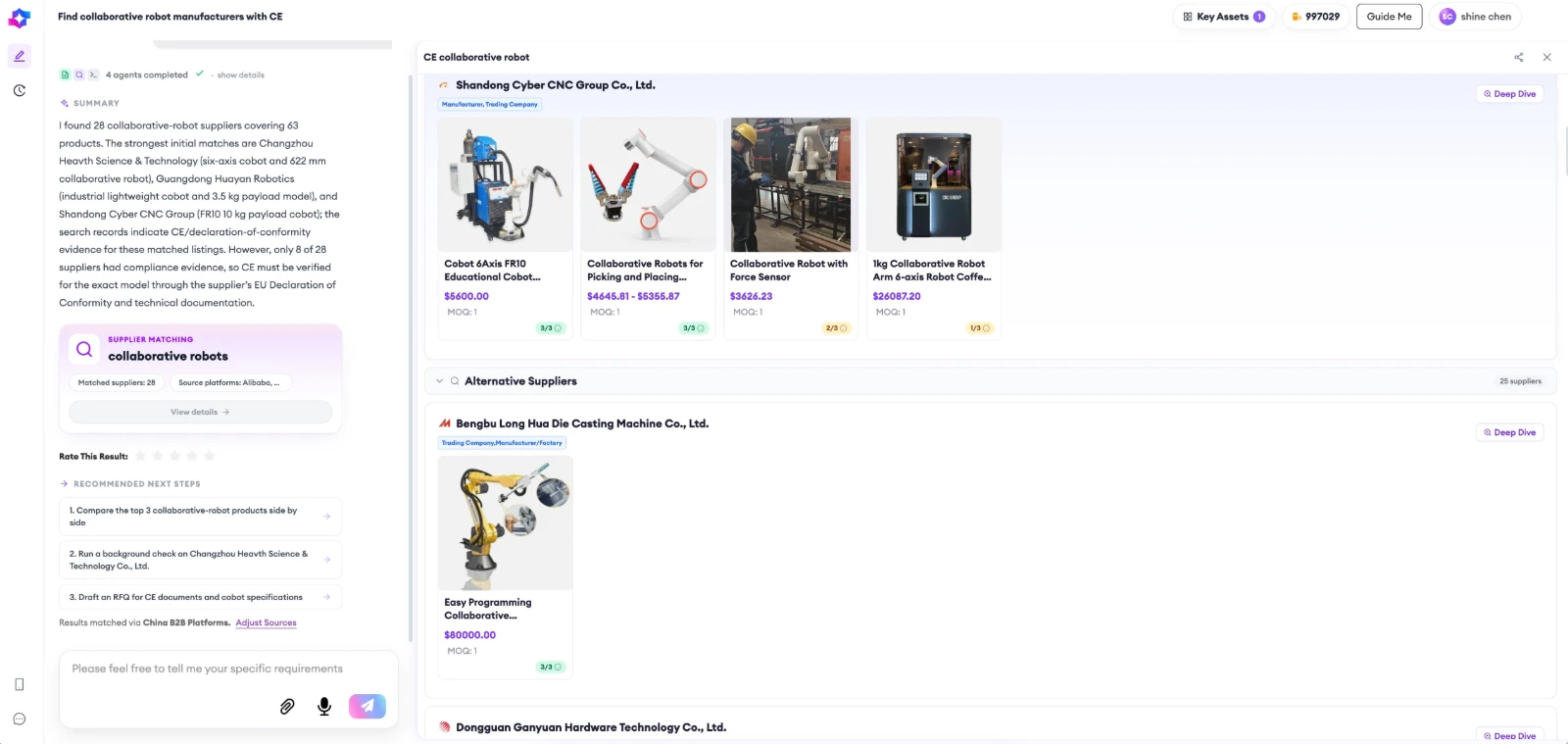
Use that information to answer practical screening questions:
Does this company appear relevant to the product?
What evidence supports the match?
Does available information raise a question that needs to be clarified?
Which candidates deserve deeper verification or an RFQ?
SourcingX should not be treated as a substitute for the buyer's final supplier approval.
A supplier that appears relevant in available data may still require direct communication, samples, document verification, testing, inspection, factory audits, or other checks appropriate to the order.
The purpose of supplier matching is to improve the candidate pool.
The purpose of shortlisting is to decide where your procurement effort should go next.
A strong shortlist does not contain the largest number of suppliers.
It contains the smallest practical group of suppliers that you have a good reason to keep evaluating.