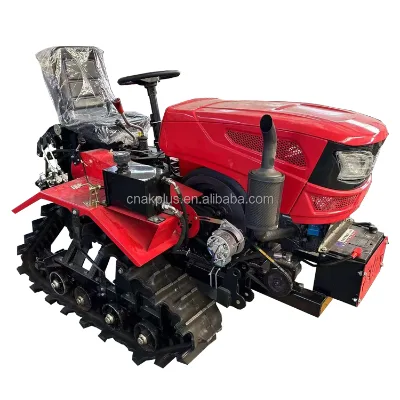
Find 25hp Rubber Track Agricultural Tractor for farm, garden, and lawn
Source 30 units of the 25hp Rubber Track Agricultural Tractor designed for diverse tasks including soil preparation and lawn maintenance. Buyers can compare specifications such as engine speed, drive type, and emission standards from verified Chinese manufacturers.
Key considerations
Products List




Big Size Rubber Track Agricultural Track Farm Track Rubber Tractor Track
$500.00 - $900.00
MOQ: 10 Pieces


25HP Agricultural Machinery Farm Cultivator Remote Control Crawler Tractor
$1700.00 - $2800.00
MOQ: 1 Pieces


Agricultural Challenger Tractor 35 45 55 Rubber Track 18inch 25 Inch 30inch
$2000.00 - $4990.00
MOQ: 1 Pieces


Rubber Track Agricultural Tractor with Low Ground Pressure for Soil Conservation
$2099.00 - $2209.00
MOQ: 1 Pieces


Comprehensive Sourcing Guide
Strategic Sourcing Guide for 25HP Rubber Track Agricultural Tractors
The global agricultural machinery market presents a complex landscape for buyers seeking specialized equipment like the 25hp Rubber Track Agricultural Tractor. This specific category of machinery bridges the gap between small-scale garden utility and heavy-duty farm operations, offering unique traction capabilities in challenging terrain. Based on current market data and product specifications, this guide provides a structured approach to evaluating, sourcing, and procuring these units. The focus remains on evidence-based criteria, ensuring that procurement decisions are grounded in verifiable attributes rather than speculative marketing claims. Understanding the distinction between crawler and wheel configurations, along with the specific power and drive requirements, is essential for aligning equipment capabilities with operational needs.
Technical Specifications and Operational Architecture
When evaluating a 25HP rubber track tractor, the buyer must first dissect the core technical architecture. The power source is a critical determinant of performance. Market observations indicate that these units typically utilize diesel engines, with specific references to Weifang or Laidong diesel engines in the supply chain. The power output is generally standardized around 25HP (18.64kW), operating at an engine speed of approximately 2400 RPM. This power rating is sufficient for soil preparation tasks, particularly when paired with high-torque drive systems.
The drive mechanism is another vital specification. Most units in this segment employ a gear drive system, which provides the necessary torque multiplication for heavy loads. The traction type is predominantly semi-hanging or fully tracked, distinguishing these units from traditional wheel tractors. The classification often falls under "Crawler Tractor" or "Crawler Tilling Tractor," with specific model numbers such as AKTLJ-A35, 25HP Crawler Tractor, or 25H-01 appearing in product listings. The net weight of these machines is substantial, often recorded around 2000kg, which contributes to their stability and ground pressure distribution.
The operational capabilities are defined by the application field, which is strictly agricultural. These machines are designed for continuous running operations, making them suitable for extended periods of soil preparation. The accessory compatibility is broad, with rotary tillers, lawn mowers, and ridging tools being common attachments. The fuel consumption is a key efficiency metric, with observed ranges indicating an oil consumption of 3L-4L per 666m² of work area. Buyers should verify if the fuel system supports both gas and diesel options, as some models in the market offer dual-fuel flexibility, though diesel remains the primary standard for this power class.
Compliance, Certification, and Emission Standards
Navigating the regulatory landscape is a non-negotiable aspect of international procurement. The compliance status of agricultural machinery varies significantly by region, and verifying certifications is the first step in risk mitigation. The supply chain for these tractors frequently cites multiple certification bodies. Commonly observed certifications include CE, ISO, EPA, ECE, CCC, and DOT. The presence of the CE mark suggests compliance with European safety directives, while ISO certifications (including ISO/TSISO) indicate adherence to quality management standards.
Emission standards are particularly critical for markets with strict environmental regulations. The observed data points to two primary emission tiers: Euro II and Euro III. Buyers must explicitly confirm which standard the specific unit meets before finalizing a purchase, as this impacts the legality of the equipment in various jurisdictions. For instance, a unit certified only to Euro II may not be permissible for import into regions mandating Euro III or higher standards. Additionally, the condition of the equipment is almost universally listed as "New," but buyers should verify the manufacturing date to ensure the unit has not been sitting in inventory for extended periods, which could affect battery life and rubber track integrity.
The following table summarizes the typical certification and standard landscape observed in this product category:
| Attribute Category | Observed Standards/Certifications | Verification Requirement |
|---|---|---|
| Safety & Quality | CE, ISO, ISO/TSISO | Confirm specific ISO standard number (e.g., ISO 9001) |
| Emission Control | Euro II, Euro III | Match with local regulatory requirements |
| Regional Compliance | ECE, CCC, DOT | Verify applicability to destination country |
| Product Origin | Made in China | Confirm country of origin for tariff classification |
Cost Drivers and Pricing Dynamics
The pricing structure for 25HP rubber track tractors exhibits a wide variance, reflecting differences in customization, component quality, and included accessories. The observed listed price range in the current market spans from $500 to $35,250. This broad spectrum is not indicative of a single product line but rather a collection of varying configurations. The lower end of the price range likely corresponds to basic chassis units or those with minimal accessories, while the higher end may include fully equipped units with advanced hydraulic systems, specialized tracks, or bundled tillage implements.
Several factors drive these costs. First, the customization level is a primary variable. The availability of customization allows buyers to tailor the tractor to specific soil conditions or attachment requirements, which naturally increases the unit price. Second, the packaging method influences logistics costs. Options range from "Shopping Container" to "Wooden Box" and "Export Packing." Wooden boxes and export-grade packaging typically incur higher costs but provide superior protection during long-distance shipping, reducing the risk of damage to the rubber tracks and hydraulic lines.
The minimum order quantity (MOQ) is another cost consideration. The observed MOQ range is between 1 and 10 units. This flexibility allows small-scale farmers or individual contractors to purchase single units, while larger agricultural enterprises can leverage bulk ordering to negotiate better rates. However, buyers should be aware that the unit price often decreases as the order volume increases, a standard practice in B2B machinery procurement. It is essential to request a detailed breakdown of costs to understand how much of the price is attributed to the base machine versus the packaging, accessories, and certification fees.
Typical Applications and Field Performance
The versatility of the 25HP rubber track tractor makes it suitable for a diverse range of agricultural applications. The primary usage includes lawn tractor, garden tractor, and farm tractor operations. The semi-hanging traction type and crawler design make these machines particularly effective in wet, muddy, or uneven terrain where wheel tractors might struggle with traction or compaction. The rubber tracks distribute the weight of the 2000kg machine over a larger surface area, reducing soil compaction and improving stability on slopes.
Soil preparation is the dominant application, with the machine functioning as a soil preparation machinery unit. The continuous running operation capability ensures that farmers can maintain productivity over large fields without frequent stops. The inclusion of a rotary tiller as a standard or optional accessory allows for direct integration into the tillage process. Furthermore, the machine's classification as a crawler tractor enables it to perform tasks such as ridging and mowing, expanding its utility beyond simple plowing.
The size of the machine is categorized as "Small," which implies it is designed for medium to small-scale farms or specialized garden operations. The dimensions, often cited around 290019001850mm, allow for maneuverability in tight spaces while still providing sufficient power for heavy-duty tasks. The service life of these units is estimated at 6-10 years, indicating a robust build quality suitable for long-term investment. Buyers should assess the specific field conditions they face, such as soil type and slope gradient, to determine if the rubber track configuration offers a tangible advantage over wheel-based alternatives.
Supplier Evaluation and Quality Control
Selecting the right supplier requires a rigorous evaluation process that goes beyond the initial product listing. Since the supply chain is dominated by manufacturers in China, buyers must verify the supplier's ability to maintain consistent quality across batches. The presence of certifications like CE and ISO is a good starting point, but it is crucial to request valid certificates and verify their authenticity with the issuing bodies. The "New" condition of the product should be confirmed through factory inspection reports or third-party quality audits.
Quality control measures should be a prerequisite for any purchase. Buyers should inquire about the testing procedures for the engine, gearbox, and rubber tracks. The gearbox is often listed as a "Custom Gear Gearbox," suggesting that the supplier may offer tailored solutions. It is vital to verify the specifications of this component, including its load capacity and durability under continuous operation. The tire design, classified as a diagonal tire with a diameter of at least 22 inches, should be inspected for material quality and resistance to wear.
The packaging method is also a proxy for the supplier's attention to detail. "Export Packing" and "Wooden Box Package" indicate a higher level of care in logistics preparation. Buyers should request photos of the packaging process to ensure that critical components are adequately protected. Additionally, the supplier's willingness to provide customization options, such as specific color schemes (Red or Green are observed) or modified attachment interfaces, demonstrates a commitment to meeting client needs.
Long-Term Procurement and Maintenance Considerations
Procuring a 25HP rubber track tractor is a long-term investment that requires careful consideration of maintenance and lifecycle management. The service life of 6-10 years suggests that the initial purchase price should be amortized over a significant period. Buyers should evaluate the availability of spare parts, particularly for the engine (Weifang/Laidong), the custom gearbox, and the rubber tracks. The oil consumption rate of 3L-4L/666m² is a key metric for calculating ongoing operational costs.
The emission standard compliance is not just a one-time check but a long-term consideration. As environmental regulations tighten, a unit compliant with Euro II may face restrictions in the future, whereas Euro III offers more longevity in regulated markets. Buyers should also consider the fuel type compatibility. While diesel is the standard, the ability to run on gas in some models could provide fuel cost savings depending on local fuel prices.
Finally, the customization availability offers a strategic advantage for long-term procurement. As operational needs evolve, the ability to modify the tractor with different attachments or upgrade components can extend the machine's useful life. Buyers should establish a relationship with the supplier that includes after-sales support, warranty terms, and technical assistance. This ensures that any issues arising during the 6-10 year service life can be addressed promptly, minimizing downtime and maximizing the return on investment. By focusing on these long-term factors, buyers can secure a reliable asset that enhances agricultural productivity for years to come.
FAQs
What engine options are available for the 25hp Rubber Track Agricultural Tractor?
The tractor typically uses Weifang or Laidong diesel engines with a power output of 25HP. This configuration ensures reliable performance for continuous soil preparation operations in various agricultural fields.
Which certifications are standard for these 25hp rubber track agricultural tractors?
Common certifications include CE, ISO, EPA, and Euro emission standards. Buyers must verify specific compliance levels like Euro II or Euro III to ensure the unit meets local regulatory requirements.
How much does a 25hp Rubber Track Agricultural Tractor cost?
Listed prices range from 500 to 35,250 USD depending on configuration. The final cost is influenced by customization options, packaging type, and included accessories like rotary tillers or lawn mowers.
Can the 25hp Rubber Track Agricultural Tractor be customized for specific needs?
Yes, customization is available to tailor the machine to specific operational requirements. Buyers can often request changes to dimensions, color, or accessory compatibility to suit their unique farming conditions.
What is the minimum order quantity for a 25hp Rubber Track Agricultural Tractor?
The minimum order quantity ranges from 1 to 10 units depending on the supplier. This flexibility allows individual farmers to purchase single units while larger enterprises can leverage bulk ordering.
Where are 25hp rubber track agricultural tractors manufactured?
These machines are manufactured in China with a net weight of approximately 2000kg. The origin is clearly stated as Made in China for tariff classification and logistics planning purposes.