Source Aluminum Running Board for Trucks SUVs and Off-Road Vehicles
Compare 30 listings for Aluminum Running Board options including universal models and brand-specific fits for Ford and Nissan. Buyers can review material details, dimensions, and customization availability to find suitable non-slip accessories for various vehicle types.
Key considerations
Products List


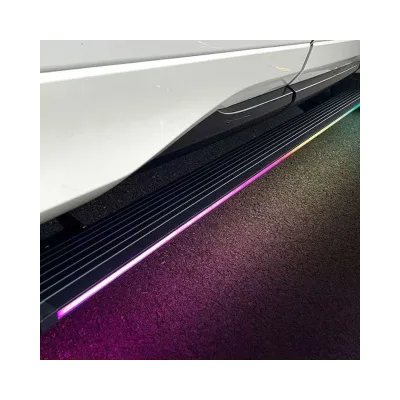




$3.00 - $20.00
MOQ: 100 Square Meters

![[Qisong] Black Side Steps Running Boards for Discovery](https://image.made-in-china.com/221f0j00FAsitTRBbYgj/-Qisong-Black-Side-Steps-Running-Boards-for-Discovery.webp)

Comprehensive Sourcing Guide
Strategic Sourcing Guide for Aluminum Alloy Running Boards
Understanding Product Composition and Material Integrity
The foundation of a reliable Aluminum Running Board lies in the precise selection of materials and the structural integrity of the alloy used. Based on current market observations, the primary construction material for these components is Aluminum Alloy, often combined with Plastic elements to enhance grip and aesthetic finish. This composite approach is critical for balancing weight reduction with durability. Aluminum alloy provides the necessary tensile strength to support vehicle weight and dynamic loads during entry and exit, while the plastic components typically serve as the non-slip surface or protective cladding.
When evaluating potential suppliers, buyers must verify the specific grade of the aluminum alloy. While the general category is "Aluminum Alloy," the specific alloy series (such as 6000 or 7000 series) determines corrosion resistance and hardness. The presence of plastic in the construction suggests a dual-material assembly that requires robust bonding techniques to prevent delamination under thermal stress or vibration. Procurement teams should request material certification sheets that confirm the alloy composition and the type of plastic used, ensuring they meet the mechanical requirements for automotive exterior applications. The observation that some products are labeled simply as "Aluminum Alloy" while others specify "Aluminum Alloy & Plastic" indicates a variance in design philosophy that buyers must align with their specific vehicle requirements.
Technical Specifications and Model Compatibility
The technical landscape of aluminum running boards is defined by a wide array of model numbers and dimensional standards, reflecting the need for vehicle-specific fitment. The market features a diverse range of model identifiers, including codes such as 802002, 802001, 802020, 802026, 802019, 12LLX-S1, 18FTC-S1, 15RA-S1, FT-S3E, RJ-S61, 20FT-S1, and the JX-SS series (JX-SS001 through JX-SS009). These alphanumeric codes are not arbitrary; they correspond to specific vehicle chassis configurations and mounting points.
Dimensional specifications are equally critical for ensuring a proper fit. Observed standard dimensions for packaging and product fitment include measurements such as 1933932cm, 2102522cm, 2201927cm, 1974040cm, 1863620cm, and 1882922cm. These figures likely represent the maximum shipping dimensions or the physical footprint of the assembled unit. Buyers must cross-reference these dimensions with their vehicle's rocker panel geometry. Furthermore, the "universal" designation found in some product listings suggests a one-size-fits-all approach, but this often requires verification against the specific make and model. For instance, specific listings explicitly mention suitability for Ford and Nissan brands, indicating that while some units are universal, many are engineered for specific OEM platforms.
| Model Series | Typical Application Context | Dimensional Reference (Approx.) |
|---|---|---|
| 802000 Series | General Universal Fit | 1933932cm |
| 12LLX/18FTC/15RA | Brand Specific (Ford/Nissan) | 2102522cm / 2201927cm |
| JX-SS Series | Electric/Heavy Duty | 1863620cm / 1882922cm |
| FT-S3E / RJ-S61 | Luxury/Performance | 1974040cm |
Compliance, Certification, and Origin Verification
In the global sourcing of automotive accessories, the origin of manufacture plays a pivotal role in quality perception and logistical planning. The majority of aluminum running boards in the current market originate from China, with specific mentions of "China (Mainland)" and "Henan, China" as production hubs. This geographic concentration suggests a mature supply chain ecosystem in the region, offering competitive pricing and high-volume manufacturing capabilities. However, buyers must remain vigilant regarding the specific factory location, as quality control standards can vary between facilities even within the same province.
Regarding compliance, the provided data indicates that products are often labeled with "universal" standards, but this term requires careful interpretation. In the context of automotive parts, "universal" may refer to the mounting system rather than a safety certification. Buyers should not assume that a "universal" label implies adherence to specific international safety standards without explicit documentation. Instead, procurement teams must verify if the supplier can provide test reports for load-bearing capacity, corrosion resistance (salt spray testing), and structural fatigue. The absence of specific certification names in the general data implies that compliance is often handled on a case-by-case basis or is specific to the destination market's regulations.
Cost Drivers and Minimum Order Quantities
The pricing structure for aluminum running boards is influenced by material costs, manufacturing complexity, and order volume. The observed price range in the market spans from $0.29 to $2100 USD. This vast disparity highlights the difference between individual components, such as pedal inserts or small plastic parts, and complete, heavy-duty running board assemblies. The lower end of the spectrum likely represents single components or basic accessories, while the upper end reflects full sets of electric or luxury-grade running boards.
Minimum Order Quantity (MOQ) is another significant cost driver. The market data shows an MOQ range from 1 to 200 units, with a specific observation of 100 PCS as a common threshold for certain models. Some suppliers offer an MOQ of just 1 Set, catering to small retailers or prototype testing, while others may require bulk orders to achieve optimal pricing. The "Sample: Accept" attribute indicates that buyers can often procure a single unit for evaluation before committing to a larger order. This flexibility is crucial for validating the quality of the aluminum alloy and the fitment of the model before scaling up production. Buyers should negotiate MOQ terms based on their inventory turnover rates and the specific model complexity, as custom designs may carry higher minimums.
Supplier Evaluation and Customization Capabilities
Selecting the right supplier requires a deep dive into their customization capabilities and OEM (Original Equipment Manufacturer) support. The market data confirms that OEM services are available, with some suppliers explicitly stating "OEM: Yes" while others indicate "OEM: No." This distinction is vital for buyers looking to brand the product or modify specifications for a specific vehicle line. Suppliers offering OEM services can typically handle custom branding, packaging, and even minor design alterations to meet unique vehicle requirements.
Customization is further supported by the "Available" status for customization attributes. This suggests that suppliers are willing to adapt the product to specific needs, such as altering the length, changing the finish, or integrating specific electronic components for electric running boards. The "Brand Name: wangzhixing" observed in the data points to the existence of established manufacturers, though buyers should conduct due diligence on the reputation and financial stability of such entities. When evaluating suppliers, procurement teams should assess their ability to handle the "Luxury" design style and "High Performance" claims often associated with premium running boards. This involves reviewing their design portfolio, production capacity, and history of delivering complex, multi-material assemblies.
Quality Control and Long-Term Procurement Strategy
Ensuring the long-term reliability of aluminum running boards requires a robust quality control (QC) strategy. The product attributes highlight "High Performance Running Board" and "Non-Slip" usage, which are critical functional requirements. To verify these claims, buyers must implement a rigorous QC protocol that includes visual inspections for surface defects, dimensional checks against the provided model specifications, and functional testing of the non-slip surface. The use of "Bubble Wrap, Plastic Bags, Cartons" for packing indicates a focus on protecting the product during transit, but the internal packaging must also prevent scratching of the aluminum alloy finish.
For long-term procurement, buyers should consider the lifecycle of the product. The "Electric pedal" attribute suggests that some running boards include active components, which introduces additional failure points compared to passive mechanical boards. These units require verification of electrical safety and the durability of the actuation mechanism. Furthermore, the "Luxury" design style implies a need for high aesthetic standards, requiring strict control over surface finishes and color consistency.
Buyers should establish a clear communication channel with suppliers regarding the "Place of Origin" and ensure that all shipments adhere to the agreed-upon packaging standards. The "Carton Box" and "Carton" packing methods are standard, but the specific internal protection (bubble wrap vs. foam) can vary. A comprehensive procurement strategy involves regular audits of the supplier's production line, especially for custom orders, to ensure that the aluminum alloy grade and plastic bonding processes remain consistent. By focusing on these technical and operational details, buyers can mitigate risks and secure a reliable supply chain for aluminum running boards that meet both functional and aesthetic expectations.
FAQs
What materials are used for aluminum running boards?
These running boards are constructed from Aluminum Alloy, often combined with Plastic elements for grip. The aluminum provides structural strength while plastic components serve as non-slip surfaces or protective cladding to enhance durability and safety.
Which car brands are compatible with these models?
Specific models are engineered for Ford and Nissan brands, while others carry a universal designation. Buyers must cross-reference model numbers like 802002 or 12LLX-S1 with their vehicle chassis to ensure proper fitment and mounting compatibility.
Can suppliers provide OEM services for custom branding?
Yes, OEM services are available for certain products to allow custom branding and packaging. However, some listings indicate OEM is not available, so buyers must verify this attribute per supplier before committing to a custom design order.
What is the minimum order quantity for these parts?
The minimum order quantity ranges from 1 Set to 200 units depending on the supplier and model. A common threshold observed is 100 PCS, though some vendors accept single sets for sample evaluation or small retail orders.
Where are these aluminum running boards manufactured?
The majority of these products originate from China, specifically from locations like China (Mainland) and Henan. This geographic concentration supports a mature supply chain, though buyers should verify specific factory locations for quality control purposes.
How are the products packaged for shipping?
Products are typically packed in Carton Boxes, sometimes with Bubble Wrap and Plastic Bags for protection. Specific packaging dimensions vary by model, with standard sizes ranging from 186*36*20cm to 220*19*27cm for safe transit.