Source CE Food Ultrasonic Emulsification Machine for Milk, Cheese, Yogurt
Compare 30 CE food ultrasonic emulsification machines designed for processing milk, cheese, and yogurt. These units offer forced stirring, milling capabilities, and titanium alloy horns to handle viscous fluids and liquids with suspended solids efficiently.
Key considerations
Products List


20kHz Laboratory Ultrasonic Emulsifying Machine Ultrasonic Homogenizer
$1480.00 - $1880.00
MOQ: 1 Pieces

Oil-Water 20kHz Ultrasonic Emulsifer Equipment Ultrasonic Emulsification
$2580.00 - $6280.00
MOQ: 1 Pieces

China Ultrasonic Homogenizer with Sound Enclosure for Ultrasonic Emulsification
$2280.00 - $2480.00
MOQ: 1 Pieces

3000W Ultrasonic Extraction Machine Ultrasonic Emulsification Equipment
$2980.00 - $3480.00
MOQ: 1 Pieces


High Quality Ultrasonic Emulsifying Homogenizer Food Milk Homogenizer Machine
$14464.00 - $15785.00
MOQ: 1 Pieces


High-Performance Ultrasonic Homogenizer for Liquid Mixing and Emulsification
$15000.00 - $25000.00
MOQ: 1 Pieces


Ultrasonic Emulsifier Emulsifying Machine High Quality Ultrasonic Extractor
$1000.00 - $1500.00
MOQ: 1 Pieces
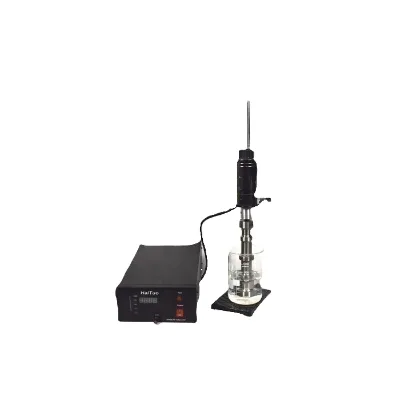


20kHz Ultrasonic Dispersion Emulsification Mixer Machine for Medical Extraction with CE
$1300.00 - $4800.00
MOQ: 1 Pieces

Ultrasonic Industry Scale Homogenizer Mixing and Dispersing Machine with Great Price
$980.00 - $7280.00
MOQ: 1 Pieces


High-Power Ultrasonic Homogeneous Emulsifying Mixing Equipment Chemical Mixing Equipment
$1500.00 - $15000.00
MOQ: 1 Sets


Preferential High Efficiency Ultrasonic Emulsifier Machine Ultrasonic Disperser Processor
$2000.00 - $2500.00
MOQ: 1 Pieces

Cosmetics Food Emulsifying Mixer Vacuum Homogenizing Emulsifying Mixing Machine
$18888.00 - $22222.00
MOQ: 1 Sets


Comprehensive Sourcing Guide
Strategic Sourcing Guide for CE-Certified Food Ultrasonic Emulsification Machines
The global demand for high-efficiency emulsification technology has driven significant innovation in the food and beverage processing sector. Buyers seeking a CE Food Ultrasonic Emulsification Machine are navigating a complex market where technical precision, regulatory compliance, and operational reliability intersect. This guide provides a structured approach to sourcing these specialized units, focusing on the specific attributes observed in current market listings while adhering to strict evidence-based procurement principles. The objective is to equip buyers with the knowledge to evaluate suppliers and specifications without relying on unverified claims or generic marketing language.
Understanding Core Technical Specifications and Operational Parameters
When evaluating ultrasonic emulsification machines, the primary focus must be on the specific operational parameters that define the machine's capability to handle various fluid dynamics. The market data indicates a diverse range of specifications tailored to different viscosity levels and processing volumes. A critical observation in the current product landscape is the variation in power output, which directly correlates to the intensity of the cavitation effect required for emulsification. Listings show power ratings ranging from 500W to 3000W in maximum capacity. For food applications involving milk, yogurt, or cheese, the lower power range may suffice for delicate emulsions, whereas processing viscous fluids or liquids with suspended solids often necessitates the higher 3000W capacity to ensure thorough homogenization.
Frequency is another pivotal technical specification. The observed data highlights frequencies of 20kHz and 28kHz. The 20kHz frequency is typically associated with high-energy applications suitable for milling and breaking down larger particles, while 28kHz offers a different resonance profile that may be preferred for finer emulsification in liquid food products. Buyers must verify that the selected frequency aligns with the specific rheological properties of their target food product. Furthermore, the mixing drum shape is a significant design factor; conical shapes are frequently observed, which can influence the flow dynamics within the vessel and the efficiency of the mixing process.
The physical configuration of the machine also varies. Some units are designed with a vertical layout, while others may feature different stirring types, such as forced stirring or diving stirrers. The choice between intermittent and continuous operating types depends heavily on the production line requirements. For high-volume food processing, continuous operating modes are generally preferred to maintain throughput, whereas intermittent types may be suitable for batch processing of specialty ingredients. The capacity of the system, observed in listings ranging from 2L to 20 L/Min, must be matched against the plant's hourly output targets to avoid bottlenecks or underutilization.
Compliance and Certification Verification Protocols
In the context of food processing machinery, regulatory compliance is not merely a formality but a fundamental requirement for market access and operational safety. The core keyword explicitly references "CE," and the provided data confirms that CE certification is a high-confidence attribute present in the current product pool. The CE marking indicates conformity with health, safety, and environmental protection standards for products sold within the European Economic Area. However, buyers must exercise due diligence to ensure that the certification is valid and specific to the model being purchased.
While the provided context lists CE as a confirmed attribute, it also mentions RoHS and ISO 9001 in a low-confidence background section. Buyers should not assume that all listed machines possess these additional certifications unless explicitly verified by the supplier's documentation. The distinction between high-confidence and low-confidence facts is crucial; procurement teams must request official certification documents that are current and issued by recognized bodies. The absence of a specific standard number in the general description does not negate the importance of verifying the exact standard to which the machine conforms.
For food applications, compliance extends beyond electrical safety to include material safety. The horn material is a critical component that comes into direct or indirect contact with the product. The observed data specifies Titanium Alloy as the horn material for several models. Titanium is a preferred material in food processing due to its corrosion resistance and non-reactive nature, ensuring that no metallic contaminants leach into the food product. Buyers should verify that the specific model they are sourcing utilizes food-grade titanium or equivalent materials that meet relevant food safety standards. Additionally, the warranty terms, often listed as 1 year with online service, provide a baseline for after-sales support, but the scope of this service should be clearly defined in the contract.
Cost Drivers and Pricing Structure Analysis
The pricing of ultrasonic emulsification machines is influenced by a complex matrix of technical specifications, material quality, and customization levels. The observed listed price range in the market spans from $980 to $138,000. This wide variance reflects the difference between basic laboratory-scale units and large-scale industrial systems. The lower end of the price spectrum likely corresponds to machines with lower power ratings (e.g., 500W), smaller capacities (2L), and standard configurations. Conversely, the higher price points are associated with high-power units (3000W), larger capacities (20 L/Min), and advanced features such as digital generators and custom horn sizes.
Customization is a significant cost driver. The data indicates that customization is available and that horns can be customized in size. Customizing the horn diameter, which is observed at 14mm in some listings, or tailoring the machine to specific process requirements will inevitably increase the unit cost. Buyers must balance the need for a tailored solution against the budget constraints. The MOQ (Minimum Order Quantity) is observed to be 1, which suggests that these machines are available for single-unit procurement, making them accessible for small to medium enterprises without the need for bulk purchasing commitments.
Other cost factors include the packing method and the origin of the product. Listings show both wooden and carton packing options, with the origin identified as China. While the origin can influence shipping costs and lead times, it is not a direct determinant of the machine's intrinsic value. Buyers should consider the total cost of ownership, which includes installation, maintenance, and energy consumption. The power consumption, ranging from 500W to 3000W, will have a direct impact on operational expenses over the machine's lifespan. A higher power unit may have a higher upfront cost but could offer greater efficiency in processing time, potentially offsetting the initial investment.
Typical Applications and Process Suitability
The versatility of ultrasonic emulsification machines makes them suitable for a broad spectrum of applications within the food industry. The observed application areas explicitly include Food, Chemical, and Agricultural Chemicals, with specific mentions of Milk, Yogurt, Milk Powder, and Cheese. These applications require the machine to handle a variety of fluid states, from low-viscosity liquids to viscous fluids and those containing suspended solids. The ability to process liquids with suspended solids is a key differentiator, as it allows for the homogenization of products that contain particulate matter without clogging or damaging the equipment.
The specific application dictates the required technical configuration. For dairy products like milk and yogurt, the machine must provide gentle yet effective emulsification to maintain the desired texture and stability. The 20kHz frequency and 500W to 1000W power range may be ideal for these applications. In contrast, processing viscous fluids or granules may require the higher 3000W power and 20kHz frequency to generate sufficient cavitation energy. The inclusion of milling capabilities in some models further expands the application scope, allowing for the simultaneous reduction of particle size and emulsification in a single step.
The operating type also plays a role in application suitability. Continuous operating modes are essential for high-volume production lines, such as those found in large dairy processing plants. Intermittent types may be more appropriate for pilot testing or small-batch production of specialty food items. The capacity of the machine, ranging from 2L to 20 L/Min, must be aligned with the production scale. A 2L capacity unit is suitable for R&D or small-scale artisanal production, while a 20 L/Min unit is necessary for industrial-scale operations. Buyers should carefully assess their production volume and product characteristics to select the most appropriate configuration.
Supplier Evaluation and Quality Control Standards
Selecting a reliable supplier is as critical as selecting the right machine. The data indicates that the products originate from China, a major manufacturing hub for industrial machinery. However, the origin alone does not guarantee quality. Buyers should evaluate suppliers based on their ability to provide verifiable documentation, including CE certificates, material safety data sheets, and detailed technical specifications. The presence of online service and a 1-year warranty are positive indicators of supplier commitment, but the terms of these services should be clearly outlined.
Quality control should be a central part of the procurement process. Buyers must verify that the manufacturing process adheres to recognized standards. While ISO 9001 is mentioned in the background data, it is not confirmed as a high-confidence fact for all products. Therefore, buyers should request proof of quality management systems from the supplier. The construction materials, particularly the Titanium Alloy horn, should be inspected to ensure they meet food-grade standards. The weight of the machines, observed at 25kg and 30kg, can be an indicator of build quality, but it should not be the sole metric.
The supplier's ability to provide customization is another key evaluation criterion. The data confirms that customization is available, including horn size and specific model configurations. A supplier that offers flexible customization options demonstrates a deeper understanding of customer needs and the technical capabilities of their machinery. Buyers should engage in detailed discussions with potential suppliers to assess their technical support capabilities and their willingness to tailor solutions to specific process requirements.
Long-Term Procurement and Operational Considerations
Long-term procurement considerations extend beyond the initial purchase price to include maintenance, spare parts availability, and scalability. The warranty period of 1 year is a standard offering, but buyers should consider the long-term support strategy. The availability of online service is a valuable asset, but it should be complemented by access to local technical support or a network of authorized service providers. The frequency of maintenance required for ultrasonic generators and horns should be understood, as these components are subject to wear and tear over time.
Scalability is another important factor. As a food business grows, the production requirements may change. A supplier that offers a range of models, from 500W to 3000W, allows for a phased approach to equipment acquisition. Buyers should consider the potential for future upgrades or the ability to integrate the emulsification machine into a larger automated production line. The voltage specifications, observed at 220V/50Hz, must be compatible with the local power infrastructure to avoid the need for expensive electrical modifications.
Finally, the total cost of ownership should be calculated, including energy costs, maintenance, and potential downtime. The power ratings and operating modes (continuous vs. intermittent) will influence energy consumption. A machine that operates efficiently and requires minimal maintenance will provide a better return on investment over its lifespan. Buyers should also consider the environmental impact of the machine, ensuring that it meets any relevant sustainability standards that may apply to their industry. By taking a holistic view of procurement, buyers can ensure that their investment in ultrasonic emulsification technology delivers long-term value and operational excellence.
FAQs
What certifications do these machines hold for food processing?
The machines hold CE certification, which confirms conformity with health and safety standards for the European Economic Area. Buyers must verify specific model documentation to ensure the certification is valid for their intended application and region.
Which power ratings are available for different food applications?
Available power ratings range from 500W to 3000W in maximum capacity. Lower power units suit delicate dairy products like milk, while higher power is required for viscous fluids and liquids with suspended solids.
Can the ultrasonic horn material be customized for food safety?
Yes, customization is available, and the horn material is typically Titanium Alloy. This material is preferred for its corrosion resistance and non-reactive nature, ensuring no metallic contaminants leach into food products during processing.
What operating modes are supported for continuous production lines?
The machines support both intermittent and continuous operating types. Continuous operation is generally preferred for high-volume food processing to maintain throughput, while intermittent types suit batch processing of specialty ingredients.
How does the frequency affect emulsification performance?
Observed frequencies include 20kHz and 28kHz. The 20kHz frequency is suitable for high-energy applications like milling, while 28kHz offers a profile often preferred for finer emulsification in liquid food products.
What capacity ranges are available for different production scales?
Capacity ranges from 2L to 20 L/Min depending on the model. Smaller capacities suit R&D or small-scale production, whereas larger capacities are necessary for industrial-scale operations requiring high hourly output.
Is customization available for the mixing drum shape and horn size?
Customization is available for both the mixing drum shape and horn size. The drum shape is often conical, and horn diameters can be tailored, such as the observed 14mm size, to meet specific process requirements.
What warranty and service options are provided with the machine?
The standard warranty is 1 year with online service support. Buyers should clearly define the scope of this service in the contract to ensure adequate after-sales support for operational reliability.